
How to Measure a Narrow Nightstand for Bedside Essentials
Affiliate Disclosure: We may earn a small commission on qualifying Amazon purchases at no extra cost to you. Full disclosure →
A narrow nightstand may fit the gap beside a bed while leaving too little usable top space for a lamp and a book. Its drawer may open into the mattress, or its height may make everyday items difficult to reach. The useful measurement is the complete bedside task, not simply the smallest width available.
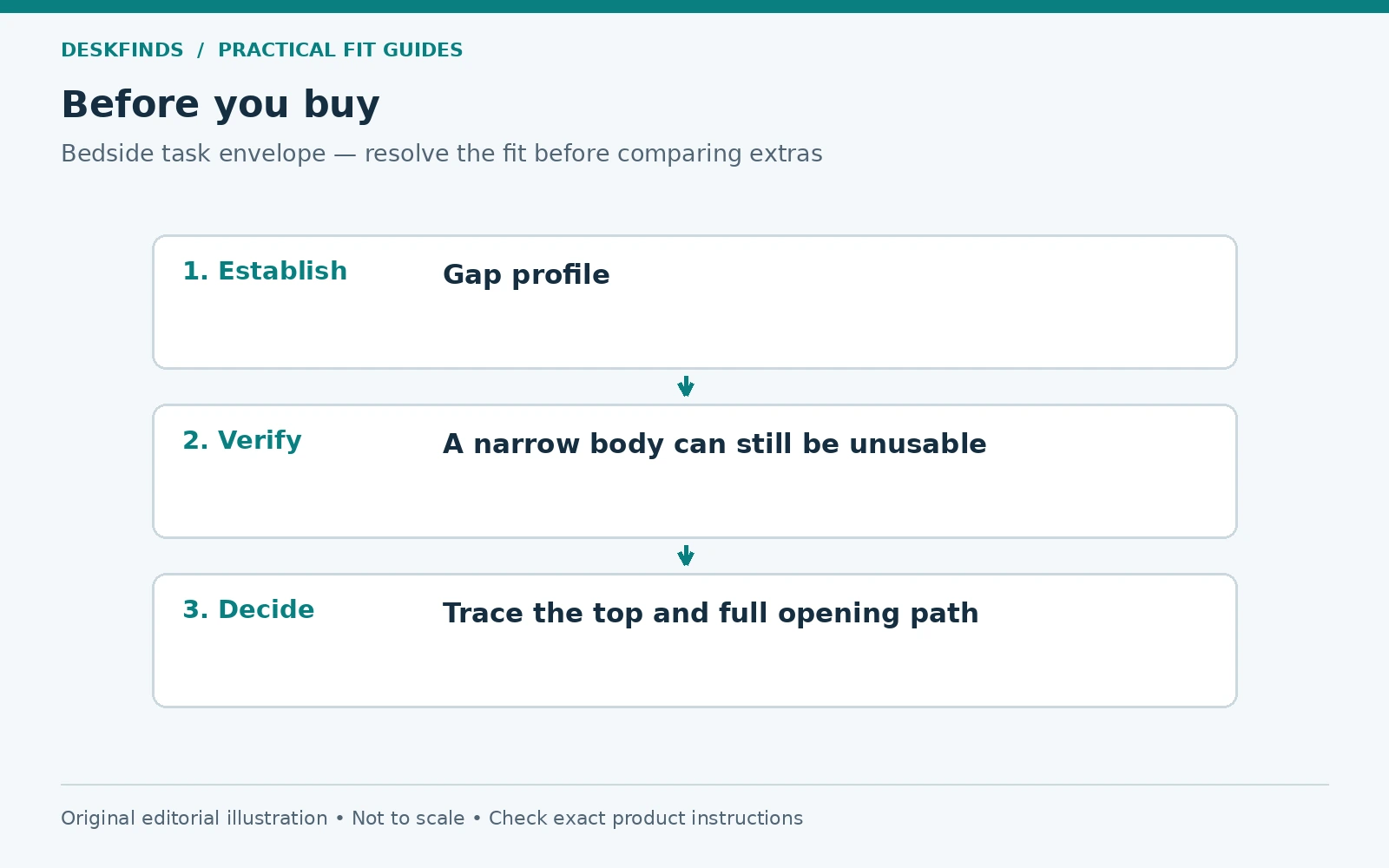
Quick answer: Measure the gap at several heights, the mattress relationship, the full furniture envelope, drawer or door movement, and the objects that need immediate access. Test reach from the bed and the room's normal walking route. Choose a surface that supports the intended items without relying on overhang, unstable stacking, or a blocked opening.
This guide is for ordinary bedside furniture. It does not assess medical equipment, transfer aids, or individual mobility needs. Our bedside caddy fit guide covers a different storage option when floor furniture is not the best match.
Decide which objects need the top surface
Gather the items you actually use beside the bed: perhaps a lamp, glasses case, phone, book, clock, or water container. Separate essentials from objects that could live in a drawer or elsewhere. A narrow top cannot serve as a general storage surface for every bedroom accessory.
Trace each object's full resting footprint, including lamp feet and charging connectors. A book needs its open shape if you read or place it open there. A phone on a stand uses a different envelope from a phone lying flat. Choose the intended arrangement rather than a collection of bare object dimensions.
Give fragile items and liquids a stable appropriate location away from electrical connections. Do not treat a narrow surface as successful if objects routinely balance at its edges. A smaller inventory can produce a more useful bedside station than adding a taller stack of organizers.
Measure the gap at floor and top height
Record the space between the bed and the wall or neighboring furniture at several points. A bed frame, skirting board, radiator, curtain, or wardrobe handle can reduce the usable width. The visible gap at mattress height may be wider than the floor opening where the nightstand's feet sit.
Measure depth along the room route. A shallow-looking table may project beyond the bed and narrow the path to a wardrobe or door. Include handles, trim, and the normal position of hanging bedding. The room should function with the bed made and the table in use, not only with fabric removed for measuring.
Check whether the bed or nearby furniture moves. An adjustable bed or opening storage base can change the required envelope. Use its instructions and keep the nightstand clear of the intended motion. Do not rely on a tight static fit where moving parts need room.
Compare complete furniture dimensions
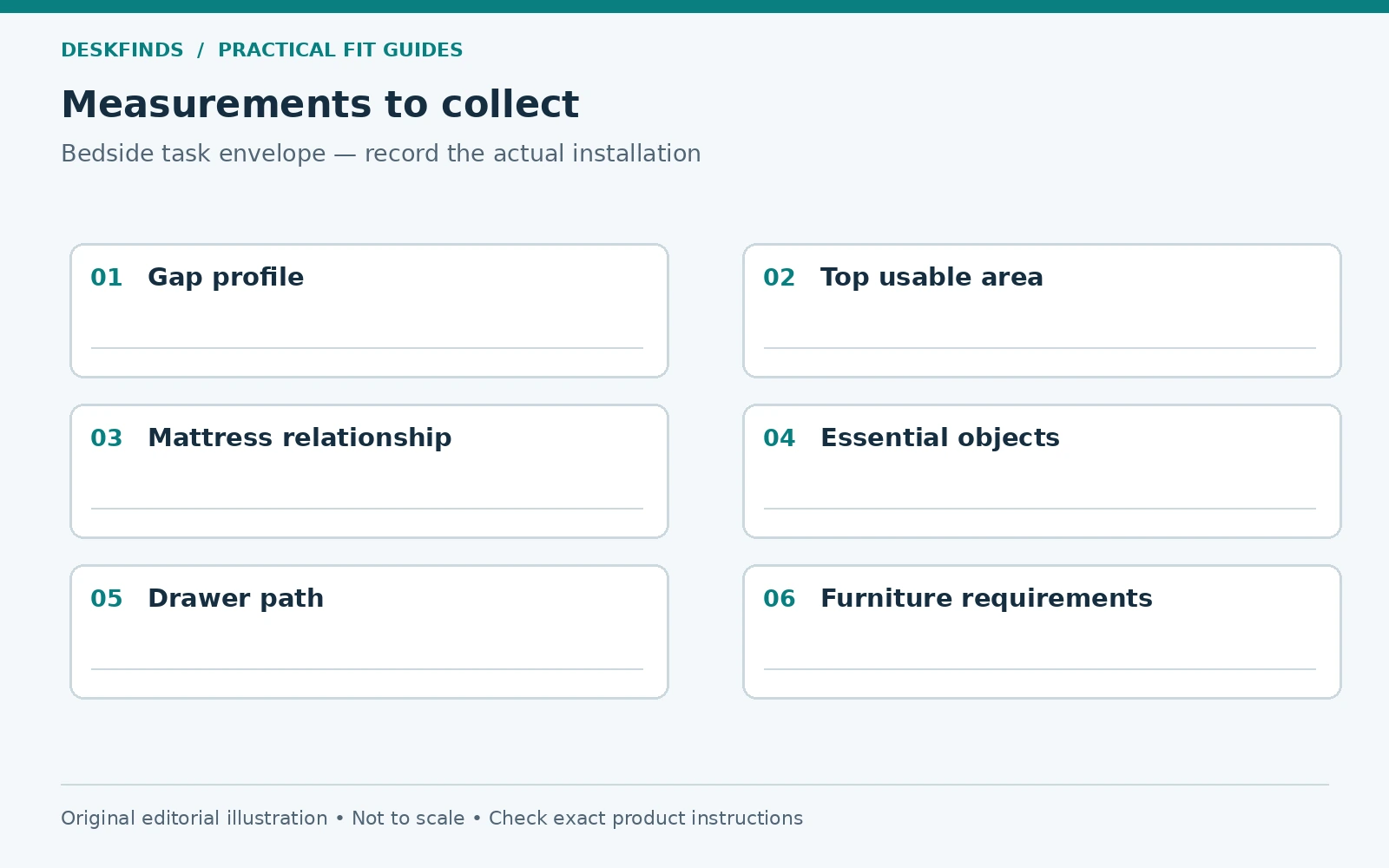
Find the nightstand's maximum width, depth, and height with all parts installed. Handles, side rails, feet, and a projecting top can extend beyond the cabinet body. A product called narrow may emphasize one dimension while remaining deep or tall. Ask for a drawing if the limiting measurement is unclear.
Check the usable top area inside any raised edge or decorative surround. The external top dimensions may not describe the flat support available to a lamp base. A rim can help contain some objects while preventing another from sitting flat. Compare the real object outlines with the actual support surface.
Read assembly, load, and stability instructions. A small table is not necessarily suitable as a seat or handhold. If the furniture requires anchoring, include the approved installation and room permission in the plan. Width alone does not establish that it can be used as intended in a narrow gap.
Set height by a real reach test
Measure the top of the mattress in the normal sleeping arrangement, including any topper. Compare the proposed table height from the same floor reference. The difference is useful information, but it is not a universal rule that every nightstand must match the mattress exactly.
From your normal position, reach toward a lightweight template representing the essentials. Check whether you can identify and retrieve them without pulling the furniture or stretching around a lamp. Repeat from sitting and lying positions if both matter. The actual person and task determine the useful relationship.
Do not choose a height solely because it aligns visually with the bed frame. A very tall surface may hide items from one position, while a low one may be difficult to reach from another. If individual access needs are significant, seek appropriate advice rather than treating a generic bedroom guide as an assessment.
| Measurement | Include |
|---|---|
| Gap width | Frame, wall trim and neighboring projections |
| Room depth | Nightstand and normal walking route |
| Height relationship | Mattress arrangement and actual reach |
| Top support | Flat usable area and object footprints |
| Storage access | Drawer, door, handle and retrieval path |
| Furniture requirements | Load, assembly and required anchoring |
Open drawers and doors on the room plan
Measure the full opening path, not only the closed furniture. A drawer can meet the mattress or bedding before reaching its useful extension. A door may need room beside the bed that the gap does not provide. Confirm that contents can be retrieved without pulling the whole table out every time.
Check the opposite direction too. A wardrobe door or bed drawer can hit the nightstand. Our cart and drawer conflict guide uses a shared-space map that applies to these moving parts. Two pieces that fit while closed can still compete during ordinary use.
For open shelves, include the lifting path for a book, bin, or device. A shelf may hold an item internally while the top above it blocks removal. Our storage-bin fit guide explains why resting capacity and access are separate questions.
Make a full-size top layout
Cut a paper rectangle matching the usable top and place the object outlines on it. Arrange the lamp, phone, book, and glasses in the positions you would use. Include cable exits and enough space to grasp items. A plan that fits only with all objects touching is likely to be inconvenient.
Test the largest routine combination rather than an empty top with one small lamp. If reading materials are occasional, decide where another item moves during that task. Every moved object needs a suitable landing place. Avoid a routine where the phone is placed on bedding beside an active charger merely to open a book.
Try a different lamp form or fewer surface items before choosing a larger table. A permitted alternative light position may free the top, but has its own support and cable requirements. The goal is a usable bedside routine, not the most objects arranged on a narrow rectangle.
Example: the table fits but the drawer cannot open
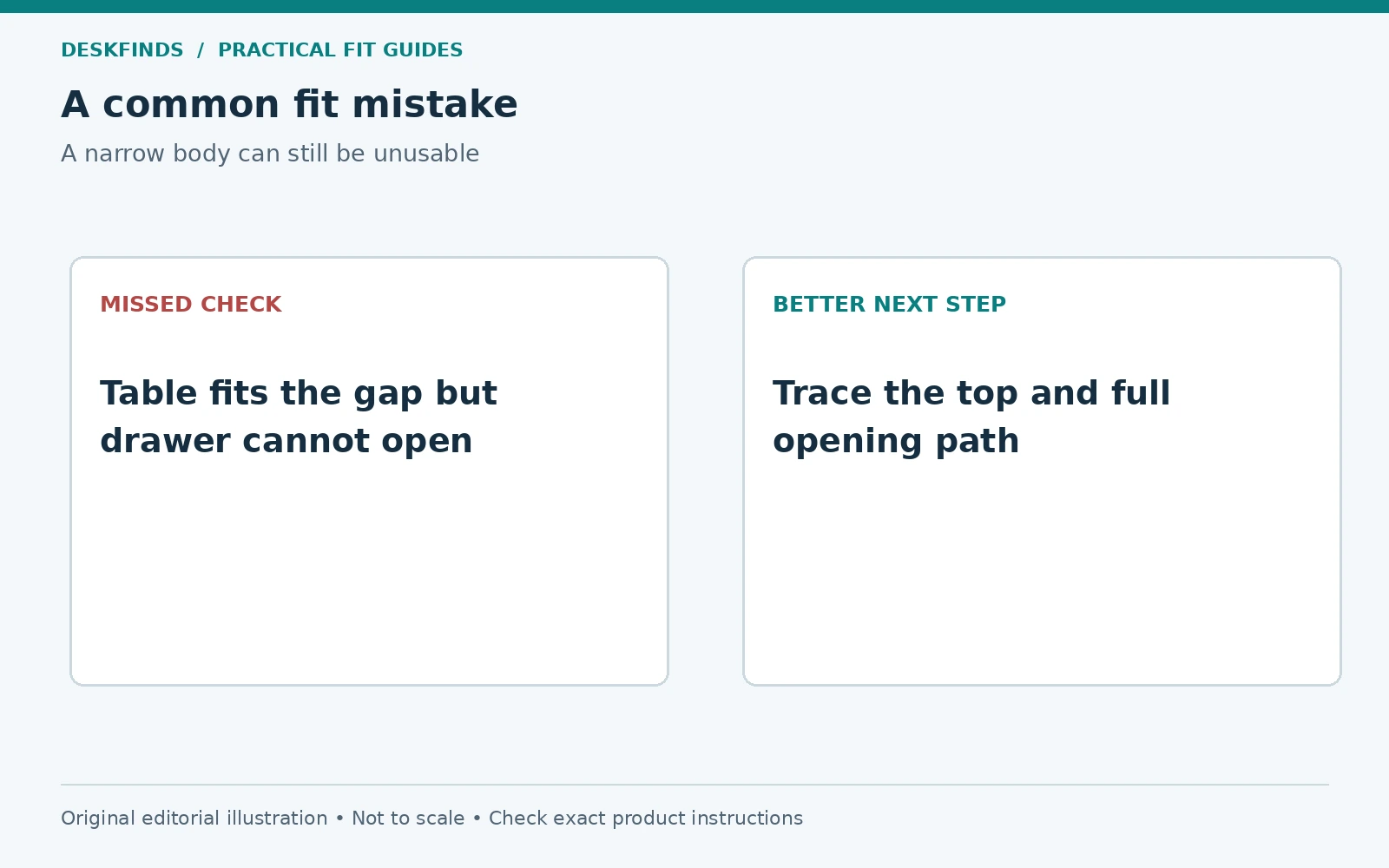
A buyer measures a gap wide enough for a slim nightstand. The closed unit sits neatly beside the bed, but the drawer handle and front meet the mattress when opened. The drawer's internal capacity is irrelevant because the access path fails.
The buyer compares another opening direction, an open-shelf design, or another permitted location. Moving the table forward is considered only if it leaves the room route clear. A shallower table may be more useful than a narrower one if depth controls the conflict.
The example shows why the room should be measured with its moving parts active. A closed product photograph cannot establish that a drawer or door will serve the intended contents. Check the full opening and retrieval before buying.
Example: the lamp base uses nearly the whole top
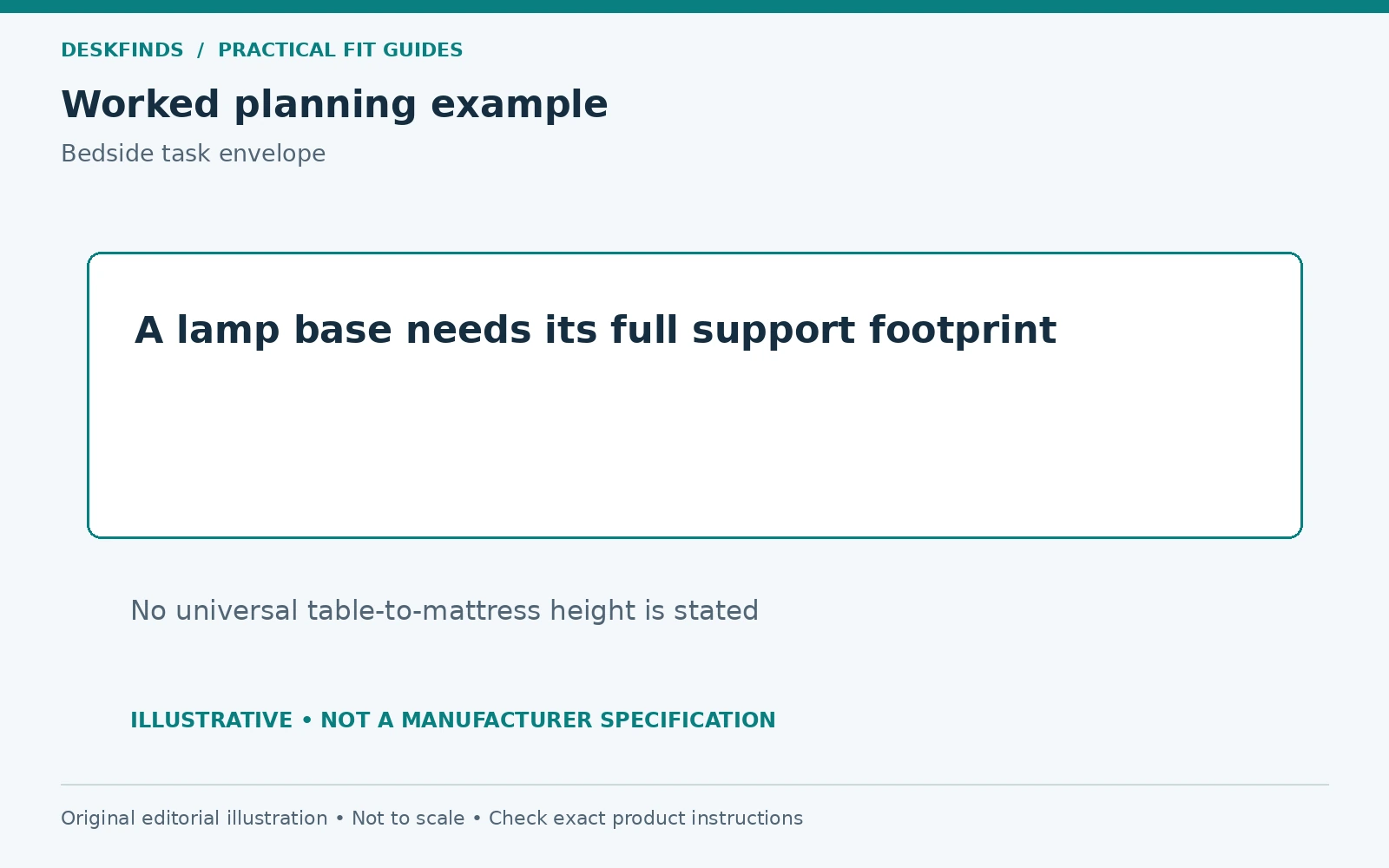
Another user chooses a very narrow table and places a broad lamp on it. A book and glasses can fit only partly over the edge. The table matches the gap, but not the essentials inventory. Adding a small tray would consume even more of the remaining area.
The user traces the lamp base and compares a suitable smaller-footprint light or another approved light location. If the lamp cannot change, a different table or contents arrangement may be necessary. The bedside station should not depend on balancing fragile objects around the base.
This is a task decision rather than a universal preference for small lamps. The light still needs to serve reading and remain supported as instructed. A space saving that produces poor illumination or an unsuitable attachment is not a complete solution.
Plan charging without hiding the requirements
Follow the device and charger's instructions for support, ventilation, and connection. A built-in charging feature or outlet does not make every device or adapter compatible. Check the exact product's requirements and keep liquid placement separate from power connections.
Route cables so they do not cross the entry path or pull devices when bedding moves. Include connected and disconnected states. Our cable pull-prevention guide provides that route test, while our shared-room charging guide helps identify actual simultaneous needs.
Do not pack operating adapters into a fabric bin or tight enclosed space contrary to their instructions to keep the top clear. A visible, accessible power arrangement can be more useful than a hidden one. The table's storage role and electrical role need independent checks.
Compare a table with other bedside storage
A caddy can move some contents off the surface but needs a compatible bed attachment. A wall shelf needs a permitted support and installation. A rolling cart needs a parking and movement route. Each alternative changes the space problem rather than removing all requirements.
Consider whether a small table plus storage elsewhere serves the essentials better than a complex multifunction unit. A drawer used only for occasional objects may not justify an awkward opening path. A clear top and one accessible shelf can sometimes provide more useful capacity than several cramped compartments.
For a product example, IKEA's BRIMNES nightstand offers a particular combination of top, drawer, and shelf. Use its exact dimensions and instructions only for that model. Do not generalize its fit or capacity to every narrow bedside table.
Check the arrangement after ordinary use
After a few nights, note which objects migrate onto the bed or floor and which drawer remains unused. Those observations reveal a missing landing place or poor access. Change the layout before adding more organizers. A small bedside station should remain simple enough to reset easily.
Recheck if the mattress, bed frame, rug, or lighting changes. The height and room route can change even when the table stays the same. Keep any required anchoring and furniture instructions in place through those changes. Do not move a restrained unit as though it were freely portable.
Compare narrow nightstands and nightstands with drawers after the fit brief is complete. The useful purchase supports the essentials, the user's reach, and the room's opening paths. A narrow label is only one part of that decision.
Make a bedside state table
Use columns for sleeping, reading, charging where appropriate, and room reset. List the lamp, phone, glasses, book, and any other essential item. Write where each rests in every state. This exposes the difference between a top that displays the objects neatly and one that serves their ordinary use.
For example, a closed book may fit beside a lamp while an open book needs the central area. If the phone moves during reading, give it a suitable destination rather than relying on the mattress. If a drawer is opened from the bed, check that the handle and contents can be reached in that state. The table makes transitions explicit.
Keep the number of moves realistic. A narrow surface can work well when only one object changes position, but become frustrating if every task requires clearing the entire top. Choose a simpler inventory or another furniture form when the routine becomes too complicated. The useful capacity is the capacity that remains accessible through the day.
Test the tabletop with actual object shapes
A lamp base can be round, rectangular, or split into several feet. Trace the complete contact pattern and keep it supported as instructed. Place the phone stand and glasses case outlines beside it, then test the open book. Do not reduce the lamp's support footprint to the width of its stem.
Include your hand's approach. A small remaining gap may hold an object but leave no easy way to grasp it without touching another. This is particularly relevant for fragile items. Leave practical retrieval space based on the actual task rather than filling every edge of the top.
If a tray is added, measure its internal area and external footprint separately. A tray can organize small items while consuming scarce space through thick walls or handles. It should solve a specific return or containment problem, not be added merely because bedside displays often include one.
Distinguish drawer capacity from useful bedside access
Measure a drawer's internal space with the intended contents, then check its opening from the positions in which it will be used. A drawer that serves standing storage may be awkward from bed. Decide whether that matters for the contents rather than assuming every compartment has the same access role.
Keep frequently needed items in a position that does not require pulling the furniture or using it as a support. For occasional storage, a different retrieval posture may be acceptable if appropriate for the user and room. This guide does not assess individual mobility needs; obtain suitable advice when those needs determine the furniture choice.
If the drawer remains unused after normal use, investigate the cause before adding organizers. The problem may be a blocked front, poor height, or a compartment too small for the actual items. Internal dividers cannot solve an inaccessible opening.
Keep a final footprint for future purchases
Save the usable top dimensions, complete furniture envelope, opening path, mattress relationship, and essential-object list. When buying a new lamp or phone stand, compare it with that record. A replacement accessory can consume more area even if the nightstand is unchanged.
Recheck when the bed is moved or new storage is added below it. A drawer or cart may begin using the same floor area as the nightstand. The bedside station should remain part of the room's operating plan rather than a fixed object whose surroundings are assumed never to change.
A good purchase brief can also make a retailer question specific. Ask whether dimensions include handles and top overhang, what the usable compartment sizes are, and which assembly or anchoring conditions apply. A general claim that the unit fits small bedrooms does not answer those details.
Keep a bedside essentials limit
Write the small set of objects the top was planned to serve and review it when the surface becomes crowded. New containers and decorative items can gradually consume the access space that made the table useful. Before adding another organizer, compare it with the full-size layout. Moving an occasional item to suitable storage elsewhere may restore the routine more effectively than increasing the amount of furniture beside the bed.
Sources and scope
- IKEA BRIMNES nightstand - model-specific dimensions, storage and assembly context.
- IKEA TONSTAD bedside table - another model-specific layout example, not a universal bedside height.
The surface templates, reach checks and cases are original editorial planning guidance. No medical access assessment or furniture load test was performed.