
How to Choose Storage Bins That Actually Fit Your Shelves
Affiliate Disclosure: We may earn a small commission on qualifying Amazon purchases at no extra cost to you. Full disclosure →
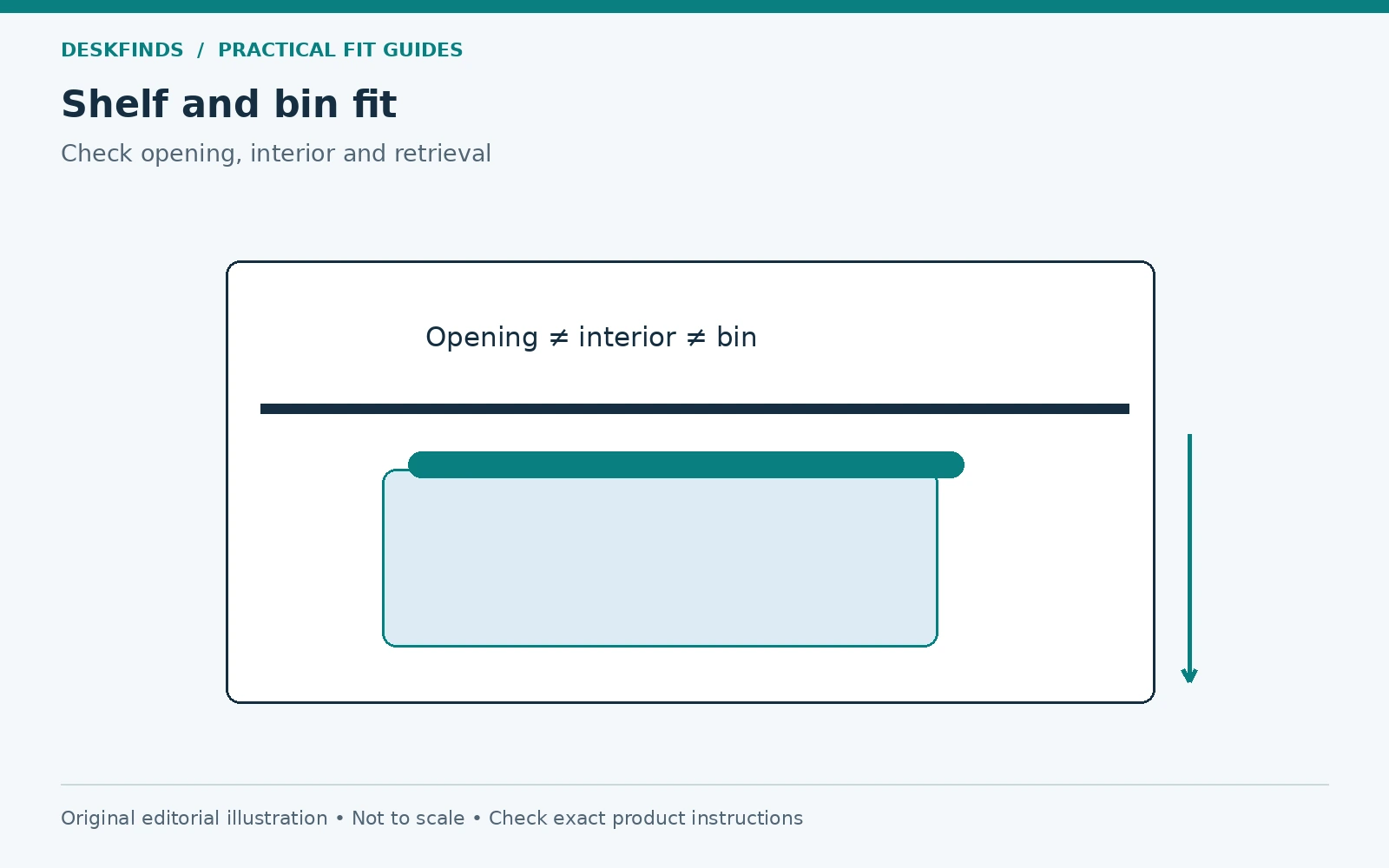
A bin can be smaller than a shelf on paper and still be difficult to use. Its lid may catch the shelf above, its handle may protrude beyond a cabinet door, or its tapered sides may leave less room inside than expected. A successful fit includes insertion, retrieval, opening, and the contents, not merely the resting footprint.
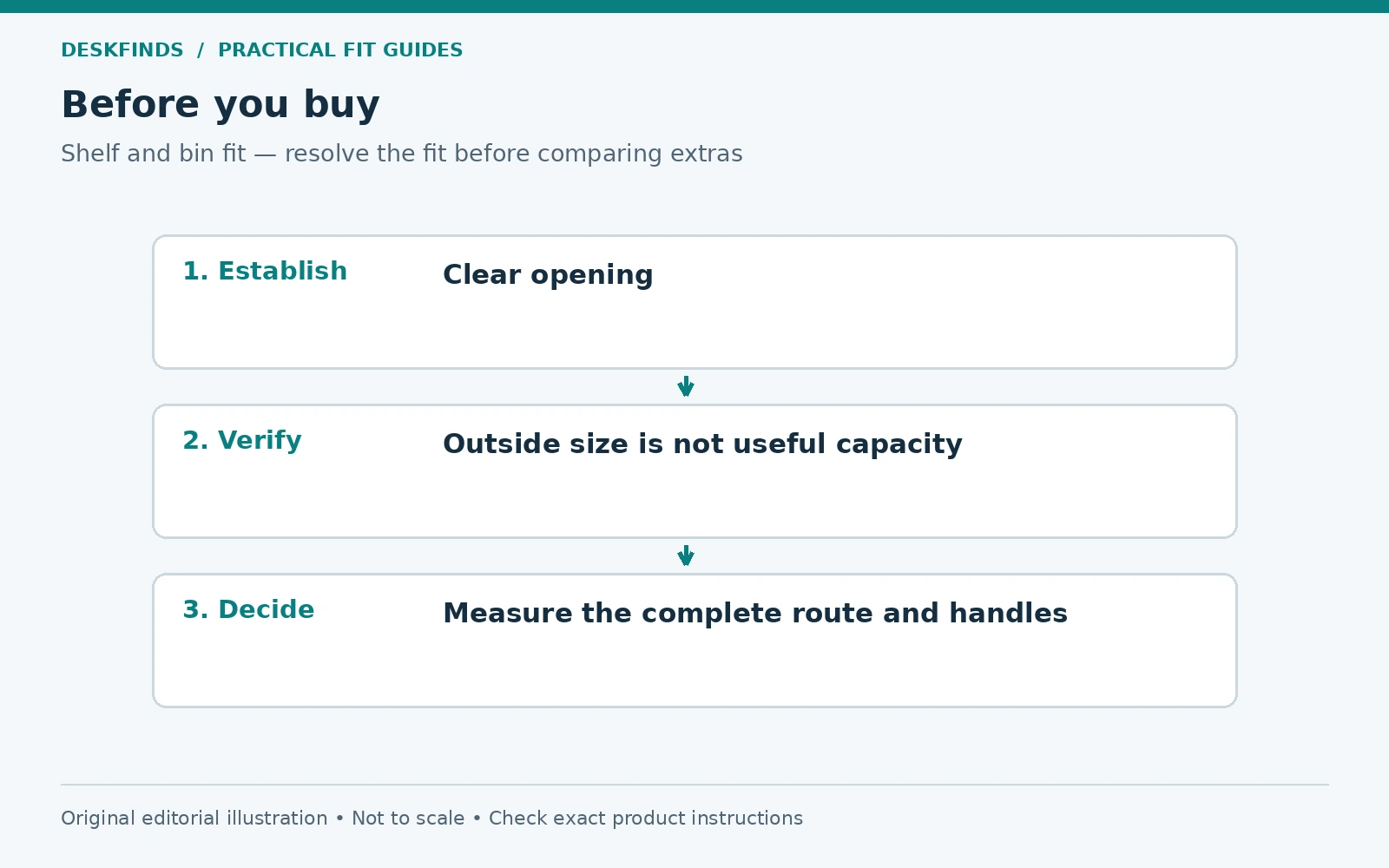
Quick answer: Measure the shelf's usable opening and internal space separately, then compare the bin's complete external dimensions and usable interior. Include handles, lids, taper, door hardware, and the movement needed to pull it out. Test with a full-size template before buying a set of matching containers.
This article covers bins on shelves and inside cabinets. For containers that pass beneath a bed frame, see our under-bed clearance guide, where the entry route has different obstacles.
Start with what the bin must hold
Gather the intended contents and remove items that do not belong in the category. Measure the largest rigid object and note how you will retrieve it. A bin for folded textiles has different requirements from one for file folders, chargers, craft supplies, or books. Choosing the container first can leave the contents awkwardly arranged around it.
Decide whether the bin will be pulled out completely, accessed from the front, or opened while still on the shelf. This changes the useful opening and required overhead room. A deep container may be appropriate for occasional supplies but inconvenient for small items used throughout the day.
Consider the loaded weight you can handle comfortably at that shelf height. A container rated to hold a heavy load does not mean lifting it from overhead is practical for every user. Divide contents where necessary and follow the bin and furniture instructions. Accessible storage is more useful than maximum nominal volume.
Measure the opening before the cavity
A cabinet can have a large internal space behind a smaller front opening. Hinges, door frames, lips, and sliding tracks can narrow the entrance. Measure the clear opening with doors in the position they can actually reach in the room. A wall or neighboring cabinet may prevent a door from opening fully.
Then measure usable internal width, depth, and height. Include shelf supports, back panels, cable openings, and any protruding hardware. Do not substitute the furniture's outside dimensions. The difference between external cabinet size and usable storage can be large enough to change the bin choice.
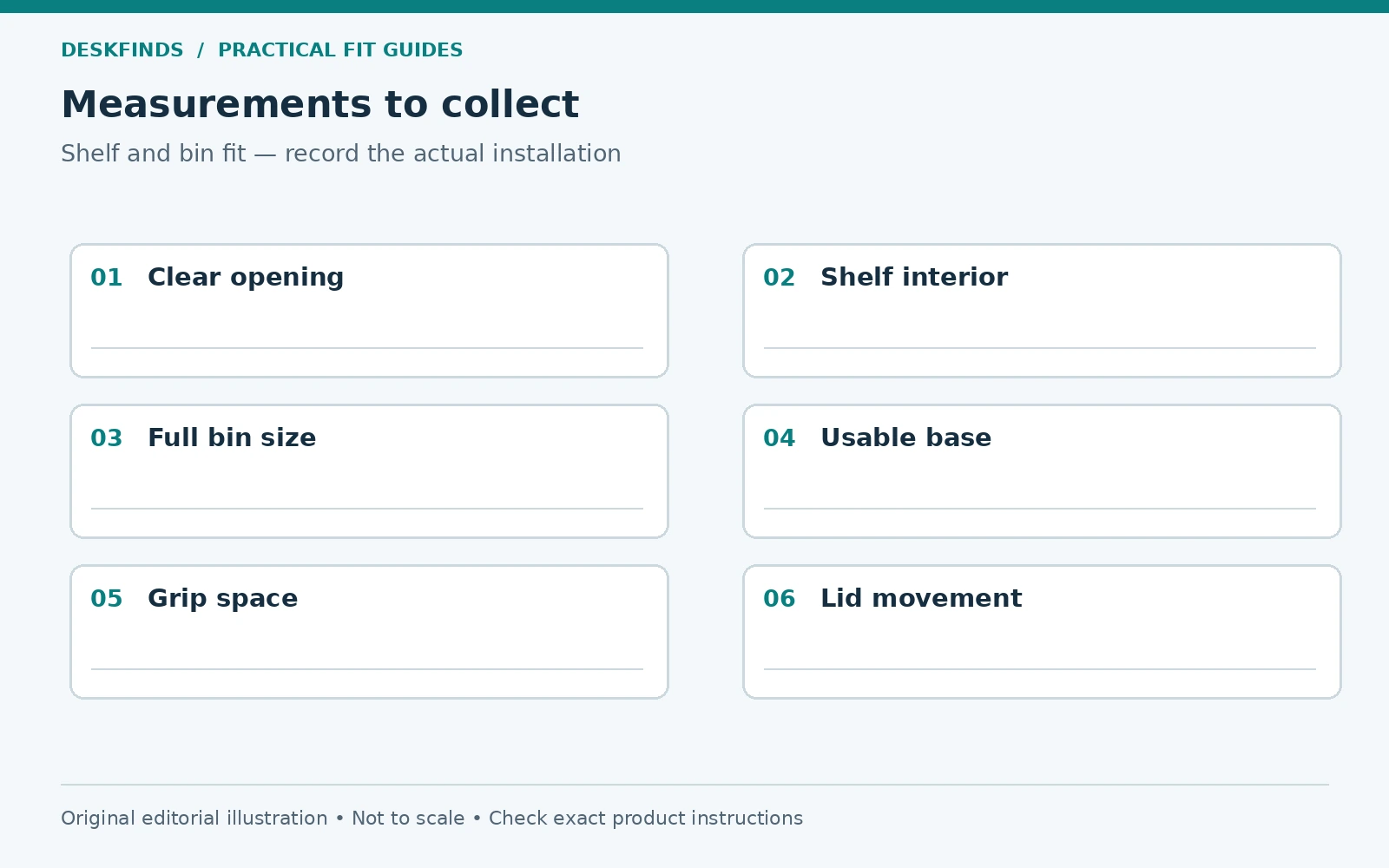
Record both sets of measurements. The bin must pass the opening and fit the interior, and may need room to turn. A container that fits once inside but cannot pass through the entrance is not a usable match. A cardboard outline makes that distinction easier to see.
Check the shelf at more than one point
Measure width near the front and rear, and height at the lowest relevant point. Adjustable shelves may not be perfectly aligned, and a support or bracket can occupy one corner. Use the limiting measurement rather than averaging the space. The tightest point controls passage.
Check the shelf's condition and load requirements. A bin concentrates its contents into a particular area and can hide an overloaded or damaged shelf. Read the furniture's total and per-shelf limits as applicable. Do not infer strength from thickness or from a similar-looking unit.
If a shelf is adjustable, confirm the permitted positions and attachment method. Moving it may improve bin clearance but reduce another compartment or conflict with doors. Keep the whole storage unit in the plan rather than optimizing one shelf in isolation.
Compare the complete external envelope
Find dimensions including the lid, handles, latches, feet, and any stacking features. A lid can be wider than the body, and a handle can project beyond the nominal front. Some listings give the body size prominently and describe the lid separately. Ask how the exact dimensions are defined.
For fabric bins, consider the loaded shape. Soft sides can bulge beyond the empty footprint, and handles may require room for a hand. Do not plan a fit that depends on squeezing the contents against the cabinet. A rigid outline from an empty product photo does not describe every loaded condition.
For stackable bins, verify that the intended stack is permitted and stable within the furniture's limits. Stacking can make the lower container hard to access even if everything fits. A matching set should be judged by the retrieval routine, not only the clean appearance of aligned fronts.
| Dimension | Fit question |
|---|---|
| Clear entry opening | Can the full bin pass through? |
| Internal shelf space | Can it rest without forcing or obstruction? |
| External bin envelope | Are lid, handles and latches included? |
| Usable interior | Do the actual contents fit? |
| Retrieval allowance | Can you grip and remove the loaded bin? |
| Opening movement | Can the lid or front open where intended? |
Distinguish interior capacity from outside size
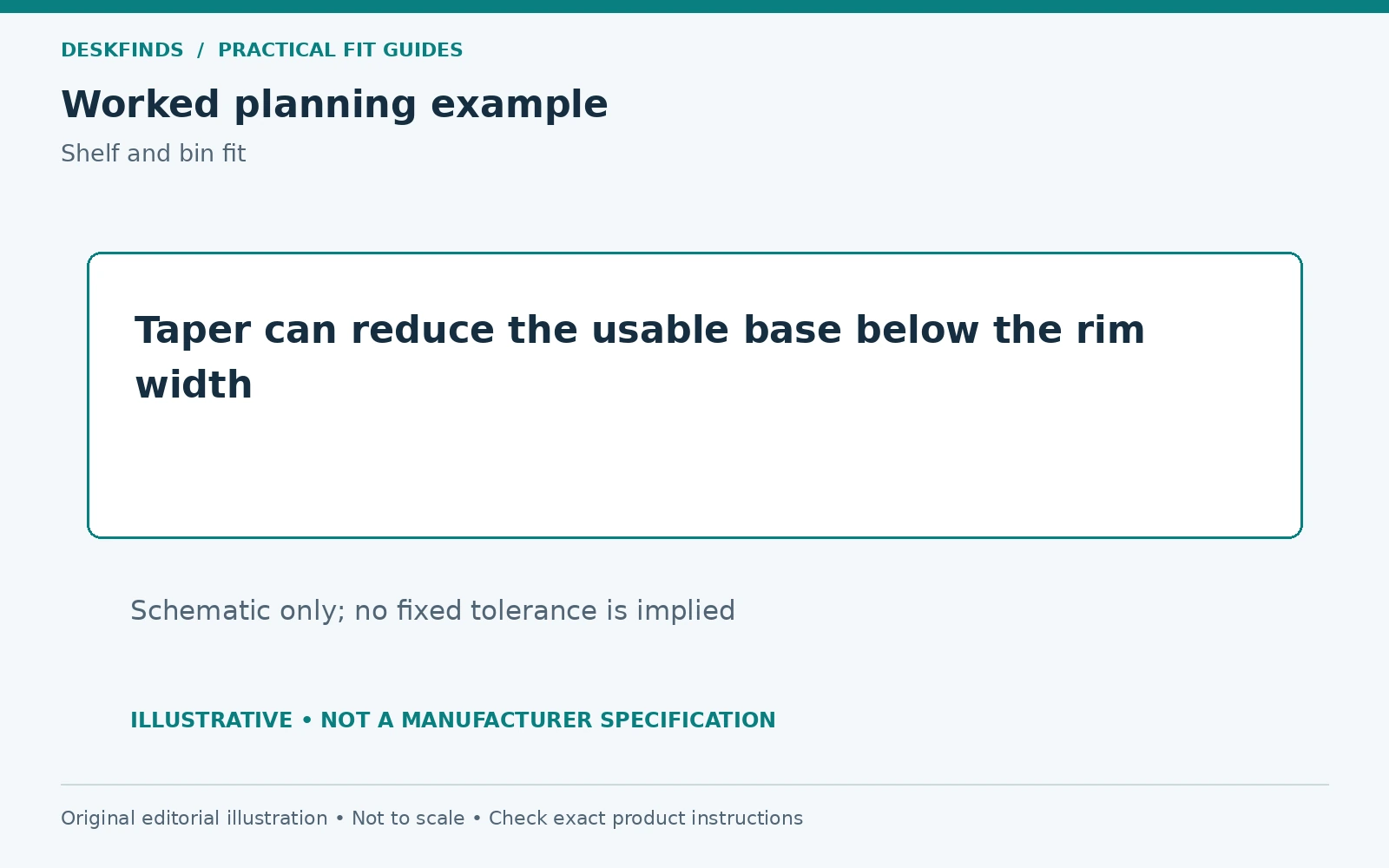
A tapered bin may be wide at the rim and narrower at the base. If you need to store a rectangular object flat, measure the interior at the level where it will sit. The largest exterior width does not establish that interior fit. Rounded corners and wall thickness also matter.
Check whether dividers, inserts, or a lid mechanism consume useful height. A small storage box may fit a charger body but not its naturally coiled cable. A file bin may fit loose paper while leaving no room for tabs or sleeves. Use the complete contents rather than the smallest component in the comparison.
Volume can help compare capacity within similar designs, but it cannot replace dimensional fit. Two containers with the same stated volume can have very different shapes and access. Choose the shape that serves the objects and shelf rather than treating liters as the decisive specification.
Test retrieval with a loaded-size mock-up
Make a cardboard box or outline matching the maximum external dimensions. Add simple handle and lid markers. Move it through the opening and into the shelf, then simulate taking it out. Use a safe lightweight mock-up, not an improvised heavy load at an awkward height.
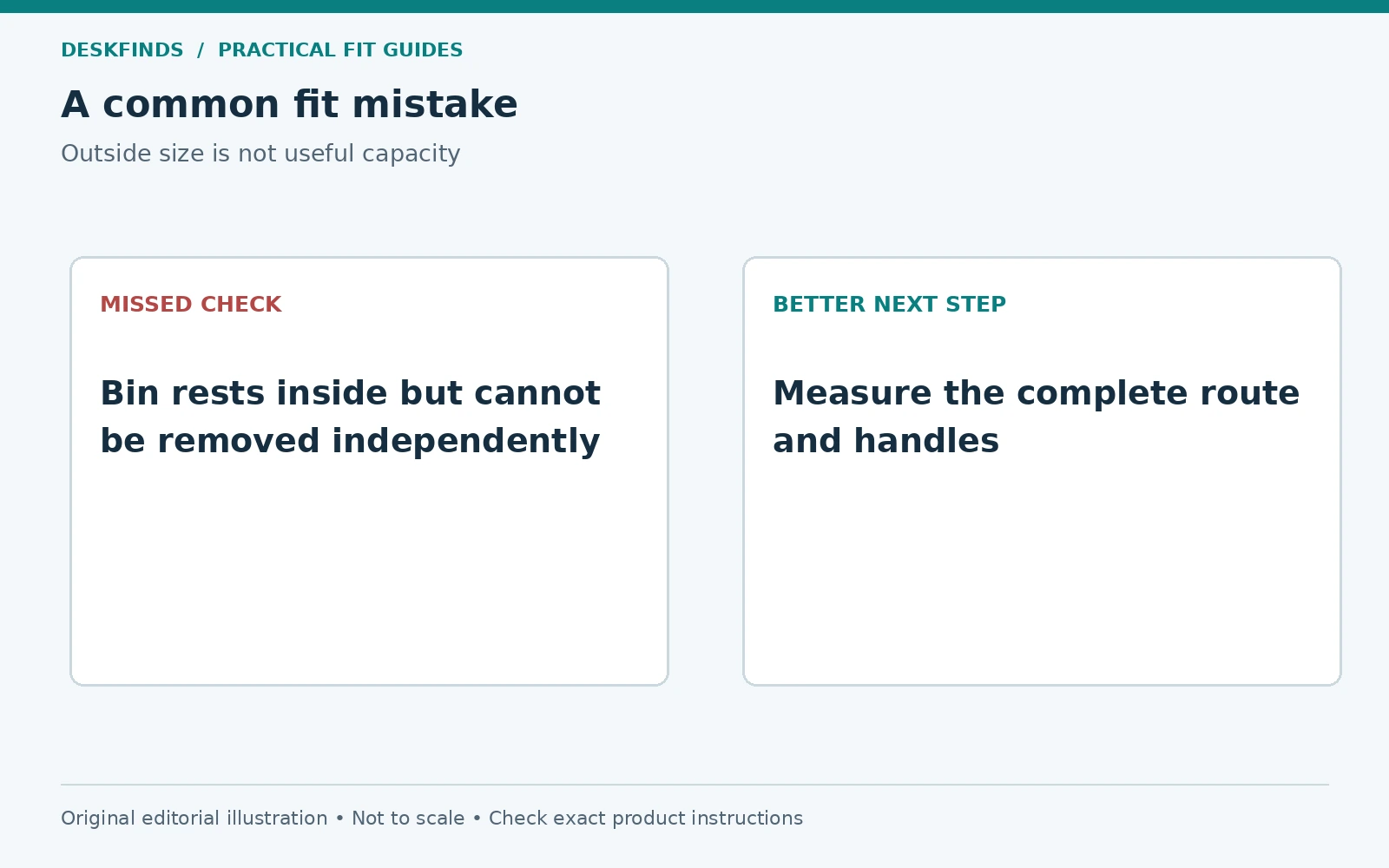
Check where your fingers go. A bin that fills the opening completely may leave no practical grip even with a front handle. A recessed handle needs access from a particular direction. If you must tilt the container, confirm that the contents can tolerate that movement and that the route allows it.
For multiple bins, test the middle one as well as the end positions. Adjacent containers can block side handles or make the fit tighter than a single-bin test suggests. Leave practical access rather than assuming every fraction of shelf width should be filled.
Example: three bins fit the shelf but not the opening
A buyer measures the cabinet's internal width and divides it by three. The selected bins fit that total on paper, but the door frame and hinges narrow the entry. The middle bin cannot be removed without first taking out another, and the end bins catch the hardware.
A smaller arrangement or different bin orientation may be more useful. The buyer tests the actual opening with a template before ordering a full set. The result may use slightly less nominal capacity while making every container independently accessible. That is often the better storage outcome.
The lesson is to keep internal storage width and clear entry width separate. A matching set should not be purchased from the furniture's outside dimensions or from a simple division that ignores the entrance and retrieval path.
Example: the bin fits, but the notebook does not
Another buyer chooses a bin whose exterior dimensions exceed those of a notebook. The base tapers inward and the corners are rounded, so the notebook cannot lie flat inside. Storing it diagonally would reduce capacity and make daily retrieval awkward.
The buyer asks for the usable interior base and opening dimensions. A different shape suits the notebook better even if its listed volume is smaller. The shelf fit is then checked independently. A container must pass both tests: fit the furniture and serve the contents.
This is particularly important for documents, device cases, and rigid supplies. Soft contents may accommodate taper more easily, but should not be compressed in a way that violates their storage needs. The right bin follows the object, not the other way around.
Choose lid and access style by frequency
A lid can protect contents from dust and contain small items, but adds an opening step and may require extra clearance. A removable lid needs somewhere to rest. A hinged lid needs room to rotate. A front opening can allow access in place, but its door or flap still has a movement envelope.
For frequently used items, an open bin may be simpler if appropriate for the contents and room. For occasional storage, a covered container may make sense. Do not assume one style is best throughout the unit. Different shelves can serve different access frequencies.
If bins are stacked, consider whether retrieving the lower one requires unloading the upper one. That may be acceptable for seasonal material but frustrating for daily tools. Match the structure of the storage to the rhythm of use rather than the visual consistency of the set.
Label for the viewing angle
Put labels where they can be read from the normal approach. A high shelf may need a front-facing label, while a low drawer-style bin may be seen from above. Avoid labeling only the lid if the lid is hidden beneath another shelf. The label should reduce handling, not require lifting the container to identify it.
Use categories that are specific enough to guide return. A bin called miscellaneous tends to collect unrelated objects. A few clear roles such as spare charging cables or active project supplies can be easier to maintain. Review categories when a bin repeatedly overflows.
For shared storage, agree where things go and which containers are personal. Labeling does not replace appropriate privacy or security controls for sensitive contents. Choose the storage method according to the actual information and access requirements.
Buy one before buying the whole system
If uncertainty remains about a product's taper, handles, or fabric behavior, start with one container where practical. Test it on the actual shelf with the intended contents and retrieval routine. A successful test is more informative than a photograph of a similar shelf filled with matching boxes.
Keep the measurement record for future purchases. Product ranges can change, and a replacement bin with the same name may have different dimensions. Compare the exact current item rather than assuming an old fit transfers. Recheck when shelf positions or room furniture change.
Our closet organizer bin guide and shelf organizer guide can help compare forms after the fit brief is ready. The right bin supports contents, shelf, access, and handling together. A little unused space is often worth more than a perfectly filled shelf that is difficult to use.
Create a shelf-and-bin matrix
Give each shelf a row with clear opening width, internal width, height, depth, and any hinge or support intrusion. Give each candidate bin a separate row with its complete external envelope and useful interior. Compare the rows directly rather than relying on the furniture and container both being described as medium or large.
Add an access method column: pull out fully, lift a lid in place, use a front opening, or remove an upper container first. This exposes the difference between resting fit and useful fit. A container can pass every static dimension while its opening method remains unsuitable beneath the shelf above.
If several shelves will use the same bin, check each one. Adjustable supports, door hardware, and room access can make compartments different. A successful fit in the widest bay is not evidence for the narrowest. Start with the limiting location when deciding whether a matching set is practical.
Use actual contents to test taper
A tapered box can be measured at its top rim and still fail a rigid object at the base. Put a paper outline of the object inside a mock-up of the usable base area. Include protective sleeves or cases that remain on the item. If the contents need to lie flat, diagonal placement is a different storage plan and should be judged explicitly.
For soft contents, test the loaded shape without overstuffing. A fabric bin may expand enough to rub neighboring containers or the cabinet door. Leave practical access and respect the bin's intended use. Do not count squeezing the sides as a reliable tolerance strategy.
Write down the dimension that controls the choice. If the notebook needs a particular base width, a larger capacity figure elsewhere does not solve the problem. This keeps shopping focused on the actual object rather than a nominal volume that can be achieved in many different shapes.
Compare independent retrieval with packed capacity
Place outlines for all proposed bins on the shelf plan and try removing the middle one. Check whether handles remain accessible and whether adjacent lids overlap. If one bin must move before another can leave, decide whether that sequence suits the contents' access frequency.
For everyday supplies, independent retrieval may be worth leaving more space between bins. For occasional archives, a sequence may be acceptable if handling and storage requirements permit it. The point is not that every container needs a large gap, but that the retrieval routine should be a conscious choice.
Do not use the shelf's entire theoretical volume as a target. Space for fingers, labels, lids, and a natural removal path contributes to usable capacity. A less densely filled shelf can support more effective storage because its contents remain accessible without unloading the whole unit.
Prepare a useful seller question
Send a list of the limiting opening, the intended contents, and the access method. Ask whether dimensions include the lid and handles, where the interior is measured, and how much the body tapers. For a soft bin, ask for the intended loaded shape or relevant product guidance rather than an unsupported promise that it will squeeze in.
Keep the answer tied to the exact model and size option. A family of visually similar bins can include different handles, lids, and proportions. If the seller cannot provide a decisive figure, consider a one-unit trial where practical and understand the return conditions. Do not order a full system on the assumption that a product photograph is a dimensioned drawing.
After a successful fit, save the measurements and product details. A future replacement should be compared again, especially if the range changes. The record is most useful when it describes the actual bin and shelf, not only the brand or an informal size name.
Sources and scope
- IKEA KUGGIS example - manufacturer dimensions and handle information for a specific bin.
- IKEA interior organizer guide - example of system-specific storage planning; verify current product documentation.
The opening/interior worksheet and cases are original editorial tools. They do not establish universal tolerances or permission to exceed furniture loading instructions.