
Full-Size Keyboard Dimensions: Length, Width, Depth (2026)
Affiliate Disclosure: We may earn a small commission on qualifying Amazon purchases at no extra cost to you. Full disclosure →
Ask three people how wide a keyboard is and you get three answers, because a slim office board, a gaming board with a wrist rest and a laptop keyboard are all called a keyboard. A full-size model is the one with a numpad, and its size is more predictable than it looks.
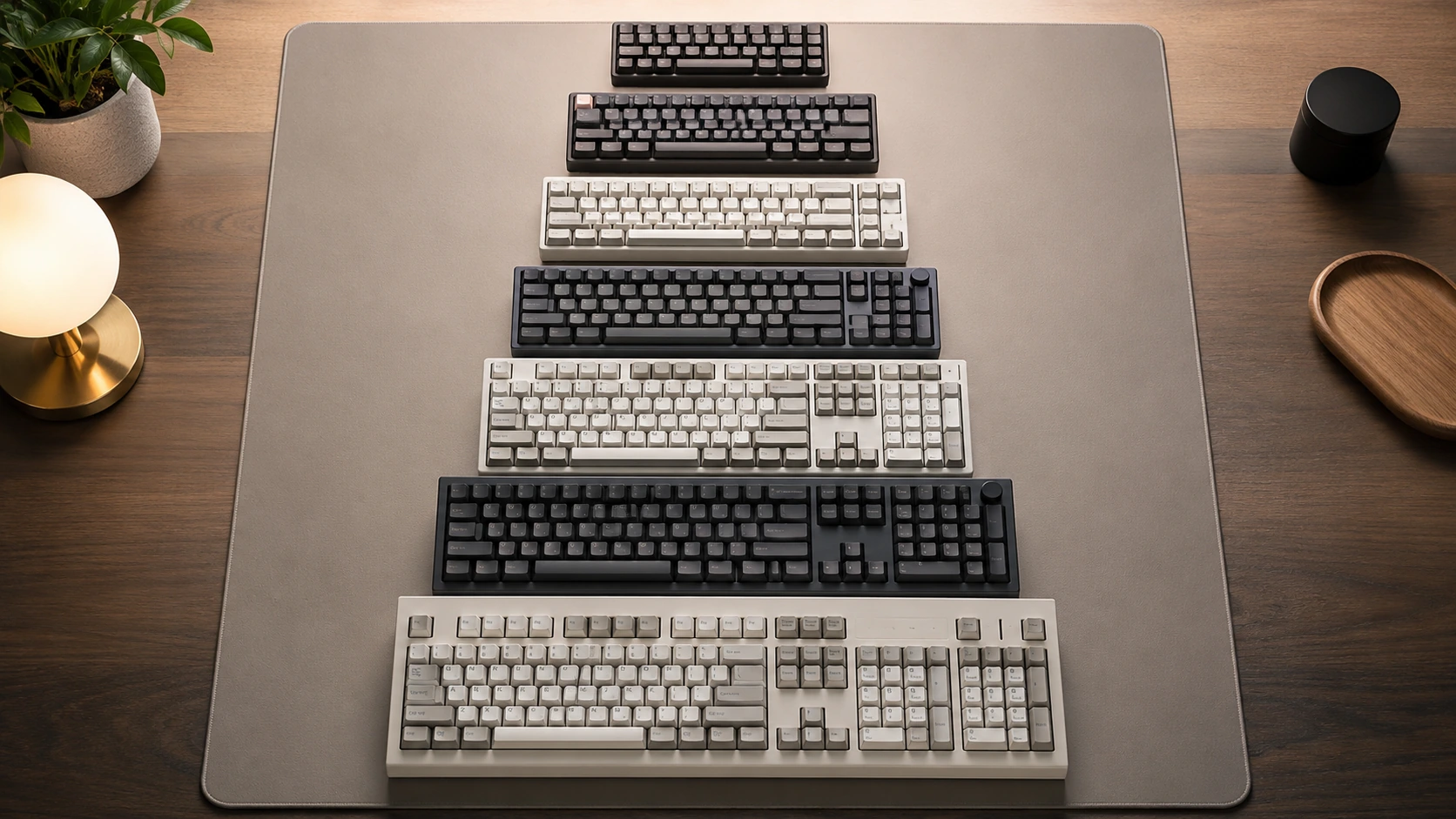
This guide gives the length, width and depth of a full-size keyboard in inches and centimetres, explains why retail numbers differ from the key area, and shows how much desk it uses next to a laptop or a compact board.
Quick answer: A normal full-size (100%) keyboard is about 17 to 18 inches (roughly 43 to 46 cm) wide, 5 to 6 inches (about 13 to 15 cm) deep, and about 1 to 1.5 inches tall at the front edge. Ergonomic, split and wrist-rest models run wider or deeper, so check the product page.
Standard full-size keyboard dimensions
The 100% layout is the one most people picture: letters in the middle, a navigation block and arrows on the right of that, then a numpad on the far right. Retail guides describe it as roughly 17 to 18 inches wide and 5 to 6 inches deep, and one comparison puts the width at about 43 to 46 cm.
| Measurement | Inches | Centimetres | Note |
|---|---|---|---|
| Width (length of the long side) | About 17 to 18 | About 43 to 46 | Includes the case around the keys |
| Depth (front to back) | About 5 to 6 | About 13 to 15 | Rises with a wrist rest or media keys |
| Key area width, calculated | About 16.9 | About 42.9 | 22.5 key units at 0.75 in per unit |
| Typical key count | 104 to 110 | Not applicable | Varies with media and macro keys |
The key area row is a calculated value, not a measured one. A standard key unit is 0.75 inch (19.05 mm), and the common ANSI layout spans about 22.5 units from the left edge of the main block to the right edge of the numpad. The case adds the rest.
Length, width or depth: which word means what
Product pages are inconsistent. Many call the long horizontal side the length, others call it the width, and depth is almost always the front to back measure. If you are checking whether a board fits a keyboard tray or a shelf drawer, the long side and the front to back side are the two numbers that matter.
- Long side: what a drawer width or a tray opening has to clear.
- Front to back: what decides how much desk space is left for a mouse pad and a wrist.
- Height: matters for wrist angle and for sliding under a monitor riser.
Ranges by model type
Within the 100% family the case style changes the footprint more than the key count does. The ranges below combine retail descriptions with the calculated key area, and individual boards can fall outside them.
| Model type | Width range | Depth range | What changes |
|---|---|---|---|
| Slim office or membrane board | About 17 to 17.5 in | About 4.5 to 5.5 in | Thin bezel, low profile |
| Mechanical full-size | About 17.3 to 18 in | About 5 to 6 in | Thicker case around the plate |
| Gaming board with media keys | About 17.5 to 18.5 in | About 5.5 to 6.5 in | Extra keys or a dial |
| Boards with a built-in wrist rest | About 17 to 18 in | About 8 to 9.5 in | Depth grows, width stays similar |
| Ergonomic split or curved | About 18 to 20 in | About 9 to 12 in | Wider splay and a palm rest |
Those last two rows are broad estimates from how those designs are built, so treat them as a prompt to read the listing. If you want to see how the full-size board stacks up against the next size down, the full-size versus TKL comparison covers the trade.
Laptop versus desktop keyboard
A laptop keyboard is narrower because most 13 and 14 inch models leave out the numpad. At the usual key spacing of about 19 mm, the main block of keys spans about 10.6 to 11.3 inches, which is a calculated range from 15 key units at 18 to 19.05 mm. A desktop full-size board is about 6 inches wider than that because of the numpad and navigation block.
Larger laptops with a numpad land much closer to a desktop keyboard in width. For a closer look at laptop dimensions, see our laptop keyboard size guide.
How much desk a full-size keyboard uses
On a 40 inch desk, a keyboard of about 17.5 inches takes a little over 40 percent of the width before you add a mouse. That is why people on narrow desks often step down a layout or add a keyboard tray.
- On a 48 inch desk there is room for the board plus a mouse and a notebook.
- On a 36 inch desk, the mouse sits almost at the desk edge.
- Under 30 inches, consider a smaller layout from our small keyboard picks instead.
If you want to keep the numpad but save width, the 96% keyboard picks are the nearest step down.
Measuring a keyboard you already own
Lay a rigid ruler along the outer edge of the case, not the keycaps, and read the long side first. Measure the front to back at the deepest point, which includes any lip or feet. Keyboard feet flipped up add height but not footprint.
Frequently asked questions
How wide is a keyboard?
A full-size desktop keyboard is about 17 to 18 inches (43 to 46 cm) wide. Laptop keyboards without a numpad are closer to 11 inches across the key area, and compact boards sit in between.
What is the length of a full-sized keyboard?
The long side is about 17 to 18 inches, or roughly 43 to 46 cm. Some pages call this the width, so compare the number rather than the label.
What is a normal keyboard size?
The normal desktop size is the full-size 100% layout, with about 104 to 110 keys including a numpad. It is the baseline other layouts are compared against.
Does a wrist rest change the keyboard dimensions?
Yes, it mostly adds depth. A built-in wrist rest can push the front to back measure toward 8 or 9 inches while the width stays about the same.
Will a full-size keyboard fit in a standard keyboard tray?
Check the tray opening against the long side of the board. Many trays list a width range, and a 17 to 18 inch board needs a tray clearly wider than that.
Is a full-size keyboard worth it on a small desk?
Only if you use the numpad often. If you do not, a TKL or 75% board returns about 3 inches of width for the mouse.
Sources and scope
- Hardware Canucks keyboard size guide: the 100% width and depth ranges
- Redragon layout comparison: the approximate key count for each layout
- RTINGS keyboard size guide: the cluster layout that sets the full-size footprint
Width and depth figures are retail ranges and a calculation from the standard 19.05 mm key unit, not a formal standard. Exact sizes vary by brand, so use the dimensions on the product page before you buy a tray or drawer.