
Acoustic Panels vs. Soundproofing: What Helps in a Small Office?

Affiliate Disclosure: We may earn a small commission on qualifying Amazon purchases at no extra cost to you. Full disclosure →
A room that sounds hollow during a call and a room that lets conversation reach the next bedroom present different problems. Decorative foam can change some reflections without making a wall an effective sound barrier. Choosing the wrong objective is an easy way to spend money without solving the complaint.
Quick answer: Use acoustic treatment when the main concern is sound reflecting inside the room. Investigate sound isolation when the concern is sound entering or leaving it. Start with the source, listening position, and actual transmission route before buying. A movable screen or a few panels should not be sold as a guarantee that calls become private or inaudible outside the room.
Name the result you need
Write the complaint as an observation: speech sounds echoey to callers, a roommate hears every meeting, traffic enters through the window, or speakers sound uneven at the desk. These statements lead to different investigations.
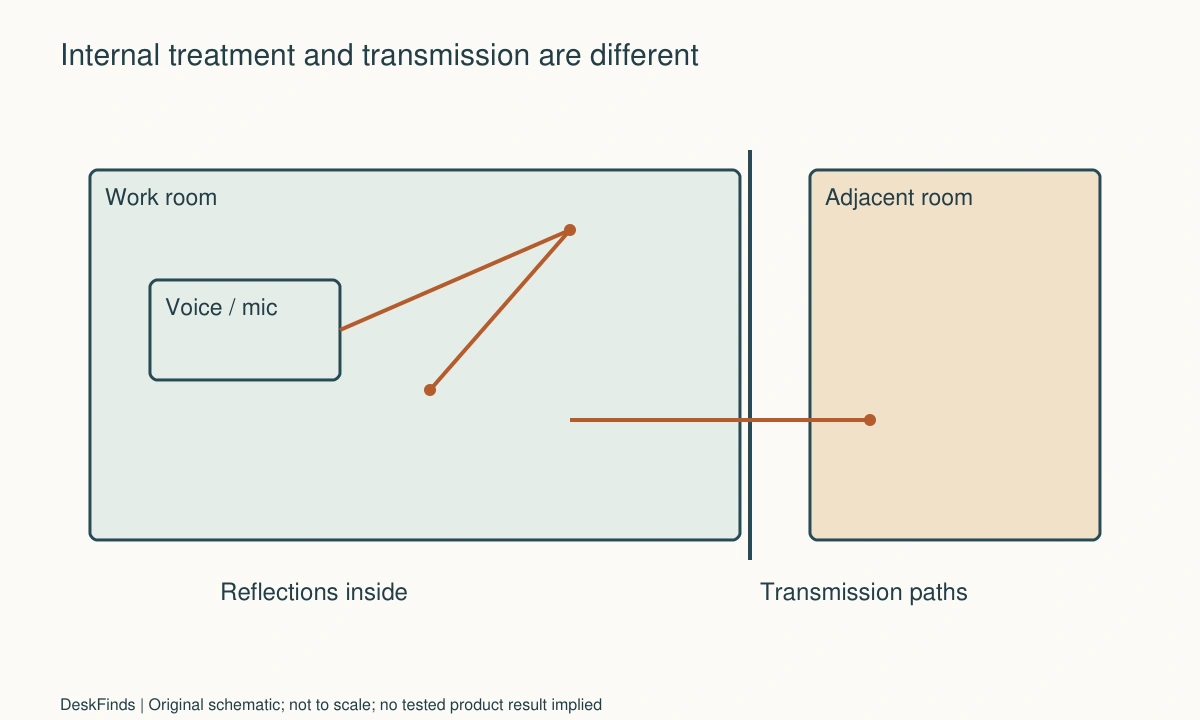
Define who must notice improvement and from which position. A local microphone recording evaluates a different result from listening in an adjacent room. Keep those observations separate. A room can improve internally while still transmitting conversation through a door.
Understand reflections in practical terms
Sound reaches surfaces and can return to the listener or microphone after the direct sound. Room geometry, materials, and placement affect what is heard. Acoustic treatment is chosen to manage that behavior inside the space.
Different products act differently across frequency and installation conditions. Do not assume a thin decorative panel, thick absorber, curtain, and bass trap are interchangeable because all are described as acoustic. Look for relevant published performance and installation information rather than choosing only color and thickness.
Understand isolation as a building problem
Sound can pass through or around partitions, openings, and connected structures. Doors, gaps, windows, vents, and flanking paths can matter. Adding material to one wall may leave another route dominant.
A serious isolation project may involve construction and professional assessment. Do not seal ventilation, block required openings, or alter fire-rated assemblies as a casual desk accessory project. The correct response depends on the building and the required result.
Try source and placement changes first
Lower speaker playback when practical, use suitable headphones for calls, and move a microphone into an appropriate position near the voice. These can reduce some unwanted pickup or playback without treating every surface.
They do not necessarily stop the user’s own voice reaching another room. If speaking disturbs a sleeper, headphones remove speaker output but not speech. A schedule change or a genuinely separate working location may be the most effective reversible option.
Compare room treatment with a useful test
Make a short speech recording from the intended microphone position using normal voice level. Keep settings, placement, and room state consistent. Compare one permitted change at a time and include ordinary speaking rather than a dramatic clap alone.
A hand clap can reveal some ringing or reflections but is not a complete room assessment or a measurement of soundproofing. Phone sound-level applications also have calibration limitations. Use them cautiously for relative observations, not promised professional ratings.
Choose treatment from the actual room
Map the desk, speaker or voice position, major reflective surfaces, and possible panel locations. Check the product’s intended use, mounting requirements, fire information where relevant, and suitability for the room. A rental may restrict installation.
Soft furnishings already present can affect the room, but they are not automatically equivalent to tested treatment. A rug might change some floor reflections while leaving other issues. Judge the task result, not the quantity of soft objects added.
Be realistic about dividers
A folding screen can create a visual boundary and sometimes influence sound depending on its construction and position. Open edges and gaps remain. It should not be described as a sealed room or a confidentiality barrier.
Our small-office room-divider guide addresses footprint and stability. Choose a divider for the function it documents. If acoustic performance is important, compare relevant evidence for the exact product rather than inferring it from an upholstered appearance.

Example: clearer calls, unchanged bedroom disturbance
Suppose a worker’s calls sound reflective and the adjacent bedroom also hears speech. A suitable treatment trial improves the local microphone recording. The worker initially expects the bedroom problem to disappear as well, but the listener there reports little change.
The result is not contradictory. Internal reflection and transmission were separate objectives. The worker retains the useful treatment for call quality, then investigates the door and other transmission routes with appropriate building guidance. No arbitrary decibel reduction is claimed from the trial.
For late calls, the household uses scheduling and another available location while assessing larger changes. A headset helps prevent meeting audio playing into the room, but the worker does not claim it isolates the speaking voice. Each measure is described accurately.
For the captured signal rather than building isolation, review call background-noise reduction.
Compare purchases by function
| Purchase or change | Main question |
|---|---|
| Absorptive treatment | Does relevant performance suit the reflection problem? |
| Headset | Does it improve pickup and avoid room playback? |
| Divider | Does it provide the documented visual or acoustic function? |
| Door or wall project | Which path needs isolation, and what professional work is appropriate? |
| Furniture rearrangement | Does a new location improve the actual task result? |
GIK Acoustics explicitly distinguishes treatment from soundproofing in its guidance. Use that distinction when reading product claims, without assuming one brand’s description certifies every panel. For the desk’s source noise, see keyboard-noise diagnosis.
Decide when to seek an assessment
If confidentiality, substantial isolation, or structural work is required, obtain advice appropriate to the building and goal. A product shortlist cannot diagnose every transmission path. Tell the professional what is heard, where, when, and what result is needed.
For a reversible home-office improvement, begin with documented placement and treatment choices that address the observed internal problem. Avoid promising silence. A clear objective and honest comparison are more valuable than filling a small room with products that solve a different acoustic question.
Put the complaint in a two-column record
Use one column for the sound inside the work room and another for what is heard elsewhere. For the first, note the microphone or listener position, whether speech sounds reflective, and which normal task is affected. For the second, note the adjacent location, door state, source, and time. This simple separation can prevent one successful trial from being misrepresented as a solution to both problems.
Do not use a product’s appearance as a performance specification. An upholstered divider, decorative slat panel, thin foam tile, and purpose-designed absorber may have different published data and installation needs. If a claim matters, look for information tied to the exact construction and test conditions. A generic word such as acoustic does not state which problem the product addresses or how much improvement to expect.
Check the installation before ordering. Panels may require wall fixings, adhesive, suspension, or a freestanding frame. Each has surface, loading, removal, and clearance requirements. In a rental, permission and restoration matter. Near a desk, the product must coexist with monitor movement, outlets, lighting, and required ventilation. An acoustic goal does not justify bypassing ordinary furniture or building instructions.
Keep reversible steps distinct from construction. Rearranging a desk or changing a suitable microphone position can be trialed with modest effort. Altering doors, ceilings, partitions, or ventilation is another project and may require professional assessment. Avoid a sequence of small unverified modifications that gradually changes a building assembly without a coherent design.
A realistic budget follows the objective. If clearer calls are sufficient, focused internal treatment and pickup changes may be worth comparing. If a neighbor must not hear confidential speech, that requirement is far more demanding and cannot be inferred from a nicer local recording. Define the required outcome before deciding whether another panel is an improvement or simply another product solving the wrong question.

Worked trial: one room, two separate outcomes
Imagine a renter taking calls in a small room with hard surfaces. Remote colleagues describe a hollow sound, and someone in the next bedroom hears the worker speaking. The renter initially considers a pack of foam tiles advertised broadly for sound control.
The renter first makes a consistent speech recording from the intended work microphone and separately asks the adjacent listener about ordinary conversation. These observations are recorded in different columns. The first concerns internal pickup; the second concerns transmission between rooms.
A supported reversible treatment arrangement is trialed for the internal reflection problem. The microphone position and processing remain consistent so the comparison has meaning. The local result becomes more acceptable, and the treatment is retained for that purpose. No calibrated rating is claimed.
The bedroom listener still hears speech. The renter does not conclude that the treatment is useless; it answered a different objective. The route may involve the door, openings, or other building paths, so a more serious isolation question receives appropriate advice rather than another arbitrary foam order. Ventilation and required openings are not sealed as a casual experiment.
During late work, the renter uses a suitable headset to prevent incoming call audio playing into the room. The speaking voice remains, so sensitive or disruptive calls use a separate approved location or schedule. The headset is not described as making the room soundproof.
The final arrangement combines a clearer local call signal with an honest household routine. If the isolation requirement later becomes stronger, the renter can provide a professional with the recorded complaint locations and conditions. The useful outcome is knowing what each measure actually achieved, not treating every soft surface as evidence that speech can no longer travel beyond the desk.
If another voice shares the room, use two-workstation call planning.
Recognize a claim that needs better evidence
A product page may use soundproof, sound absorbing, echo reducing, and acoustic as though they were interchangeable. Read the description for the actual intended function and any supporting data. If the seller cannot explain which problem the product addresses, keep the purchase unresolved rather than interpreting the broadest word as a guarantee.
A photograph of panels covering a wall does not show the sound path through the door, ceiling, floor, or ventilation. A before-and-after voice clip may demonstrate a change in the recording but not transmission to an adjacent room. Ask whether evidence matches the objective and the installed conditions. The same product can have a useful role without supplying the outcome implied by an overly broad marketing label.
Check practical constraints early. A renter may be unable to install permanent treatment; a small desk may have no supported place for a freestanding panel; a room may need daylight and access to a particular wall. These limits help define a realistic reversible trial. They do not justify improvised mounting or blocking an opening required by the room.
Keep the budget staged. First identify the complaint and confirm the work configuration. Then compare a limited supported change and record its actual effect. Escalate to more treatment or a building assessment only when the remaining problem and goal justify it. Buying many products at once can make a subjective improvement expensive without showing which part was useful.
For confidential work, the acceptable result may be defined by an employer or another relevant requirement. A casual household listening test is not a certification of speech privacy. Use an appropriate work location and advice while any larger isolation question remains unresolved. This is a practical limit of the room, not a failure to find the right decorative panel.
When documenting the finished setup, name each measure accurately: headset for playback and pickup, treatment for the internal task, visual screen for framing, or construction for a specified isolation objective. Clear descriptions make later changes easier and prevent a successful narrow improvement from growing into an unsupported claim that the room is now silent or private under all conditions.
Your practical comparison worksheet
Use the following checks with the actual people, objects, and room in your plan. Record a measured value, an observed task result, or the exact product information that answers each point. Keep unresolved details separate from confirmed ones. A result about one feature should not silently establish another: physical fit, ordinary use, support, and care may require different evidence. Work through the checks before ordering, then repeat the relevant actions with the delivered item while the return terms apply. The worksheet is a planning aid rather than a product test or approval for an improvised installation.
1. Desired listener
Identify whether the target is the worker, a call participant, a roommate in the same room, or someone beyond a partition.
Evaluate each audience from the relevant position. A clearer microphone recording does not establish that conversation is less audible in another bedroom.
2. Sound source
Separate voice, keyboard, speaker playback, outdoor sound, and building equipment in the initial notes.
Change or reduce the source when practical before buying treatment. Headphones address playback but do not remove the user’s own speaking voice from the room.
3. Internal trial
Record normal speech from the intended microphone with consistent settings and room conditions; compare one reversible supported change.
Use the result as a setup observation. A clap or phone recording can offer clues but does not certify room response or isolation performance.
4. Transmission route
Note doors, windows, vents, gaps, and connected building areas where sound is heard; avoid assuming the nearest wall is the only path.
Seek suitable assessment for significant isolation or privacy requirements. Do not block ventilation or alter required assemblies as an accessory-level workaround.
5. Product evidence
Check what the exact panel or divider claims, how it was tested, and which installation conditions the data describes.
An acoustic label or upholstered finish does not establish soundproofing. Choose evidence relevant to the actual internal or transmission objective.
6. Installation fit
Map mounting surfaces, fixing requirements, outlets, moving equipment, and room access before ordering treatment.
Obtain permission and suitable support where needed. A helpful acoustic position still needs a documented practical installation in the room.
7. Shared schedule
Identify calls or work periods that remain incompatible with another occupant’s use after reasonable reversible changes.
Use a separate location or agreement rather than promising that a few panels or a folding screen can provide confidentiality or silence.
8. Outcome record
Keep internal quality, external audibility, cost, and practical room use in separate final columns.
Retain improvements for the functions they actually deliver and avoid extending a personal observation into a universal reduction claim.
Sources and scope
- GIK Acoustics: treatment versus soundproofing - Primary distinction between internal treatment and sound isolation. Room scenarios are original planning examples.
Editorial note: This is a research-based planning guide, not a hands-on product review. Worked examples are hypothetical. Follow the exact product instructions and resolve compatibility, installation, and care questions before relying on the arrangement.