
Vacuum Storage Bags vs. Storage Bins for a Small Dorm Room
Affiliate Disclosure: We may earn a small commission on qualifying Amazon purchases at no extra cost to you. Full disclosure →
Vacuum bags and rigid bins solve different storage problems. A bag can compress suitable soft contents, while a bin provides a defined outer shape and some physical separation from surrounding objects. Neither automatically makes every material suitable for long storage or every shelf safe to load.
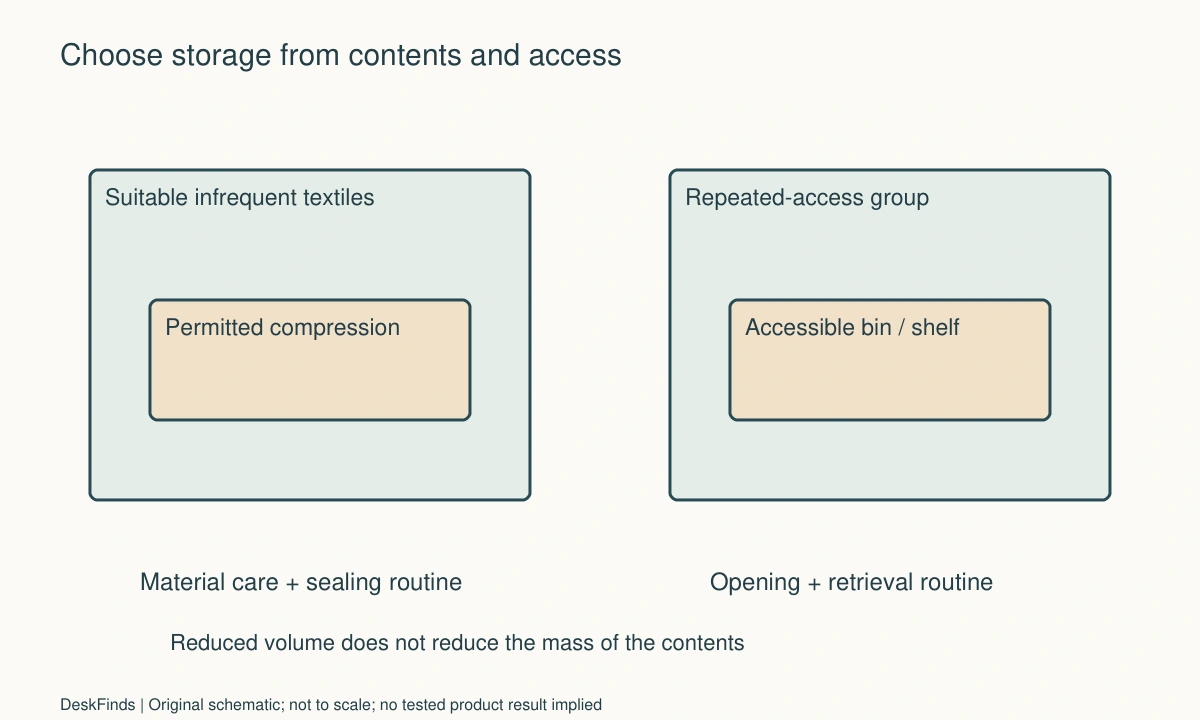
Quick answer: Use vacuum bags for items the garment and bag makers permit compressing, especially when access is infrequent and the sealed package has a practical destination. Choose bins for repeated access, shape protection, and organized retrieval. Compare the complete routine: filling, sealing, storing, reopening, and putting items away. A hybrid system is often more useful than choosing one format for everything.
Sort contents before choosing containers
Separate daily clothing, seasonal textiles, structured garments, shoes, electronics, and documents. Compression suitability depends on the item and product instructions. Do not infer that a bag labeled for bedding is appropriate for leather, down, decorative trim, or every padded item.
Check care labels and maker guidance for valuable or delicate belongings. A generic list online cannot certify every fabric or construction. If suitability is uncertain, choose an appropriate non-compressed storage method or seek specific guidance rather than treating maximum space saving as the only objective.
Compare access frequency
A vacuum bag creates several steps each time it is opened: retrieve it, release or open the seal as directed, remove the item, reseal, and evacuate again if needed. That can be reasonable for seasonal storage and frustrating for a sweater used twice a week.
A bin still needs clearance to open or extract it, but the contents may be easier to access repeatedly. Define the actual frequency before buying. Labeling a vacuum package daily clothes does not remove the work involved in reopening it.
Measure the stored shape
A compressed bag is not guaranteed to become a perfectly flat rectangle. Contents, seams, valve, and sealing area affect its final shape. Use the maker’s dimensions correctly and test the filled package where possible.
For a bin, include lid, handles, and the widest outside dimension. Internal capacity and outside fit are separate. Use the shelving guide to distinguish furniture flexibility from container size.
Account for retrieval space
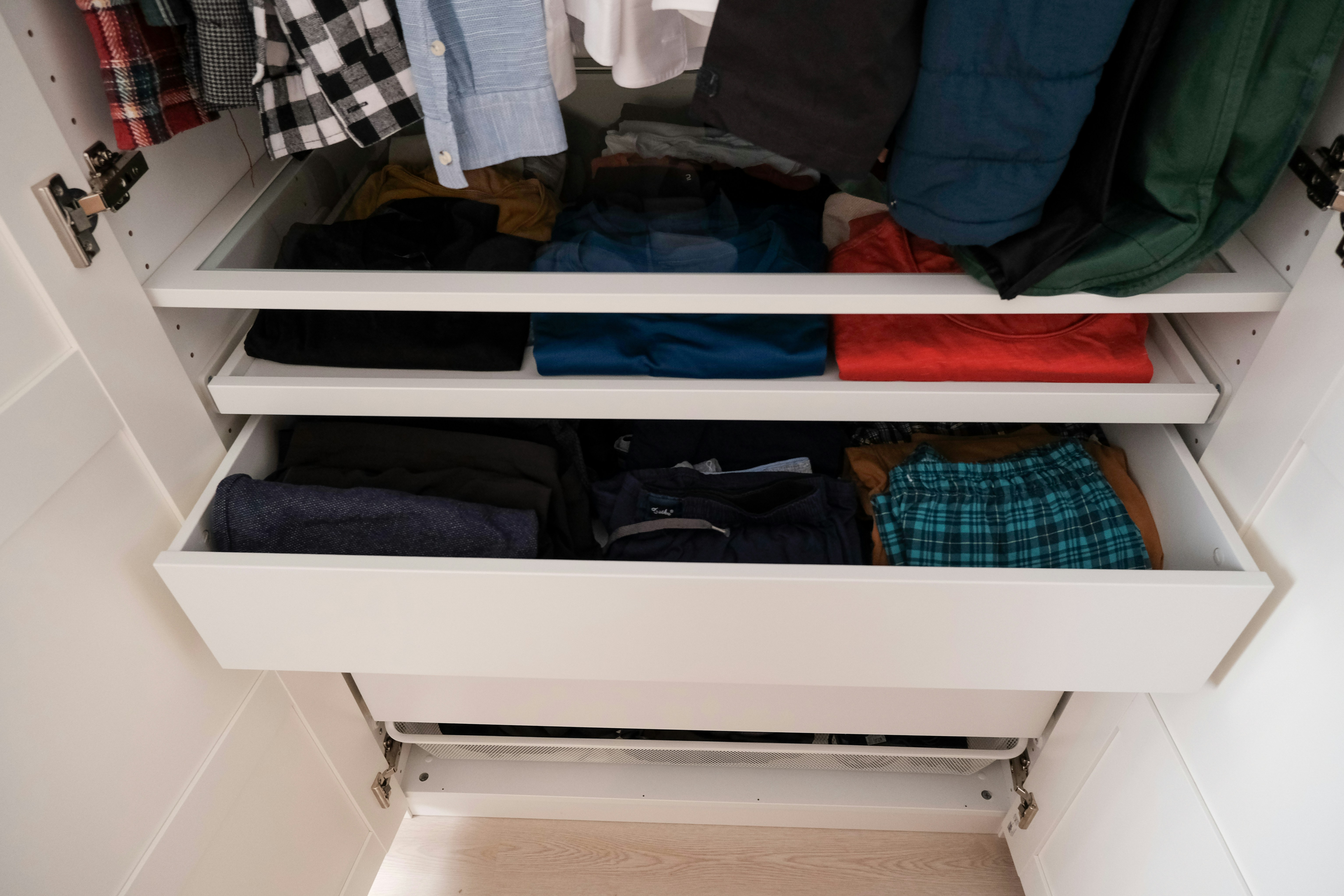
A bag stored under a bed needs a route that does not drag it across sharp parts. A bin needs enough access to lift or slide it as designed. Neither solution works well when the whole room must be dismantled for an ordinary item.
If bags are stacked in a bin or suitcase, check the outer container’s capacity and handling. Compression reduces volume, not the mass of the contents. A dense package can be awkward to carry even when it looks small.
Follow preparation and sealing instructions
Store contents clean and appropriately dry, following their care requirements and the bag or bin instructions. Compression is not a substitute for drying damp fabric. Inspect seals, valves, and surfaces before use.
Use only the specified vacuum or pump arrangement. Do not assume every handheld cleaner, nozzle, or pump is compatible. Keep the sealing strip free of trapped material and avoid overfilling past the product’s guidance.
Protect the package from damage
Sharp furniture edges, hardware, and overstuffed surroundings can damage a flexible bag. Do not use the bag as a heavy dragging handle unless designed for that handling. A protective outer location can be useful when the bag itself provides little shape protection.
A bin can also crack, deform, or fail if misused or overloaded. Stack only as supported and keep the load appropriate for the container and furniture. A rigid side is not permission to place unlimited weight above it.
Think about storage conditions
Consider the actual room and destination, including spills, heat, direct sunlight, and access for inspection. Follow item and container guidance. Do not describe a generic vacuum bag or lidded bin as a guarantee against moisture, pests, or every storage hazard.
Check valuable contents periodically as appropriate. A vacuum seal that changes requires the maker’s troubleshooting process, not an assumption that the fabric is protected indefinitely. Keep important care information available even after the contents are hidden.
Compare moving-day use
Vacuum bags can consolidate suitable textiles, but their dense contents still need manageable handling and protection. Bins offer repeatable shapes but occupy space when empty unless they nest or collapse as intended.
For a dorm move, include transport, carrying distance, and end-of-term storage. A container useful under the current bed may not fit the next room. Avoid purchasing a large matching set before checking what will actually travel and where it will be stored.
Example: seasonal bedding and weekly clothing
Imagine a student trying to reclaim wardrobe space. The first plan compresses all clothing into large bags. A trial shows that weekly items require too much opening and resealing, while one suitable seasonal textile group works well in a labeled bag.
The student uses accessible bins or shelves for frequent clothing and keeps the permitted seasonal package in a protected low-access location. Structured or unsuitable belongings remain in another appropriate format. The storage system follows use and care rather than applying compression to everything.
The student also checks lifting. The large compressed package is heavier than expected, so contents are divided into manageable groups without exceeding product instructions. The final arrangement saves useful space while preserving retrieval and handling.
Choose from a task matrix
| Need | More useful comparison |
|---|---|
| Infrequent suitable textiles | Vacuum bag instructions and protected destination |
| Weekly clothing | Repeated-access bins or shelf organization |
| Items needing shape protection | Appropriate non-compressed container |
| Frequent moves | Handling weight, empty storage, and destination fit |
| Mixed belongings | Separate formats for separate material and access needs |
For stacked rigid containers, see accessible stacking. For shared clothing space, see dorm closet boundaries. Choose the system you can use and maintain, not the one promising the largest percentage reduction without regard to the contents.
For the surrounding clothing allocation, use shared closet planning.
Compare a complete storage cycle
Start with the belongings on a clear surface and identify which ones can use compression according to the relevant item and storage-product guidance. Do not treat a material name alone as the whole answer. Padding, construction, decorative parts, and garment care can matter. If the value or sensitivity of an item makes the uncertainty important, seek a specific answer or choose a suitable non-compressed method rather than applying a generic packing rule.
For suitable bag contents, define the group and the next access date or event. A seasonal group is easier to manage when it does not contain one item needed every week. Put that frequently used item in accessible storage before sealing. Otherwise a space-saving package becomes a repeated unpacking project. Labels should describe a useful group, not conceal an arbitrary mix of overflow.
Compare the actual filled shapes. A vacuum bag can develop a rounded or irregular outline, and the valve or seal can need protected space. A bin offers a more defined body but its lid and handles can control the outside fit. Measure each according to its own product information. Do not compare a bag’s flat unfilled dimensions directly with a bin’s outside lidded dimensions and assume they describe equivalent capacity.
Handling remains important after compression. Removing air does not remove the mass of the belongings. A dense package may be more awkward than a larger light one, especially beneath a bed or above shoulder height. Divide contents into manageable supported groups and choose a destination with a usable retrieval route. Do not use the flexible bag as a load-bearing handle unless it is designed for that handling.
A hybrid arrangement can solve the daily routine well. Appropriate compressed textiles can sit in a protective destination, frequently used clothing can remain in accessible shelves or bins, and structured items can use suitable non-compressed support. This is not a compromise in storage quality. It matches different materials and access needs to different tools.
Before expanding, trial one package and one rigid container. Include filling, closing, retrieving, opening, and returning them. Note any equipment required to reseal the bag and where that equipment is kept. A product that saves volume but needs an unavailable pump or an awkward cleanup every time may be unsuitable for the intended dorm routine.

Worked comparison: one seasonal group and one weekly group
Imagine a student with spare bedding, weekly clothing, a structured garment, and miscellaneous cables competing for a small wardrobe. The initial plan is a large vacuum-bag set advertised with a dramatic space-saving percentage. The student first sorts by care and access instead of applying the same method to all contents.
The bedding is checked against its own care guidance and the exact bag’s instructions. Only suitable items enter the trial. The structured garment remains in an appropriate non-compressed arrangement. Electronics and cables receive another destination rather than being mixed into a textile package because there is unused space.
Weekly clothing is placed in a compressed bag for a trial, but retrieval proves inconvenient. The bag must be pulled out, opened, and resealed repeatedly. The student moves that group to accessible storage. The seasonal package stays because its access pattern justifies the effort and its destination protects it from sharp frame parts.
The student then measures the filled package. It is not a perfectly flat rectangle and cannot be pushed into the original gap without stressing a seam. Another protected location is compared. The student does not force the bag beneath the bed or assume an expanding seal is harmless because the label says storage.
A rigid bin is tested for another group. Its lidded outside shape fits the shelf, but opening requires lifting it out. Because those contents are infrequent and the load is manageable, the arrangement may be acceptable. The same design would be poor for daily supplies. The shelf’s loading and the container’s use instructions are checked independently.
At term-end, the student plans how both groups travel. The compressed package is dense, so carrying and protection are considered separately from volume. The bin’s empty storage and reuse at the next residence are also part of the comparison.
The final system includes more than one format and fewer unnecessary bags than the original bulk set. It does not claim guaranteed protection from every moisture or pest issue. The useful gain is suitable contents, practical access, and a repeatable routine, rather than the largest advertised compression figure.
Read the storage claim with its conditions
An advertised compression figure describes a particular demonstration or product claim, not the space every user will recover. Contents, fill, permitted compression, and final package shape matter. Do not plan a shelf or suitcase around the most favorable percentage without checking the actual suitable filled group.
Keep protection claims separate from volume claims. A sealed-looking bag is not automatically a guarantee against every moisture, odor, pest, or material-care issue. Read what the exact product supports and what preparation it requires. The contents may have restrictions independent of the bag’s general purpose.
For repeated dorm moves, compare what happens when the container is empty. A rigid bin may nest with specified matching models, while bags and pumps still need an identifiable home. Do not buy a large set simply because it appears inexpensive per piece. Empty-container storage and unused accessories also consume room space.
Label contents in a way that survives the move without implying that the package should be handled by its seal. Keep the intended lifting and transport method clear. A compressed group can become dense enough that a smaller quantity is more manageable, even if another garment would physically fit.
Before committing to a whole system, complete a return cycle: retrieve one item, prepare the remaining contents appropriately, reseal or close as directed, and put the package back. If that step is irritating for the intended frequency, change the allocation rather than assuming greater discipline will make an unsuitable format convenient.
A practical storage system can use the spare suitcase, a few accessible bins, and one suitable compressed group without needing a perfectly matched set. Compare each role independently. The aim is to preserve care, retrieval, and room access while reducing avoidable volume. Space-saving is useful when it supports those functions, not when it hides belongings so effectively that they become difficult to use or maintain.
For everyday retrieval, compare accessible stacked containers.
Your practical comparison worksheet
Use the following checks with the actual people, objects, and room in your plan. Record a measured value, an observed task result, or the exact product information that answers each point. Keep unresolved details separate from confirmed ones. A result about one feature should not silently establish another: physical fit, ordinary use, support, and care may require different evidence. Work through the checks before ordering, then repeat the relevant actions with the delivered item while the return terms apply. The worksheet is a planning aid rather than a product test or approval for an improvised installation.
1. Item suitability
List exact garments or textiles with care requirements, construction, padding, and any maker restrictions on compression.
Use the specific item and bag guidance. If suitability remains uncertain, choose an appropriate non-compressed method rather than relying on a generic material list.
2. Access frequency
Group contents by how often they are needed and identify any weekly item hidden within an otherwise seasonal package.
Move frequent belongings to accessible storage. A label cannot remove the repeated opening, resealing, and equipment steps required by a vacuum bag.
3. Filled shape
Measure the actual supported filled arrangement, including seams, valve, closure, bulging, and the bin’s complete lid and handles.
Keep reference points clear. Unfilled bag dimensions and lidded bin dimensions do not directly describe equivalent usable capacity or destination fit.
4. Preparation
Follow garment, bag, and container guidance for cleaning, appropriate drying, filling, sealing, and permitted vacuum or pump equipment.
Compression does not dry damp belongings or make an unsupported nozzle compatible. Inspect the closure rather than treating a space-saving label as a care guarantee.
5. Destination
Check the route and final position beneath a bed, on a shelf, or inside another suitable container, including sharp parts and access.
Do not force flexible packages past damaging edges or assume a closed destination protects against every storage condition. Keep contents inspectable as appropriate.
6. Handling
Consider the mass, grip, shape, and carrying distance of the filled package or bin, not only its reduced volume.
Choose manageable groups and supported handling. Compression removes air, not weight, and a dense package can be awkward even when it looks small.
7. Furniture limits
Compare the complete stored load with the container, stack, shelf, and furniture requirements, including required anchoring.
A rigid bin or compact package does not establish unlimited shelf capacity. Keep structural and loading questions separate from space efficiency.
8. Trial and move
Complete one real fill-store-retrieve-open-return cycle and consider the next dorm’s likely handling and storage needs.
Expand only after the format proves useful. Buying a large matching set before testing can create empty-container storage without improving the daily routine.
Sources and scope
- Space Bag vacuum-seal cube instructions - Primary example of product-specific filling, equipment, and material restrictions; follow the exact bag and item guidance.
Editorial note: This is a research-based planning guide, not a hands-on product review. Worked examples are hypothetical. Follow the exact product instructions and resolve compatibility, installation, and care questions before relying on the arrangement.