
How to Store a Suitcase in a Small Room-and Use the Space Inside
Affiliate Disclosure: We may earn a small commission on qualifying Amazon purchases at no extra cost to you. Full disclosure →
A suitcase can occupy awkward room space between trips, but filling it with belongings is useful only if you can access both the case and its contents. Wheels, handles, opening motion, cleanliness, and the next departure all affect the plan.
Quick answer: Measure the case in its actual stored orientation, choose a location that permits safe retrieval, and use the interior only for suitable belongings you do not need constantly. Follow the luggage and contents’ care guidance, store appropriately clean and dry, and keep a departure checklist so the case can return to travel use without a search through the room.
Record the whole outer shape
Include wheels, fixed handles, locks, feet, and any expansion panel in the relevant state. Retailer dimensions may describe a body or a complete exterior; verify the reference. Do not assume airline size labels define the exact shape needed for home storage.
Measure the proposed route as well as the destination. A case can fit beneath a bed yet be impossible to pull past a bed leg. A high shelf may fit the body while making retrieval awkward or unsuitable for the user.
Choose the orientation from the case design
Check the maker’s guidance for storing the case and supporting its shape. Upright, flat, or nested arrangements have different footprints and handling. Do not suspend a heavy loaded case from a handle unless the product is intended for that use.
If nesting luggage, confirm that handles, wheels, and interior fittings do not damage the other case. The outside of a smaller case can carry dirt into a larger one. Follow care and preparation requirements rather than assuming nesting is automatically clean storage.
Separate frequent and infrequent contents
Seasonal clothing or appropriate spare items may suit luggage storage better than daily chargers or work papers. Every access requires retrieving and opening the case. Match that effort to how often the contents are needed.
Do not use the case as a default container for unidentified overflow. A short inventory gives the interior a defined role. Keep important travel accessories or documents in a suitable accessible location rather than hiding the only essential item beneath unrelated storage.

Prepare the case appropriately
Clean and dry the luggage according to the maker’s instructions before storage. Different shell, fabric, lining, and wheel materials may need different care. Avoid unapproved chemicals and do not pack damp belongings into a closed case.
Samsonite provides product-care and storage guidance for its luggage. Apply the instructions relevant to the actual case rather than treating one brand’s method as universal for every material. Periodic inspection or airing may be part of the recommended routine.
Protect the interior organization
Use appropriate packing cubes, pouches, or another supported internal arrangement to separate contents. Do not force the zipper closed or use expansion to accommodate an unlimited load. A compressed textile package still has mass and must be suitable for the item and container.
Keep sharp or leaking items out of unsuitable contact with the lining. Do not store food, chemicals, batteries, or other specialized items casually because the case is available. Follow the relevant item instructions and choose a purpose-appropriate storage location.
Check opening space
A clamshell case may need space for two halves, while a top-opening case behaves differently. Include the place where the lid or second half rests. A case stored upright in a narrow gap may need to move elsewhere before opening.
Give that operation a real destination. Opening luggage on the bed can be practical in some households after appropriate cleaning, but it is not automatically suitable for every case or contents. The route should not depend on balancing a half-open case against furniture.
Keep travel readiness visible
Label the stored contents and note what must be removed before a trip. Keep the key or access method in an appropriate location. Test locks according to the maker’s guidance and do not leave the only access information inside the locked case.
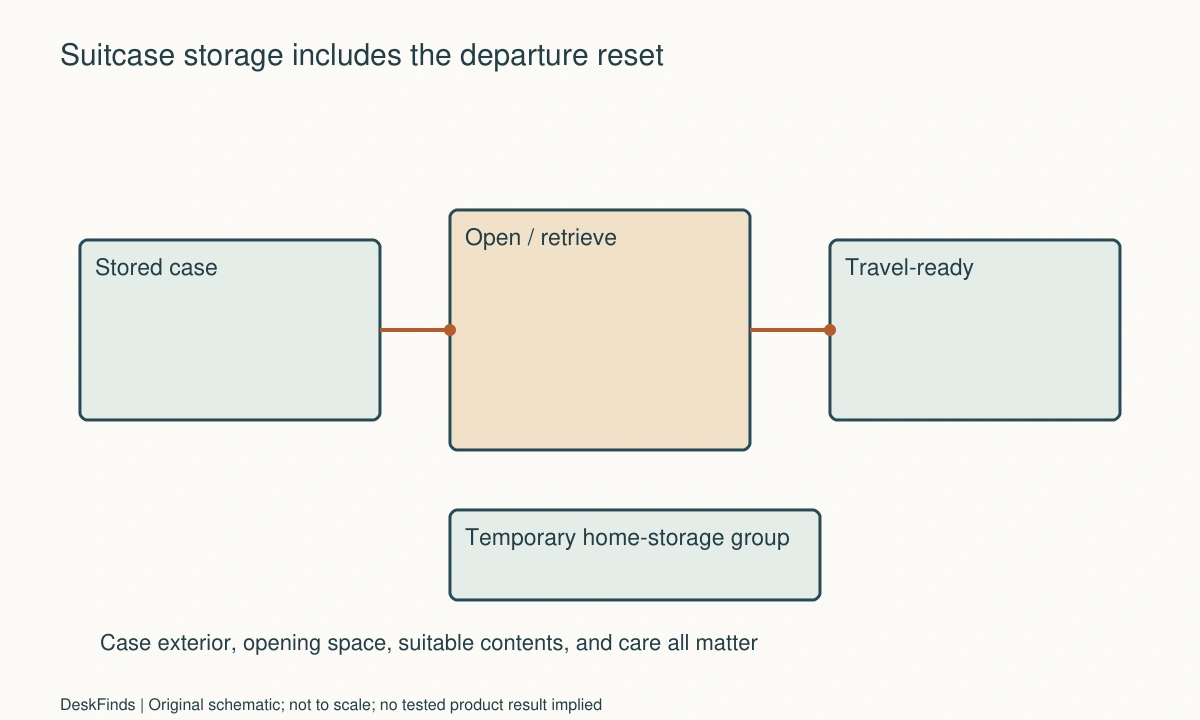
When a trip is booked, empty the home-storage group early enough to inspect the luggage and pack normally. A case full of unrelated belongings is not travel-ready merely because it is neatly stored. Give those belongings a temporary destination before departure.

Consider under-bed and high-shelf options separately
Under-bed storage needs floor clearance, a smooth retrieval path, and protection from sharp frame parts. A shelf needs documented load support and appropriate access. Include the loaded case, not only the empty weight.
Do not put heavy luggage above a bed or work position based only on apparent shelf size. Follow furniture anchoring and loading requirements. The shelf-weight guide helps frame the support question, but the exact installation must supply the answer.
Example: the case saves space but delays departure
Imagine a student storing seasonal belongings inside a case under the bed. The case fits, but frequent access to one item requires pulling it out and opening both halves. That item moves to accessible storage, while genuinely infrequent contents remain in labeled pouches.
Before a trip, the student uses a checklist to move the storage group to an agreed temporary container. The luggage is inspected and prepared according to its instructions. Travel packing no longer begins with an unplanned room-wide search for somewhere to dump the contents.
The system keeps the case useful in both roles. It does not promise moisture-proof or pest-proof protection; conditions and care remain relevant. For another seasonal option, compare vacuum bags and bins.
For suitable seasonal textile alternatives, compare vacuum bags and storage bins.
Judge usefulness beyond footprint
A suitcase earns its storage role when the case can be retrieved, opened, closed, and returned safely, and the contents can leave it before travel. A slightly less hidden but accessible location may be more practical than the tightest possible gap.
Compare the routine with ordinary bins or a shelf before committing. Reusing the case can save a purchase, but it should not make daily belongings inaccessible or turn every departure into a storage emergency.
Decide whether the case is storage, transport, or both
Give the suitcase a primary home-storage role and identify when it must return to travel use. A seasonal textile group is easier to manage than miscellaneous possessions with no alternative destination. If a trip can occur at short notice, keep the removal process simple and assign those contents a temporary suitable place before departure. A neatly packed case is not automatically ready to travel.
Measure the case using the stored orientation and the actual load. Wheels and fixed handles can control fit beneath furniture, while a clamshell opening may require a much larger working area outside the storage gap. Check the route from destination to opening area. Sliding a case out may be easy until a bed leg or another container blocks the wheel path. Do not rely on the empty case’s flexibility to force it through a tight space.
Cleaning and storage guidance should come from the luggage and contents. Different shells, linings, hardware, and textiles can require different methods. Store appropriately dry and avoid assuming a zipped case creates a controlled environment. If inspection or airing is recommended, make the case accessible enough to do it. A destination that cannot be reached without dismantling furniture makes ongoing care less likely.
Use internal containers only when they serve retrieval and protect suitable contents. A pouch can keep one group together during travel preparation, but it should not conceal a leaking bottle or compress an unsuitable item. Keep the interior loading reasonable and do not force zippers or expansion panels. The suitcase’s ability to carry belongings on a trip does not make it an appropriate container for every material during months of home storage.
For nesting, compare the complete smaller case with the larger case’s interior and care guidance. Wheels, dirt, rigid handles, and interior fittings can affect the arrangement. Do not assume that two sizes from a product family are designed to nest simply because one looks smaller. Check the documented feature or the actual suitable fit and protect surfaces as instructed.
The practical question is whether reuse avoids a purchase without creating a more difficult routine. If daily items become inaccessible or every trip creates a room-wide storage crisis, a separate suitable bin or shelf may be better value. Reusing luggage is useful when both storage and departure remain manageable.

Worked layout: under the bed until the next trip
Imagine a student placing a suitcase beneath the bed and filling it with spare textiles, a frequently used charger, and a few unidentified belongings. The case fits the visible gap, so the student initially considers the storage problem solved.
A retrieval test shows that the charger requires pulling the case out and opening both halves. The route is partly blocked by a bed leg, and the lid cannot open while the case remains in its gap. The charger moves to accessible storage because it does not belong in a low-frequency system.
The remaining contents are sorted for suitable care and grouped in identifiable pouches. The case is cleaned and appropriately dried according to its maker’s guidance before loading. No claim is made that the zipped shell guarantees protection from every environmental condition. The stored destination remains accessible for any recommended inspection or airing.
The student checks the whole exterior, including wheels, handle, and lock, along the route. Another low-access location may be better if retrieving the loaded case requires dragging it over sharp frame parts. A shelf is considered only with documented support and appropriate handling, not simply because its width matches the case.
A short trip is then simulated. The home-storage group needs somewhere to go before travel packing begins. The student assigns a suitable temporary container and makes an inventory note. The next departure can begin with inspection and normal packing rather than searching for space to dump unrelated contents.
The key or lock access method is kept appropriately available. The student does not leave the only means of access inside the locked case. If nesting another bag is part of the plan, the exterior and fit receive their own check instead of being assumed clean and compatible.
The final system uses luggage for suitable infrequent belongings and preserves a clear travel transition. It may occupy a slightly more accessible location than the tightest possible gap. That is worthwhile because storage capacity should be judged by retrieval, care, and departure readiness as well as the amount of floor space hidden from view.
Compare reuse with a separate container honestly
Using luggage for home storage can avoid buying another bin, but include the cost in access and departure work. If a case must be emptied unexpectedly before every trip, the home-storage group needs another suitable destination. That secondary container or shelf is part of the system even when it is used only occasionally.
A case used rarely may suit infrequent contents better than a cabin bag used every week. Match access patterns in both directions: how often the belongings are retrieved and how often the luggage itself travels. The wrong combination can create repeated unpacking even when each individual storage session seems tidy.
Consider transport and home storage conditions separately. Instructions for packing a short trip do not necessarily establish suitability for months of unattended storage. Follow the maker’s current care guidance, keep contents appropriate, and preserve access for recommended inspection. Do not assume the lining or shell creates a controlled environment for every stored material.
If the case must be lifted to a shelf, include its filled mass and a suitable handling plan. A container can be light when empty and dense after seasonal clothing is added. Loading and anchoring of the shelf remain separate from the suitcase’s own ability to carry contents. Avoid choosing an overhead position solely because it hides the luggage well.
Keep the final inventory simple and useful. Name the groups, note their temporary departure destination, and record any contents that should not remain inside. A small card or accessible note can prevent the only needed item being forgotten in a closed case. Do not store the only access information inside a locked container.
Before the next trip, allow time to inspect the luggage, remove the home-storage group, and pack normally. That transition completes the dual-role system. Reuse is successful when the case remains a practical travel tool as well as a sensible place for suitable belongings between trips.
For independent container access, review accessible bin stacking.
Your practical comparison worksheet
Use the following checks with the actual people, objects, and room in your plan. Record a measured value, an observed task result, or the exact product information that answers each point. Keep unresolved details separate from confirmed ones. A result about one feature should not silently establish another: physical fit, ordinary use, support, and care may require different evidence. Work through the checks before ordering, then repeat the relevant actions with the delivered item while the return terms apply. The worksheet is a planning aid rather than a product test or approval for an improvised installation.
1. Outer shape
Measure the case with wheels, fixed handles, lock, feet, and any relevant expansion in the actual stored orientation.
Check whether published dimensions describe the complete exterior. Airline categories or shell dimensions alone are not a reliable home-storage fit record.
2. Contents
Choose suitable low-frequency belongings with their care requirements and a clear group identity; remove daily essentials from the storage list.
A suitcase should not become unidentified overflow. The item and luggage guidance determine suitability, not the availability of spare interior volume.
3. Retrieval path
Pull a safely handled representative shape through the route, including bed legs, nearby bins, corners, and the opening destination.
Do not force luggage past sharp hardware or assume a parked fit establishes usable access. The loaded arrangement needs a practical route.
4. Opening area
Map top-opening or clamshell motion and the place where the lid or second half rests during retrieval.
Assign a suitable actual destination for opening. A case standing in a narrow gap may need much more room once its contents are used.
5. Preparation
Follow material-specific cleaning, appropriate drying, storage conditions, and any inspection or airing guidance from the relevant makers.
A closed zipper is not a guarantee against moisture or every storage hazard. Keep the case accessible enough to maintain as directed.
6. Internal groups
Use suitable pouches or packing organization that permits inspection and quick removal without forcing closures.
Keep sharp, leaking, or specialized items out of unsupported storage contact. Compression or expansion does not justify unlimited loading.
7. Support and nesting
Check shelf loading and access if stored high, or the actual documented smaller-case fit and preparation if nesting.
Do not infer safe support from shelf size or nesting compatibility from a similar product family. Handles and wheels can control the arrangement.
8. Departure reset
List what leaves the case, where that group goes, and how the luggage is inspected and prepared before a trip.
Keep the lock access method available appropriately. A useful dual-role case can return to travel without an unplanned room-wide unloading problem.
Sources and scope
- Samsonite product care and cleaning - Luggage-specific care and storage reference; use the instructions for the actual material and case.
Editorial note: This is a research-based planning guide, not a hands-on product review. Worked examples are hypothetical. Follow the exact product instructions and resolve compatibility, installation, and care questions before relying on the arrangement.