
How to Choose a Small Desk Trash Bin You Can Empty Easily
Affiliate Disclosure: We may earn a small commission on qualifying Amazon purchases at no extra cost to you. Full disclosure →
A narrow trash bin can fit beside a desk and still be inconvenient every day. Its lid may meet the underside, the liner may need more room to lift out, or the chair may occupy the space needed to use a pedal. Compare the bin’s full use and emptying cycle rather than choosing by capacity and parked width alone.
Quick answer: Separate the waste types you intend to collect, then measure the bin parked, opened, and emptied. Check lid travel, pedal or sensor access, liner removal, and the route past the chair and furniture. Follow the product’s liner and care instructions. A small outside footprint does not describe the space needed by a full liner or a removable inner bucket.
Define what belongs in the bin
List ordinary desk waste and distinguish dry packaging, recyclable paper, food-related waste, and anything requiring a different disposal process. Follow local collection rules and relevant organizational requirements rather than assuming one small container suits every material.
Keep confidential documents separate from a casual open-paper bin when appropriate to the records involved. This guide does not prescribe retention or legal disposal rules. Its physical planning task is to give each intended waste stream a suitable destination without mixing it into an unexamined desk pile.
For documents still awaiting action, use the paper inbox guide. A paper that needs review belongs in a process, not in a trash container chosen because it is the closest empty space.
Measure the parked bin with handles and lid
Use overall dimensions including handles, hinges, pedal projections, and the lid’s closed outline. A nominal capacity does not reveal the shape of the container. A tall narrow bin and a short broad bin can use the same volume in very different parts of the room.
Check the actual gap with baseboards, furniture legs, and cables present. Do not push a bin against a power supply or use it to hold a loose cable bundle in place. The bin should remain independently accessible and appropriate for the product’s use conditions.
If it sits on the desktop, include the loaded footprint and hand route outside the keyboard and mouse area. A tabletop bin should not displace essential input space merely because it looks small in a product photograph.
Trace the lid and access mechanism
Open the lid through its documented travel and include the space above and behind it. Under a desk, a lid can fit closed while striking the underside when used. Do not force it against furniture or assume it may be held partly open without checking the product design.
For a pedal model, reserve the foot approach and operating movement. The chair and your feet may use the same area. For a sensor model, check the intended detection area and controls so passing movement does not create an inconvenient routine. Do not assume every automatic lid behaves the same way.
A simple open-top design can avoid a lid conflict when suitable for the waste and setting, but it has different privacy, appearance, and care considerations. Choose the mechanism around the actual contents and room rather than treating the most elaborate lid as automatically better.
Measure the emptying state
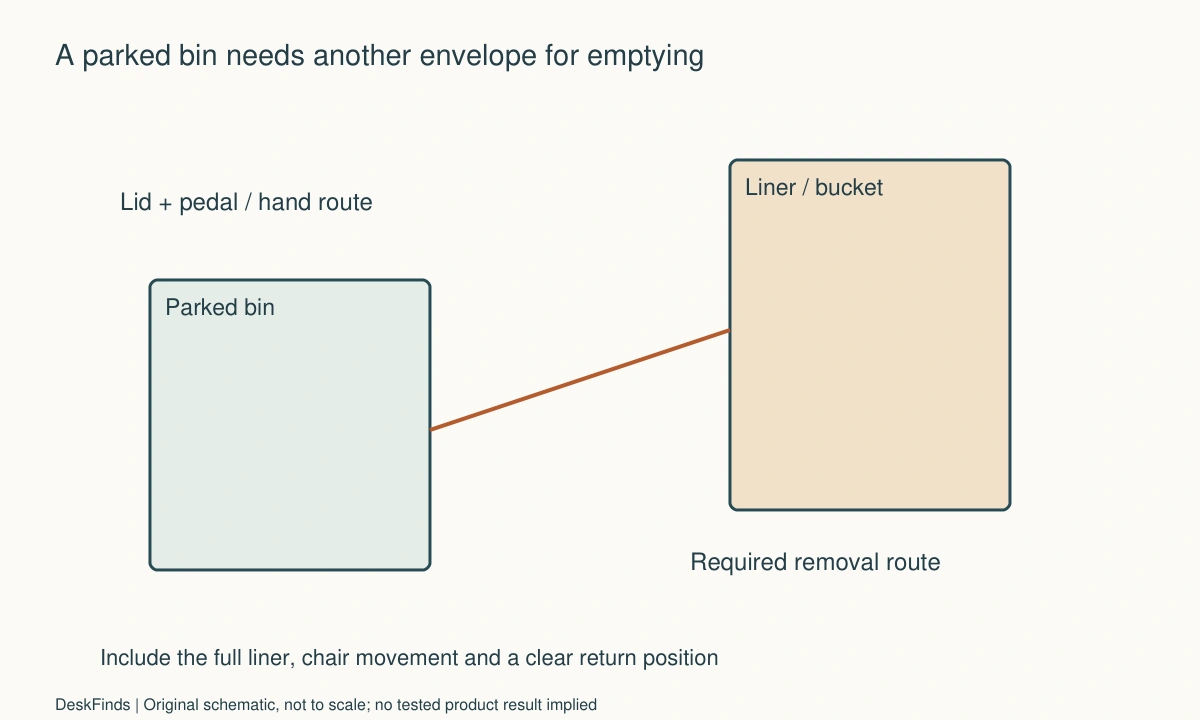
Check whether the liner lifts straight up, the inner bucket comes out, or another documented method is used. Include the full removal envelope and the hand space needed to grasp it. The space above the parked bin can matter more than its narrow width.
Simplehuman’s small-can documentation illustrates model-specific removable-bucket and liner features. Use the actual product’s instructions and dimensions; do not assume every small bin has the same inner construction or that a nominally matching bag will work correctly.
The narrow-bedroom hamper guide covers a related filled-liner geometry problem for a different task. The transferable planning idea is to measure removal, while the bin’s actual liners, contents, and care remain product-specific.
Keep the chair and room route clear
Map ordinary chair approach, turning, standing, and end-of-session parking. Include armrests or foot movement where relevant. A bin can clear the empty chair while occupying the space your body uses to leave the desk.
Check access to nearby drawers, cabinets, doors, and outlets. Emptying the bin should not require dragging a powered device or moving a heavy cabinet. If another person shares the route, include their ordinary use as well.
The small-space troubleshooting guide can help assess competing furniture routes. Do not treat a remaining strip beside the mat as automatically available for a bin; the actual walking and chair movements determine whether it is useful space.
Choose liners and care for the actual product
Read the required or compatible liner information, inner dimensions, and care guidance. A bag that fits the top opening may still be awkward to secure or remove. Avoid forcing an overfilled liner out through a narrow opening or using the bin outside its intended contents and load conditions.
Choose an emptying routine based on the waste and setting. A dry paper container and a bin receiving food-related material can need different handling. Follow relevant collection and hygiene guidance without assuming that a tight lid removes the need for appropriate emptying and cleaning.
Keep cleaning supplies and methods compatible with the container. Do not mix chemicals or use an improvised solvent to remove residue. If the product has electronics or a powered lid, follow its specific care and power instructions rather than treating it like an unpowered bucket.
Worked example: the full liner could not clear the desk
Imagine a hypothetical worker who buys a tall narrow bin for the gap beside a desk pedestal. The closed bin fits neatly and the chair can pass. When the liner needs removal, the desk underside leaves too little room for the intended upward movement.
The worker compares sliding the bin into a clear suitable removal area through an ordinary route with choosing another bin shape or location. The route must remain practical with the room in its normal state, not only after several other objects are moved. The liner is not forced sideways against the lid mechanism.
The worker also checks whether the intended waste volume can be managed through a more appropriate emptying frequency. That is a routine decision, not permission to use a bag or container outside its instructions. The bin’s body, lid, liner, and room access are considered together.
The hypothetical outcome is a container that can be used and emptied predictably. No capacity or durability test is claimed. The example shows why a parked fit is incomplete when the most important maintenance action needs another envelope of space.
A second scenario: the pedal shared the chair’s exit route
Consider a hypothetical user whose bin sits beneath the front corner of a desk. The pedal is reachable while the chair is centered, but using it or leaving the chair requires an awkward foot movement. The bin itself is not too wide; its operating approach conflicts with the task.
The user outlines the foot approach and ordinary chair exit, then compares another suitable location or lid mechanism. A sensor or open-top alternative is assessed through its own requirements rather than assumed superior. The waste types and shared-room needs remain part of the choice.
A side position may improve pedal access but block a drawer or walking route. The user checks those actions before accepting the move. The aim is not to find any place the empty bin can stand, but a location where normal use, emptying, and room movement coexist.
The final hypothetical record includes the bin’s operating and removal states. It does not recommend a universal clearance number or imply that everyone uses the same chair movement. Actual routes and product instructions provide the relevant evidence.
Compare capacity with maintenance effort
A larger bin can reduce some trips while needing more floor and liner space. A smaller one can fit a better location but require more frequent appropriate emptying. Compare the real waste pattern and removal route rather than selecting the largest capacity that can be squeezed into a gap.
For a shared room, agree on which materials go where and who empties each container. A well-labeled bin can still fail if its category overlaps an inbox or recycling destination. The label-maker planning guide covers readable, maintainable identification without assuming every surface tolerates adhesive.
Retain instructions and packaging while checking the delivered geometry. If a lid or bucket cannot operate correctly in the intended location, compare another arrangement or use return options. Do not cut a liner frame, disable a mechanism, or modify the container just to preserve a poor fit.
Six checks for an easy-to-empty desk bin
Intended contents
Define the waste streams and follow the relevant collection, privacy, and care requirements. Keep papers needing action separate from disposal. A small office container is not automatically suitable for every material. The purpose of the bin should be clear enough that another user can return or discard items appropriately without guessing from its location.
Parked outline
Measure the complete body, handles, pedal, hinges, and closed lid. Include real baseboards, legs, and cables in the gap. Do not count space occupied by a chair or power supply as permanently free. A nominal capacity and outer width are useful shortlist data, but they do not describe the whole room interaction.
Opening action
Check the documented lid route and the pedal, sensor, or hand approach. Preserve clearance without forcing the mechanism against furniture. Compare another suitable lid type when the operating route conflicts with the desk. A more elaborate mechanism is not automatically more practical if it introduces an action the room cannot accommodate.
Full removal
Use the specified liner or inner-bucket method and include the upward or other required movement. Check hand access and a suitable landing location. A bag fitting the rim does not establish easy removal when filled appropriately. If the bin must move first, make that route explicit and practical rather than an improvised maintenance workaround.
Chair and walking
Observe ordinary sitting, turning, standing, and chair parking. Include access for other users and neighboring doors or drawers. A bin that clears the empty chair can still occupy a person’s exit route. Choose a location that serves the room through normal states, not only the tidy arrangement used for a measurement photo.
Care and reset
Follow the product’s emptying, cleaning, liner, and power instructions where relevant. Keep the category label accurate and the route clear after the bin returns. A useful desk bin is one that can be operated, emptied, cleaned, and replaced predictably without interfering with the workstation or becoming a destination for unfinished paperwork.
A parked-versus-removal calculation
Imagine a hypothetical bin that is 410 mm high when closed. The intended emptying method needs an additional 260 mm of upward movement for its inner bucket before it can be removed as instructed. That creates a 670 mm conceptual removal envelope in this invented example, not a real product specification or a universal clearance recommendation.
A desk underside at 620 mm could therefore allow the closed body to park while leaving the proposed straight-up removal route unresolved. The next question is whether the bin has an ordinary suitable route to a clear emptying location, or whether another shape or position is better. Do not force the liner or bucket through an unsupported sideways action to preserve the parked fit.
Measure the actual product’s required motion, including the lid and handle. A full liner can also have a different shape from the empty bucket. Use the documented contents and filling conditions, and avoid treating nominal liters as a prediction of the exact removal geometry.
Match the mechanism to the room action
For a pedal bin, outline the foot approach with the chair occupied and when standing. For a hand-operated lid, include the reach and any need to move paper or tools first. For a sensor model, consult its detection and control instructions and compare ordinary passing movement. Those mechanisms solve different access problems.
A suitable open-top bin can avoid a lid envelope for some contents and settings, but it does not remove privacy, collection, and care requirements. A lidded product may be appropriate elsewhere while needing more opening space. Choose from the actual waste stream and room routine rather than the most elaborate feature list.
If the bin changes location for emptying, check that route with the room in its normal state. A path available only after moving several other objects may be too cumbersome for frequent use. Give the container a clear return position so it does not gradually move into the chair or doorway route.
Separate collection from unfinished paperwork
A bin placed beside a paper inbox can create ambiguity if both contain loose sheets. Keep action states and disposal destinations clearly distinct using appropriate wording and locations. This is a workflow distinction, not advice about how long any record must be kept.
Follow relevant privacy and disposal requirements for sensitive documents. Do not assume a lid provides security or that a general recycling stream is suitable for every record. The physical station should support the required process without making casual disposal the easiest response to an overflowing inbox.
For shared use, agree on categories and emptying responsibility. A clear label helps only when the destination and routine remain accurate. If the room’s collection rules or users change, update the arrangement rather than leaving an obsolete category on a familiar container.
Include care access in the final choice
Check how the liner, bucket, lid, and any powered parts are cared for through the manufacturer’s method. A narrow decorative opening can complicate cleaning even when the outer body fits well. Keep suitable supplies and methods separate from an improvised attempt to remove residue with stronger chemicals.
Retain the product instructions and verify the ordinary cycle while return options remain available. The useful result is not simply that the bin disappears into a gap. It is that the intended material can be collected, the container used, the contents removed, and the bin returned without disrupting the desk or required room access.
Sources and scope
- Simplehuman small-can product example - Model-specific removable-bucket and liner example; capacity, removal clearance and care are not generalized.
Editorial note: This is a research-based planning guide, not a hands-on product review. All worked scenarios are hypothetical. Measurements and compatibility must be confirmed for the exact equipment. Photography supplies context, not proof of a tested arrangement.
Photos are illustrative and come from free-license libraries such as Unsplash; diagrams are original to DeskFinds.