
How to Check Whether a Desk Will Fit Through Your Door and Stairwell

Affiliate Disclosure: We may earn a small commission on qualifying Amazon purchases at no extra cost to you. Full disclosure →
A desk fitting the office does not mean its delivery carton can reach the office. The narrow point may be a building entrance, elevator door, stair turn, or low ceiling at a landing. Delivery and room layout need separate measurements.
Quick answer: Obtain the dimensions and weight of every package, identify the largest rigid component if unpacking is permitted, and map the complete route from the delivery point to the assembly area. Check turns and overhead space as well as straight openings. Ask the seller or carrier to resolve uncertain access before ordering; do not use a doorway diagonal as proof that a bulky package will negotiate a whole route.
Find out what is actually being delivered
Read the packaging section for the exact desk configuration. A desk can arrive as one assembled unit, several flat cartons, or a top and frame shipped separately. Finish, size, and storage options can change the package count.
Record length, width, height, and weight for each carton. Identify whether one carton contains a rigid full-size top. A long thin box behaves differently from a shorter deep box at a stair turn. Do not substitute assembled desktop dimensions for the shipping dimensions.
Start at the service’s delivery point
Confirm whether the booked service ends at the curb, building entrance, apartment door, or room of choice. Terms vary by retailer and location. Knowing where the carrier stops determines which part of the route you must arrange yourself.
Check building rules for booking a loading bay or elevator. A route can be physically possible but unavailable at the delivery time. Ask about protective coverings, access hours, and whether the delivery team needs advance notice of stairs.
Measure the clear doorway opening
Measure between the surfaces a package must pass, with the door in its practical open position. Door thickness, stops, handles, and security hardware may reduce the clear opening. Record the available height too.
A nominal door size is not an access measurement. Also inspect the space immediately before and after the opening. A large carton may enter a door straight but have nowhere to turn inside a narrow hallway.
Map the turns
Sketch each hallway junction, stair landing, and elevator approach from above. Measure the clear passage widths and landing lengths. Add a side view where a ceiling slopes above the stairs or a light fixture hangs low.
For a difficult turn, a lightweight full-size outline or careful mock-up can help reveal the movement needed. It does not replace a professional access assessment for a heavy or expensive item. Never use the real carton as a test that could trap it or block an exit.
Understand why the diagonal is insufficient
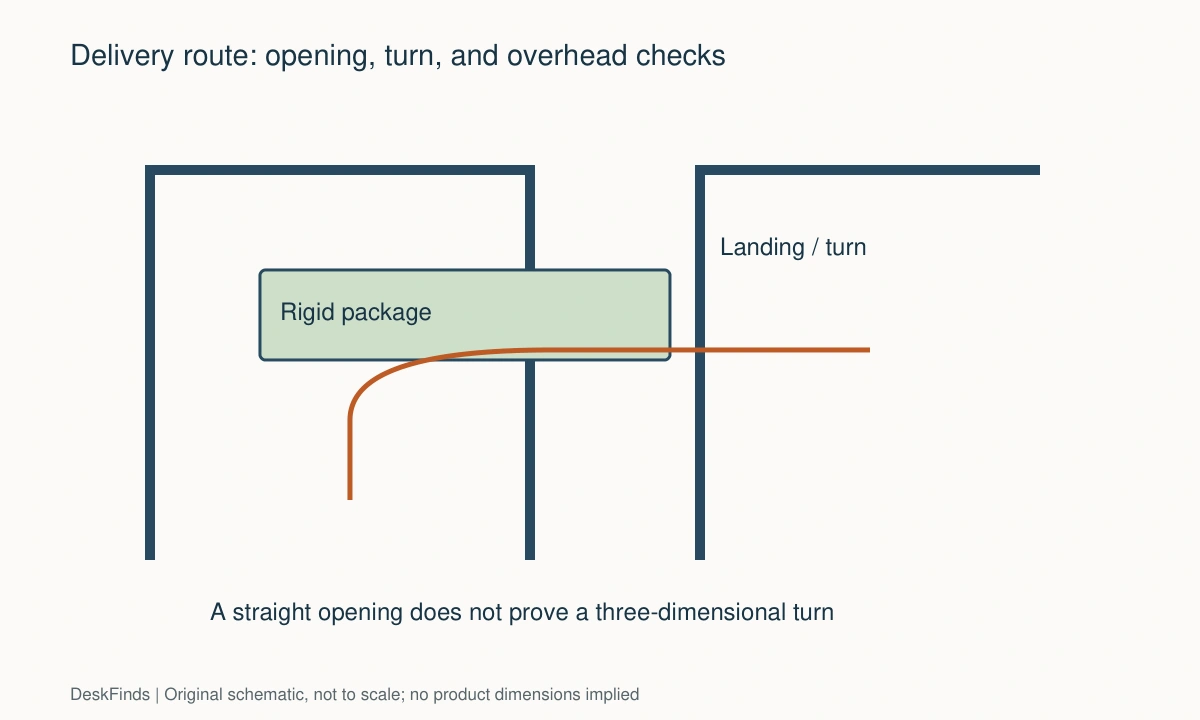
A rectangle’s diagonal describes a distance between its corners. It does not prove that a three-dimensional box can rotate inside a corridor. The box has thickness, and the people moving it need gripping and body space.
Likewise, tipping a long carton upright requires overhead clearance throughout the motion. Its final upright height alone does not describe the arc it passes through. If the route depends on a complex tilt, send the carrier a measured sketch rather than relying on a simple formula.
Check stairs as a complete route
Measure stair width between real obstructions, including handrails. Look for overhanging ceilings, turns at the top, and the doorway at the final landing. A wide flight can still lead to an impossible turn.
Use the carton weight and carrier’s handling rules to plan assistance. Do not remove safety rails or improvise lifting equipment to rescue an unsuitable purchase. A different package format may be the simpler choice.
Check elevators beyond the cabin size
Record the elevator door opening and cabin interior, then the space outside each door. A carton that fits diagonally inside may still be impossible to enter through the opening. Confirm building restrictions and maximum permitted loads with management.
If the desk travels with a trolley, include that trolley in the access plan. Ask the delivery service what equipment it expects to use. Do not design a route that depends on a different handling method without agreement.
Decide whether unpacking helps
Unpacking can reduce bulk, but only if the seller and carrier permit it and the contents can be protected and handled appropriately. An unpacked desktop may still be the same controlling length as the carton.
Ask where packaging will be removed and who keeps it. You may need the original protection for a return. Confirm whether damage found after unpacking must be documented before moving the components farther into the building.
Plan the assembly area
Once the cartons arrive, you still need space to open them, identify parts, and turn the assembled desk upright. Read the assembly instructions for required helpers and sequence. Protect the floor and avoid blocking the room’s exit with packaging.
Assembling inside the final room often avoids moving a complete desk through a small door, but the sequence must remain consistent with the manufacturer’s instructions. Do not omit a brace because it becomes difficult to attach near a wall.
Use an access record
| Route stage | Record |
|---|---|
| Delivery point | Service level and where responsibility transfers |
| Building entrance | Clear width, height, threshold, and approach |
| Corridor turn | Both passage widths and free turning space |
| Stairs | Flight width, landing dimensions, and overhead obstructions |
| Elevator | Door opening, cabin dimensions, and booking rules |
| Room | Door opening and clear assembly area |
For a hypothetical 70-inch carton and a low stair landing, neither a 72-inch door height nor a roomy office proves passage. The unresolved question is the movement between those spaces. Ask for an access assessment or choose a desk with shorter packaged components.
What to do when one stage is uncertain
Contact the seller with package identifiers and route measurements. Ask whether its delivery team can assess the route, whether another configuration arrives in smaller packages, or whether a disassemblable model is available.
Choose furniture after resolving the controlling bottleneck. Our desk-size guide addresses the final workspace; this delivery worksheet addresses getting there. Both need to pass before the purchase is practical.
Three delivery situations that need different checks
Flat-pack desk in several cartons
List the cartons separately. The longest package may contain the desktop, while the heaviest contains storage or frame components. Each can create a different handling problem. Check both rather than treating one largest number as a complete summary.
Confirm whether the carrier delivers all packages together and how missing or damaged cartons are documented. Keep the package identifiers with your order record. An incomplete desk may occupy the assembly room for several days, so leave the room usable while waiting for a replacement part.
Assembled desk with a rigid pedestal
A desk delivered assembled has a different access problem from an equivalent flat-pack model. Ask which parts the manufacturer permits removing and whether the delivery team performs that work. Drawer removal alone may reduce weight but not the controlling outside dimensions.
Do not assume the desktop can be detached because visible screws exist. Some joints are not intended for repeated disassembly, and the carrier may not be authorized to modify the item. Resolve this before the delivery date rather than at the foot of the stairs.
Apartment with an elevator and final stair flight
The route can include an elevator large enough for the carton and a final narrow stair flight that is not. Measure every stage in order. Check the turning space outside the elevator and the door at the top of the stairs, where the package may need to change orientation again.
Book required building access and send the carrier the route information. A permitted route and a physically possible route are separate requirements. Neither one guarantees the service includes carrying the item to the final room.
For a later move, review moving a desk setup.
Make a useful message to the retailer
Include the exact product configuration, package count, dimensions you were given, and a short ordered route description. Attach a sketch showing the tight turn rather than several unlabeled photographs. Ask whether the booked delivery service can assess that route and what happens if access is judged unsuitable.
Get the relevant answer before ordering if the route is marginal. A customer-service statement about standard delivery is not necessarily an access assessment for your stairwell. Keep the distinction clear so you can compare another desk or another delivery option without assumptions.
If the carrier declines a route, do not pressure the crew to attempt an unsafe maneuver. Ask about an approved alternative or return procedure. Furniture replacement is usually simpler than dealing with a trapped carton, property damage, or an obstructed escape route.
Prepare the room for the package, not just the finished desk
Clear a place to lay out parts and inspect surfaces in good light. Keep protective packaging until the desk is assembled and checked according to the retailer’s process. Avoid opening all cartons in a hallway that other occupants need to use.
Read the instructions before delivery when possible. Required tools, helpers, and assembly floor area may change whether the plan is practical. A desk arriving in manageable cartons still needs a feasible path from those cartons to a correctly assembled workstation.
Keep the access decision separate from the lifting decision
A package can fit geometrically and still require a handling method beyond what you or the delivery service can provide. Use the stated package weight, grip limitations, stairs, and service terms to decide who moves it. Do not interpret a successful cardboard mock-up as proof that moving the real item is straightforward.
Prepare the route by removing loose obstacles that you are permitted to move. Keep exits and shared corridors available. Confirm whether building staff must protect elevator surfaces or unlock service access. These practical arrangements should be made before the carrier arrives rather than improvised while a large carton waits outside.
If you plan to collect the desk yourself, check the vehicle opening and cargo area as another stage. Include the permitted transport orientation and a suitable restraint method. A long top may fit the vehicle’s interior diagonally yet not pass through the loading opening. Transport protection and safe loading remain separate requirements from room delivery.
For a move in the future, retain the assembly instructions and identify which components can be separated. A desk assembled inside a room may need to be dismantled to leave it. Keep hardware organized if disassembly is approved, and avoid treating repeated removal from composite panels as consequence-free.
Your final access record should end with a clear status for every stage: confirmed, fails, or unresolved. Do not turn unresolved into confirmed because the desk is on sale. Compare another package format or ask for a professional assessment. Solving the bottleneck before purchase is the practical value of the measurements, not producing a complicated calculation after delivery has already failed.
For a tight final recess, check uneven-alcove fit.
Worked example: a flat carton and a difficult landing
Imagine a desk that arrives in a long desktop carton and two smaller frame cartons. The final office has ample space, and the apartment door is wider than the desktop carton’s thickness. The buyer initially assumes the delivery is straightforward.
The route sketch identifies a narrow turn at the top of the stairs. The desktop carton can move along the flight, but aligning it with the room door requires a rotation beneath a low ceiling. Measuring the apartment doorway alone does not answer whether that movement is possible.
The buyer sends the retailer the carton dimensions, stair width, landing measurements, overhead obstruction, and an ordered description of the route. The question is whether the booked delivery team can assess and handle that complete route, not whether the desk generally arrives flat packed. The answer may depend on service level and local carrier policy.
Unpacking is considered. Removing cardboard would reduce some bulk but leave a rigid desktop of nearly the same controlling length. The buyer asks whether unpacking is permitted, who would protect and move the top, and what packaging must remain for a return. No assumption is made that the crew can or will alter the handling plan on arrival.
A second desk has a different top construction and shorter packaged components. It still needs enough assembly area in the office, but its documented package dimensions make the route easier to assess. The buyer compares its finished work surface and assembly requirements with the first desk rather than treating smaller cartons as the only criterion.
The final decision balances access, working fit, and service terms. If the first route remains unresolved, the buyer chooses another format or an appropriate professional assessment before purchase. A long carton passing one straight doorway is not proof of a successful delivery. The useful outcome of the access worksheet is discovering the controlling turn while there is still time to choose, rather than asking the delivery crew to attempt an uncertain maneuver with the actual furniture.
If portability matters, compare folding desks for daily work.
Your eight-point comparison worksheet
Use these checkpoints to compare the actual room, furniture, or device with a candidate product. Keep each result separate; a favorable overall impression cannot resolve a failed required function. Blank record fields are deliberate so you can use your own measurements rather than copying hypothetical examples.
1. Package list
Obtain dimensions and weight for every carton in the exact size, finish, and storage configuration ordered.
If information is missing, ask the retailer before assuming that a similar desk’s packaging or the desktop dimensions apply.
2. Entrance opening
Measure between actual obstructions with the door in its usable open position, including handles and any threshold.
Use clear opening dimensions in the route record and do not infer passage from the nominal size printed on a door specification.
3. Approach space
Measure the area before and after each doorway where a long package must align, tilt, or turn.
A package that clears the opening straight can still fail the approach; keep these as separate checks in the sketch.
4. Stair transition
Record the landing’s usable length and width, handrail position, overhead ceiling, and the next doorway.
Send the complete geometry for a difficult turn to the carrier rather than relying on a single diagonal calculation.
5. Elevator access
Include door width and height, cabin dimensions, permitted loading, trolley space, and the approach outside each floor.
Check building booking rules and carrier handling equipment so the physical plan matches the service that will actually arrive.
6. Unpacking decision
Ask whether unpacking before the final room is permitted, who performs it, and how the parts and packaging are protected.
Use unpacking only as an agreed handling method; it does not shorten a rigid desktop or remove the need for safe lifting.
7. Assembly location
Identify a clear area for opening cartons, laying out parts, using tools, and turning the desk as its instructions require.
Confirm that assembly inside the room is feasible when an assembled desk would not pass the doorway; do not improvise by omitting supports.
8. Failed-access plan
Read the delivery and return terms and ask how an access problem is handled for your booked service and location.
Resolve marginal access before ordering where possible, and choose smaller packaged components if the critical stage cannot be confirmed.
Sources and scope
- IKEA US: in-home delivery guidance - Reference for checking package access; delivery terms must be confirmed for the actual retailer, region, and service.
Editorial note: This is a research-based planning guide, not a hands-on product test or a certification of a custom installation. Dimensions described as hypothetical are examples. Follow the exact product instructions and confirm unresolved compatibility before buying.