
How to Choose a Folding Desk for Everyday Work
Affiliate Disclosure: We may earn a small commission on qualifying Amazon purchases at no extra cost to you. Full disclosure →
A folding desk is useful only if both its open and stored arrangements work. Some models save substantial floor area but require removing every device and handling a heavy panel each evening. Others fold easily but provide limited room for knees or stable equipment placement.
Quick answer: Compare the working surface, leg clearance, deployed supports, locking mechanism, folded dimensions, and handling weight. Read the instructions for setup and storage, and check whether the maker permits the accessories you want to attach. For daily work, judge the entire open-work-clear-fold-store cycle rather than the folded thickness alone.
Choose the type of folding furniture
A freestanding folding desk, a wall-mounted drop-leaf desk, and a portable trestle-style table have different support and installation needs. Start by deciding whether you can attach furniture to the wall and where the folded unit will live.
A wall-mounted design does not become suitable merely because it is compact. Wall construction, fixing selection, and installation instructions matter. A freestanding unit avoids that installation but still needs a stable floor and correctly deployed supports.
Measure the open footprint
Record desktop width and depth, then inspect feet and braces that may extend beyond it. The working footprint includes the chair and room to get in and out. A folding desk can still be too deep for the bedroom while open.
Place a full-size paper outline on the floor and use a chair in the intended position. For the desktop, arrange your actual keyboard, screen base, mouse, and notebook on a comparable surface. The goal is to fit the tasks, not just the laptop.
Look underneath
Crossed supports can occupy leg space that looks clear in a front-facing photo. Find the lowest brace, distance between supports, and location of hinges. Check both upright sitting and ordinary changes of leg position.
A front apron or mechanism below the surface may prevent a chair from parking. Do not assume a slim desktop means generous clearance. If measurements are missing, ask the maker before ordering.
Understand the locking sequence
Read how the desk is fully deployed and secured. Identify what prevents accidental folding and how the locks are released. Choose a mechanism you can operate without placing fingers in the hinge path.
A desk that requires two people or careful inversion may be reasonable for occasional use but inconvenient every day. Do not simplify the sequence by leaving a lock partly engaged. If the correct process is too demanding, choose a different model.
Evaluate stability without inventing a load test
Look for the manufacturer’s intended use, load rating, and restrictions. An evenly distributed load claim does not automatically approve a monitor arm at one edge. Typing, leaning, and adjusting a screen create different forces from static books spread over the top.
After assembly, inspect whether all feet contact the floor and the mechanism is properly locked. Follow the troubleshooting instructions if there is movement. Do not try to prove strength by standing on the desktop or hanging extra weight from it.
Decide what must come off before folding
A lamp, monitor, mounted power strip, or cable tray may obstruct the folding motion. The instructions should determine what can stay attached. Include the time and storage space for removed equipment.
A desktop computer setup with several cables may make a fixed compact desk more practical. A laptop, external keyboard, and portable caddy are usually simpler to move, but still need protected storage. Your daily routine is the deciding factor.
Measure the stored unit honestly
Folded thickness is only one dimension. The desk may remain full-width, have projecting feet, or need to stand at a particular angle. Include handles, locks, and any storage restraints the maker specifies.
Check the route to the storage location. A unit that fits behind a door may block that door or fall if stored unsupported. Do not lean a heavy folded desk where children or pets can pull it over. Use the specified storage method.
Compare handling weight and grip
The carton weight is not the same as the assembled desk’s handling weight. Find the latter if the desk moves daily. Also inspect how you would grip it and whether the folded parts stay secured during carrying.
If you must carry it up stairs, reassess whether a daily folding routine is realistic. A smaller fixed workstation may create less effort than moving a large folding desk twice a day.
Account for finish and floor protection
Frequent setup can drag feet across a floor if the desk is awkward to lift. Follow the maker’s handling instructions and use compatible floor protection. Do not attach slippery pads that make the deployed desk unstable.
For the top, check cleaning and moisture instructions. A desk used near a dining area needs an easy reset, but it should not be treated as outdoor furniture unless it is designed for that use.
For a table that also hosts meals, see dining-table workstation resets.
Make a useful shortlist
| Requirement | Evidence to obtain |
|---|---|
| Laptop and writing | Clear task area with both arranged |
| Daily folding | Instructions, handling weight, and grip |
| Chair parking | Lowest mechanism and inside leg opening |
| Monitor support | Intended loading and mount permission |
| Storage | Complete folded dimensions and restraint method |
Choose the desk you can set up correctly and store reliably every day. A slightly larger folded package may be worth accepting if it gives better working clearance and a simpler mechanism. Folding is a feature of the routine, not a substitute for a suitable workspace.
Compare three daily-folding routines
Laptop desk folded every evening
The easiest version usually has a small equipment set and a nearby storage destination. Lay out the cleared items before folding the desk, then follow the specified mechanism sequence. Make sure the folded desk can be held or restrained as the maker requires.
If a chair also needs storage, include it in the same room plan. Saving the desk’s floor area is less useful when the chair remains in the walkway. Check the combined stored arrangement rather than treating furniture pieces independently.
Folding desk kept open most of the week
Here the open working quality deserves more weight. Leg room, surface depth, finish durability, and normal stability may matter more than the smallest folded package. You can accept a more deliberate folding process if it is only occasional and still manageable.
Do not leave the desk partly deployed between uses. A proper stored state and a proper working state should be clear. When the furniture changes state, use the complete sequence instead of assuming a half-open position is a safe compromise.
Wall-mounted drop-leaf surface
The wall support and locking brackets are part of the purchase. Confirm wall construction and the installation requirements before ordering. The floor saved by removing desk legs does not eliminate the need for chair space or suitable support.
Check where cables, hinges, and the folded panel sit. The panel may project from the wall when closed, and a shelf may remain above it. Include these shapes when checking doors and nearby furniture. A neat folded photograph does not describe every installation condition.
A realistic pre-purchase simulation
Use a paper desktop outline and place the actual equipment on a comparable surface. Then move everything to its intended storage location. Notice whether the monitor, lamp, and keyboard need multiple trips or leave cables hanging where the folding legs would pass.
Estimate effort from that real sequence, not from the desk alone. A lightweight folding frame can still create a laborious reset when the equipment is heavy. If the routine is too demanding, a smaller fixed desk may be the more useful space-saving choice.
Judge storage as carefully as stability
Check the folded unit’s instructions for orientation, support, and retention. A narrow gap behind a door may be unsuitable if the door strikes the furniture or if the unit can tip. The fact that a folded desk is thin does not make every vertical storage position appropriate.
Keep the mechanism accessible for inspection and cleaning. Dust, loose hardware, or damaged locks should be addressed according to the maker’s guidance before use. Do not defeat a locking part because it makes the daily setup slower. A desk that cannot be used correctly within your routine is the wrong model for that routine.
Compare frequency before folded size
Write down how often the desk changes state. Daily folding places a premium on handling, locking, and equipment storage. Occasional folding places more weight on the open working position. The same product can be a sensible choice for one pattern and frustrating for the other.
Time a mock reset with your existing equipment. Include the chair if it also moves. The goal is to identify effort, not establish an unrealistic speed target. If removing the monitor is the difficult part, reducing the desk’s folded thickness will not solve it. A laptop-based kit or fixed compact desk may be the more meaningful change.
Look for instructions showing the exact mechanism. Promotional videos can omit steps or show an empty desk handled by someone with more space than you have. The written setup and storage requirements should determine whether you can reproduce the routine correctly in your room.
If a wall-mounted model is under consideration, include installation cost and permissions in the comparison. A freestanding folding desk and a wall-supported panel are different projects. Do not compare only product prices while leaving fixings, wall preparation, or professional installation out of one option.
Keep a place to inspect the mechanism before use. Daily folding exposes moving parts to repeated handling, so follow the maker’s care and inspection instructions. A loose or damaged lock should be addressed rather than compensated for by leaning the desk against furniture. The best folding desk is one whose correct use fits your ordinary day, including the evening when you are tired and the room is already occupied.
If the folded desk will share storage with cleaning tools, exercise equipment, or luggage, test access to those objects too. A perfect storage gap is less useful if the desk must be lifted out whenever another daily item is needed. Give the folded unit a clear destination consistent with its instructions and leave its restraint or support accessible. The surrounding cupboard or room should still work when the desk is stored, rather than becoming a second space that needs rearranging every evening.
For an installed alternative, review wall-mounted fold-down desks.
Worked example: a thin folded desk with a difficult routine
Imagine a buyer choosing between two folding desks for a small apartment. Desk A has the slimmer folded profile, while Desk B is slightly bulkier but uses a setup sequence the buyer can perform more easily. Both provide enough surface for a laptop and notebook when opened.
The buyer first checks the actual storage gap. Desk A fits the thickness, but a projecting lock and foot make it awkward to position as instructed. The door beside the gap also needs to open fully. Desk B requires another storage location, so folded dimensions alone do not produce a clear winner.
A daily reset trial reveals a larger issue. The intended equipment includes a fixed monitor and a heavy lamp that must be removed before folding. Their storage requires several trips. Reducing the desk’s folded thickness would not change this effort. The buyer compares a simpler laptop-based arrangement and a compact fixed desk before committing.
For the laptop-based arrangement, the folding desk’s underside becomes important. Desk A has a brace near the user’s knees and does not permit the chair to tuck in fully. Desk B has a more usable bay. The buyer tests the chair and ordinary leg movement with the actual footprint rather than using desktop width as a proxy.
The load and accessory instructions are checked next. A monitor-arm plan is dropped because the intended concentrated edge loading is not supported. No attempt is made to infer approval from the desk’s distributed capacity figure. The equipment list is revised to match the documented working arrangement.
The final choice depends on whether folding remains a daily need after the full room plan is considered. If the fixed compact desk preserves the room’s essential route, it may be the simpler purchase. If folding is necessary, the buyer chooses the model whose complete open, clear, fold, and secure-storage sequence works correctly. A folded desk is useful only when the furniture and the removed equipment both have practical destinations.
Before choosing a screen support, compare monitor arms and stands.
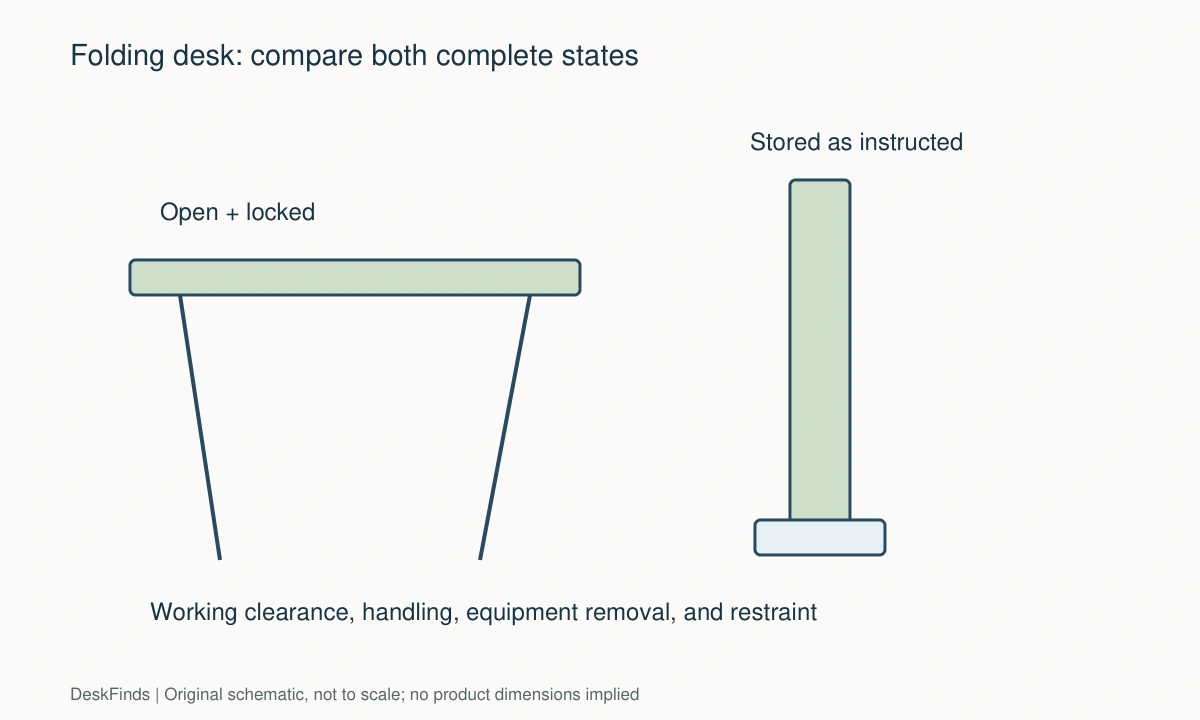
Your eight-point comparison worksheet
Use these checkpoints to compare the actual room, furniture, or device with a candidate product. Keep each result separate; a favorable overall impression cannot resolve a failed required function. Blank record fields are deliberate so you can use your own measurements rather than copying hypothetical examples.
1. Working footprint
Measure desktop and projecting supports, then add the occupied chair and the route used to enter and leave.
A compact folded size does not compensate for an open layout that blocks the room during ordinary work.
2. Under-top clearance
Locate braces, hinges, rails, and the lowest mechanism at the position your thighs and chair arms need.
Check normal movement and parking, because a slim top can still carry deep hardware below its visible edge.
3. Setup sequence
Read every deployment and locking step, including required helpers and the supported orientation during setup.
Choose a mechanism you can operate correctly each time rather than simplifying the instructions to fit the room.
4. Equipment removal
List which devices and attachments must come off before folding and give each one a protected storage place.
Do not leave a clamp or cable tray attached unless the desk and accessory instructions support the complete folding motion.
5. Published loading
Check the intended loading arrangement and any restrictions on clamped or concentrated equipment at the edge.
A distributed-load figure is not automatic approval for a monitor arm; obtain the relevant permission before adding one.
6. Folded envelope
Include feet, handles, locks, protrusions, and the prescribed storage orientation in the stored dimensions.
Compare the whole unit with the real storage route and destination instead of relying on thickness alone.
7. Handling weight
Find assembled handling weight and inspect available grip positions for carrying or repositioning the folded desk.
If daily movement is unrealistic, choose a simpler or more stationary arrangement rather than relying on awkward repeated lifting.
8. Storage restraint
Follow the maker’s instructions for securing or supporting the folded unit, especially near doors or shared routes.
Keep the room usable in the stored state and avoid leaning heavy furniture where it can be knocked or pulled over.
Sources and scope
- IKEA NORBERG: assembly and installation documents - Example of a wall-supported folding product with its own installation requirements, not approval for arbitrary wall fixings.
Editorial note: This is a research-based planning guide, not a hands-on product test or a certification of a custom installation. Dimensions described as hypothetical are examples. Follow the exact product instructions and confirm unresolved compatibility before buying.