
How to Choose a Book Stand for Thick Textbooks and Easy Page Turning

Affiliate Disclosure: We may earn a small commission on qualifying Amazon purchases at no extra cost to you. Full disclosure →
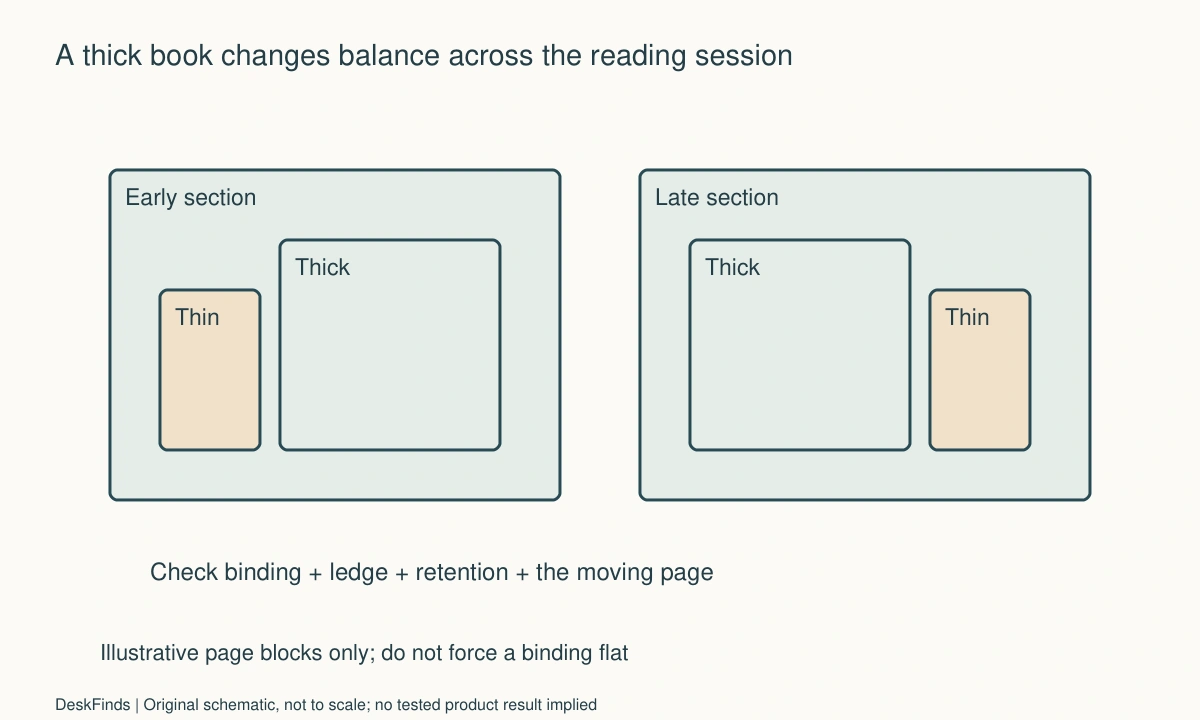
A thick textbook changes shape as you read it. Near the front, most pages sit on one side of the binding; near the back, the balance reverses. A stand that holds the closed book or one middle spread may not support the whole reading session. Check the open volume and page-turning action before choosing a compact stand.
Quick answer: Measure the book open at several ordinary reading positions and compare the stand’s documented size, load, ledge, and retention method. Include the space needed to release and turn pages. Do not force a binding flat or use tight clips on valuable material. A stand should support both the book and the way you read it, with a suitable place for notes and displaced desk items.
Measure an open book, not just its cover
Record closed thickness and the width and height of the open spread. Check near the beginning, middle, and end without stressing the binding. A flexible paperback, heavy hardcover, spiral-bound manual, and large atlas behave differently even when their page counts are similar.
Use the stand maker’s relevant limits, including weight where stated. Page count alone does not describe size or mass. If a product only lists tablet diagonals, that is not enough information for a heavy book. Ask about the actual volume and intended use rather than assuming a universal stand supports any rectangular object.
For loose documents used during typing, compare the in-line document holder guide. That format can be useful for reference sheets but should not be assumed suitable for a thick textbook merely because its backplate is wide.
Check the ledge and contact surfaces
The usable ledge must accommodate the book in its supported reading position. Compare its depth with the actual lower edge, including any protective padding or raised retaining lip. Do not count a decorative outer edge as useful support unless the product instructions identify it that way.
Check where the cover and pages contact the stand. A spine, dust jacket, or soft cover can sit differently from a rigid back. Avoid a fit in which the book is supported only by a loose jacket or a narrow page edge. Use the product as intended and keep the surface free of grit or objects that could mark the book.
An in-line holder such as the 3M DH640 shows one documented approach to supporting reference material and retaining pages. Its design is an example, not a universal recommendation for every book. The compatibility question still concerns the exact volume, contact surfaces, and permitted load.
Evaluate page retention without force
Look at how retainers release and re-engage. A clip that holds a spread firmly can also cover text or require two hands to move. An elastic guide may behave differently from separate page arms. Compare the actual reading action rather than judging retention from a static photograph.
Never force a valuable, fragile, or tightly bound book flat to make it fit. Follow appropriate handling guidance for the material. If the stand’s method requires more pressure than the book should receive, choose another approach. A reading accessory is not a reason to alter or damage the original.
Check the first and last sections as well as the middle. The side carrying more pages changes, and the retainer may need another permitted position. The useful question is whether an ordinary sequence of spreads can be supported, not whether one carefully selected spread stays open for a picture.

Include the page-turning envelope
Reserve room above and beside the book for the hand and moving page. A shelf, monitor, lamp arm, or another stack may block that route even when the final open spread fits. Include the place where a pen or note page sits while both hands are used to release a retainer.
If the stand is near a monitor, check the book’s upper edge against the active screen. If it is beside a keyboard, check whether the open cover enters the mouse area. The mouse pad size guide helps distinguish total mat coverage from the movement region that remains clear.
Do not use a cramped layout that requires sliding the loaded stand toward an edge for every page turn. Compare another supported angle or location. A little more deployed footprint can be worthwhile if it preserves the reading action and avoids repeatedly moving a heavy volume.
Choose an angle for the task
Use only the stand’s supported positions and adjustment method. A steeper angle can reduce projected depth while changing height and contact, whereas a shallower angle can use more surface. Include the loaded book at the intended angle, not just the empty stand’s folded dimensions.
Reading and writing on a book or workbook are different interactions. If annotation is necessary, confirm that the support is intended for it, or move the material to a suitable writing surface. Do not press on a display-only stand because its angle looks convenient.
For handwritten notes on a separate tablet, use the tablet and phone stand comparison. Keep the book and tablet footprints separate. Two supported items can still compete for the same hand space, charging route, or notebook position on a small desk.
Plan light and shadows
Place task lighting so the page is readable without a lamp body or hand blocking the work. Check both sides of the spread and any glossy surface. A higher stand can change where the lamp needs to reach. Use the lamp’s intended positions and keep its operating clearance rather than resting it against the book.
For a screen nearby, compare reflected light and the view of the document together. Do not solve page glare by making the monitor difficult to see or covering a lamp with improvised material. The actual room light, page finish, and stand angle should be assessed as one supported arrangement.
The desk lamp placement guide is relevant when paper and monitor share the desk. A book stand can change the task geometry, so repeat the useful light check after the book is loaded.
Worked example: the middle spread hid a poor fit
Imagine a hypothetical student with a thick course textbook and a small folding stand. The stand appears suitable when the book is opened near the middle, where the two sides have similar thickness. The student almost accepts that single position as the whole compatibility check.
Near the beginning, the larger page block changes how the book rests and how the retainer reaches the thinner side. The student checks the product instructions and the book’s ordinary shape rather than forcing the binding flatter. A different documented retainer arrangement may help, but only if it is intended for that book and stand.
The student also tries a harmless page-turning sequence in the supported position. The clip release takes space beside the volume, and a nearby keyboard blocks one hand route. Moving the keyboard to a defined supported position during reading is compared with choosing another stand location.
The final hypothetical choice depends on the full reading session: several book positions, retention, page turns, and note taking. The example does not claim that a particular stand passed a load test or that every hardcover needs the same design. It shows why a balanced middle spread can conceal the more demanding parts of the task.

A second scenario: reference reading alternated with problem solving
Consider a hypothetical learner using a textbook alongside a workbook. The book needs to remain open for reference, while the workbook must lie on a suitable writing surface. An oversized stand would occupy the center of the desk and leave no practical writing area.
The learner outlines the open textbook, stand base, workbook, and ordinary hand movement. A side-reference position is compared with an in-line position. The chosen angle must remain within the stand’s instructions and keep the book readable without blocking the monitor or lamp controls.
The learner gives completed worksheets and loose notes separate destinations. The stand does not become a shelf for all course materials. If the textbook changes daily, the replacement and storage sequence is included: remove the book appropriately, fold or leave the stand as instructed, and restore the writing area.
A tablet reference copy may be another option when legitimately available and suitable for the task, but it is not assumed to replace every book. The comparison concerns the actual material and workflow. The learner does not buy a smaller stand simply to hide the fact that two large open items cannot occupy the same surface at once.
This hypothetical arrangement can use a stable reference state and a separate problem-solving area. Its benefit is concrete: the book remains supported while the learner writes elsewhere. It is not presented as a measured learning improvement or a medical posture recommendation.
Compare folding size with daily usefulness
A stand stored every evening needs a practical folded shape and a suitable place for its retainers. A stand left deployed mainly needs an appropriate working footprint. Do not pay for extreme foldability if the book remains on the desk, or ignore storage depth when the surface must be cleared daily.
Check the adjustment method with the book removed or supported as the instructions require. Do not tighten a hinge beyond its intended procedure to hold an unsuitable load. If the book cannot remain supported correctly, contact the maker or choose another product rather than adding improvised weights or clips.
Keep the purchasing record specific: book dimensions and relevant weight, supported angle, usable ledge, retention method, and page-turning space. That record is more useful than a generic claim that the stand fits thick books, which can describe many very different volumes.
Six acceptance checks for a textbook stand
The actual volume
Check the intended book at ordinary early, middle, and late reading positions without stressing it. Record open dimensions and relevant load information. Do not substitute a lighter sample merely because it is easier to handle. The product should support the book that motivated the purchase through its documented method, rather than a convenient demonstration object.
Ledge and back support
Inspect the usable contact surfaces with the book loaded as instructed. Include padding, cover shape, and any jacket. If only a loose cover flap or narrow page edge bears on the ledge, resolve that fit before use. A nominal ledge depth is a shortlisting measurement, not proof that every binding rests appropriately.
Retainer operation
Release and re-engage the page holders through the intended action. Check text coverage and the change in page-block thickness as reading progresses. Avoid excessive pressure, improvised clips, or forcing a binding flat. If the retention method is unsuitable for the material, choose another supported approach rather than treating stronger grip as automatically better.
Page movement
Allow room for hands and turning pages above and beside the open spread. Include nearby screens, lamps, and note materials. A stand that holds a book well in a static position can still be inconvenient if every page change requires moving the loaded assembly. Check the actual reading sequence while return options remain available.
Notes and reference
Place the notebook, workbook, or tablet used alongside the book in its supported working position. Check whether each task has enough clear space. If the keyboard moves, define its destination and return route. The book stand should solve reference access without creating an unplanned pile of displaced equipment on the rest of the desk.
End-of-session handling
Remove and store the book appropriately, then fold or reset the stand according to its instructions. Keep small retainers and accessories identifiable. A compact stand is useful when the whole reading setup can be deployed and cleared predictably, with the book’s condition and the room’s other tasks preserved throughout the routine.

Work through an open-book footprint
Imagine a hypothetical textbook whose open spread is 440 mm wide and 285 mm high, while its closed thickness is 48 mm. A stand’s overall width of 400 mm would not, by itself, answer compatibility: some designs support a permitted overhanging spread, while others have different requirements. Only the exact product guidance can establish the supported contact. The figures here describe invented planning objects, not a named stand or a recommended book limit.
Mark the 440 mm spread, the actual stand base, and the hand area needed for a page turn separately. If the available desk region is 500 mm wide, the 60 mm difference is not automatically sufficient hand clearance. The retainer release, neighboring objects, and ordinary page movement still need observation. Arithmetic identifies the margin; it does not approve the task.
Repeat the outline with the book near an early and late section. The outer spread may stay similar while the page-block thickness changes from side to side. That can affect contact and retainer operation without changing the cover dimensions. This is why the middle spread should not be the only fit sample.
Compare retention methods through the reading sequence
A retainer that covers a small part of a blank margin may be acceptable for one book but obstruct a diagram in another. Check representative pages containing the content you actually use. Do not judge the whole volume from a spread whose margins happen to suit the clip.
If a release action needs two hands, include where the pen and note page go during it. If the book tends to close through its normal binding behavior, do not counter it with arbitrary added clips or force. The next shortlist item should offer a documented suitable support method, not simply a more aggressive grip.
A stand used mainly for one long reference chapter can have a different acceptance criterion from a stand used to turn pages continuously. Write the frequency and sequence explicitly. That makes it possible to compare a simple support, another retention design, or a different reference workflow without claiming one style is best for all textbooks.
Keep book care separate from desk neatness
A borrowed, valuable, or fragile volume should not become the test object for uncertain retention. Use appropriate handling guidance and a suitable harmless sample where that can establish a preliminary geometric question. A sample does not certify the actual book, but it can reject an obviously unsuitable footprint before the original is handled.
When asking for help, provide the book’s open dimensions, thickness, relevant weight, and intended page-turning frequency. Ask about contact and retention rather than whether the product fits books generally. A practical purchase record should describe the actual volume and method that were confirmed.
Sources and scope
- 3M DH640 reference-support example - A documented reference-support and retention example; exact book compatibility remains a separate product-specific check.
Editorial note: This is a research-based planning guide, not a hands-on product review. All worked scenarios are hypothetical. Measurements and compatibility must be confirmed for the exact equipment. Photography supplies context, not proof of a tested arrangement.
Photos are illustrative and come from free-license libraries such as Unsplash; diagrams are original to DeskFinds.