
4 Best PoE Injectors in 2026
We compared PoE injectors by real power budget and port speed, since a 15.4W 802.3af unit and a 30W 802.3at unit serve genuinely different device categories.

New to Amazon Prime?
Get fast, free shipping on every pick in this guide, plus Prime Video and exclusive deals.
Try Prime Free


At a Glance
Gigabit POE Injector, 48V 15.4W (TP-Link TL-POE150S compatible)
↓ See why we picked itA PoE injector adds Power over Ethernet capability to a single non-PoE network port, letting you power an IP camera, access point, or VoIP phone through the same cable that carries its data, without running a separate power line to the device.
We compared this lineup on real power budget and port speed, since a 15.4W 802.3af injector suits a basic IP camera or VoIP phone while a 30W 802.3at injector is required for higher-draw devices like pan-tilt-zoom cameras or newer Wi-Fi 6 access points.
5 Criteria to Look For Before Buying a PoE Injector
Key buying criteria so you get the right fit the first time.
The 802.3af vs 802.3at Standard Determines Which Devices an Injector Can Actually Power
The 802.3af standard delivers up to 15.4W at the source (about 12.95W at the device after cable loss), while 802.3at (PoE+) delivers up to 30W, and connecting a device that needs 30W to a 15.4W-only injector simply won't power it correctly or will cause it to behave erratically. This matters significantly for PTZ cameras, newer Wi-Fi 6/6E access points, and some VoIP phones with screens, all of which typically draw more than 15.4W and require an 802.3at-rated injector. Check your device's own spec sheet or power label for its exact wattage draw, then match it against the injector's stated maximum output rather than assuming any PoE injector works with any PoE device.
Gigabit Port Speed Prevents a PoE Injector From Becoming the Slowest Link in Your Network
A PoE injector with only 100Mbps ports will cap the connected device's network speed at 100Mbps even if every other component in your network supports Gigabit speeds, effectively creating a bottleneck at that one point. This matters if you're powering a high-resolution IP camera streaming 4K footage or any device that benefits from faster data transfer, and matters less for a basic VoIP phone or low-resolution camera where 100Mbps is already more than sufficient. Check the injector's listed port speed specifically, since some budget listings only state PoE compliance without clearly stating whether the ports are Gigabit or Fast Ethernet.
A PoE Injector's Stated Electrical Protections Reduce Real Risk of Damage to Connected Equipment
Features like over current protection, over load protection, and over voltage protection are circuit-level safeguards that prevent a power fluctuation or wiring fault from damaging the connected camera, phone, or access point, and their absence from a listing doesn't necessarily mean they're missing, but a listing that explicitly names them gives you more confidence than one that doesn't mention safety features at all. This matters more in environments with less stable power, like older buildings or outdoor installations, and matters less in a controlled office environment with clean, stable power. Look for a listing that explicitly names its electrical protections in the bullet points rather than assuming all injectors include the same safeguards.
UL Certification Signals Independent Safety Verification, Not Just a Manufacturer's Own Claim
UL certification means an independent testing organization has verified the product meets defined electrical safety standards, which is a meaningfully different level of assurance than a manufacturer simply stating their product is safe in the listing copy. This matters more for a permanent installation in a wall or ceiling where fire safety is a real consideration, and matters less for a temporary desktop setup where you're more focused on data throughput than long-term electrical safety certification. Check the listing title and bullet points for an explicit UL, ETL, or similar certification mark rather than assuming generic PoE compliance implies third-party safety testing.
An Included Ethernet Cable Saves a Second Purchase but Isn't Universal Across Listings
Some PoE injector listings bundle a short Ethernet cable, typically 3 feet, meant to connect the injector to your switch or router, while others expect you to already have a compatible cable on hand, and assuming a cable is included when it isn't means your installation stalls until you source one separately. This matters more for a first-time buyer setting up a single device who wants everything in one box, and matters less for anyone who already has spare Ethernet cables around from previous networking work. Check the listing's bullet points and included-items section specifically for the word cable before assuming one comes in the box.
4 Best PoE Injectors in 2026
Omada PoE+ Injector, Up to 30W, Gigabit (POE160S)
About this pick
This injector's listing specifically states auto-detect technology that delivers up to 30W to 802.3at PoE+ devices while remaining backward compatible with 15.4W 802.3af devices, letting one unit serve both device categories without manual configuration. Its Gigabit input and output ports avoid the throughput bottleneck that a 100Mbps-only injector would introduce on a modern network.
Compared to the budget picks below, this one's UL certification and auto-sensing power delivery justify its position at the top of this comparison, since it removes the guesswork of matching wattage to a specific device.
Best for buyers who want one injector that reliably serves both older 802.3af devices and newer 802.3at devices without manual switches.
Best for: buyers who want one injector that reliably serves both older and newer PoE devices
Check price on AmazonPros
- +Auto-detect technology serves both 15.4W and 30W devices
- +UL certification adds a real safety verification
- +Gigabit ports avoid a throughput bottleneck
Cons
- −Higher price than the basic 15.4W picks below
- −No included Ethernet cable
ULTRAPOE Gigabit PoE+ Injector, 30W 48V
About this pick
This injector's listing specifically states a flame retardant plastic housing alongside auto-sensing technology that delivers up to 30W and 1Gb data over a single Ethernet cable, with backward compatibility for 15.4W 802.3af devices. Its stated compatibility list names CCTV cameras, IP phones, wireless APs, and 802.11n/ac/ax routers specifically.
Compared to the Omada pick above, this one matches the same 30W power budget and Gigabit speed at an identical price, differing mainly in its explicit flame retardant housing claim and named device compatibility list rather than a UL certification.
Best for buyers who want the same 30W Gigabit performance as the top pick with a broader named compatibility list.
Best for: buyers who want 30W Gigabit performance with a broad named device compatibility list
Check price on AmazonPros
- +Same 30W power budget as the top pick
- +Flame retardant housing adds a stated safety feature
- +Explicitly compatible with 802.11ac/ax routers and access points
Cons
- −No UL certification stated unlike the top pick
- −No included Ethernet cable
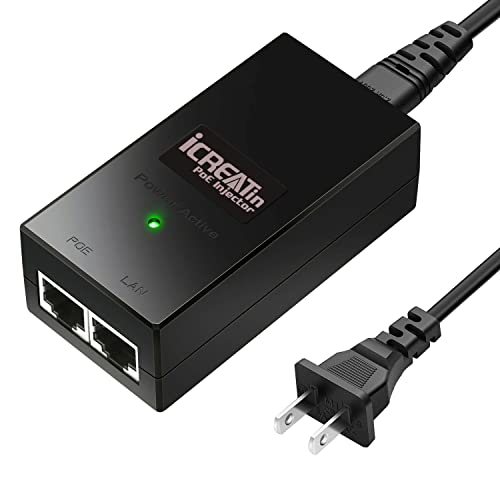
Gigabit POE Injector, 48V 15.4W (TP-Link TL-POE150S compatible)
About this pick
This injector's listing specifically states a 15.4W 802.3af power budget with multiple protections including over current, over load, over voltage, and anti-interference protection, a more detailed safety feature list than the basic budget pick below. Its Gigabit input and output ports specifically state up to 2Gbps full duplex Ethernet speed.
Compared to the two 30W picks above, this one's lower 15.4W budget suits standard IP cameras and VoIP phones that don't draw PoE+ power, at a lower price than either 30W option.
Best for buyers with standard IP cameras or VoIP phones that don't need PoE+ power levels.
Best for: buyers with standard IP cameras or VoIP phones that don't need PoE+ power
Check price on AmazonPros
- +Multiple stated electrical protections beyond basic PoE compliance
- +Gigabit speed at a lower price than the 30W picks
- +Named compatibility with TP-Link TL-POE150S and TRENDnet TPE-113GI
Cons
- −Fixed 15.4W budget, not enough for PoE+ devices
- −No included Ethernet cable
Gigabit PoE Injector 48V with 3ft Cat 6 Cable
About this pick
This injector's listing specifically states an included 3ft Cat 6 Gigabit Ethernet cable, the only pick in this comparison bundling a cable rather than requiring you to supply your own. Its compact, lightweight form factor is specifically called out as suited to tight spaces or network closets.
Compared to the picks above, this one's lowest price in the comparison and included cable make it a reasonable starting point for a single basic device, though its listing states fewer explicit electrical protections than the TL-POE150S-compatible pick.
Best for buyers who want the lowest price and don't want to source a separate Ethernet cable.
Best for: buyers who want the lowest price and a bundled cable for a single basic device
Check price on AmazonPros
- +Lowest price in this comparison
- +Includes a Cat 6 cable so nothing extra to buy
- +Compact size fits tight network closets
Cons
- −Listing states fewer explicit electrical protections than other picks
- −Power budget not clearly specified beyond 802.3at/af compliance
How We Evaluated These PoE Injectors
Each pick was assessed across 5 criteria weighted for real-world use.
Power Budget Accuracy
Compared each listing's stated wattage against the 802.3af (15.4W) and 802.3at (30W) standards it claims to meet.
Port Speed
Compared Gigabit versus 100Mbps port speeds and their effect on real network throughput.
Electrical Safety Features
Compared stated protections like over current, over load, and over voltage protection.
Device Compatibility
Compared named compatibility lists against common IP camera, VoIP phone, and access point brands.
Included Accessories
Compared whether a listing bundles an Ethernet cable or requires a separate purchase.
How to Choose the Right PoE Injectors
By Power Requirement
| Your device needs | Recommended pick |
|---|---|
| 802.3af 15.4W (basic camera, VoIP phone) | Gigabit POE Injector 48V 15.4W |
| 802.3at 30W (PTZ camera, Wi-Fi 6 AP) | Omada PoE+ Injector 30W |
| Either, without knowing the exact spec | ULTRAPOE Gigabit PoE+ Injector 30W |
| A single basic device on a tight budget | Gigabit PoE Injector 48V with 3ft Cable |
By Budget
| Price range | Recommended pick |
|---|---|
| Under $9 | Gigabit PoE Injector 48V with 3ft Cable ($8.97) |
| Under $14 | Gigabit POE Injector 48V 15.4W ($13.99) |
| Under $20 | Omada PoE+ Injector 30W or ULTRAPOE 30W (both $19.99) |
802.3af 15.4W vs 802.3at 30W
802.3af (15.4W)
Suits standard IP cameras, VoIP phones, and basic access points that don't draw heavy power, at a lower unit cost, as offered by the TL-POE150S-compatible pick.
802.3at (30W)
Required for PTZ cameras, Wi-Fi 6/6E access points, and other higher-draw devices, as offered by the Omada and ULTRAPOE picks.
Most buyers with a modern Wi-Fi access point or PTZ camera should default to a 30W 802.3at injector unless their device's spec sheet explicitly confirms 15.4W is sufficient.
By Certification and Safety Features
| What you want confirmed | Recommended pick |
|---|---|
| UL certification specifically stated | Omada PoE+ Injector 30W |
| Flame retardant housing specifically stated | ULTRAPOE Gigabit PoE+ Injector 30W |
| Multiple named electrical protections | Gigabit POE Injector 48V 15.4W |
For a First IP Camera Installation Specifically
Look for
A stated power budget matching your camera's exact wattage requirement from its own spec sheet, plus a bundled Ethernet cable if you don't already have one on hand.
In this comparison
The budget pick with the included 3ft Cat 6 cable removes one shopping step for a first-time single-camera installation.
When to Spend More
Spend more if
Your device draws 802.3at power or you want a UL-certified unit, where the Omada pick's $19.99 price buys documented safety certification and a wider power range.
Save if
You have one standard 15.4W device and just need reliable power and data delivery, where the $8.97 budget pick with its included cable covers that need.
Frequently Asked Questions
What's the difference between a PoE injector and a PoE switch?
A PoE injector adds power to a single existing non-PoE network port, while a PoE switch has multiple built-in PoE ports and replaces your existing switch entirely, so an injector is the simpler and cheaper choice for powering just one or two devices.
Can I use a 30W 802.3at injector with a device that only needs 15.4W?
Yes, higher-power 802.3at injectors are backward compatible with 802.3af devices and will typically auto-detect the lower power requirement, so a 30W injector safely powers a 15.4W device.
Is it worth paying extra for a UL-certified PoE injector?
For a permanent installation, especially indoors or near flammable materials, UL certification provides independent safety verification that's worth the modest price difference over an uncertified budget option.
How do I know if my IP camera needs 802.3af or 802.3at power?
Check your camera's own product specification sheet or power label for its exact wattage draw; PTZ cameras and cameras with heaters or IR illuminators typically need 802.3at's 30W, while fixed basic cameras usually work fine on 802.3af's 15.4W.
What's the maximum distance a PoE injector can power a device?
Standard PoE injectors are rated for up to 100 meters (328 feet) over standard Ethernet cable, consistent with the Ethernet standard's own distance limit, beyond which you'd need a repeater or extender rather than a longer run.
Does a PoE injector need Gigabit ports for a basic security camera?
A basic single security camera typically works fine with 100Mbps, but Gigabit ports future-proof the injector for higher-resolution cameras or additional bandwidth-hungry devices you might add later.
Bottom Line
best overall: Omada PoE+ Injector, Up to 30W, Gigabit (POE160S) - best overall pick in this roundup.
See the full rankings above for all picks with pros, cons, and best-for summaries.
Browse on Amazon
All Prime-eligible options with current pricing.
Shop on Amazon →