
4 Best 10GbE PoE Injectors in 2026
We compared 10GbE PoE injectors by real named device compatibility, since one targets eero and UniFi hardware while another names Cudy's own high-power APs.

New to Amazon Prime?
Get fast, free shipping on every pick in this guide, plus Prime Video and exclusive deals.
Try Prime Free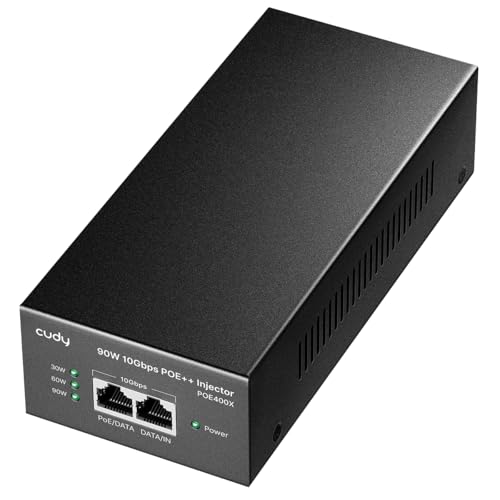


At a Glance
A true 10GbE PoE injector breaks past the traditional 1Gbps bottleneck for the newest Wi-Fi 6E and Wi-Fi 7 access points, high-resolution multi-camera surveillance systems, and other genuinely bandwidth-hungry PoE devices that a Gigabit or even 2.5G injector would throttle.
We compared this lineup on real named device compatibility and power delivery, since one listing specifically names eero PoE 7, UniFi U6-Enterprise, and U7 Pro Max/XG compatibility while another targets Cudy's own AP11000 and AP6500 access points.
5 Criteria to Look For Before Buying a 10GbE PoE Injector
Key buying criteria so you get the right fit the first time.
A '10GbE' Label Should Be Confirmed as True 10Gbps Speed, Not a Rebranded 2.5G or 5G Unit
All four picks in this comparison explicitly state true 10Gbps speed capability, but the broader market includes units marketed loosely with '10G' language that actually cap at lower speeds internally, meaning the specific stated speed range in a listing's technical specifications matters more than the product title alone. This matters significantly if you're specifically buying to support a genuinely bandwidth-hungry application like aggregated 4K camera feeds or a high-density Wi-Fi 7 deployment, since a mislabeled unit would fail to deliver the throughput you're paying for. Check the listing's technical specification section for an explicit 10Gbps mention alongside the full speed range (10/100/1000M/2.5G/5G/10G), not just a product title using '10GbE' language.
Named Compatibility With Specific Access Point Brands Like eero, UniFi, or Cudy Removes Real Negotiation Uncertainty
A listing that specifically names compatible access point models, like eero PoE 7 or UniFi U6-Enterprise, suggests the manufacturer has validated real-world PoE negotiation with that specific hardware, which matters more at the 10GbE tier where the connected equipment tends to be expensive and mission-critical. This matters significantly if you're deploying a specific brand's high-end access point and want documented confidence rather than relying on generic 802.3bt compliance claims, and matters less if you're comfortable troubleshooting a generic compliant unit. Check for named brand compatibility specifically when the connected device represents a significant investment you don't want to risk on an unverified pairing.
60W and 90W Power Tiers at the 10Gbps Speed Level Match Genuinely Different Device Categories
Even among true 10Gbps injectors, the actual power delivery tier varies between 60W and 90W in this comparison, and a device with a heater element or the most demanding enterprise features can specifically require the higher 90W ceiling while most standard Wi-Fi 6E/7 access points and PTZ cameras operate comfortably within 60W. This matters for correctly matching power tier to your specific device without either underpowering it or overpaying for unused capacity. Check your specific device's documented power class rather than assuming the highest-priced, highest-wattage 10Gbps injector is automatically the correct choice.
Dual AC/DC Input With Redundant Power Support Matters Specifically for Mission-Critical Industrial Deployments
A standard indoor 10Gbps injector accepts only AC power from a single source, while an industrial DIN-rail unit with dual AC/DC input and redundant power capability can continue operating if one power source fails, a genuinely different reliability tier appropriate for infrastructure where downtime has a real cost. This matters significantly for a critical installation like a security operations center or industrial control system, and matters not at all for a standard office or home network where a brief power interruption isn't consequential. Consider redundant power input specifically for deployments where continuous uptime is a genuine operational requirement.
UL Certification and Documented Surge Protection Ratings Matter More at the 10Gbps Tier Given the Cost of Connected Equipment
A 10Gbps-capable access point or camera system represents a significant equipment investment, making the electrical safety and protection quality of the injector powering it a more consequential decision than at a lower-cost PoE tier, and a listing with UL certification or specific stated surge protection numbers (like 4kV or 6kV) gives you concrete, checkable assurance rather than a vague safety claim. This matters more for a permanent installation protecting expensive connected equipment, and matters less for a short-term test setup. Compare specific certification marks and stated protection numbers between listings when the cost of your connected 10Gbps equipment justifies the extra scrutiny.
4 Best 10GbE PoE Injectors in 2026
Cudy 90W 10 Gbps PoE++ Injector (POE400X)
About this pick
This injector's listing specifically states 4kV surge and 6kV ESD protection alongside a full 90W 802.3bt power tier at true 10Gbps speed, the highest combined power and speed spec in this comparison. Its Cat.6A cabling support at 90 meters and named compatibility with Cudy's own AP11000, AP6500, AP3600, and AP3000 Outdoor access points confirms real-world validation.
Compared to the PROCET picks below, this one combines the highest power ceiling (90W versus their 60W) with the same top-end 10Gbps speed, at a price between the two PROCET options.
Best for buyers running the highest-draw Wi-Fi 7 access points or PTZ cameras with heaters who need both maximum power and 10Gbps speed together.
Best for: buyers running the highest-draw Wi-Fi 7 access points or PTZ cameras needing maximum power and 10Gbps speed
Check price on AmazonPros
- +Highest power ceiling in this comparison at 90W
- +Documented surge and ESD protection ratings
- +Real-time wattage LED for power monitoring
Cons
- −Higher price than the PROCET eero/UniFi pick
- −Best-documented compatibility is with Cudy's own AP lineup
PROCET PoE Injector 10 Gigabit 60W
About this pick
This injector's listing specifically names eero PoE 7, UniFi U6-Enterprise, and U7 Pro Max/XG as compatible devices, a distinct multi-brand compatibility list from the Cudy-focused pick above. Its active power detecting chip automatically identifies compliant devices while protecting non-PoE equipment from accidental damage.
Compared to the Cudy pick above, this one costs $30 less at a 60W rather than 90W ceiling, correctly matched for eero and UniFi hardware that typically doesn't need the full 90W tier.
Best for buyers with an eero PoE 7 or UniFi U6-Enterprise/U7 Pro access point who want named compatibility at a lower price than the highest-power tier.
Best for: buyers with an eero PoE 7 or UniFi U6-Enterprise/U7 Pro access point wanting named compatibility
Check price on AmazonPros
- +Named compatibility with eero and UniFi Wi-Fi 7 hardware
- +Lower price than the Cudy 90W pick
- +Ultra-compact and lightweight for tight installation spaces
Cons
- −Lower power ceiling than the Cudy 90W pick
- −Narrower stated temperature range than the industrial DIN-rail pick
PROCET 10 Gbps PoE++ Injector Din Rail, AC/DC Input
About this pick
This injector's listing specifically states dual power input support, accepting either 100-240Vac or 44-57Vdc, with one input usable as a redundant backup power supply, a genuinely different design purpose from the AC-only picks above. Its high-impact metal shell with DIN-rail mount bracket and -40F to 149F operating range specifically target industrial cabinet installations.
Compared to the two standard indoor picks above, this one's dual AC/DC input with redundancy support and industrial DIN-rail mounting justify its higher price for a mission-critical cabinet-mounted deployment.
Best for buyers needing a redundant-power-capable 10Gbps injector for an industrial DIN-rail cabinet installation.
Best for: buyers needing redundant power and DIN-rail mounting for an industrial 10Gbps installation
Check price on AmazonPros
- +Dual AC/DC input with redundant power capability
- +Industrial DIN-rail mount for cabinet installations
- +Widest stated operating temperature range in this comparison
Cons
- −Highest price in this comparison
- −Lower power ceiling than the Cudy 90W pick
Omada 10G PoE++ Injector, Up to 90W (POE380S)
About this pick
This injector's listing specifically states UL certification alongside support for 10 Gbps, 5 Gbps, 2.5 Gbps, 1 Gbps, 100 Mbps, and 10 Mbps port speeds, the widest stated speed range in this comparison for compatibility with older and newer devices alike. Its automatic power detection supplies the exact wattage a connected device needs across the full 802.3af/at/bt range.
Compared to the Cudy and PROCET picks above, this one's UL certification and broader speed range compatibility make it a safer default choice when you're not certain every device in your network supports the newest speed standards.
Best for buyers who specifically want UL certification and the widest backward-compatible speed range in a 10Gbps injector.
Best for: buyers who want UL certification and the widest backward-compatible speed range
Check price on AmazonPros
- +UL certification adds independent safety verification
- +Widest stated speed range for backward compatibility
- +Full 90W power ceiling matching the Cudy pick
Cons
- −No named specific device compatibility list unlike the PROCET or Cudy picks
- −Second-highest price in this comparison
How We Evaluated These 10GbE PoE Injectors
Each pick was assessed across 5 criteria weighted for real-world use.
True 10Gbps Verification
Confirmed each listing explicitly states true 10Gbps port speed, not just a 2.5G or 5G label.
Named Device Compatibility
Compared listings naming specific compatible eero, UniFi, or brand-specific access point models.
Power Delivery Tier
Compared 60W versus 90W power ceilings relative to real device requirements.
Power Input Flexibility
Compared AC-only designs against dual AC/DC input with redundancy support.
Certification and Protection
Compared UL certification and stated surge/ESD protection ratings.
How to Choose the Right 10GbE PoE Injectors
By Access Point Brand
| Your access point | Recommended pick |
|---|---|
| Cudy AP11000, AP6500, or similar | Cudy 90W 10 Gbps PoE++ Injector |
| eero PoE 7 or UniFi U6-Enterprise/U7 Pro | PROCET PoE Injector 10 Gigabit 60W |
| No specific brand, want UL certification | Omada 10G PoE++ Injector |
| Industrial cabinet with redundancy need | PROCET 10 Gbps DIN Rail AC/DC |
By Budget
| Price range | Recommended pick |
|---|---|
| Under $60 | PROCET PoE Injector 10 Gigabit 60W ($59.99) |
| Under $81 | Omada 10G PoE++ Injector ($80.45) |
| Under $90 | Cudy 90W 10 Gbps PoE++ Injector ($89.99) |
| Under $120 | PROCET 10 Gbps DIN Rail AC/DC ($119.00) |
60W vs 90W at the 10Gbps Tier
60W (PROCET picks)
Sufficient for most Wi-Fi 6E/7 access points and standard PTZ cameras that don't include a heater element or extreme high-draw features.
90W (Cudy, Omada)
Necessary for the highest-draw devices like a PTZ camera with a heater or the most demanding enterprise access point models.
Check your specific device's actual power draw specification before assuming you need the higher 90W tier; most devices this injector class serves fall within the 60W ceiling.
By Power Input Type
| Your installation | Recommended pick |
|---|---|
| Standard indoor AC outlet | Cudy, PROCET 60W, or Omada picks |
| Industrial cabinet with AC or DC available | PROCET 10 Gbps DIN Rail AC/DC |
| Mission-critical with redundancy need | PROCET 10 Gbps DIN Rail AC/DC |
For a Multi-Camera 4K Surveillance Backbone Specifically
Look for
Confirmed true 10Gbps speed rather than a 2.5G unit mislabeled with 10G marketing language, since aggregating multiple 4K camera feeds genuinely benefits from the higher bandwidth ceiling.
In this comparison
All four picks confirm true 10Gbps speed, with the Cudy pick's documented surge protection and Cat.6A cable support at 90m specifically suited to a demanding camera backbone.
When to Spend More
Spend more if
You need the highest power ceiling with documented surge protection, or an industrial DIN-rail unit with redundant power input, where the Cudy or PROCET DIN-rail picks justify their price.
Save if
You have an eero or UniFi Wi-Fi 7 access point that doesn't need more than 60W, where the PROCET pick's $59.99 price delivers named compatibility at the lowest cost in this comparison.
Frequently Asked Questions
Do I need a true 10GbE PoE injector for a standard home network?
Most home networks don't need 10Gbps speed; this tier is specifically justified for high-density Wi-Fi 7 deployments, multi-camera 4K surveillance backbones, or other genuinely bandwidth-intensive applications.
Can I use a 10GbE PoE injector on a Gigabit-only network?
Yes, these injectors are backward compatible with lower speeds, but you won't see any benefit from the 10Gbps capability unless both the connected device and your network switch also support the higher speed.
What's the difference between the 60W and 90W tiers at the 10Gbps speed level?
60W suits most standard Wi-Fi 6E/7 access points and PTZ cameras, while 90W is necessary only for the highest-draw devices like a camera with a heater element or the most demanding enterprise access point models.
Is a first-party or brand-named-compatible 10GbE injector necessary for eero or UniFi hardware?
It's not strictly necessary since any compliant 802.3bt injector should work, but a listing with named eero or UniFi compatibility, like the PROCET pick, offers more confidence for that specific expensive hardware pairing.
Does a 10GbE PoE injector need dual AC/DC input for a home installation?
No, dual power input with redundancy is specifically valuable for mission-critical industrial or infrastructure deployments; a standard AC-only unit is sufficient for a home or typical office installation.
What cabling do I need for a true 10Gbps PoE connection?
Cat.6A cabling is typically required to reliably support 10Gbps speeds at longer distances (up to 90-100 meters), while standard Cat5e or Cat6 may not reliably sustain the full 10Gbps speed over longer runs.
Bottom Line
best overall: Cudy 90W 10 Gbps PoE++ Injector (POE400X) - best overall pick in this roundup.
See the full rankings above for all picks with pros, cons, and best-for summaries.
Browse on Amazon
All Prime-eligible options with current pricing.
Shop on Amazon →