
Standard Desk Height: What It Is and How to Find Yours
Standard desk height in the U.S. is 29-30 inches. Learn the correct desk height for your body, how to measure elbow height, and what to do if it's wrong.
Affiliate Disclosure: We may earn a small commission on qualifying Amazon purchases at no extra cost to you. Full disclosure →
Quick answer: The standard desk height in the U.S. is 29-30 inches (74-76cm). This height is optimized for an average adult male around 5'9"-5'10" seated in a standard chair. If you are shorter than 5'7" or taller than 6'1", the standard height is likely wrong for you, and adjusting your chair and/or desk height makes a measurable difference in posture and comfort.
What Is the Standard Desk Height?
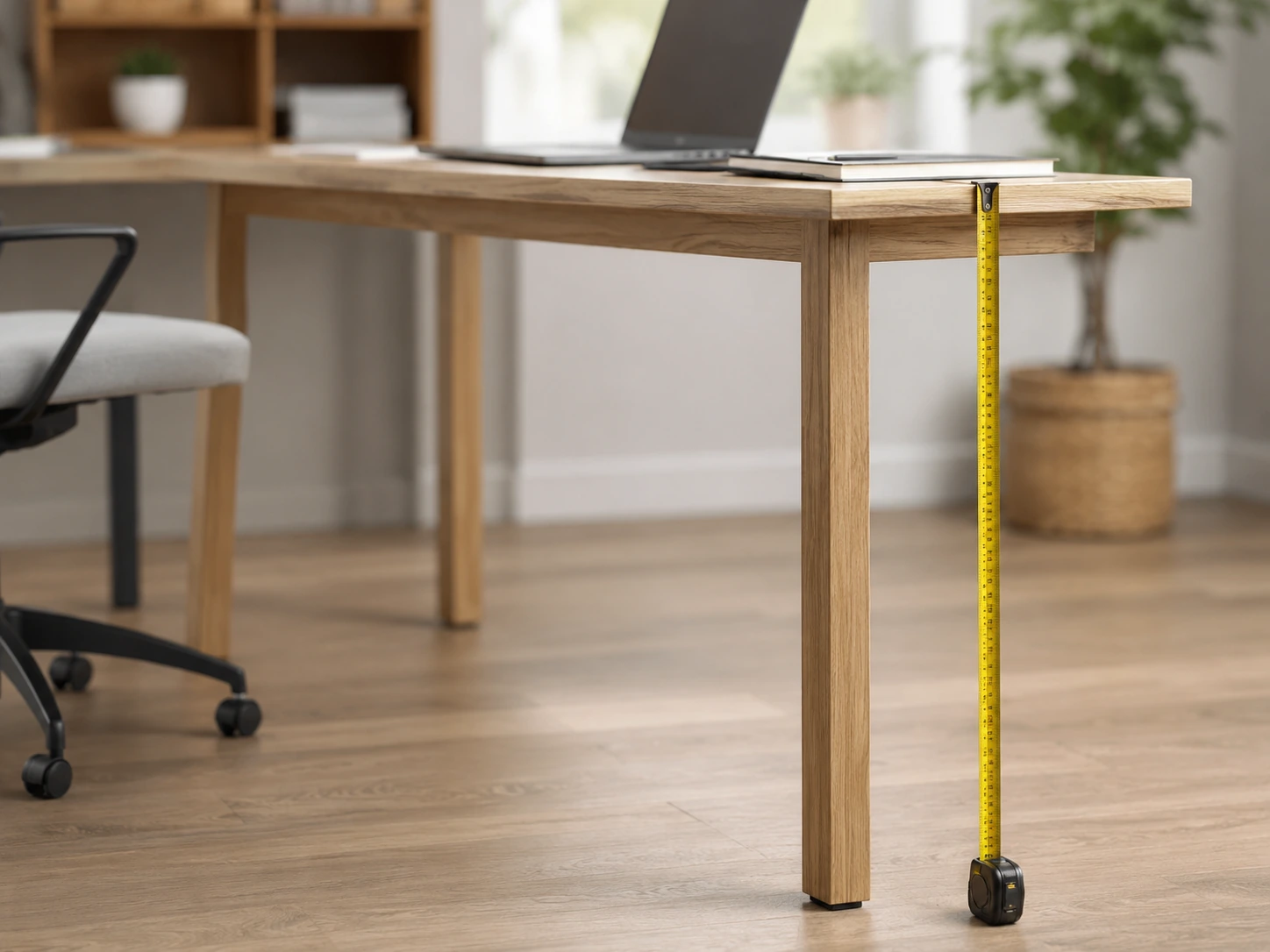
The standard desk height (the default height at which most fixed desks are manufactured) is 29 to 30 inches (74-76cm) from the floor to the desktop surface.
This measurement has been the industry default since the 1950s, when it was standardized around the average adult male height of the era. The logic: for an average-height adult sitting in a standard chair (seat height ~17-18"), a 29-30" desk puts the work surface near elbow height, allowing the 90-degree arm angle that reduces shoulder and wrist strain.
The problem: the "average adult male" the standard was designed for is 5'9"-5'10". If you are meaningfully shorter or taller, a 30" desk is not ergonomically correct for your body. You are adapting your posture to the desk, not the desk to your posture.
Desk Height by User Height
| User Height | Recommended Desk Height | Notes |
|---|---|---|
| Under 5'0" | 24-26" (61-66cm) | Standard desk is 4-6" too high |
| 5'0"-5'3" | 26-27" (66-69cm) | Standard desk requires chair raise + footrest |
| 5'4"-5'7" | 27-28" (69-71cm) | Slightly under standard - chair adjustment may compensate |
| 5'8"-5'11" | 28-30" (71-76cm) | Standard desk height is appropriate |
| 6'0"-6'2" | 30-31" (76-79cm) | At or slightly above standard |
| 6'3"-6'5" | 31-33" (79-84cm) | Standard desk too low by 1-3" |
| Over 6'5" | 33"+ (84cm+) | Standard desk significantly too low |
Important: These are starting points. Your actual comfortable height depends on whether you use a keyboard tray, monitor stand, wrist rest, and chair height in combination. Measure your own seated elbow height for precision.
How to Measure Your Correct Desk Height
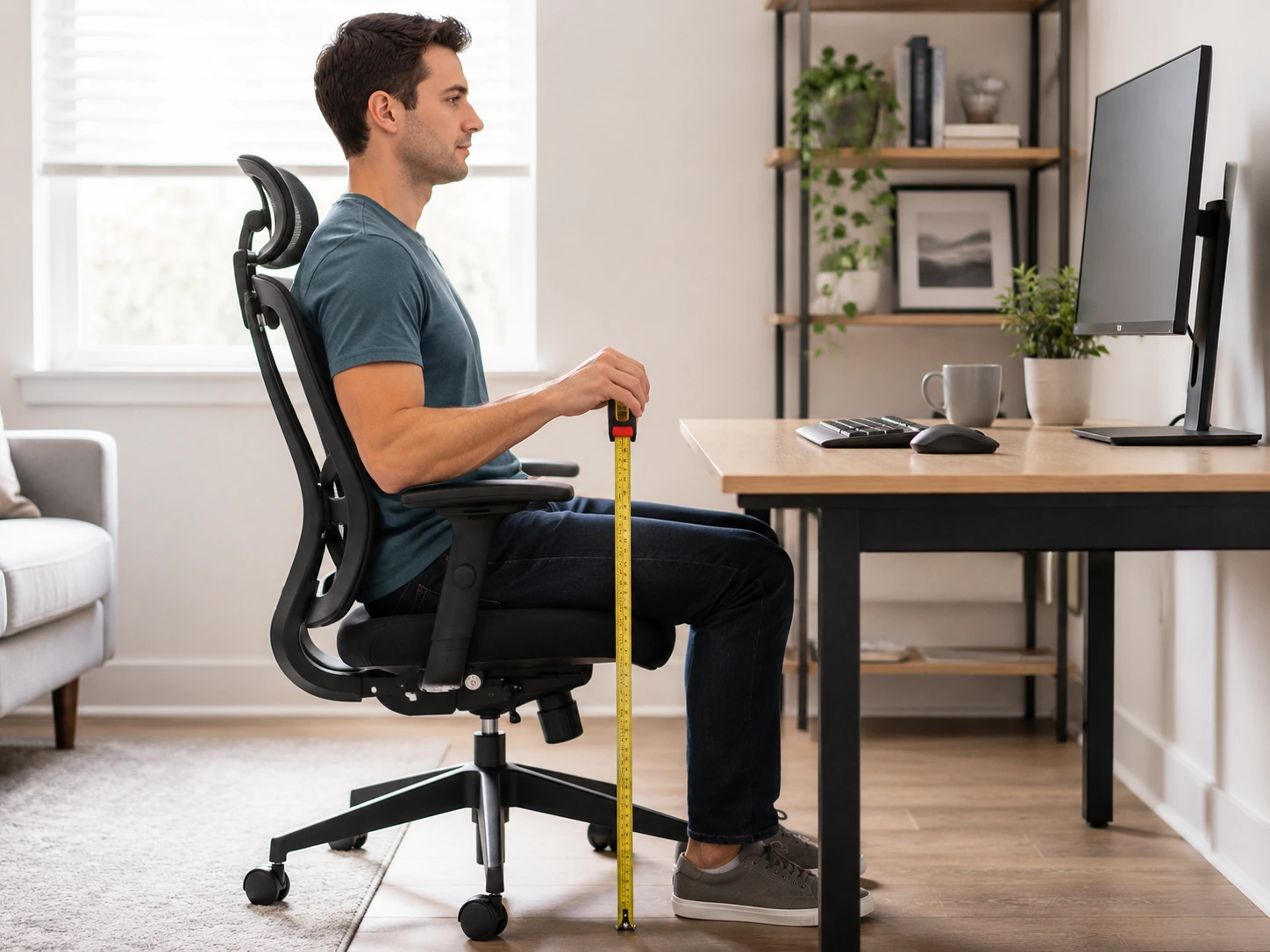
- Set your chair height correctly first. Sit down. Adjust the chair until your feet are flat on the floor and your hips are at a 90-degree angle (thighs parallel to the floor or slightly declining).
- Relax your shoulders. Let your arms hang naturally at your sides. Your shoulders should not be raised or hunched.
- Bend your elbows to 90 degrees. Your forearms should be parallel to the floor or angled slightly downward (5-10 degree decline is acceptable and reduces wrist strain).
- Measure from the floor to the bottom of your elbow. This distance is your target desk height for flat keyboard placement. If you use a keyboard tray (positioned below desk surface), your target desk height can be 1-2" higher.
Why the Standard Height Does Not Fit Everyone
The 30" standard was set for a specific population and has not changed as ergonomic understanding evolved.
For shorter users (under 5'5"): A 30" desk forces the arms to reach upward to reach the keyboard, raising the shoulders, creating trapezius tension, and compressing the wrist angle. The compensation is raising the chair, which then lifts the feet off the floor, creating pressure under the thighs. The fix is either a lower desk, a footrest, or an adjustable-height desk.
For taller users (over 6'1"): A 30" desk is too low. Reaching down to the keyboard causes the shoulders to roll forward and the neck to flex downward. Over 8 hours, this creates cervical and thoracic strain. A 31-33" desk surface or an adjustable standing desk at the correct height solves this.
Standard Desk Height vs. Ergonomic Desk Height
| Standard desk | Ergonomic desk | |
|---|---|---|
| Height | Fixed at 29-30" | Adjustable to fit user |
| Designed for | Average adult male ~5'9" | Any height |
| Accommodation | User adapts to desk | Desk adapts to user |
| Cost | Lower ($100-400) | Higher ($300-800+) |
| Best for | Users 5'7"-6'0" | Everyone outside average range |
If you fall within the 5'7"-6'0" range, a standard fixed-height desk at 29-30" is ergonomically appropriate with proper chair height. Outside that range, a height-adjustable desk removes the problem entirely.
Desk Height, Chair Height, and Monitor Height: The System
Desk ergonomics is a system, and desk height, chair height, and monitor height must be set in relation to each other.
The correct sequence:
- Set chair height so feet are flat and hips at 90 degrees
- Set desk height (if adjustable) to match seated elbow height
- Set monitor height so the top of the screen is at or slightly below eye level
- Set monitor distance so the screen is 20-28" from your eyes (approximately arm's length)
| Component | Correct position | Common mistake |
|---|---|---|
| Chair | Feet flat, hips 90 degrees, knees at or below hip level | Too low = feet dangle; too high = feet flat but hips pinched |
| Desk | Elbow height when seated correctly | Too high = raised shoulders; too low = hunching forward |
| Monitor | Top of screen at eye level | Too low = constant neck flex downward |
| Keyboard | At or slightly below elbow height | Too high = elevated shoulders; too low = wrist extension |
Standing Desk Height: What Changes
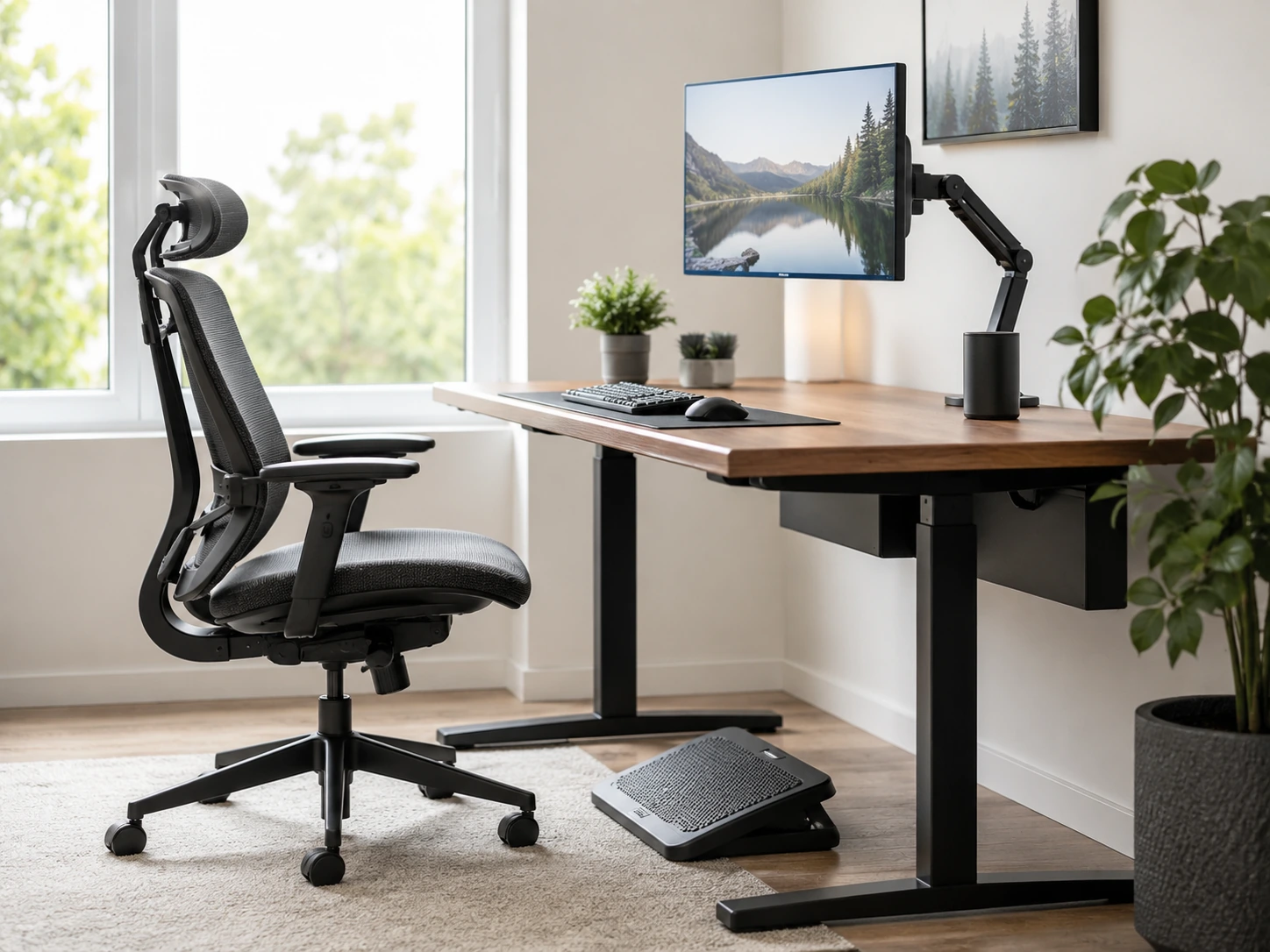
For standing work, the correct desk height is your standing elbow height - the distance from the floor to the bottom of your elbow when standing upright with shoulders relaxed.
| User Height | Recommended Standing Height | Notes |
|---|---|---|
| 5'0"-5'3" | 35-38" (89-97cm) | Most standing desks minimum is 27-29" - fits |
| 5'4"-5'7" | 38-41" (97-104cm) | Mid-range standing desks cover this |
| 5'8"-5'11" | 40-43" (102-109cm) | Standard standing desk range covers this |
| 6'0"-6'2" | 43-46" (109-117cm) | Requires standing desk with higher max range |
| 6'3"-6'5" | 46-49" (117-124cm) | Need high-range standing desk (FlexiSpot E7, etc.) |
| Over 6'5" | 49"+ | Verify max height before buying any standing desk |
Most standing desks have a height range of approximately 27"-47". Users under 5'3" and over 6'3" should verify the specific min/max heights before purchasing, as some budget models have more limited ranges.
How We Picked
Every product in this guide was evaluated across five criteria, weighted for real small-space use. We do not claim hands-on lab testing — our evaluation is based on verified buyer feedback patterns, published product specifications, and structured comparison criteria.
Small-Space Fit
Physical footprint, mounting options, and whether the product works without consuming space you don't have.
Build Quality
Materials, finish durability, and construction quality as indicated by product specs and verified buyer feedback patterns.
Ease of Use
Setup time, daily usability, and how much adjustment the product requires once in place.
Value for Money
Price-to-performance ratio compared to competing products in the same subcategory.
Buyer Feedback
Patterns from verified Amazon reviews — what real buyers praise and complain about most over time.
What to Do When Your Desk Is the Wrong Height
Your desk is too high (most common problem)
- Raise your chair height so your elbows align with the desk surface
- Add a footrest to keep your feet flat once the chair is raised
- Use a negative-tilt keyboard tray (mounted below desk surface) to lower the keyboard
- Replace the desk with an adjustable-height model
Your desk is too low (less common, affects tall users)
- Desk risers (furniture feet extenders) can add 2-4" at low cost
- Monitor arm raises the screen independently of desk height
- Replace with an adjustable standing desk
The standing desk solution: If you find yourself constantly adjusting because no fixed height works throughout the day, an adjustable standing desk removes the problem entirely. See our Best Standing Desks Under $300 guide for options starting at ~$200, or Best Standing Desks Under $500 for dual-motor and L-shaped options.
Frequently Asked Questions
What is the standard desk height in inches?
The standard desk height in the United States and most of Europe is 29 to 30 inches (74-76cm) from floor to desktop surface. Most fixed office desks, dining tables used as desks, and entry-level writing desks fall in this range.
What desk height is correct for someone 5'4"?
For a user at 5'4", the ergonomically correct desk height is approximately 26-27 inches (66-69cm). A standard 30" desk is 3-4 inches too high. With a standard desk, raise your chair until your elbows align with the desk surface, then add a footrest to keep your feet flat.
Is a 30-inch desk height good?
For users between 5'7" and 6'0", yes. For users shorter than 5'7" or taller than 6'1", a 30-inch desk creates ergonomic problems. An adjustable-height desk solves this for users outside the average range.
Does desk height affect back pain?
Yes, indirectly. A desk that is too high forces the shoulders upward, creating tension in the upper back and neck. A desk that is too low causes the user to lean forward, increasing lumbar flexion and lower back strain. Correct desk height, in combination with correct chair height and monitor position, is one of the three most impactful ergonomic variables.
What is the ergonomic desk height for standing?
For standing use, the correct height is your standing elbow height, typically 40-45 inches for users between 5'7" and 6'1". Verify your specific measurement using the formula: height in inches x 0.63 = approximate standing desk height in inches.
Related Buying Guides
7 Best Standing Desks Under $300 in 2026: Dual Motor, Compact, and Small Apartment Picks
5 Best Standing Desks Under $500 in 2026: Dual Motor, L-Shaped, and Premium Picks
10 Best Ergonomic Chairs Under $300 in 2026
Ergonomic Chair vs Gaming Chair: The Real Difference
Want to browse more options? See all related products on Amazon.
Browse on AmazonEvaluation note: Products in this guide were assessed on overall score, small-space fit, build quality, ease of use, value for money, and buyer feedback from verified Amazon reviews. We do not claim hands-on product testing.
Read our full methodology →