
How to Choose a Rolling Cart That Fits Between Furniture
Affiliate Disclosure: We may earn a small commission on qualifying Amazon purchases at no extra cost to you. Full disclosure →
The gap between a desk and a cabinet can look perfect for a narrow rolling cart. But the advertised cart width may exclude handles, caster movement, or the space needed to pull out a drawer. A cart that slides into the gap can become unusable once loaded or trapped behind a furniture edge.
Quick answer: Measure the narrowest part of the gap at floor, wheel, shelf, and handle heights. Check the cart's complete external dimensions, caster sweep, loaded access, and pull-out route. Compare usable shelf or drawer dimensions separately. A cart should fit both its parking space and the way you will use it.
This guide is for indoor storage carts used within their stated limits. It does not establish that a cart can support a printer, appliance, heavy equipment, or a leaning load unless its documentation specifically permits that use.
Define what the cart will hold
Gather the intended contents before measuring products. A cart for stationery has different needs from one holding a printer, books, toiletries, or craft supplies. Measure the largest items and note their weight where relevant. Check how each item needs to be accessed: from above, from the side, or by opening a lid or tray.
Decide whether the cart will stay mostly parked or move around the room. A frequently moved cart needs a clear route, accessible handle, and suitable casters for the floor. A mostly stationary cart still needs enough room for cleaning and retrieval. Wheels do not remove the need to plan access.
Avoid using the gap simply because it exists. If the location is far from the task, blocks a vent, or makes the contents difficult to see, another storage method may be better. Storage is useful when it supports a routine, not when it fills an otherwise empty strip of floor.
Measure the gap at several heights
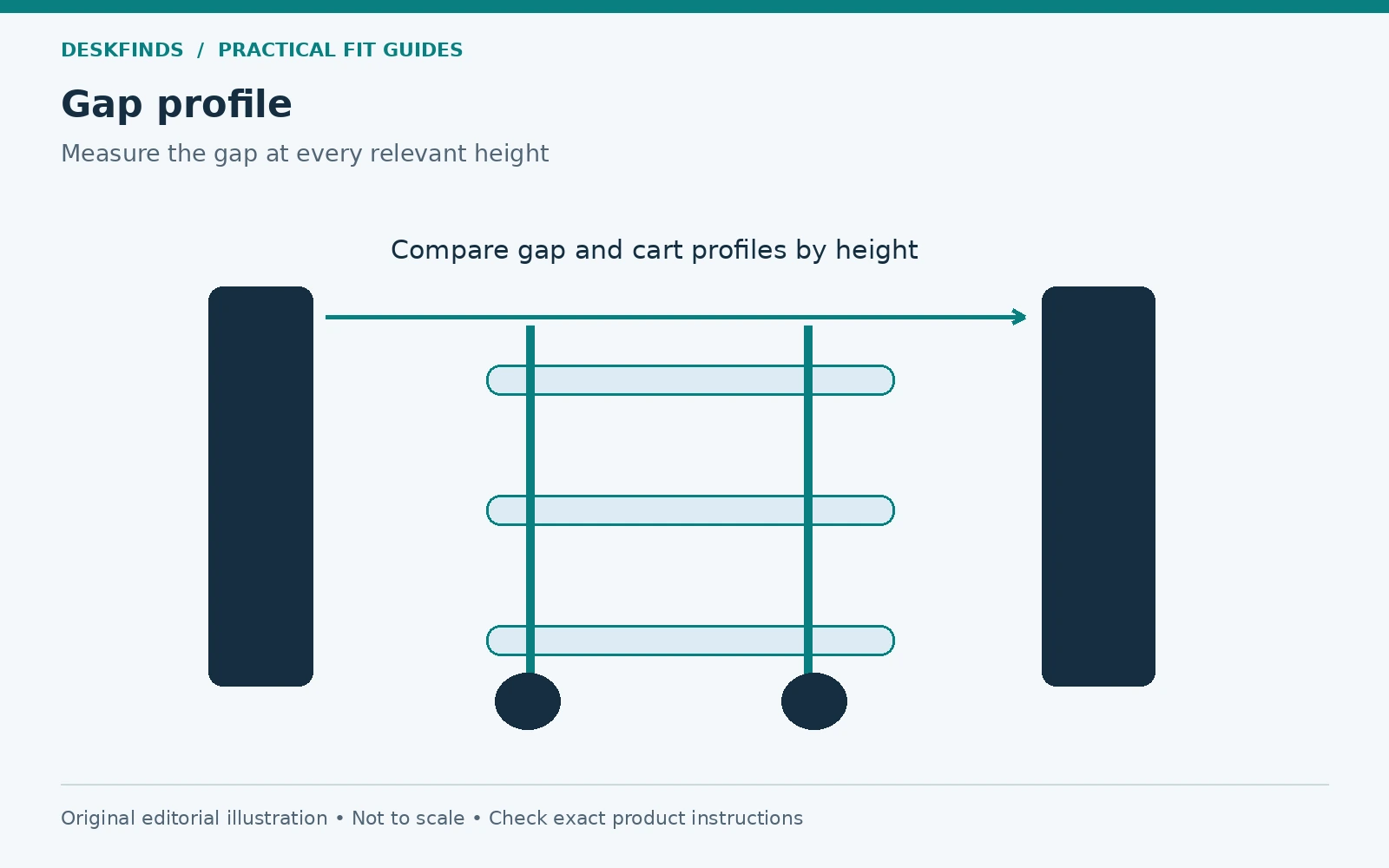
Measure between the nearest surfaces at floor level, above the skirting board, at shelf height, and near any handles. Furniture sides are not always parallel, and a base or foot can project farther than the upper panel. Record the narrowest measurement rather than the widest visible gap.
Include wall trim, cables, desk feet, cabinet handles, and uneven flooring. A cart may clear the gap at the top while its wheels hit a furniture foot below. Conversely, the wheels may fit while an upper handle catches a drawer pull. The complete profile matters more than one width taken at eye level.
Check whether the neighboring furniture moves. A standing desk, opening cabinet, or reclining chair can change the space. Measure the gap in the positions that occur during normal use. A cart parked beneath a moving desktop can become a collision point if its height is not considered through the desk's operating range.
Read the overall dimensions carefully
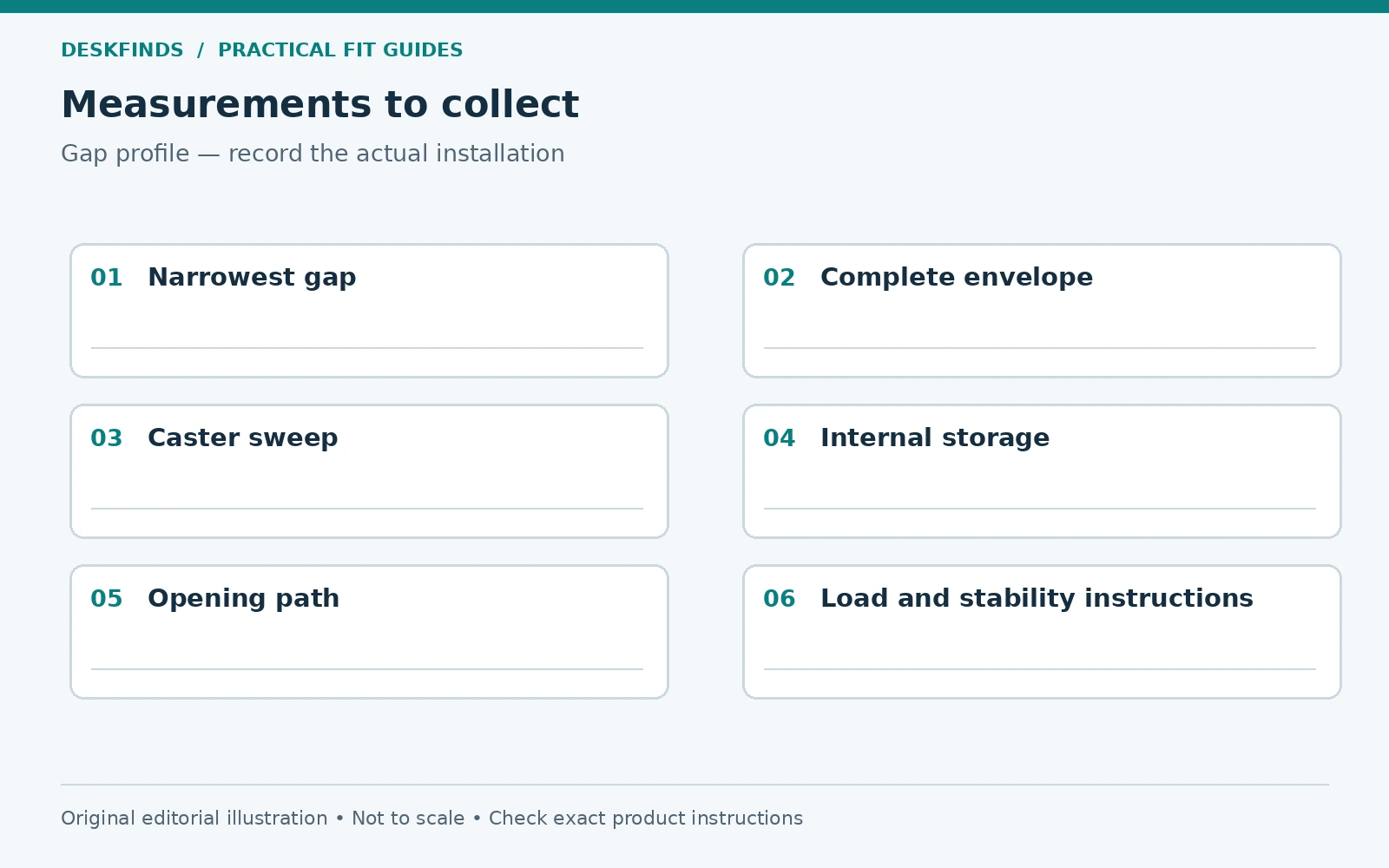
Find the cart's maximum width, depth, and height with all required components installed. Handles, side hooks, basket rims, and caster mounts can extend beyond the shelf body. A product titled as a narrow cart may list only shelf width prominently. Ask for an overall drawing if the distinction is unclear.
Check whether casters are included in the height. Some products offer feet or wheels as alternatives, which changes the installed dimensions. Use the configuration you intend to assemble. Do not remove structural parts or handles to force a fit unless the manufacturer explicitly permits that configuration.
Confirm the units and avoid rounding away a meaningful difference. A tight gap offers little tolerance for wall irregularities or normal assembly variation. Rather than planning a friction fit, allow practical movement space based on the actual surfaces and product. No single margin works for every room and cart design.
Account for caster swivel and direction changes
Swivel casters can occupy a different footprint as they turn. A cart that rolls straight into a gap may need more room to turn out of it. Look for the caster envelope or ask the seller how far the wheels project in their widest orientation. Include wheel locks and their access where provided.
Consider the floor. A thick rug, threshold, or uneven joint can make a loaded cart harder to move or alter its stability. Follow the cart's intended floor and loading conditions. Do not assume that larger wheels automatically make a tall, narrow cart suitable for every surface.
Test the route with a full-size floor outline. If a turn is needed, model the whole rectangle and any protruding handle. A cart can fit the parking bay but fail to rotate in the aisle outside it. Planning the exit route prevents turning a mobile product into a permanently wedged shelf.
Check useful storage dimensions
External fit does not tell you what fits on the shelves. Measure usable shelf width and depth inside rims or rails. Check vertical spacing, drawer opening size, and any taper in baskets. A bottle, file box, or printer may be smaller than the overall cart yet too large for the actual storage surface.
For drawers, check full extension and access to the rear. A neighboring desk leg can block opening even when the cart itself clears. For open shelves, consider how you will lift items out. A tall container may need extra overhead room beyond the shelf spacing to clear a rail or handle.
If the cart is intended for a printer, include paper trays, scanner lid movement, cable exits, and the manufacturer's support and ventilation requirements. Do not use only the printer's closed dimensions. A machine that fits while idle can need much more room during printing or maintenance.
| Dimension | Why it matters |
|---|---|
| Narrowest room gap | Controls whether the cart can enter |
| Overall cart envelope | Includes handles, rims and hardware |
| Caster sweep | Controls movement and turning |
| Internal shelf or drawer size | Determines usable storage |
| Opening and lifting space | Determines access to contents |
| Pull-out route | Keeps the cart mobile after loading |
Evaluate height and stability together
A tall narrow cart can offer capacity, but its permitted load distribution and movement instructions matter. Read the total and per-shelf limits for the exact model. Do not assume those limits are interchangeable. A shelf's rating may not mean the whole cart can carry that amount on every level at once.
Place contents as the manufacturer directs and avoid top-heavy arrangements. Do not use the cart as a step, seat, or support when standing up unless it is specifically designed for that purpose. A handle intended for moving the cart is not necessarily suitable for other forces.
If the product requires an anti-tip attachment or another stabilizing measure, include that in the installation plan. A tether can affect whether and how the cart moves. Follow the instructions rather than removing the requirement to preserve the idea of mobility. If the product cannot be installed as intended in the gap, choose another design.
Example: the shelf width fits, the handle does not
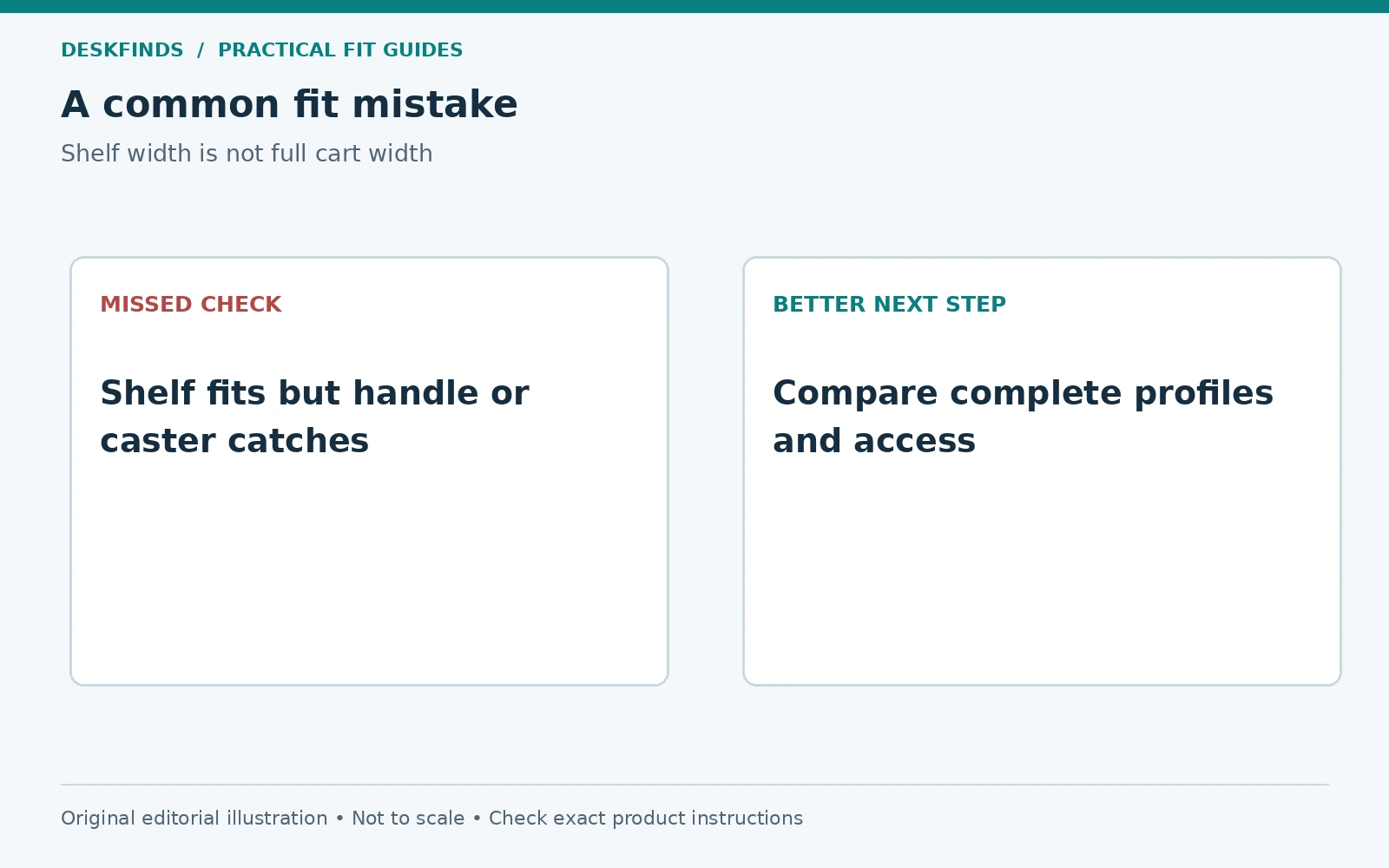
A buyer finds a cart with shelves narrower than the gap beside a desk. The complete width, however, includes an upper handle that projects beyond the shelf body. At handle height the neighboring cabinet also has a protruding pull. The two meet before the cart reaches its parked position.
The buyer asks for the maximum assembled dimensions and compares a different cart whose handle arrangement suits the gap. Removing the first cart's handle is not assumed to be allowed. The full-size outline includes the cabinet pull, making the conflict visible before delivery.
This case is common because product titles often emphasize the narrowest part of the design. The correct comparison uses the widest installed point at each relevant height. A product can be narrow in one sense while still being too wide for the room.
Example: the cart parks but cannot be used
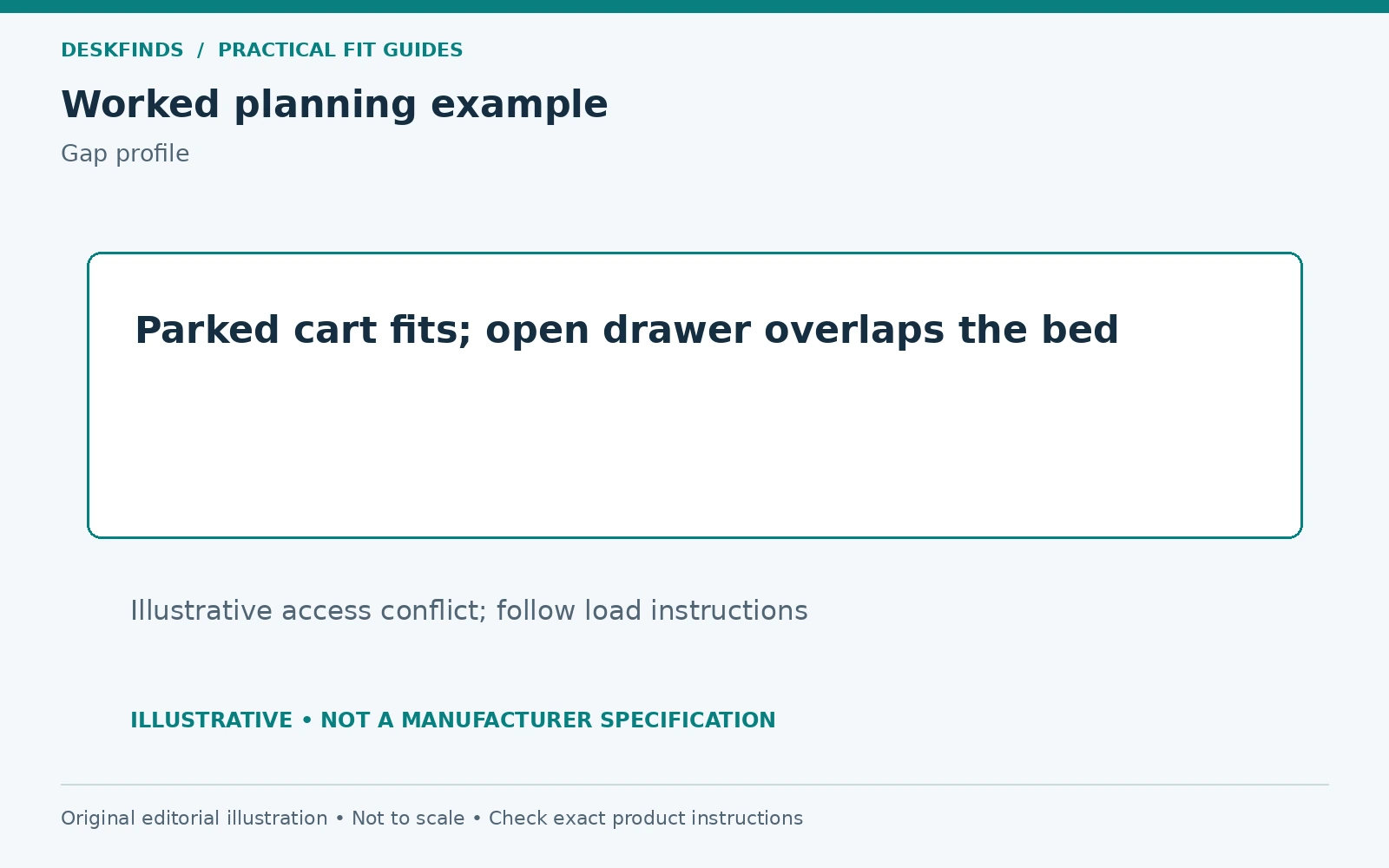
Another cart slides neatly between a bed and a wardrobe. Its drawers open toward the foot of the bed, where there is little room. The rear drawer contents cannot be reached without pulling the entire cart out, but the aisle is too short for that move. The parking dimensions pass while access fails.
A shorter cart with open shelves may suit the location better, or the original cart may work elsewhere in the room. The buyer tests the retrieval action with a cardboard mock-up and actual storage objects. That reveals whether the issue is depth, drawer extension, or the surrounding furniture.
Do not choose open shelves automatically if drawers fail. The contents may need dust protection, containment, or privacy. Compare the storage function and access together. A different location can preserve both more effectively than forcing a less suitable product into the original gap.
Keep the cart out of other operating zones
Open nearby doors, drawers, and windows while the cart outline is in place. Check the chair's entry and exit movement. A cart that fits beside the desk can still block the chair arm or become an obstacle when you stand up. Our chair clearance guide helps map that shared space.
On a standing desk, verify that the cart remains outside any collision zone throughout the desk's permitted travel. Do not rely on an anti-collision feature to make a deliberate obstruction acceptable. Keep desk controls, frame mechanisms, and cables accessible. A low cart can still catch a hanging cable as the top moves.
If electrical devices sit on the cart, plan their power and data connections before moving it. A wheeled shelf is not mobile while tethered by a short cable unless the setup is designed for that use. Disconnect or manage connections according to the device instructions; do not let the connectors stop the cart's movement.
Assemble and load with the intended use in mind
Follow the assembly instructions and verify that shelves, rails, and casters are installed correctly. Use locks where provided and appropriate. Check for wobble or parts that do not seat as intended before adding contents. Do not compensate for an assembly fault by wedging the cart tightly between furniture.
Load within the stated limits and test movement on the actual route. Keep hands clear of pinch points between the cart and neighboring surfaces. Move it using the intended handle or method, at a controlled pace. If it catches on the floor or tilts, stop and reassess the route and load.
Organize frequently used items where they are visible and reachable. Labels can help on deep or narrow shelves. Leave enough room to grip objects without pulling the cart sideways. The cart should reduce searching and handling, not become a vertical pile of tightly packed items.
Preserve the access route over time
Recheck the fit after adding hooks, bins, trays, or a larger device. Those additions can extend the cart's envelope beyond the original measurement. A new rug can also change movement. Treat accessories as part of the cart rather than free capacity outside its dimensions.
Clean the wheels and floor as the product instructions permit, and inspect for loose or damaged parts. Keep the gap free of cords and objects that can catch a caster. Do not park the cart against a heater or over a vent simply because that location is otherwise unused.
Compare our rolling storage cart guide after preparing a purchase brief. Include the narrowest gap, full external envelope, loaded access, caster route, and intended contents. The right cart fits the room while parked, moving, and being used-not only in the empty gap shown in a photo.
Make a gap profile rather than one measurement
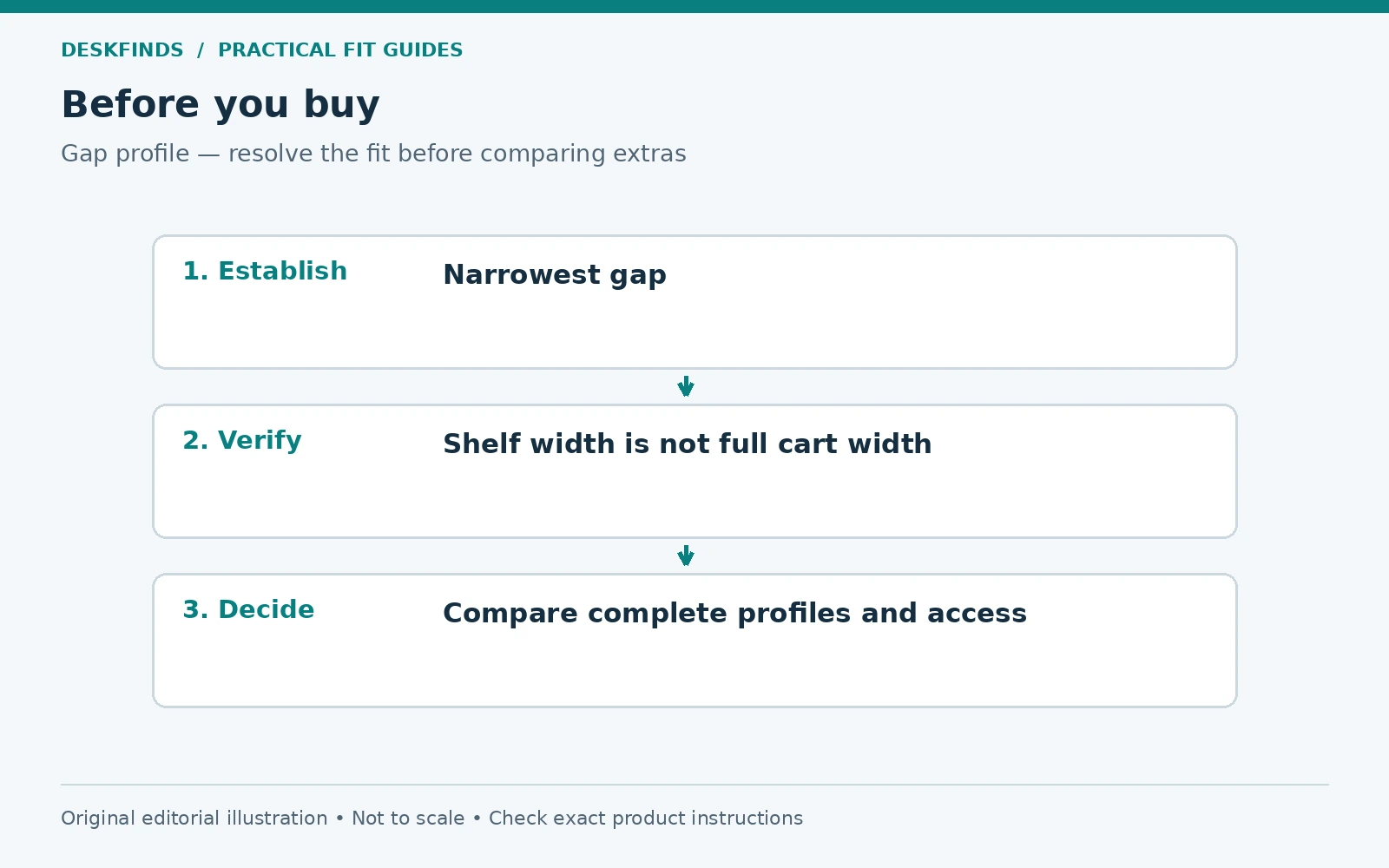
Draw a side view of the space and write its width at the floor, caster level, lower shelf, upper shelf, and handle. Add the height at which each obstruction begins and ends. This profile is useful when a cabinet base projects only near the floor or a desk control occupies a small upper section.
Compare the cart's profile at the same heights. A cart with narrower shelves but wide caster mounts may fail at the bottom, while another with the same advertised width may clear because its handle sits above the cabinet pull. Matching profiles is more informative than comparing a single maximum width without knowing where it occurs.
Keep the cart's assembly options in the record. If the manufacturer permits a handle on either side, that may change the fit. If it does not, do not assume the part can be reversed. A supported configuration is a useful design option; an improvised one is an unresolved question.
Test the cart's intended task with actual objects
For stationery, check whether you can see and grasp supplies from the parked position. For books, check the internal depth and whether the load is permitted. For a printer, check the operating envelope, support requirements, and access to paper and service panels. The cart should be evaluated as a working station, not just a container.
Place the objects on a stable temporary surface with a footprint matching the candidate shelf. Simulate taking them off and putting them back. If you need to pull the cart fully into the room every time, include that movement in the route test. A parked fit is less valuable when the daily task always requires a second location.
Keep frequently used heavy objects within a practical handling position for the user and within the cart's instructions. Do not use a tall top shelf simply because it is empty. A load arrangement that is convenient for retrieval also needs to preserve the product's permitted stability and capacity conditions.
Ask for load information without merging different limits
A product may list total capacity, per-shelf capacity, or a limit for a particular configuration. Ask which applies to the exact model and assembled arrangement. Do not multiply a per-shelf figure to invent a total unless the manufacturer explicitly defines it that way. Likewise, do not place the full total on one shelf without permission.
For a concrete documentation example, IKEA's RÅSKOG cart page separates product dimensions and shelf loading information. Use that style of model-specific evidence when comparing candidates, rather than transferring a limit from one visually similar cart to another. Versions and market listings can differ.
If the cart will move while loaded, check the instructions for movement as well as static storage. A load that is permitted while parked may need additional care or a different arrangement during transport. Do not infer transport performance from a shelf rating alone. Keep the planned route and contents available when asking support.
Decide whether mobility adds value in this gap
A cart that never leaves a tight bay may not need to be mobile, but it still needs cleaning and service access. Compare a suitable stationary shelf if wheels add height or reduce usable capacity without helping the task. Conversely, a cart used around the room needs a clear parking place and route wherever it goes.
The useful comparison is the whole routine: retrieve, use, return, and clean. If the cart makes each action simpler, the gap is serving a purpose. If the wheels are only a feature on the box while the unit remains trapped, a different storage arrangement may offer better access.
Sources and scope
- IKEA small-bedroom storage planning - general room-planning reference.
- The exact cart's assembly and load instructions - obtain from the manufacturer before selecting a configuration; this guide does not assign a universal capacity.
The multi-height gap map and cases are original editorial tools. They do not certify stability or permit changes to required safety hardware.