
How to Check Whether Replacement Casters Fit Your Office Chair

Affiliate Disclosure: We may earn a small commission on qualifying Amazon purchases at no extra cost to you. Full disclosure →
Replacement chair wheels are often advertised as universal, but chair bases do not all use the same connection. Stem type, dimensions, seating depth, wheel height, and floor suitability can all change the result. The chair brand alone is not enough to choose a set.
Quick answer: Identify the chair model and approved replacement options, then confirm the original caster connection and dimensions using the manufacturer’s procedure. Match stem type, diameter, length, and seating arrangement. Check installed height, floor compatibility, and intended loading as well. Do not force a mismatched stem into the base or modify the socket.
Start with the chair identification
Look for a label beneath the seat or in the original purchase record. Include model, generation, and any relevant manufacturing information when asking for parts. Similar-looking chairs can use different bases or caster options.
Check the manufacturer’s parts service first. An approved replacement reduces uncertainty about the connection and intended use. If considering a third-party product, ask for explicit compatibility with the exact chair rather than treating universal as a technical specification.
Find the replacement procedure
Read the chair maker’s instructions before removing anything. The chair should be supported in the specified position, and heavy or awkward models may need assistance. The goal is to inspect the caster connection without damaging the base, cylinder, or floor.
This guide addresses choosing a compatible part, not dismantling a gas cylinder. If the instructions are unavailable or the caster is seized, contact the manufacturer or a repair service. Do not improvise with heat or cut into chair components.
Identify the connection type
Casters can use grip-ring stems, threaded stems, sockets, plates, or other connections. A smooth stem with a retention ring does not interchange with a threaded stem simply because both enter a round opening.
Photograph the original caster and socket when accessible through the approved procedure. Include the entire stem and any shoulder or sleeve. Check whether a sleeve belongs to the base or came out with the caster; the manufacturer’s guidance should resolve that distinction.
Measure the relevant dimensions
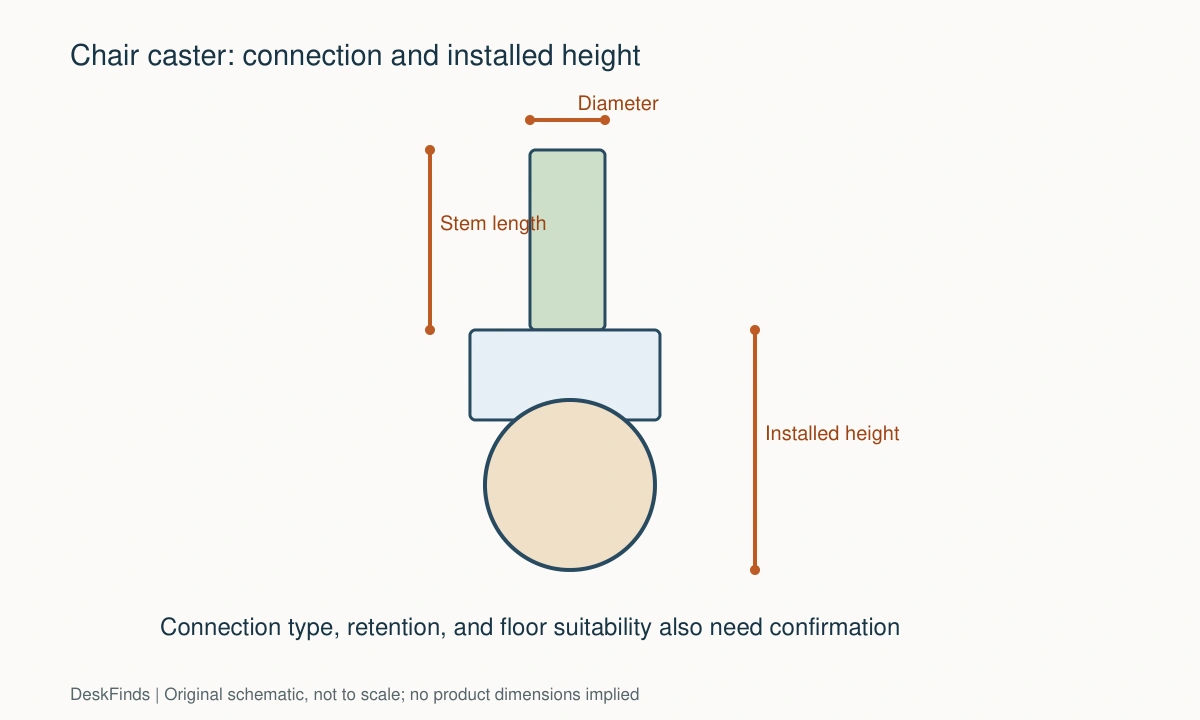
For a stem connection, record diameter and usable length using a suitable measuring tool. A caliper can distinguish dimensions that are difficult to judge with a ruler. Record units accurately and do not round a close measurement to the nearest common listing.
For threaded connections, thread diameter and pitch matter. Length alone is insufficient. Obtain the part specification rather than guessing the pitch from a picture. Keep the original caster available while comparing candidates.

Compare seating and shoulder geometry
Two stems may have similar dimensions but different retention or shoulder arrangements. A replacement must seat as designed, not stop halfway or bottom out incorrectly. Look for the maker’s installation drawing and any compatibility exclusions.
Do not grind, shim, glue, or drill a connection to make it fit. Those changes can compromise retention or damage the base. A part that needs an improvised adapter should be treated as unresolved unless the manufacturer approves that specific adapter.
Account for changed chair height
A larger wheel can raise the seat’s minimum position. Measure the chair at the height you normally use and determine whether the increase would prevent your feet reaching a stable support or your arms fitting beneath the desk.
Wheel diameter is not the same as installed caster height, because the fork and stem arrangement also matter. Compare the complete installed height specification where available. Do not calculate the seat change from diameter alone.
Match the floor and movement behavior
Choose casters rated for the floor surface and chair use. Soft-looking wheels are not automatically compatible with every finish. Floor care instructions may matter, and debris caught in a wheel can still cause marks.
Consider how easily the chair will roll. A low-resistance replacement may move more readily than the original. That affects getting in and out, especially on a sloped or very smooth surface. A floor mat or different approved caster may be more appropriate than maximizing free rolling.
Read load claims carefully
A per-wheel rating is not necessarily a rating for the complete chair system. The chair’s base, seat, and other components retain their original limits. Replacing wheels does not increase the chair’s stated capacity.
Check whether the replacement set is specified for office chairs and the intended arrangement. Do not combine different wheel sizes or types unless the chair maker permits it. Uneven installed heights can change support and behavior.
For the wider chair dimensions, use the office-chair size chart.
Inspect before returning the chair to use
Follow the specified installation process and confirm each caster is fully seated. Check for visible damage or looseness. Do not sit in a chair with an uncertain connection simply to see whether it holds.
After proper installation, test movement cautiously on a suitable clear surface according to the instructions. If a wheel pulls out, binds, or leaves the chair uneven, stop use and resolve the part or installation issue.

Keep a compatibility record
| Field | Record |
|---|---|
| Chair | Model, generation, and original part information |
| Connection | Stem, thread, plate, or model-specific design |
| Dimensions | Diameter, length, pitch if threaded, and installed height |
| Retention | Ring, shoulder, socket, and seating requirements |
| Floor | Surface type and relevant care restrictions |
| Approval | Manufacturer compatibility or unresolved question |
See our chair-caster types guide for floor and design comparisons. Choose the replacement only when the connection and the working height both make sense. A smoother wheel is not an upgrade if it does not fit the chair safely.
Three replacement decisions
Original-equipment replacement
An approved caster for the exact chair is a useful starting point when the original wheels are worn. Confirm the floor option and any model-generation exclusions. A part sold by the chair maker may still be intended for a different base or surface.
Keep the old caster until installation and compatibility are confirmed. Its shape and part markings can help resolve a support question. Photograph the original connection before disposing of damaged parts, following the replacement instructions.
Larger third-party wheels
A larger caster may change rolling behavior and chair height. Compare the complete installed dimensions, not wheel diameter alone. If your chair is already at its lowest usable seat setting, an increase may leave you needing additional foot support or make the arms hit the desk.
Also check turning clearance around the chair base. A different fork or wider wheel can occupy a larger swept area. The fact that a stem enters the socket does not establish that the assembled caster behaves appropriately beneath the chair.
Glides instead of rolling casters
A non-rolling glide can be useful in some arrangements, but it needs the same connection and installed-height checks. Confirm that the chair maker permits the conversion. A glide’s floor behavior and contact area differ from a wheel’s.
Do not replace only some wheels with glides to create a homemade brake. Mixed support heights and behaviors can change the chair’s stability and movement. Use a complete approved arrangement rather than improvising a partial conversion.
Make a precise parts inquiry
Send a chair-label photo, an original-caster photo, connection measurements, and the floor type. Ask whether the proposed part is approved or explicitly supported. If dimensions are close but not identical, report both values instead of rounding them into a match.
For threaded parts, include the specified thread information if available. A caliper reading of the outside diameter does not identify pitch. The part number or manufacturer documentation is more reliable than guessing from a photograph of the threads.
Keep the upgrade claim realistic
Replacement wheels can address wear, a floor mismatch, or a particular movement need. They do not renew every part of an old chair. Inspect the chair according to the maker’s care guidance and address damage to the base or other components separately.
A higher advertised wheel capacity does not raise the chair’s rating. A smooth roll is also not universally desirable: users may prefer controlled movement during entry and exit. Choose the complete chair-and-floor behavior you need rather than treating maximum rolling freedom as the only measure of quality.

Decide whether replacement is the right repair
Worn wheels are only one possible source of chair movement problems. A loose base connection, damaged socket, debris, or floor issue can require a different response. Follow the chair maker’s troubleshooting procedure and inspect the relevant components before assuming a new wheel set will solve everything.
Do not use a larger stem or adhesive to compensate for a damaged socket. That changes the connection rather than repairing it according to the design. Ask the manufacturer or a qualified repair service about the appropriate replacement part or base repair. A wheel purchase is not a substitute for resolving structural damage.
When changing to another approved floor option, compare the chair’s behavior in the actual room. A smooth hard floor can make a low-resistance wheel move more readily than expected. Keep the entry and exit routine in mind, not just how easily the empty chair rolls across a video demonstration.
Record the installed seat-height effect after correct replacement. If the original lowest chair position was already important, the new caster height can create a new fit problem. Recheck desk clearance and foot support before treating the job as complete. This is one reason to compare complete installed dimensions before buying.
Retain part information for the next replacement. A photo of the chair label, the approved caster code, and the date of installation can save another round of uncertain measurement. If the chair is later sold or passed to someone else, provide the relevant instructions and disclose the replacement configuration rather than calling it universally upgraded.
Check whether the original problem occurs on every part of the floor or only at a mat edge, rug, or transition. That observation can distinguish a worn wheel from a route problem that a replacement will not remove. Do not deliberately roll an occupied chair over an unsafe obstacle to investigate it. Inspect the clear route and follow the maker’s troubleshooting guidance. A different caster may change handling at a transition, but it does not make an unsuitable threshold or damaged floor acceptable. Treat the room route and the replacement connection as separate maintenance decisions, and resolve both before calling the change complete.
For floor protection choices, compare chair mats and caster changes.
Worked example: larger wheels that change the minimum seat height
Suppose a chair’s original casters are worn and the owner considers a larger replacement set marketed as universal. The product promises easy rolling, but the chair is normally used at its lowest seat setting. The owner begins by finding the chair model and approved parts information.
The original connection is inspected through the manufacturer’s replacement procedure. Stem type and dimensions are recorded rather than inferred from the replacement’s title. A similar-looking option is rejected because its connection specification differs. No attempt is made to force the stem or alter the socket.
The remaining option matches the documented connection, but its complete installed height exceeds the original arrangement. The owner compares the seat position with foot support and desk-arm clearance. Wheel diameter alone would not have described this change accurately because the fork geometry also contributes.
The room’s floor behavior is then considered. The owner wants controlled movement during entry and exit, not merely a chair that rolls the longest distance when empty. The approved floor option and relevant finish guidance are checked. A mat remains another possible response to the floor issue, subject to its own fit and material requirements.
If the taller configuration would leave the feet unsupported or the arms unable to park beneath the desk, the owner compares another approved caster with a closer installed height. Adding a footrest could be appropriate in some setups, but should be evaluated as a separate workstation change rather than an automatic consequence of a wheel upgrade.
After correct installation, the connections are checked as instructed before normal use. Any damaged socket or uncertain retention would stop the process and require support. The owner retains the original part information and replacement code for future maintenance.
The example separates three questions: connection fit, installed chair geometry, and floor behavior. A replacement can pass the first and still be a poor purchase for the other two. Higher wheel capacity and freer rolling do not by themselves establish a better chair for the person using it.
If wheel height changes foot support, see footrests for a high desk.
Your eight-point comparison worksheet
Use these checkpoints to compare the actual room, furniture, or device with a candidate product. Keep each result separate; a favorable overall impression cannot resolve a failed required function. Blank record fields are deliberate so you can use your own measurements rather than copying hypothetical examples.
1. Original part
Identify chair model, generation, base type, and any original caster part number before comparing replacements.
Use the maker’s parts information to distinguish superficially similar chairs and confirm that the proposed set belongs to the correct configuration.
2. Connection category
Inspect the approved removed part for grip-ring stem, thread, plate, or another specified attachment.
Do not substitute one connection category for another because it appears to enter the same opening; retention and seating must match.
3. Stem dimensions
Measure diameter and usable length with suitable tools and record exact units without rounding to a convenient common size.
When the dimensions are uncertain, ask for the specification rather than forcing a close fit into the chair base.
4. Thread specification
For threaded parts, obtain diameter, pitch, length, and the required seating arrangement from documentation or support.
A matching outside diameter alone is insufficient, and guessing pitch can damage the socket or leave the part improperly retained.
5. Installed height
Compare complete caster height with the original arrangement and measure the chair at your normal seat setting.
Recheck foot support and desk-arm clearance if the new set raises the chair; wheel diameter alone does not predict the exact change.
6. Floor behavior
Check intended floor surfaces, finish-care restrictions, and the amount of rolling freedom appropriate to your room.
Choose a controlled suitable combination rather than assuming a softer-looking or freer-rolling wheel protects every floor and user equally.
7. Load and set
Read the replacement’s intended chair use and the chair’s own limits, keeping per-wheel claims separate from system ratings.
Use a consistent approved set and do not present stronger wheels as an increase to the chair’s overall capacity.
8. Post-installation check
Follow the specified installation and seating inspection, then check for looseness, binding, and uneven support before normal use.
Stop if a connection remains uncertain; a chair should not be occupied simply to see whether a questionable replacement holds.
Sources and scope
- Herman Miller: Setu caster and glide replacement instructions - Example of a chair-specific replacement procedure; use instructions for your actual chair.
- Herman Miller: replacement-parts support - Reference route for identifying and obtaining model-specific parts.
Editorial note: This is a research-based planning guide, not a hands-on product test or a certification of a custom installation. Dimensions described as hypothetical are examples. Follow the exact product instructions and confirm unresolved compatibility before buying.