
How to Plan Drawer Space for Letter- and A4-Size Documents
Affiliate Disclosure: We may earn a small commission on qualifying Amazon purchases at no extra cost to you. Full disclosure →
A drawer labeled for documents may hold loose paper but fail once folders, tabs, sleeves, and hanging rails are added. Letter and A4 are close in size, yet neither dimension alone tells you whether a filing arrangement will work. The drawer needs usable interior space and access for the complete storage system.
Quick answer: Identify the paper format, folder type, and filing orientation first. Measure the drawer's internal width, depth, clear height, and opening, then check the complete folder or frame dimensions. For hanging files, verify rail compatibility directly. A drawer large enough for a sheet is not necessarily a filing drawer.
This guide addresses physical fit. It does not determine how long documents should be kept or what security and preservation controls they require. Our document retention guide covers a different planning question.
Distinguish paper formats before measuring storage
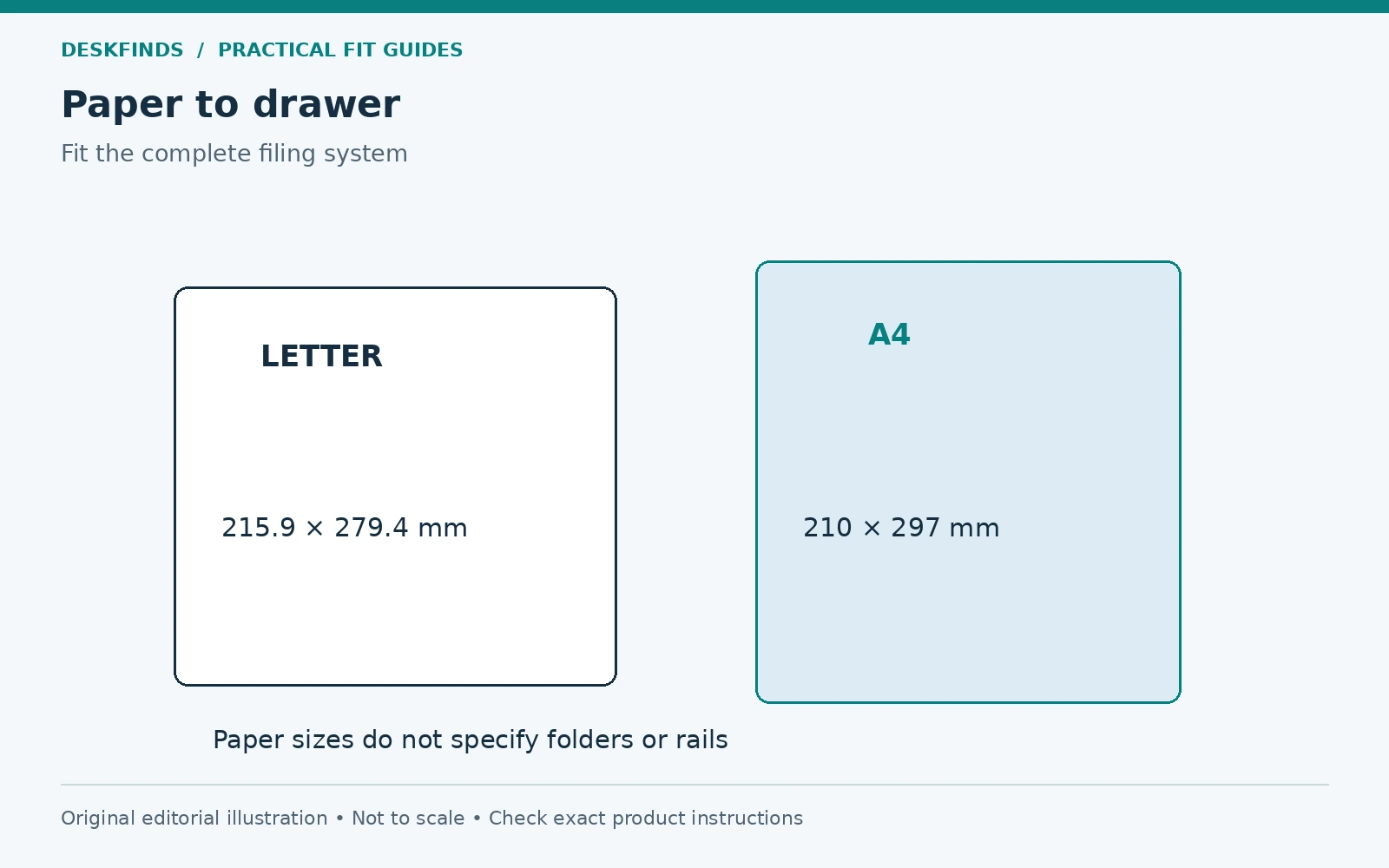
US Letter paper measures 8.5 by 11 inches, or 215.9 by 279.4 millimeters. A4 measures 210 by 297 millimeters. A4 is narrower and longer, so a compartment that accepts Letter across one dimension may still be too short for A4. Use the actual format rather than a generic office-paper label.
Check the documents you really keep. Some collections include mixed formats, envelopes, folded statements, certificates, or booklets. Do not choose a system from the most common sheet alone if a smaller number of important items need another size. Separate those items deliberately rather than forcing them into an unsuitable folder.
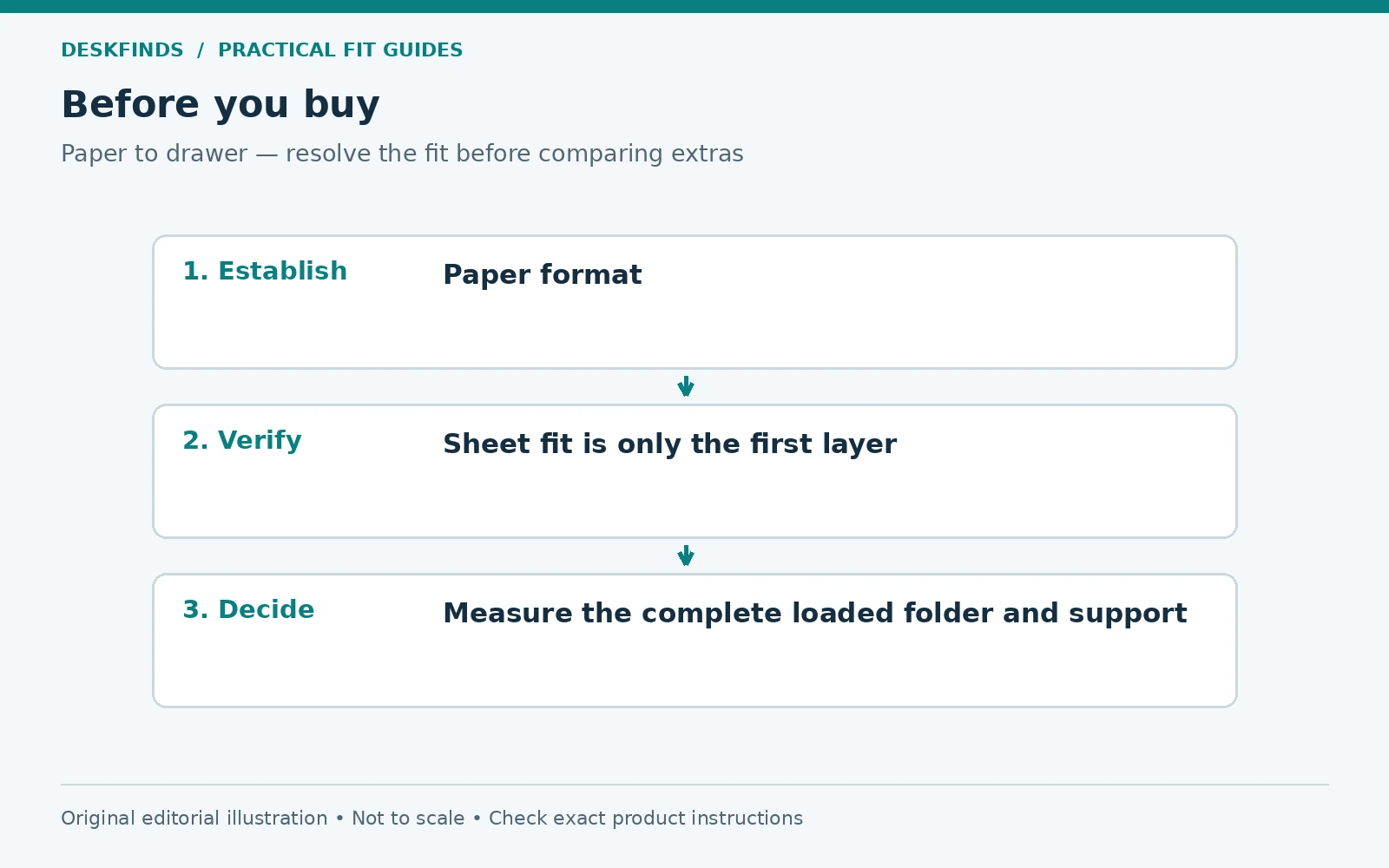
Paper measurements are only the starting point. A folder extends beyond the sheet, and tabs or sleeves may add more. A hanging file includes support bars and hooks. Each layer changes the fit requirement. Record the complete system you intend to use before comparing drawers.
Choose flat, upright, or hanging storage
Flat storage can suit a small active stack, provided the drawer supports it and access is practical. It needs a usable footprint larger than the complete folder or sleeve and enough height for the intended stack. Avoid assuming that papers can be bent slightly to make an almost-correct drawer work.
Upright folders need support and a clear height that includes tabs. A deep drawer may hold them physically while allowing them to fall or become difficult to identify. A suitable divider or file box can help, but it consumes space and must fit the drawer opening and load conditions.
Hanging files require compatible rails or a frame. Check the folder format, hook arrangement, rail spacing, and orientation from the product documentation. A label saying Letter/Legal should not be treated as an automatic A4 compatibility statement. Ask for explicit confirmation for the actual folder and frame combination.
Measure the drawer's usable interior
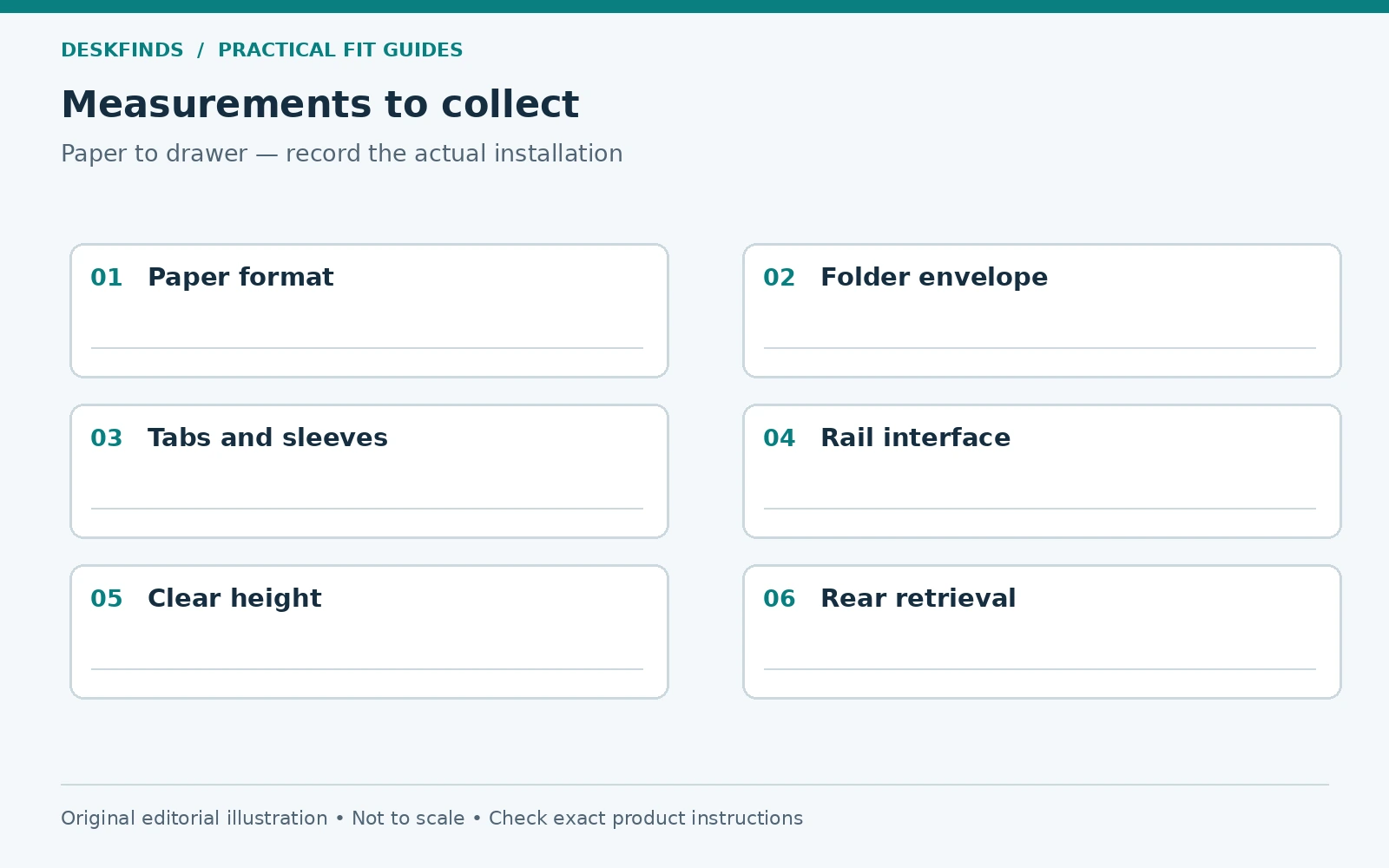
Measure inside the sidewalls at the floor and near the top, because taper or hardware can reduce space. Record usable depth from the inside front to the rear obstruction. Include locks, slide parts, raised screw heads, and any built-in divider. Outside cabinet dimensions are not useful substitutes.
Measure clear height beneath the closed top or next drawer, not merely the height of the front panel. A folder tab can hit an obstruction above the compartment. Check the opening too: the drawer may not extend fully, leaving the rear area difficult to access.
Do not remove structural parts or alter rails to gain a small amount of space without approval. A filing system should fit the drawer's intended configuration. If it does not, compare another orientation or storage product rather than trimming the furniture or folding important documents arbitrarily.
Test the complete folder envelope
Measure a folder with representative contents, tabs, and sleeves installed. Empty folders can be thinner and more flexible than loaded ones. Check how the folder expands and whether it remains supported. A nominal format name does not establish every external dimension.
For hanging files, use a compatible sample to confirm seating as the manufacturer directs. The hooks should engage the intended rails without forcing or balancing on an edge. Do not improvise a rail spacing from paper width. The support system has its own geometry and loading instructions.
| Item | Measurement to verify |
|---|---|
| Loose paper | Actual format and orientation |
| Standard folder | Complete width, height and loaded thickness |
| Tabs and sleeves | Added height, width or projection |
| Hanging folder | Bar and hook compatibility with rails |
| Removable frame | Full installed envelope and supported configuration |
| Drawer | Usable interior, clear opening and permitted load |
Plan access to the rear files
Open the drawer as far as it is designed to travel and simulate retrieving a folder from the back. A large internal depth is less useful if the rear files remain beneath the cabinet top. Do not pull the drawer beyond its stops or remove safety hardware to gain access.
Keep labels visible from the normal standing or seated position. Overfilled folders can obscure tabs and make the whole row hard to move. Leave practical browsing space rather than treating the drawer's volume as a target to fill completely. The system should permit a folder to be removed without lifting an entire packed row.
Check the room outside the cabinet. A fully extended drawer may overlap a chair, bed, or walkway. Our chair clearance guide helps assess that shared operating space. The drawer needs both internal fit and an opening path in the room.
Example: Letter paper fits but the tabs do not
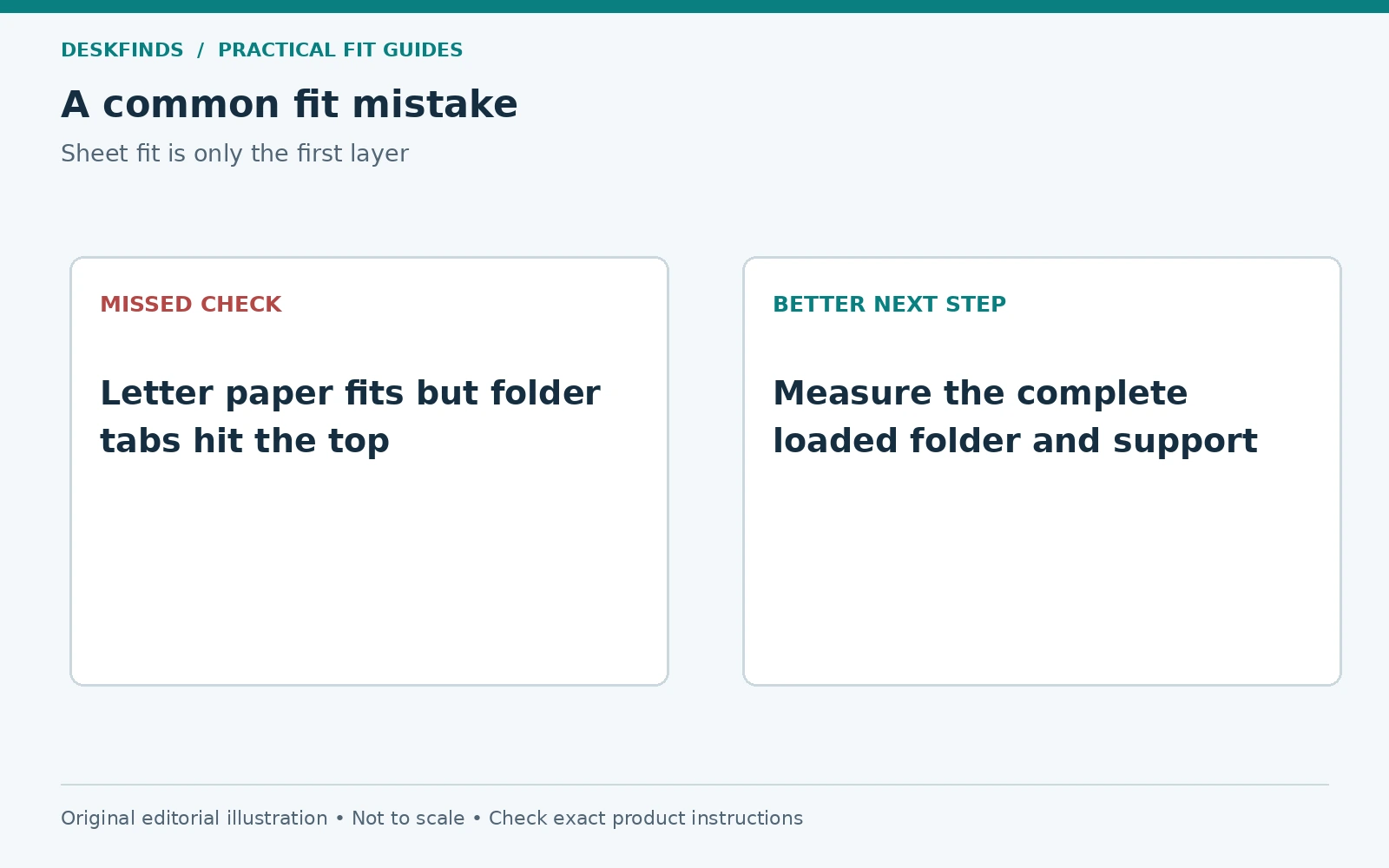
A buyer measures a sheet and finds a drawer slightly larger in both horizontal dimensions. The intended folders include tabs that extend above the clear height. The drawer closes on the tabs even though the paper lies within its footprint. The sheet-size test passed, but the complete-folder test failed.
The buyer compares a different storage orientation or a suitable file box. Removing labels may make the drawer close but can undermine retrieval, and folding tabs is not a general solution. The full system should serve identification as well as containment.
This example is especially relevant to shallow desk drawers. They may suit loose active papers or writing tools without being suitable for upright filing. A product called a document drawer should still be assessed from its actual usable dimensions.
Example: mixed Letter and A4 in one system
Another user receives both US and international documents. A Letter-only folder arrangement leaves longer A4 sheets protruding or bending. The user measures the complete mixed-format set and asks the storage manufacturer about explicit compatibility rather than assuming the difference is negligible.
One option is a system designed for the required formats. Another is separate clearly labeled storage for the minority format, if appropriate for the task and document needs. The choice depends on access frequency and space, not an assumption that all office paper is interchangeable.
If a removable frame is considered, its full dimensions and load requirements are checked before purchase. A frame that accepts the right folder can still be too large for the drawer or block access at the rear. Compatibility must pass at every layer.
Keep loading and cabinet stability in view
Read the cabinet's drawer and total load limits and any anti-tip requirements. Paper can become heavy as files accumulate. Do not infer allowable loading from how easily the empty drawer slides. Use the furniture's intended installation and operating rules, including restrictions on opening multiple drawers where specified.
Distribute contents according to the instructions and avoid using the open drawer as a work surface or support for body weight. If a cabinet needs anchoring, include the approved installation and room permission in the plan. The filing layout is not complete until the furniture can be used as intended.
Review growth realistically. A small active file system may be more useful than filling a large cabinet with material that should be archived elsewhere under the applicable policy. This article does not decide retention, but it encourages separating active access needs from long-term storage volume.
Design labels around retrieval
Choose categories that reflect how you look for documents. A few meaningful groups can be easier to maintain than a complicated sequence of tiny labels. Keep sensitive information out of labels visible to others where appropriate. Storage organization and information privacy are different requirements.
Test a retrieval task: find one document, remove it, use it, and return it. Notice whether the folder row collapses, labels are hidden, or the drawer must be emptied to reach the back. Those are practical design failures even if all dimensions fit.
Use dividers only when they improve support and access. They consume width and can reduce capacity. Check that their height and attachment suit the drawer. A fitted organizer should not jam the slides or require force to close the cabinet.
Decide when another storage type is better
A file box can move with a project or shared desk, but its loaded weight and handle need assessment. A desktop holder offers immediate access but occupies the work surface. A cabinet can provide more capacity, though it needs floor and opening space. Compare the complete task rather than treating a drawer as the default.
Our file cabinet versus box guide and hanging versus manila folder guide can help define the system. Use our commercial filing guides only after the format, support method, and available space are clear.
Keep a purchase brief with paper formats, complete folder dimensions, rail requirements, usable drawer measurements, load, and room access. Ask for missing figures before ordering. A useful file system protects the documents' shape and makes retrieval straightforward; fitting a bare sheet is only the first check.
Make a paper-to-drawer chain of measurements
Write the fit chain in order: sheet, sleeve if used, folder, tab, support frame or rails, drawer interior, drawer opening, and room opening path. Each layer has to accept the previous one. A pass at the sheet level cannot skip the folder and support dimensions. This is the most useful way to investigate a near fit.
For each layer, record whether the figure is a manufacturer specification, a measurement of your actual item, or an unknown. Keep units consistent and avoid rounding away a difference that decides passage. You do not need a complex drawing; a clear list with reference points is enough to make a seller question specific.
If the system fails, identify the first failing layer. A different folder may solve an internal envelope issue, while a different frame may solve a rail issue. A larger cabinet may be unnecessary if the problem is only the chosen insert. Conversely, a new insert cannot fix a drawer that lacks enough clear height for the complete file.
Test with a representative loaded sample
Use a folder containing a realistic amount and type of material, not the thinnest empty example. Add the actual sleeves and tabs. Check how the folder opens, expands, and returns to its place. A system that works for one empty folder can become difficult once the row contains normal working files.
For a hanging system, confirm seating and movement as instructed by the manufacturer. The folder should not balance on improvised supports or require its bars to bend. Check that the bottom and tabs clear the drawer's intended space. If a frame is adjustable, use only its supported configurations and keep any required hardware in place.
Then retrieve a file from the front, middle, and rear. The middle position often reveals whether the row has enough browsing room. The rear test reveals limited drawer extension. A complete trial should include returning the file without disturbing the labels or forcing the drawer closed.
Keep mixed-format exceptions visible
If most documents are Letter but some are A4, record the exception rather than hiding it in a general paper category. Measure the longer sheets and their protective materials. If a separate storage location is chosen, label it clearly so the minority format does not become an untracked pile beside the cabinet.
Do not fold an important document simply because the current drawer is almost large enough. Whether folding or another treatment is acceptable depends on the document and its use. Choose suitable storage and preservation advice where needed. This guide's physical-fit process does not determine what alterations a document can tolerate.
A mixed-format collection can also include envelopes and booklets whose dimensions differ from both standards. Keep those in the inventory. A small exception may be handled separately, while a frequent category may justify a more flexible system. The decision should follow actual access and storage needs rather than a universal preference for one paper size.
Separate working capacity from future accumulation
Estimate how many active folders need to be browsed comfortably now and how that number is likely to change. Do not calculate capacity only from tightly compressed empty folders. Loaded documents and access space consume depth. A drawer that closes at maximum density may be unpleasant to use long before it is physically full.
Keep archive decisions separate from furniture capacity. If the applicable policy requires long-term storage, choose an appropriate location and system. If material can be disposed of, follow the correct policy and secure method. Buying a deeper drawer is not a substitute for deciding what belongs in the active system.
Review the row when labels become hidden or files are difficult to move. These are practical signs that the working capacity has been exceeded, even if another folder can be forced in. A useful filing system should preserve retrieval and return rather than reward the largest possible count.
Ask about rail compatibility with a precise sketch
Show the drawer's clear internal dimensions and the intended folder orientation. Ask the frame or cabinet manufacturer which formats and folder interfaces are explicitly supported. Avoid asking only whether it takes office files. That phrase leaves the decisive format and support details unspecified.
If a retailer supplies a generic reply, request the relevant drawing or manual for the exact product. Keep the answer with the purchase record. The goal is a verified chain from document to storage, so that the final drawer can close normally and each file can be retrieved without bending, balancing, or dismantling the row.
Save one reference folder
Keep the dimensions and identity of a representative compatible folder in the storage record. When buying replacements, compare the exact current product rather than relying only on the Letter or A4 label. Tabs, sleeves, bar shapes and expansion can differ. A reference sample can reveal a mismatch early, but the cabinet and frame documentation still control supported use. Recheck the drawer opening and loading when the system grows. The goal is a file row that remains easy to browse and close normally, not a drawer whose original fit is slowly lost through unexamined substitutions.
Sources and scope
- HP worldwide paper sizes - Letter and A4 dimensions.
- National Archives folder requirements - example showing that a folder's dimensions differ from the sheet it contains; these are not universal consumer-folder specifications.
The drawer worksheets and mixed-format examples are original editorial guidance. They do not certify archival suitability, security or a universal hanging-rail spacing.