
How to Choose a Desktop Organizer for Notebooks and Thick Planners

Affiliate Disclosure: We may earn a small commission on qualifying Amazon purchases at no extra cost to you. Full disclosure →
A desktop sorter can have several slots and still fail to hold one thick planner. Binding rings, spiral wire, rigid covers, tabs, and the space needed to grip a book all change the required opening. Count usable compartments for the actual objects rather than buying the most slots.
Quick answer: Measure each notebook or planner closed in its normal stored condition, including binding and projecting parts. Compare usable slot width, support height, base depth, retrieval direction, and the organizer’s complete footprint. Test whether books remain stable and easy to remove without blocking the monitor, lamp, or mouse area.
Inventory by actual shape
Group thin notebooks, thick planners, ring binders, loose folders, and reference books separately. A planner’s nominal page size does not describe its cover or binding width. Include tabs, elastic closures, and covers that project beyond the paper.
Decide whether the object stores closed, partly open, or inside a sleeve. Choose a routine supported by the object and organizer. Do not force a book into a narrow slot or compress a binding simply to use an attractive sorter.
Measure slot width correctly
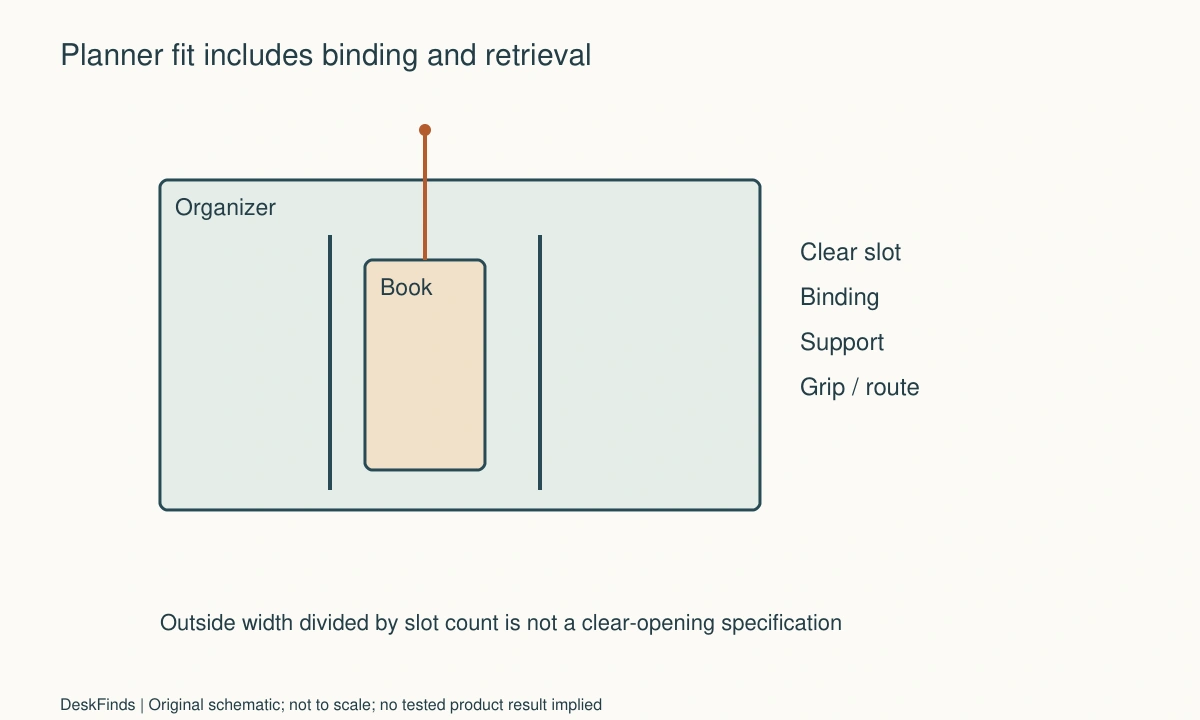
Ask for clear width between dividers at the height where the planner passes. Outside organizer width divided by slot count is not a reliable internal measurement. Dividers, taper, and decorative edges consume space.
If slots vary, map each one. A stepped sorter may have compartments with different depth or support. Keep the object-to-slot assignment explicit instead of assuming all notebooks can go anywhere.
Compare support height and depth
A tall planner in a shallow low-sided compartment may lean or tip. A deep compartment can support it but make a short notebook hard to see or grip. Match the useful supported area to the object.
Check whether the organizer’s maker specifies intended objects or loading. Do not turn a lightweight letter sorter into a heavy book rack without appropriate support information. A metal appearance alone does not establish its capacity or stability.

Plan the retrieval direction
Will the planner lift upward, slide forward, or pull sideways? Include the user’s grip and any shelf above. A slot that fits the closed book may still be inconvenient if the monitor or lamp blocks removal.
Place daily planners where they can be reached without leaning across the screen. Put occasional references farther away if appropriate. The active work area should not become a permanent storage wall that pushes keyboard and mouse out of position.
Consider adjustable dividers
An adjustable organizer can suit mixed thicknesses, but check how dividers lock and which positions are supported. Moving one divider may change the stability of neighboring contents. Use the intended configuration rather than leaving parts loosely balanced.
Compare the complete footprint at the required spacing. An expandable rack may fit folded in a product photo but occupy much more desk width when holding several thick items. Measure the loaded arrangement.
Keep active and archived paper separate
A daily planner belongs to an active work routine. Old notebooks or records may be better elsewhere. Do not buy a larger desktop rack simply because inactive paper has no filing destination.
For incoming loose paper, use a distinct process. Our paper inbox guide prevents an organizer from becoming a mixed pile of tasks and references. A planner slot should remain usable rather than filling with unsorted envelopes.
For active incoming papers, use a simple paper inbox.
Check finish and movement
The loaded organizer should sit on an appropriate stable surface. Check compatible feet or backing and desk care instructions. Dragging a heavy rack can mark a finish or pull nearby cables.
Do not place it partly over a desk edge to reclaim space. A raised shelf is another support system with its own capacity and reach requirements. Keep the load and its retrieval movement within the intended arrangement.

Example: the spiral binding controls the fit
Imagine a planner whose pages fit a standard paper-size slot but whose spiral binding is substantially thicker than the closed pages. The user measures only the cover width and chooses a multi-slot sorter. The planner catches at the divider during removal.
The user records the complete stored thickness and compares a wider clear compartment or a suitable adjustable rack. A second issue appears: the planner needs upward removal beneath a low shelf. Moving the organizer to a reachable side position solves that route without raising the screen.
Only current notebooks remain on the desk. Inactive ones move to suitable storage, allowing a smaller rack with useful compartments rather than a large assortment of narrow slots. The final purchase is based on loaded fit and retrieval.
Make a notebook-to-slot map
| Object | Record |
|---|---|
| Daily planner | Complete thickness, height, and binding projection |
| Notebook | Stored orientation and cover size |
| Ring binder | Ring mechanism, cover depth, and gripping space |
| Reference book | Weight and required side support |
| Loose papers | Separate active-paper destination |
For sorter categories, compare desk organizer types. For filing formats, see hanging and manila folders. Keep each storage format tied to the object it must hold rather than assuming one rack should solve all desk paper needs.
Test the ordinary session
Retrieve the planner, write, return it, and use the mouse with the organizer fully loaded. Notice any object moved unnecessarily. A useful organizer reduces those interruptions and keeps the daily book visible. It should not win on slot count while making the most important item difficult to use.
Match each object to one clear compartment
Make a notebook-to-slot list with the complete stored thickness, height, depth, weight where relevant, and removal direction. Include spiral wire, rings, tabs, hard covers, and any sleeve. A page-size label is a weak fit specification for a thick planner. The widest relevant part of the stored object must pass the clear opening, and the hand needs an appropriate way to grip it without dragging neighboring items out.
Ask for clear internal slot dimensions when the seller provides only overall width and compartment count. Dividers have thickness, slots can taper, and an expandable product can occupy a different shape when loaded. Dividing total width by the number of slots can produce a misleading answer. A useful drawing or support response should identify the actual opening and the configuration in which it is measured.
Consider support and retrieval together. A tall heavy planner may need more side or rear support than a letter sorter offers. A short notebook can disappear below a high front edge or become hard to grip. A divider that fits the thickness may still provide an unsuitable shape for the book. Use the maker’s intended objects and loading rather than inferring stability from material appearance.
Keep active work separate from desktop archive. A current planner and frequently used notebook may justify a visible accessible rack. Old notes can use another appropriate destination. Filling a desk organizer with inactive material can push the mouse and writing area away from the user, creating a new problem in the name of storage. Decide which objects genuinely need to remain within daily reach before increasing slot count.
For adjustable dividers, check how they retain their position and which arrangements are supported. Do not leave a loose divider balanced between books or expand a rack beyond its intended range. The complete loaded footprint, including the removal path, should fit the desk. A product that is compact while empty may no longer be small when opened wide enough for several thick planners.
Use the actual desk scene for the trial. The monitor, lamp, keyboard, and overhead shelf can obstruct upward or sideways removal. If the organizer needs moving every time the planner is used, compare another orientation, format, or location. Storage earns its surface area when it makes the important book easier to use, not merely when every object can be wedged into a slot.

Worked comparison: page size matches, binding does not
Imagine a worker choosing a multi-slot desktop organizer for a daily planner, two notebooks, and a ring binder. The product lists a suitable paper format and many compartments. The worker initially assumes those labels establish fit.
Measuring the stored objects reveals the planner’s spiral and the binder’s ring structure control thickness. The seller’s outside organizer width cannot confirm clear slot width. The worker requests the internal dimensions or compares a documented wider compartment instead of forcing the planner between dividers.
A suitable compartment accepts the planner, but the low shelf above the desk blocks upward removal. Turning the organizer changes the retrieval direction and the footprint. The worker tests that orientation with the keyboard and mouse active, not just the books resting in place.
The binder adds another issue: its height and weight make a lightweight shallow sorter an uncertain support. The worker checks the intended loading and object range. A different appropriate holder or another storage location may be better than treating every book as equivalent to loose letters.
Inactive notebooks are removed from the desktop group and sent to suitable reference storage. This allows fewer useful compartments rather than a large bank of narrow slots. One clearly defined active-paper destination handles loose incoming documents, so the planner’s compartment does not become an unsorted mail pile.
The worker retrieves, writes in, and returns the planner during a normal call and computer session. The pen cup and a lamp base initially enter the forearm route, so their positions are revised. The organizer’s backing and loaded movement are checked against the desk finish instructions.
The final purchase has fewer nominal slots than the original candidate but fits the real objects and retrieval task. The outcome is not a universal endorsement of adjustable or fixed dividers. It follows the planner’s complete shape, supported book arrangement, active work area, and room for the user’s hand.
Buy fewer useful slots
Count the objects that genuinely need daily desktop access, then compare how many suitable compartments they require. A rack with many narrow slots may offer less useful storage for thick planners than a smaller one with the correct clear widths and support. More dividers can also make gripping and returning books awkward.
Keep an empty allowance only when it serves a plausible routine. Buying a large rack for every future notebook can permanently consume the current mouse or writing area. Inactive records and old notebooks may belong elsewhere. The desk organizer should not become the archive merely because it is visible.
For mixed objects, check each assignment. A binder’s ring construction, a planner’s spiral, and a slim notebook may require different slots or support. Do not assume the largest compartment solves every orientation. The hand’s approach and overhead space can control whether a physically fitting object is actually convenient to use.
If the rack is adjustable, record the supported configuration that works. A new thick object can change the neighboring compartments and overall width. Recheck retention and stability rather than moving a divider casually into an unsupported position. Keep the instructions so the system can be restored correctly after cleaning or a move.
During the return period, use the planner through several ordinary sessions. Include taking notes, opening the binder, reaching the keyboard, and moving the lamp. A new organizer often feels spacious before the rest of the desk returns. The useful trial is the loaded complete workstation, with the same objects that will remain there afterward.
If one book still needs several other objects moved each time, choose another location or format. A storage accessory earns its footprint by making that routine easier. A neat row of covers is not a successful result when the main planner is harder to retrieve than it was before the purchase.
For a different paper format, compare organizer and tray roles.
Your practical comparison worksheet
Use the following checks with the actual people, objects, and room in your plan. Record a measured value, an observed task result, or the exact product information that answers each point. Keep unresolved details separate from confirmed ones. A result about one feature should not silently establish another: physical fit, ordinary use, support, and care may require different evidence. Work through the checks before ordering, then repeat the relevant actions with the delivered item while the return terms apply. The worksheet is a planning aid rather than a product test or approval for an improvised installation.
1. Object envelope
Measure each book closed as stored, including covers, spiral wire, rings, tabs, sleeves, and the relevant supported weight.
Do not use nominal page size as the complete fit. The binding or projecting part can determine the clear width and retrieval route.
2. Clear slot
Obtain internal width and shape at the point the object must pass, noting taper, divider thickness, and varied compartments.
Do not divide overall rack width by slot count and call the result a specification. Ask for the actual clear opening when it decides the purchase.
3. Support
Compare side height, base depth, intended objects, loading, and the book’s tendency to lean in the supported arrangement.
A metal-looking letter sorter is not automatically a heavy book rack. Fit must include stable intended support rather than only a matching thickness.
4. Retrieval
Identify upward, forward, or side removal and include hand grip, shelves, screen, and lamp movement.
A book resting in a slot has not passed if it cannot leave normally. Choose a position that reduces rather than creates repeated object moves.
5. Adjustability
Check divider retention, permitted positions, and the full loaded or expanded footprint for the intended number of thick objects.
Use the documented configuration. A compact empty rack can become wide in use, and loose dividers are not a supported adaptation.
6. Active contents
Separate current planner and frequently used notes from old references, archived records, and incoming loose paper.
Keep the desktop group limited to its real role. Buying more slots should not compensate for material that needs another destination.
7. Desk surface
Check the loaded rack’s complete support, backing, feet, finish compatibility, and movement during retrieval.
Do not overhang a desk edge or drag a heavy organizer across a surface simply to preserve space. Keep the working area and cables usable.
8. Session trial
Retrieve, use, and return the main planner with normal typing, pointing, writing, and call tasks present.
Keep the product only if it simplifies the important task. Compartment count is less useful than a reliable fit for the object used every day.
Sources and scope
- OSHA document-holder purchasing context - General stable support and accessibility context. Slot measurements and book examples are original fit analysis.
Editorial note: This is a research-based planning guide, not a hands-on product review. Worked examples are hypothetical. Follow the exact product instructions and resolve compatibility, installation, and care questions before relying on the arrangement.