
4 Best Travel Routers in 2026
We compared travel routers by real firmware, since an OpenWrt router with built-in VPN clients handles hotel Wi-Fi differently than a basic model.

New to Amazon Prime?
Get fast, free shipping on every pick in this guide, plus Prime Video and exclusive deals.
Try Prime Free

At a Glance
A travel router converts a single hotel Ethernet port or public Wi-Fi hotspot into your own private, secured network, letting multiple devices connect safely without exposing them directly to a shared network.
We compared this lineup on real firmware and VPN capability, since two picks here specifically run OpenWrt with pre-installed OpenVPN and WireGuard clients supporting 30+ VPN providers, while a simpler pick skips OpenWrt support entirely for an easier, more streamlined setup.
5 Criteria to Look For Before Buying a Travel Router
Key buying criteria so you get the right fit the first time.
OpenWrt Support Determines How Much You Can Customize the Router, but Also How Complex Setup Becomes
OpenWrt is an open-source router firmware that unlocks thousands of installable plug-ins and deep configuration control over VPN routing, firewall rules, and network behavior, but this same depth means a first-time user faces more settings and terminology than a simplified mode-based interface presents. This matters significantly if you want to customize VPN split-tunneling or install ad-blocking software directly on the router, and matters less if you just want a private network that works reliably out of the box. Check whether a travel router explicitly supports OpenWrt if customization is a priority, or explicitly favor a non-OpenWrt model if straightforward setup matters more to you.
Pre-Installed VPN Clients Save Real Setup Time Compared to Manually Configuring VPN Software Yourself
A router with OpenVPN and WireGuard pre-installed and compatible with 30+ VPN providers lets you simply log into your existing VPN subscription rather than manually installing and configuring VPN client software on the router's firmware from scratch, a real time saver especially while traveling with limited time or unfamiliar network conditions. This matters significantly if you already have an active VPN subscription you want to run at the router level rather than per-device, and matters less if you don't currently use a VPN service. Check whether your specific VPN provider is named in a router's compatibility list before assuming any travel router works seamlessly with your existing subscription.
Wired Uplink Port Speed Matters More Than Wireless Speed When Connecting to a Hotel's Ethernet Jack
Many hotels and short-term rentals still provide a single wired Ethernet port for internet access, meaning the travel router's wired WAN port speed, whether standard Gigabit or the faster 2.5G found on some models, determines your actual maximum internet speed regardless of how fast the router's Wi-Fi radio itself is rated. This matters more if you're a frequent traveler who values consistently fast wired connections in properties with capable internet infrastructure, and matters less if you're primarily connecting to a hotel's existing Wi-Fi rather than an Ethernet jack. Check the router's wired WAN port speed specifically, not just its wireless speed rating, if maximizing wired hotel internet throughput matters to you.
A Travel Router Is Not the Same Product Category as a Mobile Hotspot or Mi-Fi Device
A travel router requires an existing internet source, either a wired Ethernet connection, a public Wi-Fi network, or a tethered phone connection, and then creates its own private secured network from that source, while a mobile hotspot or Mi-Fi device has its own cellular data connection built in and doesn't require an existing network to connect to. This matters significantly if you're traveling somewhere without any existing Wi-Fi or Ethernet access and specifically need cellular data capability, which a standard travel router cannot provide on its own. Confirm you have or will have access to an existing internet source at your destination before assuming a travel router alone solves your connectivity need.
USB-C Power Input Compatibility With a Standard Power Bank Adds Real Flexibility for Travel Without a Wall Outlet
A travel router that specifically accepts standard 5V/3A USB-C PD power, like the TP-Link Roam 6 pick, can be powered from any compatible portable power bank rather than requiring a dedicated wall adapter or proprietary power connector, useful in a vehicle, train, or location without a convenient outlet nearby. This matters more if you travel by car, train, or in locations with limited outlet access, and matters less if you're always near a standard wall outlet during use. Check a travel router's specific power input requirements if powering it from a portable battery source is a realistic scenario for your travel style.
4 Best Travel Routers in 2026
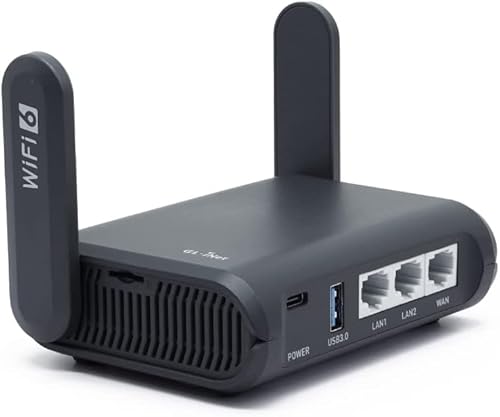
GL.iNet GL-MT3000 Beryl AX
About this pick
This router's listing specifically states a 2.5G multi-gigabit WAN port alongside dual-band Wi-Fi 6 speeds of 574Mbps on 2.4GHz and 2402Mbps on 5GHz, a meaningfully faster wired uplink than the Gigabit-only picks below. Its OpenWrt 21.02 firmware supports over 5,000 ready-made plug-ins, with OpenVPN and WireGuard pre-installed and compatible with 30+ VPN providers.
Compared to the GL-AXT1800 Slate AX below, this one adds a 2.5G WAN port for faster wired hotel internet uplinks, at a lower price than the Slate AX despite the faster port.
Best for buyers who want the fastest wired uplink speed alongside full OpenWrt customization and VPN support.
Best for: buyers who want the fastest wired uplink speed alongside full OpenWrt customization and VPN support
Check price on AmazonPros
- +2.5G WAN port outpaces the Gigabit-only alternatives
- +Full OpenWrt customization with 5,000+ plug-ins
- +Can run VPN client and server simultaneously
Cons
- −Higher price than the basic Roam 6 or Opal picks
- −OpenWrt's depth may be more than a casual user needs
GL.iNet GL-AXT1800 Slate AX
About this pick
This router's listing specifically states OpenVPN speeds up to 500 Mbps and WireGuard speeds up to 550 Mbps, the highest stated VPN throughput in this comparison, alongside support for up to 120 simultaneous connected devices via MU-MIMO and OFDMA. Its built-in NAS feature supports SAMBA and WebDAV protocols for private file sharing from a plugged-in USB hard disk.
Compared to the Beryl AX above, this one trades the 2.5G WAN port for higher stated VPN throughput and NAS file sharing capability, at a slightly higher price.
Best for buyers who prioritize the fastest possible VPN speeds and want built-in NAS file sharing from a travel router.
Best for: buyers who prioritize the fastest VPN speeds and want built-in NAS file sharing
Check price on AmazonPros
- +Highest stated VPN throughput in this comparison
- +Supports up to 120 simultaneous connected devices
- +Built-in NAS file sharing from a USB hard disk
Cons
- −Highest price in this comparison
- −No 2.5G WAN port unlike the Beryl AX
TP-Link Roam 6 AX1500 (TL-WR1502X)
About this pick
This router's listing specifically states three distinct operating modes, Router mode for Ethernet or USB phone tethering, Hotspot mode for securing public Wi-Fi, and AP/RE/Client mode for extending Wi-Fi, giving a clear mode for nearly any hotel or travel scenario without OpenWrt's added complexity. Its compact 4.09 x 3.54 x 1.10 inch size and USB-C power input work with any 5V/3A PD power source, including a portable power bank.
Compared to the two GL.iNet picks above, this one explicitly doesn't support OpenWrt, trading deep customization for a simpler, more approachable setup at less than half the Beryl AX's price.
Best for buyers who want a straightforward, easy-to-set-up travel router without needing OpenWrt-level customization.
Best for: buyers who want a straightforward, easy-to-set-up travel router without OpenWrt complexity
Check price on AmazonPros
- +Simple mode-based setup without OpenWrt complexity
- +USB-C power works with any standard power bank
- +Significantly lower price than the GL.iNet picks
Cons
- −No OpenWrt support for advanced customization
- −Lower stated Wi-Fi speed than the GL.iNet picks
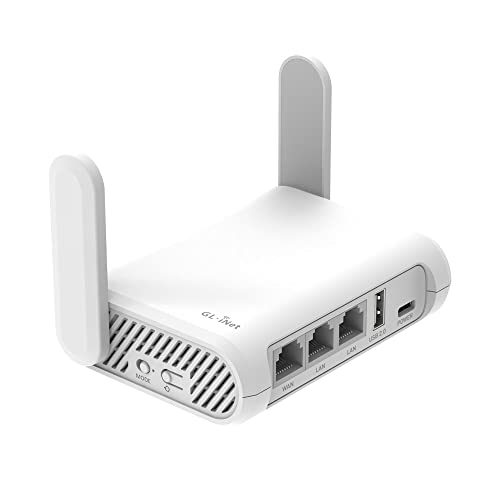
GL.iNet GL-SFT1200 Opal
About this pick
This router's listing specifically states full Gigabit ports, 2 Gigabit LAN and 1 Gigabit WAN, at the same price as the TP-Link Roam 6 pick, along with pre-installed OpenVPN and WireGuard support compatible with 30+ providers. Its lightweight 145g design with retractable antennas balances portability with improved signal reception when extended.
Compared to the TP-Link Roam 6 pick above, this one matches the price while adding Gigabit ports and VPN client pre-installation, though its AC1200 Wi-Fi standard is a generation behind the Wi-Fi 6 speeds of the other three picks.
Best for buyers who want Gigabit wired ports and VPN support at a budget price, without needing Wi-Fi 6 speed.
Best for: buyers who want Gigabit wired ports and VPN support at a budget price without needing Wi-Fi 6
Check price on AmazonPros
- +Full Gigabit wired ports at a budget price
- +Pre-installed VPN client support matching the pricier picks
- +Very lightweight and compact for travel
Cons
- −AC1200 Wi-Fi standard, a generation behind the Wi-Fi 6 picks
- −Does not support easy tethering per the listing
How We Evaluated These Travel Routers
Each pick was assessed across 5 criteria weighted for real-world use.
Firmware and Customization
Compared OpenWrt-based routers offering deep customization against simpler mode-based firmware.
VPN Support and Throughput
Compared pre-installed VPN client/server support and stated OpenVPN/WireGuard throughput.
Wired Port Speed
Compared 2.5G, Gigabit, and standard wired port speeds across the lineup.
Portability and Power Options
Compared physical size, weight, and power input flexibility including USB-C and power bank compatibility.
Setup Complexity
Compared straightforward mode-based setup against OpenWrt's deeper but more complex configuration options.
How to Choose the Right Travel Routers
By Priority
| What matters most | Recommended pick |
|---|---|
| Fastest wired uplink speed | GL.iNet GL-MT3000 Beryl AX |
| Fastest VPN throughput and NAS | GL.iNet GL-AXT1800 Slate AX |
| Easiest setup without OpenWrt | TP-Link Roam 6 AX1500 |
| Budget with Gigabit ports | GL.iNet GL-SFT1200 Opal |
By Budget
| Price range | Recommended pick |
|---|---|
| Under $40 | TP-Link Roam 6 AX1500 or GL.iNet Opal (both $39.99) |
| Under $100 | GL.iNet GL-MT3000 Beryl AX ($98.99) |
| Under $120 | GL.iNet GL-AXT1800 Slate AX ($119.99) |
OpenWrt vs Simplified Firmware
OpenWrt (Beryl AX, Slate AX)
Offers deep customization with thousands of plug-ins, ideal for tech-savvy travelers who want full control over VPN configuration and network behavior.
Simplified firmware (Roam 6, Opal)
A mode-based setup that's faster to configure for a non-technical traveler who just needs reliable Wi-Fi security without deep customization.
Most casual travelers should default to a simplified-firmware router; choose OpenWrt specifically if you want to customize VPN routing rules or install additional network utilities.
By Wi-Fi Generation
| Your bandwidth need | Recommended pick |
|---|---|
| Wi-Fi 6 for multiple 4K streams or video calls | GL.iNet Beryl AX, Slate AX, or TP-Link Roam 6 |
| Basic browsing and email, budget priority | GL.iNet GL-SFT1200 Opal (AC1200) |
For Frequent Hotel Wi-Fi Use Specifically
Look for
A dedicated hotspot or repeater mode that converts a shared public network into your own private, secured network, plus WPA3 support to protect against password brute-force attacks on that private network.
In this comparison
All four picks support converting public or hotel Wi-Fi into a private network, with the Beryl AX and Slate AX specifically adding WPA3 protocol support.
When to Spend More
Spend more if
You want the fastest wired uplink or VPN throughput plus deep OpenWrt customization, where the Beryl AX or Slate AX near $100-120 deliver genuinely faster performance and more configuration depth.
Save if
You want reliable Wi-Fi 6 security with simple setup, where the TP-Link Roam 6 at $39.99 covers that need without OpenWrt's added complexity.
Frequently Asked Questions
What's the difference between a travel router and a mobile hotspot?
A travel router needs an existing internet source, like a hotel Ethernet port or public Wi-Fi, to create its own private secured network, while a mobile hotspot has its own built-in cellular data connection and doesn't require an existing network.
Do I need OpenWrt support in a travel router?
Only if you want deep customization like custom VPN routing rules or additional installed software; most travelers do fine with a simpler mode-based router that skips OpenWrt entirely for easier setup.
Can a travel router improve hotel Wi-Fi speed?
No, a travel router cannot make a slow hotel connection faster; it converts a shared or public connection into your own private, more secure network, which can sometimes reduce congestion from other users sharing the same hotel Wi-Fi.
How do I set up a travel router in a hotel room?
Connect the router to the hotel's Ethernet port if available, or use its hotspot/repeater mode to connect to the hotel's Wi-Fi network, then connect your own devices to the router's newly created private network.
Is Wi-Fi 6 necessary for a travel router?
Wi-Fi 6 provides better performance for multiple simultaneous devices or high-bandwidth activities like video calls and streaming, but a Wi-Fi 5 or AC-standard router is often sufficient for basic browsing and email while traveling.
Can I run a VPN on a travel router instead of installing it on each device?
Yes, most modern travel routers with pre-installed VPN client support let you configure your VPN subscription once at the router level, automatically securing every device that connects to it without individual per-device setup.
Bottom Line
best overall: GL.iNet GL-MT3000 Beryl AX - best overall pick in this roundup.
See the full rankings above for all picks with pros, cons, and best-for summaries.
Browse on Amazon
All Prime-eligible options with current pricing.
Shop on Amazon →