
4 Best Pocket and Mini Travel Routers in 2026
We compared pocket travel routers by real size and weight, since two models weigh just 39 grams while others prioritize more ports over minimal size.

New to Amazon Prime?
Get fast, free shipping on every pick in this guide, plus Prime Video and exclusive deals.
Try Prime Free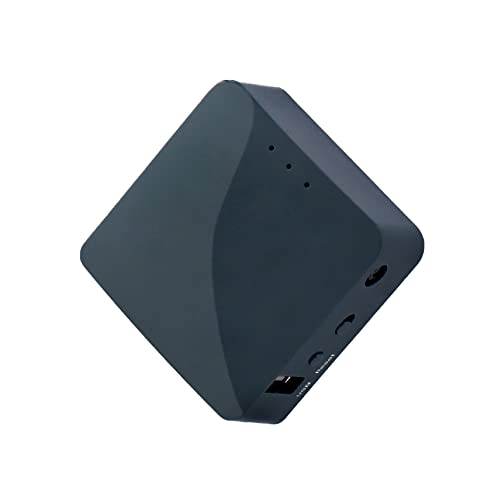


At a Glance
TP-Link N300 Wireless Portable Nano Travel Router (TL-WR802N)
↓ See why we picked itA truly pocket-sized travel router prioritizes minimal size and weight above all else, trading some ports or advanced features for a device that genuinely disappears into a jacket pocket or small bag compartment.
We compared this lineup on real stated weight and dimensions, since two picks here weigh just 39 grams, dramatically lighter than a standard travel router, while others prioritize additional Ethernet ports or VPN server capability over achieving the smallest possible footprint.
5 Criteria to Look For Before Buying a Pocket and Mini Travel Router
Key buying criteria so you get the right fit the first time.
A Router's Stated Weight in Grams Is a More Reliable Comparison Point Than 'Pocket-Sized' Marketing Language
Multiple travel routers describe themselves as pocket-sized or compact in marketing copy, but only a specific stated weight (like 39 grams) and dimension measurement give you an objective way to compare actual physical size between listings, since 'pocket-sized' can mean very different things depending on the specific pocket or bag compartment you have in mind. This matters significantly if minimizing carry weight is a genuine priority, like for backpacking or strict carry-on luggage limits, and matters less if you have ample room in checked luggage or a larger travel bag. Check for a specific stated weight and dimension figure rather than relying on marketing terms like 'pocket-sized' or 'compact' alone.
The Smallest Routers Often Trade Away Dual-Band Wi-Fi for 2.4GHz-Only Operation
Both of the lightest routers in this comparison operate on 2.4GHz only, while the slightly larger TP-Link WiFi 5 pick offers dual-band AC750 speed, meaning the smallest physical size sometimes comes with a real bandwidth tradeoff since 2.4GHz networks are more prone to congestion and interference in busy areas like hotels or airports. This matters more if you're often in Wi-Fi-congested environments where 5GHz's cleaner spectrum offers a real speed advantage, and matters less for basic browsing and email where 2.4GHz's range advantage can actually help. Check whether a compact router specifically supports 5GHz if congestion resistance and speed matter more to you than achieving the absolute minimum size.
Operation Mode Flexibility Determines How Many Different Travel Scenarios a Single Router Can Actually Handle
A router supporting 5 distinct operation modes, like router, AP, client, repeater, and WISP, can adapt to a wider range of situations, from connecting to a hotel's wired Ethernet, to extending an existing weak Wi-Fi signal, to connecting through a WISP-style outdoor antenna setup, while a simpler router might only support a router or hotspot mode. This matters more if you travel to varied locations with different connectivity setups (hotels, campgrounds, coworking spaces), and matters less if your travel pattern is consistent and always involves the same type of connection. Check the specific number and type of supported operation modes if your travel involves genuinely varied connectivity scenarios.
VPN Software Included on the Smallest Routers Isn't Guaranteed, Even Among Otherwise Similar Ultra-Light Models
Two routers can share nearly identical size and weight specifications while differing significantly in VPN capability, as seen between the two 39-gram picks in this comparison, one offering client and server support with WireGuard while the other offers OpenVPN client only. This matters if VPN protection is a requirement alongside minimal size, and matters less if you plan to run VPN software on your individual devices rather than at the router level. Check a compact router's specific VPN feature list rather than assuming similar-sized units offer identical security capability.
A Router Designed Specifically for Ethernet-to-WiFi Conversion Solves a Different Problem Than a General-Purpose Pocket Router
Some travel routers are specifically designed around converting a wired Ethernet-only connection into Wi-Fi, useful for older hotels or rentals that never upgraded to in-room Wi-Fi, while a general-purpose pocket router handles wired, wireless, and cellular tethering scenarios more broadly. This matters if you frequently encounter Ethernet-only accommodations, where a purpose-built converter router avoids any Wi-Fi hotspot mode compatibility questions with public networks, and matters less if you mostly deal with existing Wi-Fi networks needing conversion to a private one. Check whether a router's stated design purpose specifically matches your most common connectivity scenario while traveling.
4 Best Pocket and Mini Travel Routers in 2026
GL.iNet GL-AR300M16 Mini Travel Wi-Fi Router
About this pick
This router's listing specifically states a weight of just 39 grams (1.41 oz) while still including dual Ethernet ports, OpenWrt firmware, and OpenVPN/WireGuard client and server support, a rare combination of genuine pocket size and real feature depth. Its flexible power options, laptop USB, power bank, or 5V/2A DC adapter, mean you're not tied to a specific charger.
Compared to the TP-Link Nano pick below, this one adds OpenWrt customization and VPN server capability at nearly the same ultra-light weight, a meaningfully more capable option for the same portability tradeoff.
Best for buyers who want genuine pocket-sized portability without sacrificing OpenWrt customization or VPN server capability.
Best for: buyers who want genuine pocket-sized portability without sacrificing OpenWrt customization
Check price on AmazonPros
- +Genuine 39g ultra-lightweight design
- +Full OpenWrt customization despite the small size
- +Includes VPN server capability, not just client
Cons
- −2.4GHz-capable dual Ethernet setup requires slightly more configuration
- −128MB RAM limits some advanced use cases
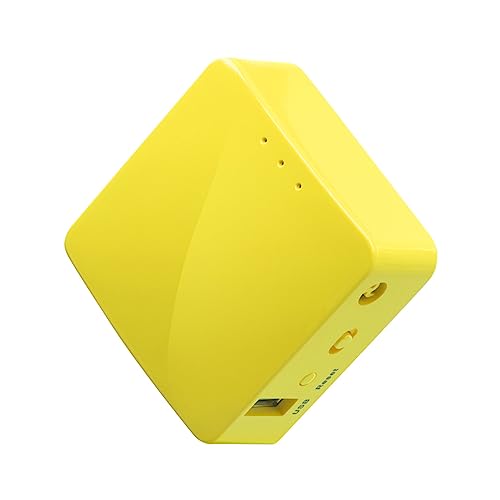
GL.iNet GL-MT300N-V2 (Mango)
About this pick
This router's listing specifically states the same 39g weight as the AR300M16 above at a lower price, with OpenVPN client pre-installed and dual Ethernet ports for wired connectivity options. Its intuitive mobile app and web admin panel are specifically called out for quick, accessible setup.
Compared to the AR300M16 above, this one costs about $7 less but includes OpenVPN client only, without the WireGuard and VPN server support the AR300M16 offers, and its radio is 2.4GHz only rather than dual-band.
Best for budget-conscious buyers who want the same ultra-light 39g size with basic OpenVPN support at a lower price.
Best for: budget-conscious buyers who want ultra-light size with basic OpenVPN support at a lower price
Check price on AmazonPros
- +Same ultra-lightweight 39g size as the pricier AR300M16
- +Lower price than the AR300M16
- +Easy setup via mobile app or web panel
Cons
- −2.4GHz only, no 5GHz band
- −OpenVPN client only, no WireGuard or server capability stated
TP-Link N300 Wireless Portable Nano Travel Router (TL-WR802N)
About this pick
This router's listing specifically states support for 5 distinct operation modes, Router, AP, Client, Repeater, and WISP, more mode flexibility than most compact travel routers in this comparison offer. Its industry-leading 2-year warranty with unlimited 24/7 technical support backs a genuinely pocket-sized nano design.
Compared to the GL.iNet picks above, this one skips OpenWrt and VPN client software entirely in favor of a simpler, mode-based setup with more operational flexibility for different network scenarios.
Best for buyers who want maximum flexibility across different network scenarios (repeater, WISP, client) without needing OpenWrt or VPN features.
Best for: buyers who want maximum operation mode flexibility without needing OpenWrt or VPN features
Check price on AmazonPros
- +Most operation mode flexibility in this comparison at 5 modes
- +Industry-leading 2-year warranty with 24/7 support
- +Genuinely pocket-sized nano design
Cons
- −No VPN client software unlike the GL.iNet picks
- −2.4GHz only, no 5GHz band
TP-Link WiFi Travel Router (WiFi 5)
About this pick
This router's listing specifically states it creates a Wi-Fi network via Ethernet, a design purpose built for hotel rooms or rentals that only provide a wired internet jack with no Wi-Fi. Its AC750 dual-band speed and one-switch mode selector for home, hotel, or on-the-road use simplify switching contexts.
Compared to the three picks above, this one's dual-band AC750 Wi-Fi and Ethernet-focused design make it a solid choice specifically for properties with only a wired connection available, at a slightly higher price than the ultra-light GL.iNet picks.
Best for buyers who frequently stay in properties with only a wired Ethernet jack and no Wi-Fi available.
Best for: buyers who frequently stay in properties with only a wired Ethernet jack and no Wi-Fi
Check price on AmazonPros
- +Specifically designed for Ethernet-only hotel rooms
- +Dual-band AC750 speed for HD streaming
- +One-switch mode selector simplifies context switching
Cons
- −No VPN client software unlike the GL.iNet picks
- −Slightly higher price than the ultra-light picks in this comparison
How We Evaluated These Pocket and Mini Travel Routers
Each pick was assessed across 5 criteria weighted for real-world use.
Physical Size and Weight
Compared stated weight and dimensions to identify genuinely pocket-sized units versus standard-sized travel routers.
Feature Depth at Minimal Size
Compared which compact routers retain OpenWrt, VPN, or multi-mode capability despite their small footprint.
Operation Mode Flexibility
Compared the number of distinct operation modes (router, AP, repeater, WISP, client) each unit supports.
Power Flexibility
Compared USB, power bank, and DC adapter power compatibility.
Warranty and Support
Compared stated warranty length and support availability across listings.
How to Choose the Right Pocket and Mini Travel Routers
By Priority
| What matters most | Recommended pick |
|---|---|
| Smallest size with full VPN features | GL.iNet GL-AR300M16 Mini |
| Smallest size, lowest price | GL.iNet GL-MT300N-V2 (Mango) |
| Maximum mode flexibility | TP-Link N300 Nano (TL-WR802N) |
| Ethernet-only hotel rooms | TP-Link WiFi Travel Router (WiFi 5) |
By Budget
| Price range | Recommended pick |
|---|---|
| Under $30 | GL.iNet Mango or TP-Link N300 Nano (both $29.99) |
| Under $37 | GL.iNet GL-AR300M16 Mini ($36.99) |
| Under $40 | TP-Link WiFi Travel Router WiFi 5 ($39.99) |
Ultra-Light OpenWrt vs Simplified Nano Routers
Ultra-light OpenWrt (AR300M16, Mango)
Delivers genuine pocket size without sacrificing VPN client software, ideal if security features matter alongside minimal size.
Simplified nano (TP-Link N300, WiFi 5)
Trades VPN software for broader operation mode flexibility or Ethernet-to-WiFi conversion focus, a reasonable choice if you don't need VPN on the router itself.
If VPN protection matters to you, default to the GL.iNet picks; if you need repeater or WISP mode flexibility instead, the TP-Link nano picks cover that better.
By Power Source
| Available power source | Recommended pick |
|---|---|
| Laptop USB port or power bank | GL.iNet GL-AR300M16 or Mango |
| Standard wall adapter | TP-Link N300 Nano or WiFi 5 Travel Router |
For Ultralight Backpacking or Minimalist Carry-On Travel Specifically
Look for
A specifically stated weight under 50 grams, since every gram matters when optimizing a minimalist travel kit, and many standard travel routers weigh considerably more without stating an exact figure.
In this comparison
Both the AR300M16 and Mango specifically state a 39g weight, the lightest options in this comparison for weight-conscious minimalist travel.
When to Spend More
Spend more if
You want the smallest possible size while keeping VPN server capability and OpenWrt customization, where the AR300M16's $36.99 price delivers that specific combination.
Save if
You just need basic OpenVPN protection in the smallest package, where the Mango at $29.99 covers that need at the lowest price in this comparison.
Frequently Asked Questions
How small is a genuinely pocket-sized travel router?
The lightest models in this comparison weigh just 39 grams (about 1.4 ounces), significantly lighter than a standard travel router, small enough to fit easily in a jacket pocket or small bag compartment.
Do the smallest travel routers sacrifice features for their size?
Not always; some ultra-light 39-gram routers in this comparison still include OpenWrt customization and VPN client and server support, though others trade away 5GHz Wi-Fi or VPN software for the smallest possible size.
Can a pocket travel router work in a hotel room with only an Ethernet jack?
Yes, but check that the specific model supports converting a wired connection to Wi-Fi; some travel routers are specifically designed for this Ethernet-to-WiFi conversion scenario.
Is 2.4GHz-only Wi-Fi a problem for a travel router?
It can be more prone to congestion in busy areas like hotels or airports compared to 5GHz, though it also offers better range, so the tradeoff depends on your specific environment and priorities.
What's the difference between router mode and repeater mode on a pocket travel router?
Router mode typically connects to a wired or tethered internet source and creates a new network, while repeater mode extends an existing Wi-Fi signal that's already present but weak in your current location.
Do I need OpenWrt on a pocket travel router?
Only if you want deep customization or plan to install additional network software; several pocket-sized routers in this comparison skip OpenWrt entirely in favor of a simpler, more accessible setup process.
Bottom Line
best overall: GL.iNet GL-AR300M16 Mini Travel Wi-Fi Router - best overall pick in this roundup.
See the full rankings above for all picks with pros, cons, and best-for summaries.
Browse on Amazon
All Prime-eligible options with current pricing.
Shop on Amazon →