
8 Best Docking Stations for Dual & Multi-Monitor Setups in 2026
8 best docking stations for dual and multi-monitor setups in 2026, from budget DisplayLink hubs to Thunderbolt 5 docks. Compare simultaneous 4K support and bandwidth.

New to Amazon Prime?
Get fast, free shipping on every pick in this guide, plus Prime Video and exclusive deals.
Try Prime Free




At a Glance
UGREEN 8-in-1 Thunderbolt 4 Docking Station (Revodok Max 208)
↓ See why we picked itA docking station that lists "dual monitor support" doesn't always mean two 4K displays running at full 60Hz at the same time. Many docks split available bandwidth so one port caps at 30Hz or drops to 1440p once a second screen is active, which is exactly the kind of fine print that trips up buyers who assume dual monitor support means the same thing on every listing.
Below are 8 docking stations we evaluated for their ability to drive two or more displays simultaneously, spanning DisplayLink-based budget hubs, certified Thunderbolt 4 docks, and the newest Thunderbolt 5 hardware, ranging from a $119.99 compact 13-in-1 to a $499.99 professional Thunderbolt 5 workstation dock.
5 Criteria to Look For Before Buying a Docking Stations for Dual & Multi-Monitor Setup
Key buying criteria so you get the right fit the first time.
Check the real power delivery wattage, not just "PD" in the listing
Power delivery (PD) wattage determines whether a dock can actually charge your laptop while it's connected, not just pass a trickle of power through, and this number varies widely, from 60W barely-adequate figures up to 100W or higher business-tier docks.
This matters because a dock rated below what your laptop actually needs to charge under load, especially a larger laptop or one running demanding tasks while docked, will slowly drain the battery even while "charging", a frustrating and easy-to-miss problem.
Check the listing for the specific PD wattage number, and compare it against your laptop's actual charging brick wattage, not just whether the listing mentions power delivery at all.
Verify actual display support against your specific laptop and GPU, not just port count
A dock listing multiple HDMI or DisplayPort outputs doesn't guarantee your laptop can actually drive all of them at full resolution and refresh rate simultaneously, that capability depends on your laptop's specific GPU and USB-C controller, which some docks work around using DisplayLink technology and others don't.
This distinction matters a lot if you're building a dual or triple monitor setup, since a laptop that can't natively drive multiple external displays will show a blank or mirrored screen on a non-DisplayLink dock's extra port, regardless of how many ports the dock has.
Check whether the dock uses native DisplayPort Alt Mode or DisplayLink chip technology, and separately verify your specific laptop model's documented maximum number of external displays before assuming any multi-port dock will drive them all.
Match data transfer speeds and Ethernet to what you actually move and how
USB data ports on a dock range widely in real transfer speed, from basic 480Mbps USB 2.0 speeds up to 10Gbps or higher, a gap that matters enormously if you regularly move large files to and from external drives, but barely matters if you're just charging a mouse and keyboard.
Ethernet port speed follows the same logic, a dock's Gigabit or 2.5Gb Ethernet port is only as fast as your actual home or office network infrastructure supports, so paying for 2.5Gb Ethernet on a network that tops out at Gigabit gains nothing.
Check the specific listed speed for each port type you'll actually use regularly, and compare Ethernet speed against your router's actual rated speed, not just the dock's spec sheet in isolation.
Confirm compatibility with your specific laptop's USB-C or Thunderbolt port
Not every USB-C port supports the same features, some laptops only support USB-C data and charging without any video output over that port at all, while others support full Thunderbolt with much higher bandwidth for multiple 4K displays.
Docks built around Thunderbolt certification generally support more demanding multi-display and high-speed configurations, but require a genuinely Thunderbolt-capable port on your laptop to unlock that performance, plugging a Thunderbolt dock into a USB-C-only port still works but loses the extra bandwidth.
Check your specific laptop's documented port capabilities (Thunderbolt 3, Thunderbolt 4, or USB-C without Thunderbolt), not just that it has a USB-C-shaped port, before assuming any docking station will unlock its full advertised capability.
Consider heat and long-term reliability under sustained daily use
A docking station that stays plugged in and under load for 8+ hours a day handles thermal stress very differently than a hub used occasionally for a quick file transfer, and a compact plastic-bodied dock with no real heat dissipation can throttle performance or degrade faster under that kind of sustained daily use than an aluminum-bodied one.
This matters more for anyone using the dock as their primary daily workstation setup than for occasional or travel use.
Check reviews specifically for mentions of the dock running hot, disconnecting intermittently after extended use, or degrading over months, rather than relying on the unboxing-day performance most reviews describe.
8 Best Docking Stations for Dual & Multi-Monitor Setups in 2026
WAVLINK Pro Dual 4K@60Hz Universal Docking Station
About this pick
The WAVLINK Pro is a universal docking station built around DisplayLink software rather than native Thunderbolt, which is how it manages simultaneous dual 4K@60Hz output at this price point. It accepts either a USB-C or USB-A host connection, so it works across a wider range of older and newer laptops than most Thunderbolt-only docks.
Because it relies on DisplayLink's CPU-based compression to drive the second display, it's a solid fit for office productivity and everyday multitasking but can introduce a touch of input lag that's noticeable in fast-motion video editing or gaming. For spreadsheet, browser, and document work across two screens, that tradeoff is easy to live with.
A genuine advantage here is that works over both USB-C and USB-A hosts. The tradeoff is that displayLink compression adds minor input lag.
Best for: Budget buyers who want simultaneous dual 4K without paying for Thunderbolt
Check price on AmazonPros
- +Cheapest true dual-4K@60Hz pick in this guide
- +Works over both USB-C and USB-A hosts
- +Wide compatibility across older and newer laptops
- +Simple universal setup
Cons
- −DisplayLink compression adds minor input lag
- −Not ideal for color-accurate design work or gaming
- −No certified Thunderbolt bandwidth guarantee
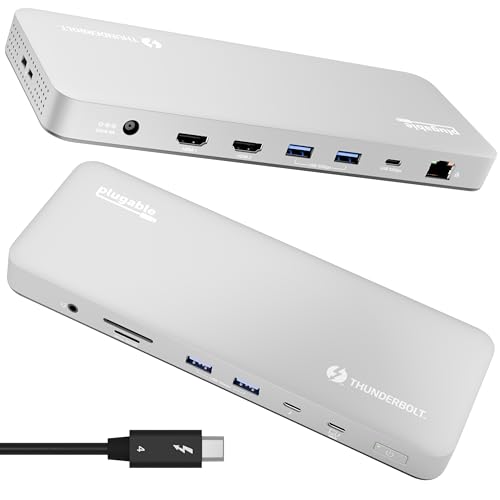
Plugable 16-in-1 Thunderbolt 4 Dock
About this pick
Plugable's 16-in-1 uses genuine, certified Thunderbolt 4 rather than a software-based display driver, so it drives dual 4K monitors natively from the GPU with no compression lag. It's explicitly validated for current M4/M5 MacBook Air/Pro models as well as Windows laptops with true Thunderbolt 4 support.
The dock's 100W charging passthrough and driverless setup make it a strong pick for running two 4K displays alongside a fast external SSD and Ethernet at once, the kind of simultaneous heavy load that can saturate a lesser dock's USB controller. Sixteen ports also mean you're less likely to need a secondary hub daisy-chained on top.
No DisplayLink compression lag. That said, pricier than the DisplayLink and USB-C hub picks. Neither should be a surprise once you know to look for it.
Best for: Buyers running dual 4K plus a fast SSD and Ethernet simultaneously
Check price on AmazonPros
- +Genuine certified Thunderbolt 4, not USB4
- +No DisplayLink compression lag
- +Explicitly validated for the newest Mac chips
- +16 ports reduce the need for extra hubs
Cons
- −Pricier than the DisplayLink and USB-C hub picks
- −100W passthrough may not fully fast-charge the largest workstation laptops
- −Overkill for a simple two-port dual monitor need
UGREEN 8-in-1 Thunderbolt 4 Docking Station (Revodok Max 208)
About this pick
The Revodok Max 208 is genuine 40Gbps Thunderbolt 4, not the USB4 hardware that only claims Thunderbolt compatibility, which matters because Thunderbolt 4's Intel certification guarantees the simultaneous dual 4K@60Hz performance this dock lists, rather than just a "should work" spec. Three Thunderbolt 4 ports give real flexibility for daisy-chaining additional Thunderbolt peripherals. It supports true simultaneous dual 4K@60Hz or a single 8K display, plus 85W charging and Gigabit Ethernet. It lands well below the 16-in-1 Plugable while still carrying the same certified Thunderbolt guarantee, making it the strongest value pick for buyers who specifically need confirmed simultaneous dual-4K@60Hz rather than a dock that only promises it at a lower refresh rate. Worth calling out specifically: confirmed simultaneous 4K@60Hz on both displays. The catch is 85W passthrough falls short of what some workstation laptops draw under load.
Best for: Buyers who want confirmed certified Thunderbolt dual-4K@60Hz at the best price
Check price on AmazonPros
- +Certified Thunderbolt 4 at a lower price than most TB4 docks
- +Confirmed simultaneous 4K@60Hz on both displays
- +3 Thunderbolt 4 ports for daisy-chaining
- +Includes Gigabit Ethernet
Cons
- −85W passthrough falls short of what some workstation laptops draw under load
- −Fewer total ports than the 14-16 port picks
- −No detachable secondary hub like some competitors
Anker Prime Docking Station 14-Port
About this pick
Anker's Prime dock packs 14 ports into one unit, the most of any pick in this guide, and supports up to 160W of total output across connected devices along with dual 4K display support. That port density is genuinely useful once you're running two monitors, an external drive, and a handful of peripherals off a single cable.
The 10Gbps data throughput helps keep large file transfers from bottlenecking display output when everything runs at once, though buyers stacking multiple high-bandwidth tasks simultaneously should still watch for the kind of USB controller saturation that shows up as random disconnects under the heaviest combined loads.
160W max output covers laptop plus multiple peripherals. Set against that, not certified Thunderbolt, so compatibility isn't guaranteed the same way. Both matter when comparing it to the other picks here.
Best for: Buyers who want the most ports and highest wattage in one dock
Check price on AmazonPros
- +Highest port count in this guide at 14
- +160W max output covers laptop plus multiple peripherals
- +10Gbps data keeps transfers fast alongside dual displays
- +Reasonable price for the port count
Cons
- −Not certified Thunderbolt, so compatibility isn't guaranteed the same way
- −Heavy simultaneous loads can still saturate the USB controller
- −Bulkier than the compact single-purpose docks
Plugable Thunderbolt 4 Dock (TBT-UDM)
About this pick
This Plugable dock carries genuine certified Thunderbolt 4, meaning it's held to Intel's compatibility guarantee rather than the looser "should work" standard that applies to generic USB4 hardware, a distinction that matters most for buyers connecting Thunderbolt-specific peripherals. It supports 4K HDMI dual monitor output or a single 6K display, plus 100W charging.
Six USB ports, an SD card slot, and Ethernet round out a compact, driverless setup. It's a smaller footprint than the 16-in-1 Plugable at a lower price, making it the more budget-conscious certified Thunderbolt option for buyers who don't need the full port count.
The standout detail is that 100W charging covers most ultrabooks at full speed. Balancing that out, fewer ports than the higher-end Plugable and Anker docks.
Best for: Buyers who want certified Thunderbolt 4 without paying for a 16-port dock
Check price on AmazonPros
- +Certified Thunderbolt 4 at a lower price than the 16-in-1 model
- +100W charging covers most ultrabooks at full speed
- +Includes Ethernet and SD card reader
- +Compact, driverless design
Cons
- −Fewer ports than the higher-end Plugable and Anker docks
- −100W may fall short for 16-inch workstation laptops under full load
- −Single 6K mode sacrifices the dual-display option
Anker Prime TB5 Docking Station 14-in-1
About this pick
Anker's Prime TB5 moves up to Thunderbolt 5, the highest bandwidth tier in this guide, built for buyers running the most demanding multi-4K or 8K multi-display setups alongside heavy simultaneous data transfer. Fourteen ports keep the connectivity dense without needing a second hub.
Thunderbolt 5's added bandwidth headroom over Thunderbolt 4 is specifically useful for avoiding the USB bus saturation that shows up on lower-bandwidth docks when dual 4K displays, a fast SSD, and other peripherals are all pushing data at once. It's a meaningful step up in price, but it's built for setups that would otherwise bottleneck a standard Thunderbolt 4 dock.
14 ports in one unit. That's a real strength, but weigh it against the flip side: meaningful price jump over Thunderbolt 4 alternatives.
Best for: Buyers pushing multiple 4K or 8K displays plus heavy data transfer at once
Check price on AmazonPros
- +Highest bandwidth tier available in this guide short of the CalDigit
- +14 ports in one unit
- +Extra headroom against USB bus saturation under heavy load
- +Certified Thunderbolt reliability
Cons
- −Meaningful price jump over Thunderbolt 4 alternatives
- −Thunderbolt 5's extra bandwidth is wasted on lighter dual-monitor setups
- −Requires a Thunderbolt 5 or 4 compatible host to fully benefit
CalDigit TS5 Plus Thunderbolt 5 Dock
About this pick
CalDigit built its reputation on professional-grade docking hardware, and the TS5 Plus is its Thunderbolt 5 flagship, positioned squarely for professional multi-monitor workstation setups rather than casual dual-screen use. Its high port count and Thunderbolt 5 bandwidth are built to handle simultaneous multi-4K output alongside demanding storage and networking tasks without the disconnect issues that come from bus saturation on lower-tier docks. It's the most expensive pick in this guide, and it's overkill for anyone who just needs two displays running side by side. It's the right call for a workstation setup running multiple high-refresh 4K or 8K displays alongside professional-grade peripherals where reliability under sustained heavy load is worth paying for. Built to avoid bus saturation under sustained professional workloads. On the other hand, most expensive pick in this guide by a wide margin. Both are worth keeping in mind before deciding.
Best for: Professional workstation setups running multiple 4K or 8K displays under sustained load
Check price on AmazonPros
- +Most feature-complete, highest-spec dock in this guide
- +Built to avoid bus saturation under sustained professional workloads
- +Long-established Thunderbolt dock manufacturer
- +Handles the most demanding multi-display configurations
Cons
- −Most expensive pick in this guide by a wide margin
- −Far more dock than a standard dual-monitor setup needs
- −Best value only realized in genuinely demanding workstation use
Anker Nano 13-in-1 Laptop Docking Station
About this pick
The Anker Nano 13-in-1 pairs a compact main dock with a detachable 6-in-1 hub, giving it a smaller footprint than the full-size docks in this guide while still supporting 3 displays at once, 2 HDMI plus 1 DisplayPort. That's genuinely more simultaneous display support than most docks at this price and size offer.
10Gbps USB-C data and 100W max PD round out the spec sheet, though buyers should keep in mind PD math means the laptop itself typically receives somewhat less than the rated 100W once the dock's own circuitry draws its share. It's the pick for a desk setup that needs 3 displays without committing to a full-size 14-16 port dock.
A genuine advantage here is that detachable hub adds flexibility. The tradeoff is that 100W max PD delivers less in practice once dock overhead is factored in.
Best for: Buyers who want 3-display support in the most compact, portable dock in this guide
Check price on AmazonPros
- +Supports 3 simultaneous displays in a compact size
- +Detachable hub adds flexibility
- +Cheapest way to reach 3-display support in this guide
- +10Gbps data keeps transfers fast
Cons
- −100W max PD delivers less in practice once dock overhead is factored in
- −Not certified Thunderbolt
- −3-display mode may split bandwidth depending on host GPU support
How We Evaluated These Docking Stations for Dual & Multi-Monitor Setups
Each pick was assessed across 5 criteria weighted for real-world use.
Simultaneous dual/multi-display bandwidth
Checked whether each dock's spec sheet explicitly confirms simultaneous 4K@60Hz on both displays at once, versus a dock that only reaches that combo at a reduced 30Hz refresh rate or lower resolution.
Thunderbolt certification vs USB4/USB-C
Distinguished genuinely certified Thunderbolt 4/5 hardware, backed by Intel's guarantee, from USB4 or generic USB-C hubs that are only expected to work with Thunderbolt devices without the same certification.
Power delivery realism
Compared each dock's rated PD wattage against the roughly 10-15W typically lost to the dock's own circuitry, and flagged which picks fall short for 100W+ workstation laptops.
Bandwidth headroom under combined load
Weighed port count and data throughput against the realistic scenario of dual 4K displays, a fast SSD, and Ethernet all active simultaneously, the load pattern most likely to trigger USB bus saturation.
Value relative to display and port count
Weighed price against confirmed display support, port density, and charging wattage, since a certified Thunderbolt dock and a DisplayLink hub can land at very different price points for similar-sounding dual-monitor claims.
How to Choose the Right Docking Stations for Dual & Multi-Monitor Setups
By Power Delivery Wattage
| Your priority | Recommended pick |
|---|---|
| Around 100W power delivery | Plugable 16 |
| Around 100W power delivery | Anker Nano 13 |
By Budget
| Budget | Recommended pick |
|---|---|
| Under $120 | Anker Nano 13 |
| Up to $500 | CalDigit TS5 Plus Thunderbolt 5 Dock |
Thunderbolt vs USB-C Only
Thunderbolt-certified
Higher bandwidth for demanding multi-display and high-speed data setups, but requires a genuinely Thunderbolt-capable laptop port. In this comparison: WAVLINK Pro Dual 4K@60Hz Universal Docking Station, Plugable 16, UGREEN 8, Plugable Thunderbolt 4 Dock, Anker Prime TB5 Docking Station 14, CalDigit TS5 Plus Thunderbolt 5 Dock.
USB-C only
Usually cheaper and works with any USB-C laptop, but with less headroom for multiple high-resolution displays. In this comparison: Anker Prime Docking Station 14, Anker Nano 13.
Default to USB-C only unless your laptop has a genuine Thunderbolt port and you need the extra display or data bandwidth.
By Ethernet Support
| Your priority | Recommended pick |
|---|---|
| Wired Ethernet needed | Plugable 16 |
| Wi-Fi only is fine | WAVLINK Pro Dual 4K@60Hz Universal Docking Station |
For a Dual or Triple Monitor Setup Specifically
Look for
Native DisplayPort Alt Mode or DisplayLink chip technology, verified against your specific laptop's documented maximum external display count.
In this comparison
WAVLINK Pro Dual 4K@60Hz Universal Docking Station is worth checking against its listed display support before buying, given its strong review base.
When to Spend More
Spend more if
You need reliable multi-display support and full-speed charging under daily sustained use, where CalDigit TS5 Plus Thunderbolt 5 Dock's higher price buys real headroom over the cheaper picks.
Save if
You only need occasional charging and a single extra port, where Anker Nano 13 covers the same job at a lower price.
Frequently Asked Questions
Will any docking station drive two 4K monitors at 60Hz at the same time?
No. Many docks that list "dual monitor support" only guarantee full 4K@60Hz on both screens when checked carefully, otherwise one port can cap at 30Hz or drop to 1440p once both are active. Look for a listing that explicitly states simultaneous 4K+4K@60Hz, like the WAVLINK Pro or UGREEN 8-in-1 in this guide, rather than assuming from the phrase "dual monitor" alone.
What's the difference between Thunderbolt and USB4 for a dual-monitor dock?
Thunderbolt 4 and 5 carry Intel's certification, which guarantees compatibility and bandwidth performance. USB4 docks are generally expected to work with Thunderbolt devices but aren't held to the same certified standard, and some newer AMD laptop chips ship with USB4 instead of true Thunderbolt. If reliable simultaneous dual-4K output matters to you, prioritize certified Thunderbolt hardware like the UGREEN 8-in-1 or Plugable picks in this guide.
Why does my dock keep disconnecting when I run two monitors plus a file transfer?
This is usually USB bus saturation, not a defective dock. Running dual 4K displays, fast file transfer, and a USB drive at once can overload a dock's internal USB controller, causing intermittent drops. Spreading demanding tasks across fewer simultaneous operations, avoiding daisy-chained hubs, and checking for a firmware update usually resolves it.
Does MST or DisplayLink matter for a multi-monitor dock?
Yes. MST (Multi-Stream Transport) drives extra displays natively from the GPU with no compression lag, but requires GPU and driver MST support. DisplayLink uses a software driver and CPU-based compression to add displays, which works more broadly across hardware but introduces minor input lag, noticeable mainly in video editing or gaming rather than everyday office work.
Will a 100W-rated dock fully fast-charge my laptop while running dual monitors?
Not always. A dock rated for 100W typically delivers about 10-15W less to the laptop after the dock's own circuitry draws power, so a 16-inch MacBook Pro or workstation laptop needing 100-210W under load may charge more slowly than expected. For high-power laptops, look for the highest-rated PD dock in this guide, like the Plugable 16-in-1 or Anker Prime TB5.
Which dock in this guide supports the most simultaneous displays?
The Anker Nano 13-in-1 supports 3 displays at once through its detachable hub, 2 HDMI plus 1 DisplayPort, more than most docks at its price and size. For buyers who only need 2 displays, the certified Thunderbolt UGREEN 8-in-1 and Plugable picks confirm true simultaneous dual-4K@60Hz.
Bottom Line
best overall: WAVLINK Pro Dual 4K@60Hz Universal Docking Station - best budget dual 4k pick in this roundup.
See the full rankings above for all picks with pros, cons, and best-for summaries.
Browse on Amazon
All Prime-eligible options with current pricing.
Shop on Amazon →