
7 Best DisplayLink Docking Stations in 2026
7 best DisplayLink docking stations in 2026 for driving extra monitors on laptops that can't natively support them, plus when native Thunderbolt is the better call.

New to Amazon Prime?
Get fast, free shipping on every pick in this guide, plus Prime Video and exclusive deals.
Try Prime Free




At a Glance
WAVLINK Docking Station 3 Monitors, 12-in-1 DisplayLink
↓ See why we picked itAnker Prime Docking Station (DL7400), 14-Port DisplayLink
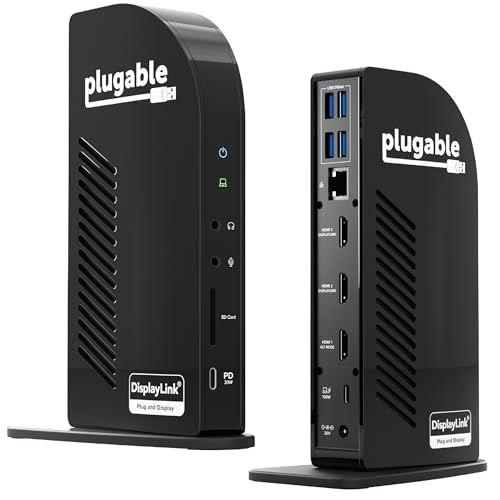
↓ See why we picked itPlugable USB-C Triple Monitor Docking Station (UD-ULTCDL)
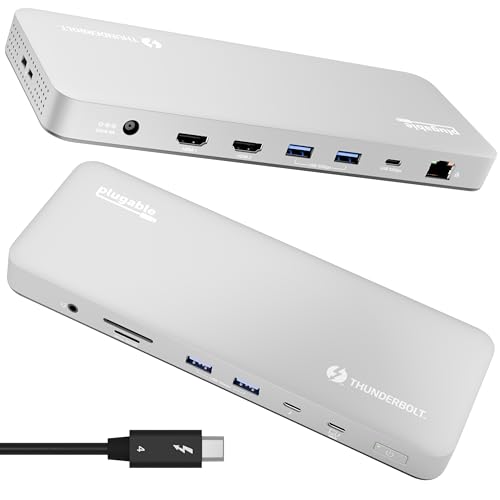
↓ See why we picked itPlugable Thunderbolt 4 Dock (TBT-UDM), Native Alternative
↓ See why we picked itDell Pro Thunderbolt 4 Smart Dock (SD25TB4), Native Alternative
↓ See why we picked itAnker Prime Docking Station, 14-Port 160W, USB Alternative
↓ See why we picked itA DisplayLink docking station solves a real problem: many laptops, especially base Apple Silicon Macs and older AMD systems, simply can't natively drive more than one or two external displays no matter how many ports a dock offers. DisplayLink's driver intercepts and compresses the GPU output over USB so extra monitors work at all.
Below are 7 docking stations we evaluated for multi-monitor setups, most of them genuine DisplayLink-driven docks, alongside a couple of native Thunderbolt 4 alternatives included for buyers whose color-critical work makes DisplayLink the wrong choice for their primary display.
5 Criteria to Look For Before Buying a DisplayLink Docking Station
Key buying criteria so you get the right fit the first time.
Check the real power delivery wattage, not just "PD" in the listing
Power delivery (PD) wattage determines whether a dock can actually charge your laptop while it's connected, not just pass a trickle of power through, and this number varies widely, from 60W barely-adequate figures up to 100W or higher business-tier docks.
This matters because a dock rated below what your laptop actually needs to charge under load, especially a larger laptop or one running demanding tasks while docked, will slowly drain the battery even while "charging", a frustrating and easy-to-miss problem.
Check the listing for the specific PD wattage number, and compare it against your laptop's actual charging brick wattage, not just whether the listing mentions power delivery at all.
Verify actual display support against your specific laptop and GPU, not just port count
A dock listing multiple HDMI or DisplayPort outputs doesn't guarantee your laptop can actually drive all of them at full resolution and refresh rate simultaneously, that capability depends on your laptop's specific GPU and USB-C controller, which some docks work around using DisplayLink technology and others don't.
This distinction matters a lot if you're building a dual or triple monitor setup, since a laptop that can't natively drive multiple external displays will show a blank or mirrored screen on a non-DisplayLink dock's extra port, regardless of how many ports the dock has.
Check whether the dock uses native DisplayPort Alt Mode or DisplayLink chip technology, and separately verify your specific laptop model's documented maximum number of external displays before assuming any multi-port dock will drive them all.
Match data transfer speeds and Ethernet to what you actually move and how
USB data ports on a dock range widely in real transfer speed, from basic 480Mbps USB 2.0 speeds up to 10Gbps or higher, a gap that matters enormously if you regularly move large files to and from external drives, but barely matters if you're just charging a mouse and keyboard.
Ethernet port speed follows the same logic, a dock's Gigabit or 2.5Gb Ethernet port is only as fast as your actual home or office network infrastructure supports, so paying for 2.5Gb Ethernet on a network that tops out at Gigabit gains nothing.
Check the specific listed speed for each port type you'll actually use regularly, and compare Ethernet speed against your router's actual rated speed, not just the dock's spec sheet in isolation.
Confirm compatibility with your specific laptop's USB-C or Thunderbolt port
Not every USB-C port supports the same features, some laptops only support USB-C data and charging without any video output over that port at all, while others support full Thunderbolt with much higher bandwidth for multiple 4K displays.
Docks built around Thunderbolt certification generally support more demanding multi-display and high-speed configurations, but require a genuinely Thunderbolt-capable port on your laptop to unlock that performance, plugging a Thunderbolt dock into a USB-C-only port still works but loses the extra bandwidth.
Check your specific laptop's documented port capabilities (Thunderbolt 3, Thunderbolt 4, or USB-C without Thunderbolt), not just that it has a USB-C-shaped port, before assuming any docking station will unlock its full advertised capability.
Consider heat and long-term reliability under sustained daily use
A docking station that stays plugged in and under load for 8+ hours a day handles thermal stress very differently than a hub used occasionally for a quick file transfer, and a compact plastic-bodied dock with no real heat dissipation can throttle performance or degrade faster under that kind of sustained daily use than an aluminum-bodied one.
This matters more for anyone using the dock as their primary daily workstation setup than for occasional or travel use.
Check reviews specifically for mentions of the dock running hot, disconnecting intermittently after extended use, or degrading over months, rather than relying on the unboxing-day performance most reviews describe.
7 Best DisplayLink Docking Stations in 2026
WAVLINK Docking Station 3 Monitors, 12-in-1 DisplayLink
About this pick
This WAVLINK dock is explicitly built around DisplayLink to drive 3 monitors at up to 4K 60Hz each, a genuine triple-display capability at a price well below most DisplayLink competitors in this list. The DisplayLink driver install is required on first setup for Windows and Mac.
100W PD charging and a mix of HDMI, DisplayPort, Gigabit Ethernet, and 5Gbps USB 3.0 round out a genuinely well-equipped hub. It's the pick for buyers who want 3 extra screens without paying for a premium DisplayLink brand name.
A genuine advantage here is that lowest price among the true triple-display picks here. The tradeoff is that requires installing and maintaining the DisplayLink driver.
Best for: Buyers who want 3 real 4K 60Hz displays without paying a premium brand price
Check price on AmazonPros
- +Genuine triple 4K 60Hz DisplayLink output
- +Lowest price among the true triple-display picks here
- +100W charging keeps the laptop topped up
- +Broad laptop brand compatibility
Cons
- −Requires installing and maintaining the DisplayLink driver
- −Not suited for color-critical creative work on any DisplayLink screen
- −Smaller brand recognition than Anker or Plugable
Anker Prime Docking Station (DL7400), 14-Port DisplayLink
About this pick
The Anker Prime DL7400 is upfront that the latest DisplayLink driver must be installed for correct operation, and in return it delivers a genuinely rare spec: triple 4K 60Hz output driven entirely through DisplayLink. That's more display real estate than most non-DisplayLink docks can offer at all.
Because DisplayLink's video compression runs through the CPU, sustained use generates real heat, which is why this dock includes an active cooling fan and a high 140W max output aimed at buyers who leave it running all day rather than plugging in occasionally.
Active cooling for sustained all-day use. That said, requires the latest DisplayLink driver installed and kept current. Neither should be a surprise once you know to look for it.
Best for: Windows users who run 3 real 4K displays all day and want active cooling
Check price on AmazonPros
- +Genuine triple 4K 60Hz through DisplayLink
- +Active cooling for sustained all-day use
- +High 140W max power output
- +Smart Display status indicator
Cons
- −Requires the latest DisplayLink driver installed and kept current
- −Windows-focused, less proven on macOS
- −Priciest DisplayLink-only pick in this list
Plugable USB-C Triple Monitor Docking Station (UD-ULTCDL)
About this pick
This Plugable dock explicitly requires a DisplayLink driver on Mac to drive its triple-HDMI output, which is exactly the workaround base Apple Silicon Macs need since they natively support only a single external display. Once the driver is installed, it runs 3 monitors plus 100W charging over one cable.
Gigabit Ethernet, an SD reader, and 4 extra USB ports round it out as a complete desk hub for Mac users, though buyers doing color-critical creative work should keep their primary editing monitor off DisplayLink and route it natively instead.
Worth calling out specifically: 100W charging plus a secondary 20W USB-C output. The catch is requires installing and maintaining a DisplayLink driver.
Best for: Mac users on a base M-series chip who need 3 external displays
Check price on AmazonPros
- +Genuine triple-monitor support on Macs that can't do it natively
- +100W charging plus a secondary 20W USB-C output
- +Gigabit Ethernet and SD reader included
- +Well-established Plugable reliability track record
Cons
- −Requires installing and maintaining a DisplayLink driver
- −Not suited for color-critical creative work
- −macOS DisplayLink drivers can lag behind major macOS releases
Plugable USB C Triple Display Docking Station
About this pick
This Plugable dock drives a 4K 30Hz display plus two 1080p 60Hz displays through USB-based video output, giving Windows, macOS, and ChromeOS users a genuinely broad compatibility range for adding extra screens at a moderate price.
100W PD charging and 6 USB ports at 5Gbps round out a solid everyday hub. It's a fit for buyers who want more than one extra display and don't need the highest resolution on every panel, since the main display here caps at 4K 30Hz rather than 60Hz.
100W charging covers most laptops. Set against that, main 4K display is capped at 30Hz, not 60Hz. Both matter when comparing it to the other picks here.
Best for: ChromeOS or mixed-OS households that want 3 displays at a moderate price
Check price on AmazonPros
- +Broadest OS compatibility in this list including ChromeOS
- +100W charging covers most laptops
- +Genuinely adds 3 total displays
- +6 well-populated USB ports
Cons
- −Main 4K display is capped at 30Hz, not 60Hz
- −Secondary displays are limited to 1080p
- −Video output relies on driver-based compression
Plugable Thunderbolt 4 Dock (TBT-UDM), Native Alternative
About this pick
Unlike every other pick in this list, the Plugable TBT-UDM is not a DisplayLink product; it's a Thunderbolt Certified dock that drives displays natively through the laptop's own GPU rather than compressing video over USB. That's the right call whenever DisplayLink's known color calibration limitations aren't acceptable.
It runs driverless on both macOS and Windows with dual 4K or single 6K output and 100W charging. Buyers doing photo, video, or design work who need one accurately-calibrated display should route that monitor through a native dock like this one rather than a DisplayLink hub.
The standout detail is that no driver installation or maintenance required. Balancing that out, only dual displays, not triple like the DisplayLink picks.
Best for: Color-critical creative work where DisplayLink's compression isn't acceptable
Check price on AmazonPros
- +Native video output avoids DisplayLink's color calibration limits
- +No driver installation or maintenance required
- +Genuine TB4 certification for guaranteed bandwidth
- +Solid 100W charging for most laptops
Cons
- −Only dual displays, not triple like the DisplayLink picks
- −Requires a laptop with a genuine TB4 or Thunderbolt port
- −Not a fit if your goal is specifically 3+ external displays
Dell Pro Thunderbolt 4 Smart Dock (SD25TB4), Native Alternative
About this pick
Like the Plugable TBT-UDM, the Dell SD25TB4 is a certified Thunderbolt 4 dock rather than a DisplayLink product, included here as the native alternative for Dell laptop owners who need reliable, color-accurate multi-display output instead of USB-compressed video.
It supports up to 4 displays natively when the host laptop's own TB4 controller allows it, plus 130W charging and built-in 2.5GbE and Wi-Fi. For Dell users specifically, this is the more dependable path to extra screens than layering a DisplayLink hub on top of a native TB4 port.
Supports up to 4 displays without any driver install. That's a real strength, but weigh it against the flip side: optimized around Dell hardware, less proven elsewhere.
Best for: Dell laptop owners who need multiple displays without DisplayLink's tradeoffs
Check price on AmazonPros
- +Native output avoids DisplayLink's known limitations entirely
- +Supports up to 4 displays without any driver install
- +130W charging, higher than most docks in this category
- +Dell-validated reliability
Cons
- −Optimized around Dell hardware, less proven elsewhere
- −Requires a laptop with a native TB4 controller to hit 4 displays
- −Bulkier than a compact DisplayLink hub
Anker Prime Docking Station, 14-Port 160W, USB Alternative
About this pick
This Anker Prime dock is a USB4-class hub rather than a DisplayLink or certified Thunderbolt device, included as a middle-ground option for buyers who want dual 4K output without either DisplayLink's driver dependency or the price premium of certified TB4 hardware.
Its standout spec is 160W total power output across the host laptop and downstream accessories, unusually high for a 14-port hub, which lets it power both the laptop and connected peripherals without a separate charger.
Very high 160W total power output. On the other hand, only dual display, not a triple-display DisplayLink alternative. Both are worth keeping in mind before deciding.
Best for: Buyers who want driver-free dual 4K output at a reasonable price
Check price on AmazonPros
- +No DisplayLink driver dependency at all
- +Very high 160W total power output
- +Solid 10Gbps transfer for everyday storage tasks
- +Dual 4K covers most standard 2-monitor desk setups
Cons
- −Only dual display, not a triple-display DisplayLink alternative
- −Not Thunderbolt Certified
- −Doesn't solve the specific problem of needing 3+ displays
How We Evaluated These DisplayLink Docking Stations
Each pick was assessed across 5 criteria weighted for real-world use.
Genuine DisplayLink vs native output
Verified each listing's actual video technology rather than assuming TB4-port compatibility meant DisplayLink, and clearly separated the two in our picks.
Display count and resolution honesty
Checked whether triple-display claims held up at genuine 4K 60Hz or quietly dropped to 30Hz or 1080p on secondary displays.
Driver dependency and maintenance
Weighed how much ongoing DisplayLink driver maintenance each dock requires, particularly around macOS update compatibility risk.
CPU overhead and cooling
Considered whether a dock includes active cooling for DisplayLink's CPU-driven compression load during sustained multi-display use.
Native alternative availability
Included native Thunderbolt options specifically for buyers whose color-critical work makes DisplayLink compression the wrong tool for the job.
How to Choose the Right DisplayLink Docking Stations
By Rating Confidence: Highest Rated vs Most Reviewed
| Your priority | Recommended pick |
|---|---|
| Highest average rating | WAVLINK Docking Station 3 Monitors |
| Largest review base, strongest reliability signal | WAVLINK Docking Station 3 Monitors |
By Budget
| Budget | Recommended pick |
|---|---|
| Under $117 | WAVLINK Docking Station 3 Monitors |
| Up to $228 | Anker Prime Docking Station |
Thunderbolt vs USB-C Only
Thunderbolt-certified
Higher bandwidth for demanding multi-display and high-speed data setups, but requires a genuinely Thunderbolt-capable laptop port. In this comparison: Plugable Thunderbolt 4 Dock, Dell Pro Thunderbolt 4 Smart Dock, Anker Prime Docking Station.
USB-C only
Usually cheaper and works with any USB-C laptop, but with less headroom for multiple high-resolution displays. In this comparison: WAVLINK Docking Station 3 Monitors, Anker Prime Docking Station, Plugable USB, Plugable USB C Triple Display Docking Station.
Default to USB-C only unless your laptop has a genuine Thunderbolt port and you need the extra display or data bandwidth.
By Ethernet Support
| Your priority | Recommended pick |
|---|---|
| Wired Ethernet needed | WAVLINK Docking Station 3 Monitors |
| Wi-Fi only is fine | Anker Prime Docking Station |
For a Dual or Triple Monitor Setup Specifically
Look for
Native DisplayPort Alt Mode or DisplayLink chip technology, verified against your specific laptop's documented maximum external display count.
In this comparison
WAVLINK Docking Station 3 Monitors is worth checking against its listed display support before buying, given its strong review base.
When to Spend More
Spend more if
You need reliable multi-display support and full-speed charging under daily sustained use, where Anker Prime Docking Station's higher price buys real headroom over the cheaper picks.
Save if
You only need occasional charging and a single extra port, where WAVLINK Docking Station 3 Monitors covers the same job at a lower price.
Frequently Asked Questions
Why can't I calibrate color on my DisplayLink-connected monitor?
DisplayLink's driver intercepts the GPU's output and compresses it into USB data before sending it to the display, which means Windows Display Color Calibration and ICC color profiles have no effect on that connection. This is a structural limitation of DisplayLink technology, not a bug, so color-critical work should stay off DisplayLink-connected displays entirely.
Will a DisplayLink dock slow down my laptop?
It adds a real but usually modest CPU tax, typically 3-15% additional load even at idle, since DisplayLink renders display output through CPU and GPU compression rather than passing it through natively. On fanless laptops like base MacBooks, this can show up as noticeably higher surface temperature during extended use.
Why did my external monitors stop working after a macOS update?
DisplayLink driver updates typically lag macOS releases by days to weeks, so updating macOS right after a new release can leave DisplayLink-connected monitors dark until DisplayLink ships a compatible driver. Check DisplayLink's compatibility page before updating macOS if you rely on a DisplayLink dock daily.
Should I use DisplayLink or a native Thunderbolt dock?
Use DisplayLink when your laptop genuinely can't natively drive the number of displays you want, which covers base Apple Silicon Macs and many older Windows laptops. Use a native Thunderbolt dock like the Plugable TBT-UDM or Dell SD25TB4 when color accuracy or minimal latency matters more than adding extra screens.
Why is my DisplayLink 4K display running at 30Hz instead of 60Hz?
4K at 60Hz over DisplayLink requires at least a USB 3.0 connection at 5Gbps. If your laptop's port is actually USB 2.0, or the dock's internal wiring bottlenecks the connection, output drops to 1080p or 4K at 30Hz. Check both your laptop's port spec and the dock's rated USB generation before expecting full 4K 60Hz.
Which pick in this list is best for a MacBook Air that needs 3 monitors?
The Plugable UD-ULTCDL is built specifically around Mac compatibility and explicitly documents its DisplayLink driver requirement for triple-display output, which is exactly what a base M-series MacBook Air needs since it only natively supports a single external display.
Bottom Line
best overall: WAVLINK Docking Station 3 Monitors, 12-in-1 DisplayLink - best value displaylink dock pick in this roundup.
See the full rankings above for all picks with pros, cons, and best-for summaries.
Browse on Amazon
All Prime-eligible options with current pricing.
Shop on Amazon →