
4 Best USB4 eGPU Docks and Enclosures in 2026
We compared USB4 eGPU docks by controller chip, PCIe bandwidth, and power input flexibility, since the controller chip directly determines real GPU throughput.


At a Glance
USB4 eGPU docks let you connect a desktop-class graphics card to a laptop or mini PC through a single Thunderbolt or USB4 cable, but the specific controller chip inside the dock, not just its USB4 label, is what actually determines real-world PCIe bandwidth to the graphics card.
We compared this lineup on controller chip generation, PCIe bandwidth, and power input flexibility, since a dock's stated compatible GPU list and required ATX power supply setup matter as much as raw bandwidth for actually getting a graphics card running.
5 Criteria to Look For Before Buying a USB4 eGPU Docks and Enclosure
Key buying criteria so you get the right fit the first time.
The Controller Chip Inside an eGPU Dock, Not Just Its USB4 Label, Determines Real PCIe Bandwidth
The PCIE 3.0 x16 pick uses a JHL6340 controller delivering a stated ~22Gbps, while the GOLDSOUN and GODLIY picks use an officially certified JHL7440 controller delivering 40Gbps, a meaningful real-world difference in graphics card throughput despite all three docks being marketed with similar USB4/Thunderbolt language. This matters directly if you're running demanding workloads like AI training or 8K rendering where bandwidth bottlenecks are noticeable, and matters less for lighter gaming or general creative work where the lower bandwidth still performs adequately. Check the specifically named controller chip model in a listing (JHL6340, JHL7440, or similar) rather than assuming all USB4-labeled eGPU docks deliver identical real-world bandwidth.
An eGPU Dock Purchase Requires Budgeting for a Separate ATX or SFX Power Supply and Graphics Card
All four picks in this comparison specifically state that the graphics card and, in most cases, the ATX power supply are not included in the package, meaning the dock's listed price is only the enclosure and controller itself, not a complete working eGPU setup. This matters significantly when comparing total cost across eGPU dock options, where a cheaper dock might still require the same additional PSU and GPU purchases as a pricier one. Factor in the cost of a compatible power supply and your chosen graphics card before comparing eGPU dock prices as if they represented a complete solution.
Flexible Power Input Options Matter More If You're Reusing Components From an Existing Build
The PCIE 3.0 x16 pick specifically supports four different power input methods (CPU 4+4-pin, Molex, PD 3.0, or DC5521), giving you more flexibility to power the enclosure using whatever power supply or cables you already have on hand, compared to docks with a single fixed power input method. This matters if you're building an eGPU setup around a spare PSU salvaged from an old desktop, and matters less if you're buying a dedicated new power supply specifically for this build regardless of input type. Check a dock's specifically stated power input options if you're planning to reuse an existing power supply rather than buying one new for this specific purpose.
Built-In NVMe Storage in an eGPU Dock Serves a Specific AI and Creative Workflow Need
The MINISFORUM DEG2 pick's integrated M.2 2280 NVMe slot lets you store AI models and project files directly on the dock, maintaining a synchronized workspace when switching the dock between different host devices, a genuinely useful feature for workflows involving large AI model files that would otherwise need to be re-transferred each time you switch hosts. This matters if you regularly move the eGPU dock between multiple computers and want consistent access to large local files, and matters less if the dock stays permanently connected to one host machine with its own adequate storage. Consider whether your specific workflow involves switching hosts frequently before treating built-in NVMe storage as a must-have feature.
A Manufacturer's Specific Wiring Warnings Should Be Read Carefully Before First Power-On
Both the GOLDSOUN and GODLIY picks include a specific and important manufacturer warning against inserting the CPU cable into the dock's PCIE-8PIN port, since doing so triggers an automatic power-off protection and requires unplugging and reconnecting the ATX-24PIN cable to recover, a real risk of user error during initial setup that isn't obvious without reading the specific instructions. This matters for any buyer assembling their first eGPU enclosure, where following the manufacturer's specific power cable sequence avoids an easily preventable setup mistake. Read a dock's specific power cabling instructions and warnings in full before connecting any power source, rather than assuming standard PC power cable conventions apply identically to eGPU enclosures.
4 Best USB4 eGPU Docks and Enclosures in 2026
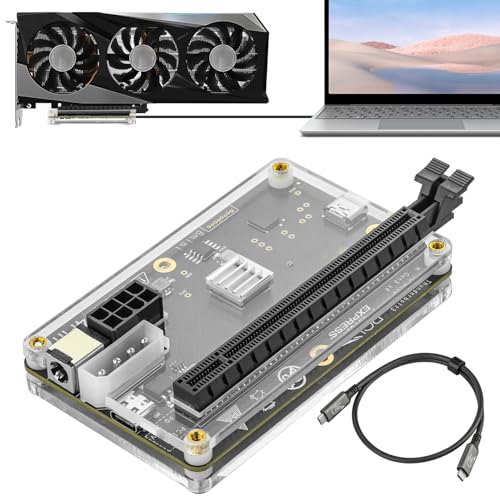
PCIE 3.0 x16 22Gbps eGPU Dock
About this pick
This dock's JHL6340 controller specifically delivers speeds around 22Gbps, a stated bandwidth figure lower than the JHL7440-based picks in this comparison but still enough for graphics work, video editing, AI art, and AAA gaming according to the listing. Its 4 flexible power input options (CPU 4+4-pin, Molex, PD 3.0, or DC5521) give you more ways to power the enclosure than most competing docks offer.
Compared to the GOLDSOUN and GODLIY picks below, this one is the lowest-priced option in this comparison while still supporting the full range of NVIDIA GPUs from the RTX 5090 down to the older GTX 450, plus AMD cards, and explicitly states compatibility with the Lenovo Legion Go handheld. Its included Thunderbolt 4 cable and 24-pin power jumper cable come bundled in the box.
Best for buyers who want the lowest price while still supporting a wide range of NVIDIA and AMD graphics cards.
Best for: buyers who want the lowest price while still supporting a wide range of graphics cards
Check price on AmazonPros
- +Lowest price in this comparison at $99.99
- +4 flexible power input options for different setups
- +Wide GPU compatibility from budget to flagship cards
Cons
- −Lower stated bandwidth (22Gbps) than the JHL7440-based picks
- −ATX power supply and graphics card not included
GOLDSOUN External eGPU Dock
About this pick
This dock's officially certified JHL7440 controller module is a genuinely more rigorously validated chip than the JHL6340 in the cheaper pick above, delivering high-performance results specifically for gaming, AI training and inference, and 3D modeling and rendering. Its listing specifically states support for local deployment of Deepseek-R1, a concrete AI workload benchmark most competing eGPU docks don't reference.
Compared to the PCIE 3.0 x16 pick above, this one's 40Gbps and 85W PD charging TB4 port doubles as a hub with a daisy chain port, letting you attach additional external devices beyond just the graphics card. It supports the latest NVIDIA RTX 50 series and AMD RX 7000 series GPUs specifically.
Best for buyers who want an officially certified controller chip validated for AI and rendering workloads.
Best for: buyers who want a certified controller chip validated for AI and rendering workloads
Check price on AmazonPros
- +Officially certified JHL7440 controller chip
- +Specifically validated for AI workloads like local Deepseek-R1
- +Daisy chain port adds hub functionality
Cons
- −ATX power supply and graphics card not included
- −CPU cable must not be inserted into the PCIE-8PIN port, per an important manufacturer warning
MINISFORUM DEG2 USB4 V2 eGPU Dock
About this pick
This dock's dual-link USB4 V2 and OCuLink interfaces support transfer speeds up to 80Gbps over Thunderbolt 5 or 64Gbps over OCuLink, meaningfully higher bandwidth than the JHL7440-based picks in this comparison, with a dedicated hardware switch to instantly toggle between all-in-one docking mode and pure GPU performance mode. Its integrated M.2 2280 NVMe slot lets you store AI models and project files directly on the dock itself.
Compared to the GOLDSOUN and GODLIY picks above, this one adds a built-in re-drive signal booster specifically designed to stabilize PCIe data transfer and minimize latency during high-bandwidth tasks like LLM inference or 8K rendering. Its single-cable workflow handles data, display, and laptop charging simultaneously with automatic power-on when synced to the host computer.
Best for buyers who want the highest bandwidth with built-in NVMe storage for AI and rendering workflows.
Best for: buyers who want the highest bandwidth with built-in NVMe storage for demanding workflows
Check price on AmazonPros
- +Highest stated bandwidth in this comparison at up to 80Gbps
- +Integrated M.2 NVMe slot for direct AI model and project storage
- +Built-in signal booster stabilizes high-bandwidth PCIe transfer
Cons
- −Highest price in this comparison at $247.00
- −Hardware mode switch adds complexity versus simpler always-on docks
GODLIY External eGPU Dock
About this pick
This dock also uses the officially certified JHL7440 controller for workstation-grade performance across gaming, AI training and inference, and 3D modeling, matching the GOLDSOUN pick's controller quality at a slightly different price point. Its two Thunderbolt 4/3 USB4 ports specifically support the latest NVIDIA RTX 50 series and AMD RX 7000 series graphics cards.
Compared to the GOLDSOUN pick above, this one includes the identical 40Gbps and 85W PD charging TB4 port with daisy chain hub functionality, positioning it as a close alternative from a different manufacturer at a modest price difference. Both docks carry the same important manufacturer warning about not inserting the CPU cable into the PCIE-8PIN port.
Best for buyers who want a certified JHL7440 controller as an alternative brand option to the GOLDSOUN pick.
Best for: buyers who want a certified controller chip as an alternative brand option
Check price on AmazonPros
- +Officially certified JHL7440 controller matches the GOLDSOUN pick's quality
- +2 Thunderbolt/USB4 ports for flexible host connections
- +Supports the latest RTX 50 series and RX 7000 series GPUs
Cons
- −ATX power supply and graphics card not included
- −Priced $10 higher than the GOLDSOUN pick with the same controller chip
How We Evaluated These USB4 eGPU Docks and Enclosures
Each pick was assessed across 5 criteria weighted for real-world use.
Controller Chip Generation
Compared JHL6340 versus officially certified JHL7440 and USB4 V2 controller chips.
PCIe Bandwidth
Compared stated Gbps throughput figures across all four docks.
Power Input Flexibility
Compared the number and type of power input options for the enclosure.
GPU Compatibility Range
Compared stated compatible NVIDIA and AMD graphics card generations.
Additional Features
Compared daisy chain hub functionality and built-in NVMe storage options.
How to Choose the Right USB4 eGPU Docks and Enclosures
By Primary Need
| If you mainly need | Recommended pick |
|---|---|
| The lowest price with wide GPU support | PCIE 3.0 x16 22Gbps eGPU Dock |
| A certified controller validated for AI workloads | GOLDSOUN External eGPU Dock |
| The highest bandwidth with built-in NVMe storage | MINISFORUM DEG2 USB4 V2 eGPU Dock |
| A certified controller as an alternative brand | GODLIY External eGPU Dock |
By Budget
| Price range | Recommended pick |
|---|---|
| Under $100 | PCIE 3.0 x16 22Gbps eGPU Dock ($99.99) |
| Under $150 | GOLDSOUN External eGPU Dock ($149.99) |
| Under $160 | GODLIY External eGPU Dock ($159.99) |
| Under $250 | MINISFORUM DEG2 USB4 V2 ($247.00) |
JHL6340 vs JHL7440 Controller Chips
JHL6340 (PCIE 3.0 x16 pick)
Delivers a stated 22Gbps, a lower but still capable bandwidth ceiling suited to most gaming and creative workloads at a lower price.
Officially certified JHL7440 (GOLDSOUN, GODLIY)
A more rigorously validated controller chip delivering 40Gbps, specifically recommended for AI training and demanding rendering workloads.
If your workload is mainstream gaming or general creative work, the JHL6340-based pick's lower price is a reasonable tradeoff. If you're doing AI training or heavy rendering, the certified JHL7440 controller's validation matters more.
By Power Input Flexibility Needed
| Your power setup | Recommended pick |
|---|---|
| Need flexible power options (CPU, Molex, PD, DC) | PCIE 3.0 x16 22Gbps eGPU Dock |
| Already have a standard ATX or SFX PSU | MINISFORUM DEG2 USB4 V2 |
For AI Training and Local LLM Inference Specifically
Look for
A dock specifically validated for AI workloads with a built-in re-drive signal booster to stabilize high-bandwidth PCIe transfer during sustained inference tasks.
In this comparison
The GOLDSOUN pick specifically states support for local Deepseek-R1 deployment, and the MINISFORUM pick specifically includes a re-drive signal booster for LLM inference stability.
When to Spend More
Spend more if
You want the highest bandwidth with built-in NVMe storage for AI and rendering work, where the MINISFORUM DEG2 justifies its $247.00 price.
Save if
You want broad GPU compatibility at the lowest price, where the PCIE 3.0 x16 pick delivers that for $99.99.
Frequently Asked Questions
Do I need to buy a graphics card and power supply separately for any of these eGPU docks?
Yes, all four picks in this comparison specifically state the graphics card and, in most cases, the ATX or SFX power supply are not included, so budget for these as separate purchases when planning your total eGPU setup cost.
What's the most common mistake buyers make when setting up an eGPU dock for the first time?
Inserting the CPU power cable into the wrong port, specifically the PCIE-8PIN port on the GOLDSOUN and GODLIY docks, which the manufacturer explicitly warns against and which triggers an automatic power-off protection requiring a cable reset to recover from.
Is the MINISFORUM DEG2's higher price worth it over the JHL7440-based picks for gaming?
For mainstream gaming, the JHL7440-based GOLDSOUN or GODLIY picks deliver strong performance at a meaningfully lower price, but if you're doing AI training, LLM inference, or 8K rendering where the extra bandwidth and built-in NVMe storage matter, the MINISFORUM DEG2's higher price is justified.
How do I know if my laptop's USB4 or Thunderbolt port supports eGPU functionality?
Checking your specific laptop or device's documentation for confirmed Thunderbolt 3/4 or USB4 eGPU support is worth doing, and some devices with USB4 may require a BIOS update to enable full eGPU functionality, as specifically noted for certain console-class devices.
Can I use these eGPU docks with a Lenovo Legion Go or other gaming handheld?
The PCIE 3.0 x16 pick specifically states compatibility with the Lenovo Legion Go, and other picks in this comparison generally support USB4/Thunderbolt-equipped devices including gaming handhelds, though checking each specific handheld model's own USB4 implementation is worth doing before purchase.
Does using an eGPU dock void my laptop's warranty?
Connecting an external eGPU dock through a standard USB4 or Thunderbolt port generally does not void a laptop's warranty since no internal modification is required, though checking your specific laptop manufacturer's warranty terms is worth doing if you have concerns.
Bottom Line
best overall: PCIE 3.0 x16 22Gbps eGPU Dock - best overall value pick in this roundup.
See the full rankings above for all picks with pros, cons, and best-for summaries.
Browse on Amazon
All Prime-eligible options with current pricing.
Shop on Amazon →