
6 Best UPS Battery Backups for Multiple Monitors in 2026
6 UPS units we evaluated for multi-monitor desk setups, with the outlet-count and real-wattage math competitors skip: each additional monitor adds meaningful draw, and outlet count matters as much as capacity for a 2-3 monitor setup.

New to Amazon Prime?
Get fast, free shipping on every pick in this guide, plus Prime Video and exclusive deals.
Try Prime Free


At a Glance
APC UPS 1500VA/900W Pure Sine Wave UPS for Computer, Electronics, BR1500MS2
↓ See why we picked itCyberPower CP1500PFCLCD PFC Sinewave UPS Battery Backup and Surge Protector, 1500VA/1000W, 12 Outlets, AVR, Mini Tower, UL Certified
↓ See why we picked itAPC UPS 1500VA/900W Battery Backup for PCs, Office Electronics, BX1500M
↓ See why we picked itAPC 1000VA/600W Pro UPS Battery Backup for Office Electronics, AVR, BX1000M
↓ See why we picked itGOLDENMATE 1500VA/1000W Lithium UPS Battery Backup & Surge Protector, Gray
↓ See why we picked itAPC 850VA/510W Pro UPS Battery Backup for Office Electronics, AVR, BX850M
↓ See why we picked itEach additional monitor in a multi-monitor setup adds meaningful real wattage draw, typically 20-40W per monitor depending on size and panel type, a two or three-monitor setup can push combined draw well past what a basic single-monitor UPS was sized for.
Outlet count matters as much as capacity for multi-monitor setups, since a PC plus two or three monitors plus peripherals needs enough battery-backed outlets to actually plug everything in, not just enough total wattage.
5 Criteria to Look For Before Buying a UPS Battery Backups for Multiple Monitor
Key buying criteria so you get the right fit the first time.
Convert VA rating to real usable watts before sizing your equipment
A UPS's VA (volt-amps) rating is a marketing number, not the real power it can actually deliver, due to typical UPS power factor design, real usable wattage runs roughly 0.6 times the VA figure, meaning a 1000VA unit is usually rated for about 600W, not the full 1000.
This matters enormously when sizing a UPS against your actual equipment, buying based on the bigger-looking VA number instead of the real watts figure is a common mistake that leaves less real headroom than expected.
Add up your actual equipment's real wattage draw (not the power supply's maximum rating, but its typical operating draw), and compare that total against the UPS's stated watts number specifically, not its VA rating.
Check waveform type against your power supply's compatibility requirements
A UPS outputs either a pure sine wave, matching the clean power from a wall outlet, or a simulated/modified sine wave, a rougher, stepped approximation that's cheaper to produce but can cause certain power supplies, particularly ones with Active Power Factor Correction (APFC), to buzz audibly or shut down unexpectedly when running on battery power.
This matters directly for a modern PC power supply, which very often includes APFC, running an APFC-equipped PC on a modified sine wave UPS during an outage can trigger exactly the shutdown you bought the UPS to prevent.
Check whether your PC's power supply is APFC-equipped (common in most modern units), and match it with a pure sine wave UPS specifically if so.
Estimate real runtime at your actual load, not the UPS's rated maximum runtime
Published runtime figures on a UPS listing are typically measured at a specific test load, often lower than what you'll actually draw with a PC and monitor running, meaning your real runtime during an actual outage will likely be shorter than the headline number suggests.
This matters because runtime is what actually determines whether you have enough time to save your work and shut down cleanly versus losing everything the moment the battery depletes.
Check whether the listing provides a runtime-at-load chart or calculator (many UPS brands publish one), and estimate your real runtime at your actual equipment's combined wattage draw, not the single headline runtime figure.
Consider AVR (Automatic Voltage Regulation) if your power is prone to sags or surges
AVR corrects minor voltage fluctuations, brownouts and small surges, without switching to battery power at all, extending battery lifespan by handling the vast majority of small power irregularities through voltage correction alone rather than draining the battery every time.
This matters more if you live somewhere with less stable grid power or frequent minor fluctuations, less in an area with consistently clean, stable power.
Check the listing specifically for AVR as a named feature, not just generic "surge protection," which addresses a different, more severe class of power event.
Check whether the internal battery is user-replaceable before the unit ages out
Every UPS battery degrades over 3-5 years of use regardless of how well the unit is otherwise built, and a model with a user-replaceable battery lets you extend the UPS's usable life for the cost of a battery alone, while a sealed unit with no replaceable battery means buying an entirely new UPS once the battery degrades.
This matters directly for total cost of ownership over several years, not just the upfront purchase price.
Check the listing specifically for "user-replaceable battery" language and confirm replacement batteries are readily available for that specific model before assuming any UPS supports this.
6 Best UPS Battery Backups for Multiple Monitors in 2026
APC UPS 1500VA/900W Pure Sine Wave UPS for Computer, Electronics, BR1500MS2
About this pick
900W of real capacity and 10 outlets, genuinely enough headroom and plug count for a PC plus two or three monitors and basic peripherals, the combined draw of a multi-monitor setup adds up faster than single-monitor UPS sizing accounts for.
Pure sine wave and APFC compatibility protect a modern PC power supply, while the outlet count means you won't run out of battery-backed plugs partway through wiring up your desk.
10 outlets, genuinely enough for a multi-monitor desk. On the other hand, highest price in this guide. Both are worth keeping in mind before deciding.
Best for: Buyers with a 2-3 monitor desk setup who need both wattage and outlet headroom
Check price on AmazonPros
- +Real headroom for 2-3 monitors plus PC and peripherals
- +10 outlets, genuinely enough for a multi-monitor desk
- +Pure sine wave APFC compatibility
- +Strong review base
Cons
- −Highest price in this guide
- −Larger footprint
- −Overkill for a two-monitor setup on a small desk
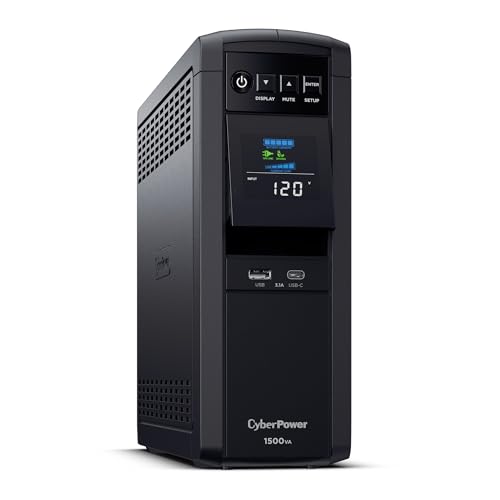
CyberPower CP1500PFCLCD PFC Sinewave UPS Battery Backup and Surge Protector, 1500VA/1000W, 12 Outlets, AVR, Mini Tower, UL Certified
About this pick
12 outlets, the most of any pick in this guide, genuinely useful when a multi-monitor setup means plugging in two or three monitors, a PC, speakers, and a dock all on the same UPS. Largest review base here as evidence of long-term reliability.
1000W real capacity gives real headroom above the typical combined draw of a 2-3 monitor desk setup.
A genuine advantage here is that largest review base, strong long-term evidence. The tradeoff is that bulkier mini-tower form factor.
Best for: Buyers who need the most battery-backed outlets for a fully wired multi-monitor desk
Check price on AmazonPros
- +Most outlets of any pick in this guide
- +Largest review base, strong long-term evidence
- +1000W real capacity
- +AVR included
Cons
- −Bulkier mini-tower form factor
- −Not pure sine wave confirmed
- −Lower price than the top pick but still a meaningful investment
APC UPS 1500VA/900W Battery Backup for PCs, Office Electronics, BX1500M
About this pick
The single largest review base across this entire UPS lineup, strong evidence this capacity tier handles multi-monitor desk setups reliably in the real world. 900W real capacity at a notably lower price than the pure sine wave equivalent.
Check outlet count against your specific monitor count and peripherals before buying, more monitors means more battery-backed plugs needed, not just more watts.
900W real capacity at a lower price than pure sine wave. That said, not pure sine wave. Neither should be a surprise once you know to look for it.
Best for: Buyers who want the most-proven capacity tier for a multi-monitor desktop
Check price on AmazonPros
- +Largest review base of any pick across this guide
- +900W real capacity at a lower price than pure sine wave
- +AVR included
- +Strong reliability track record
Cons
- −Not pure sine wave
- −Fewer outlets than the CyberPower 12-outlet pick
- −Bulkier than compact single-monitor UPS units
APC 1000VA/600W Pro UPS Battery Backup for Office Electronics, AVR, BX1000M
About this pick
600W real capacity, appropriate for a two-monitor setup with a standard office PC rather than a three-monitor high-performance build. Do the wattage math on your specific monitors (typically 20-40W each) plus PC before assuming this covers your setup.
AVR included handles brownouts without draining the battery, extending real-world runtime for genuine outages.
Worth calling out specifically: aVR extends battery life. The catch is less headroom for a three-monitor or high-performance setup.
Best for: Buyers with a standard two-monitor office desktop
Check price on AmazonPros
- +Appropriately sized for a two-monitor office setup
- +AVR extends battery life
- +Reasonable price
- +Solid rating base
Cons
- −Less headroom for a three-monitor or high-performance setup
- −Not pure sine wave
- −Fewer outlets than the higher-capacity picks
GOLDENMATE 1500VA/1000W Lithium UPS Battery Backup & Surge Protector, Gray
About this pick
1000W real capacity from a 1500VA rating, a strong real-watt-to-VA ratio giving genuine headroom for a multi-monitor desk. Lithium battery chemistry generally handles heat and repeated charge cycles better long-term than lead-acid designs.
A small review base so far given how new this model is, weigh that against the genuinely strong capacity and battery chemistry if you want to try a newer entrant.
Lithium battery, better long-term charge-cycle life. Set against that, small review base, less long-term evidence. Both matter when comparing it to the other picks here.
Best for: Buyers who want strong real-watt capacity and lithium battery longevity for a multi-monitor desk
Check price on AmazonPros
- +1000W real capacity, strong ratio for its VA rating
- +Lithium battery, better long-term charge-cycle life
- +Very high early rating
- +Compact footprint for the capacity
Cons
- −Small review base, less long-term evidence
- −Higher price than comparable lead-acid options
- −Newer brand than APC/CyberPower
APC 850VA/510W Pro UPS Battery Backup for Office Electronics, AVR, BX850M
About this pick
510W real capacity, the entry point in this guide for a two-monitor setup on a tighter budget. Do the wattage math carefully here, this is the lowest-capacity pick in this multi-monitor guide, appropriate only for smaller or lower-power monitors.
AVR included, the same brownout-correction benefit as the higher-capacity APC picks.
The standout detail is that aVR included. Balancing that out, least headroom of any pick in this guide, verify your monitors' actual wattage.
Best for: Budget-conscious buyers with two smaller or lower-power monitors
Check price on AmazonPros
- +Lowest price in this guide
- +AVR included
- +Compact footprint
- +Good rating base
Cons
- −Least headroom of any pick in this guide, verify your monitors' actual wattage
- −Not suited to a three-monitor or high-performance setup
- −Not pure sine wave
How We Evaluated These UPS Battery Backups for Multiple Monitors
Each pick was assessed across 3 criteria weighted for real-world use.
Real wattage headroom for combined multi-monitor draw
Checked each pick's real watt capacity against the realistic combined draw of a PC plus 2-3 monitors, since each additional monitor adds meaningful wattage that basic single-monitor UPS sizing doesn't account for.
Outlet count as a first-class sizing factor
Weighed outlet count alongside wattage, since a multi-monitor desk with a PC, monitors, and peripherals needs enough battery-backed plugs to actually connect everything, not just enough total capacity.
Capacity tiers from budget two-monitor to full three-monitor setups
Ranked picks from entry-level 850VA (two smaller monitors) through 1500VA/1000W (a fully wired 2-3 monitor desk) so buyers size to their actual monitor count.
How to Choose the Right UPS Battery Backups for Multiple Monitors
By Rating Confidence: Highest Rated vs Most Reviewed
| Your priority | Recommended pick |
|---|---|
| Highest average rating | GOLDENMATE 1500VA/1000W Lithium UPS Battery Backup & Surge Protector |
| Largest review base, strongest reliability signal | APC UPS 1500VA/900W Battery Backup for PCs |
By Budget
| Budget | Recommended pick |
|---|---|
| Under $162 | APC 850VA/510W Pro UPS Battery Backup for Office Electronics |
| Up to $350 | GOLDENMATE 1500VA/1000W Lithium UPS Battery Backup & Surge Protector |
Pure Sine Wave vs Modified Sine Wave
Pure sine wave
Clean power matching wall-outlet quality, avoids APFC compatibility issues with modern PC power supplies. In this comparison: APC UPS 1500VA/900W Pure Sine Wave UPS for Computer, APC UPS 1500VA/900W Battery Backup for PCs.
Modified sine wave
Cheaper, but can cause buzzing or shutdown risk on APFC-equipped power supplies. In this comparison: CyberPower CP1500PFCLCD PFC Sinewave UPS Battery Backup and Surge Protector, APC 1000VA/600W Pro UPS Battery Backup for Office Electronics, GOLDENMATE 1500VA/1000W Lithium UPS Battery Backup & Surge Protector, APC 850VA/510W Pro UPS Battery Backup for Office Electronics.
Default to pure sine wave if your PC has an APFC power supply, which most modern PCs do.
By Runtime at Real Load
Check each pick's runtime-at-load chart against your actual equipment's combined wattage draw before buying, not just the headline runtime figure. APC UPS 1500VA/900W Battery Backup for PCs is the most-reviewed option here if you want the safer bet.
For a PC Plus Monitor Setup Specifically
Look for
Real watts (not VA) comfortably above your combined equipment draw, plus pure sine wave if your PC has an APFC power supply.
In this comparison
CyberPower CP1500PFCLCD PFC Sinewave UPS Battery Backup and Surge Protector discloses the highest real capacity at 1000W.
When to Spend More
Spend more if
You have a high-draw workstation, multiple monitors, or NAS equipment, where GOLDENMATE 1500VA/1000W Lithium UPS Battery Backup & Surge Protector's higher watts capacity gives real headroom over the cheaper picks.
Save if
You just need brief runtime for a single low-draw device, where APC 850VA/510W Pro UPS Battery Backup for Office Electronics covers the same job at a lower price.
Frequently Asked Questions
How much more UPS capacity do I need for a second or third monitor?
Each additional monitor typically adds 20-40W of real draw depending on size and panel type. Add up your specific monitors' wattage plus your PC's typical draw to size correctly, rather than assuming a single-monitor UPS scales automatically.
Does outlet count matter more than wattage for a multi-monitor desk?
Both matter. A multi-monitor setup needs enough real watt capacity for the combined load, but also enough battery-backed outlets to actually plug in a PC, multiple monitors, a dock, and speakers without running out of plugs.
What UPS capacity do I need for three monitors?
Plan for roughly 900-1000W of real capacity for a three-monitor setup with a high-performance PC, picks like the APC BR1500MS2 or CyberPower CP1500PFCLCD provide that headroom along with enough outlets.
Can I use a single-monitor UPS for a two-monitor setup?
Only if you've verified the real watt capacity against your combined PC and monitor draw. A UPS sized for one monitor may not have enough headroom or outlets once a second monitor and its peripherals are added.
Bottom Line
best overall: APC UPS 1500VA/900W Pure Sine Wave UPS for Computer, Electronics, BR1500MS2 - best for 2-3 monitor setups pick in this roundup.
See the full rankings above for all picks with pros, cons, and best-for summaries.
Browse on Amazon
All Prime-eligible options with current pricing.
Shop on Amazon →