
5 Best Ultrawide USB-C Monitors in 2026
5 ultrawide USB-C monitors we evaluated, with a note that not all apps handle a 21:9 or 32:9 aspect ratio gracefully, some older software stretches or displays with black bars instead of expanding.

New to Amazon Prime?
Get fast, free shipping on every pick in this guide, plus Prime Video and exclusive deals.
Try Prime Free


At a Glance
Deco Gear 49 Inch Curved Ultrawide Monitor, 5120x1440 Dual QHD 32:9 1500R VA Display, HDR400
↓ See why we picked itDell 34 Monitor S3425DW, WQHD VA, 120Hz, FreeSync Premium, Eye Comfort
↓ See why we picked itPixio PXC348C Neo 34 inch 180Hz Refresh Rate UWQHD 1440p Ultrawide Resolution 1000R Curve
↓ See why we picked itSAMSUNG Viewfinity S65UA Series 34-Inch Ultrawide QHD Curved Monitor, 100Hz, USB-C, HDR10
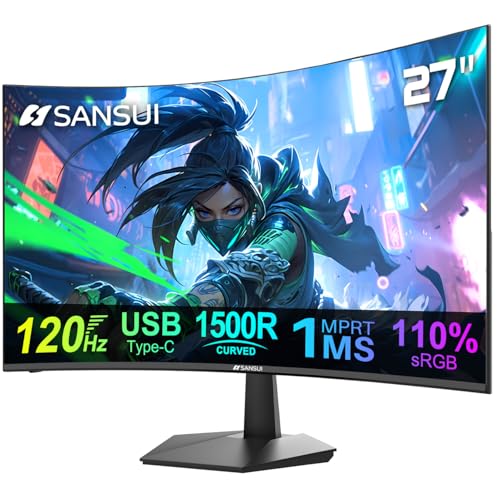
↓ See why we picked itSANSUI Curved Monitor 27 inch 120Hz USB Type-C Computer Monitor
↓ See why we picked itNot all applications handle a 21:9 or 32:9 ultrawide aspect ratio gracefully, some older or poorly optimized software stretches content or displays with black bars rather than genuinely expanding to fill the extra horizontal space.
An ultrawide monitor can replace a dual-monitor setup for many workflows, but window-snapping software becomes far more useful on an ultrawide than a standard panel, worth planning for this rather than assuming default OS window management is sufficient.
5 Criteria to Look For Before Buying a Ultrawide USB-C Monitor
Key buying criteria so you get the right fit the first time.
Check the actual power delivery wattage against your laptop's charging need
A USB-C monitor's power delivery wattage determines whether it can charge your laptop at full speed through the same single cable that carries video, and this number varies widely, from 15-30W enough only for a phone or tablet, up to 65-100W enough for most laptops.
This matters because a monitor rated below your laptop's actual charging draw will still display video correctly but won't keep the battery from slowly draining under real use, a problem that's easy to miss until the laptop unexpectedly runs low.
Check the listing for the specific PD wattage number, and compare it directly against your laptop's charging brick wattage, not just whether the listing mentions "USB-C charging" at all.
Confirm DisplayPort Alt Mode support on both the monitor and your specific laptop
Not every USB-C port carries video signal, DisplayPort Alt Mode is the specific standard that lets a single USB-C cable carry video, data, and power together, and some laptops' USB-C ports support only charging and data without any video capability at all.
This distinction matters because plugging a genuinely capable USB-C monitor into a non-video USB-C port on your laptop simply won't show anything, regardless of how good the monitor itself is.
Check your specific laptop model's documented port capabilities, not just that it has a USB-C-shaped port, and confirm the monitor explicitly states DisplayPort Alt Mode support before assuming single-cable video will work.
Match resolution and panel size to your actual viewing distance and desk depth
A 4K panel crammed onto a shallow desk at typical monitor viewing distance can make text and UI elements uncomfortably small without OS scaling adjustments, while the same resolution on a larger panel or at a greater viewing distance looks sharp without any downside.
This matters because buying based on resolution alone, without considering panel size and how far you'll actually sit from it, is a common mistake that leads to either eye strain from tiny text or wasted resolution that gets scaled back up anyway.
Check both the panel size and your desk's actual depth before choosing resolution, and consider that a 27-inch 1440p panel is often more usable day to day than a 24-inch 4K panel at typical desk distances.
Verify daisy-chaining support if you plan to run multiple monitors from one cable
Daisy-chaining lets one monitor pass a video signal through to a second monitor using a single upstream cable from your laptop, but this requires both the laptop's GPU driver and the monitor's own hardware to explicitly support it, DisplayPort MST specifically, not every USB-C monitor advertised for multi-monitor setups actually includes this capability.
This matters directly if you're trying to run two or more external displays from a laptop with limited USB-C ports, since daisy-chaining eliminates the need for a separate dock or hub.
Check the listing specifically for DisplayPort MST or daisy-chain support, and verify your laptop's GPU documentation confirms MST support before assuming any dual-USB-C-port monitor enables this.
Consider built-in USB hub ports as a genuine desk-decluttering feature, not filler
Some USB-C monitors include a small built-in USB hub, letting you plug a mouse, keyboard, or external drive directly into the monitor instead of running separate cables back to your laptop, which meaningfully reduces desk cable clutter if you already own USB-A peripherals.
This matters more if you're trying to run a genuinely single-cable setup between your laptop and monitor, since a monitor without hub ports means those peripherals still need their own separate connection.
Check the listing for the specific number and type of hub ports (USB-A vs USB-C, and their data speed), not just that it mentions "hub" somewhere in the description.
5 Best Ultrawide USB-C Monitors in 2026
Deco Gear 49 Inch Curved Ultrawide Monitor, 5120x1440 Dual QHD 32:9 1500R VA Display, HDR400
About this pick
A genuinely massive 32:9 super-ultrawide panel, appropriate for buyers wanting the equivalent of two side-by-side QHD monitors without a bezel gap in between.
Plan for window-snapping software to make the most of this extreme aspect ratio, default OS window management often isn't sufficient for a panel this wide.
Worth calling out specifically: hDR400 support for richer contrast. The catch is requires substantial desk depth and width.
Best for: Buyers wanting to fully replace a dual-monitor setup with one seamless super-ultrawide panel
Check price on AmazonPros
- +Massive 32:9 workspace effectively replaces a dual-monitor setup
- +HDR400 support for richer contrast
- +No bezel gap unlike a true dual-monitor arrangement
- +Dual QHD resolution across the width
Cons
- −Requires substantial desk depth and width
- −Some older software may not handle the extreme aspect ratio gracefully
- −Window-snapping software strongly recommended for full utility
Dell 34 Monitor S3425DW, WQHD VA, 120Hz, FreeSync Premium, Eye Comfort
About this pick
A standard 21:9 ultrawide format that most modern software handles gracefully, a safer choice than a 32:9 super-ultrawide for buyers concerned about app compatibility.
Explicit eye comfort features and a 120Hz refresh rate round out a strong productivity-focused ultrawide.
Explicit eye comfort features for long sessions. Set against that, less extreme workspace than a 32:9 super-ultrawide. Both matter when comparing it to the other picks here.
Best for: Buyers wanting reliable software compatibility with a standard 21:9 ultrawide format
Check price on AmazonPros
- +Standard 21:9 aspect ratio handled gracefully by most modern software
- +Explicit eye comfort features for long sessions
- +120Hz refresh rate for smoother motion
- +Reliable Dell build quality
Cons
- −Less extreme workspace than a 32:9 super-ultrawide
- −Verify USB-C power delivery wattage against your laptop
- −Large 34-inch size still needs generous desk space
Pixio PXC348C Neo 34 inch 180Hz Refresh Rate UWQHD 1440p Ultrawide Resolution 1000R Curve
About this pick
A genuinely high 180Hz refresh rate on a standard 21:9 ultrawide, appropriate for buyers wanting both expansive workspace and smooth motion for gaming.
A tight 1000R curve pairs well with the ultrawide format for a more immersive feel at typical desk viewing distances.
The standout detail is that standard 21:9 aspect ratio for broad software compatibility. Balancing that out, verify USB-C power delivery wattage against your laptop.
Best for: Buyers wanting a standard ultrawide with genuinely high refresh rate for gaming and productivity
Check price on AmazonPros
- +Very high 180Hz refresh rate for smooth motion
- +Standard 21:9 aspect ratio for broad software compatibility
- +Tight 1000R curve for genuine immersion
- +Good value for the spec combination
Cons
- −Verify USB-C power delivery wattage against your laptop
- −Large 34-inch size needs generous desk space
- −1000R curve suits closer viewing distances specifically
SAMSUNG Viewfinity S65UA Series 34-Inch Ultrawide QHD Curved Monitor, 100Hz, USB-C, HDR10
About this pick
A premium 34-inch ultrawide from Samsung's Viewfinity line, HDR10 support adds genuine contrast benefit for both productivity and media consumption on the wide canvas.
Samsung's panel quality and reliability make this a strong pick for buyers wanting a premium ultrawide experience.
Samsung panel quality and reliability. That's a real strength, but weigh it against the flip side: premium price relative to the Pixio alternative.
Best for: Buyers wanting a premium ultrawide experience with HDR10 for work and media
Check price on AmazonPros
- +HDR10 support for richer contrast in both work and media use
- +Samsung panel quality and reliability
- +Standard 21:9 aspect ratio for broad software compatibility
- +100Hz refresh rate for smoother motion
Cons
- −Premium price relative to the Pixio alternative
- −Verify USB-C power delivery wattage against your laptop
- −Large 34-inch size needs generous desk space
SANSUI Curved Monitor 27 inch 120Hz USB Type-C Computer Monitor
About this pick
A more budget-friendly, standard-width curved monitor for buyers wanting to test whether a wider or curved format suits their workflow before committing to a true ultrawide.
Note this is not a true ultrawide aspect ratio, it's a starting point for buyers unsure if they'll benefit from the extra width.
120Hz refresh rate for smoother motion. On the other hand, not a true ultrawide aspect ratio, verify this matches your expectations. Both are worth keeping in mind before deciding.
Best for: Budget-conscious buyers testing wide-format preferences before a true ultrawide purchase
Check price on AmazonPros
- +Budget-friendly price to test curved and wide-format preferences
- +120Hz refresh rate for smoother motion
- +USB-C single-cable connectivity
- +Good entry point before a true ultrawide investment
Cons
- −Not a true ultrawide aspect ratio, verify this matches your expectations
- −Less workspace than a genuine 21:9 or 32:9 panel
- −Verify USB-C power delivery wattage against your laptop
How We Evaluated These Ultrawide USB-C Monitors
Each pick was assessed across 4 criteria weighted for real-world use.
Software compatibility with extreme aspect ratios considered
Considered that not all applications handle a 21:9 or 32:9 aspect ratio gracefully, some stretch content or display with black bars rather than expanding.
Window-snapping software need flagged for ultrawide buyers
Flagged that window-snapping software becomes far more useful on an ultrawide than a standard panel, since default OS window management often isn't sufficient.
21:9 versus 32:9 trade-offs weighed for workspace versus compatibility
Weighed a standard 21:9 ultrawide's broader software compatibility against a 32:9 super-ultrawide's more extreme workspace.
Curve radius and refresh rate matched to stated use case
Matched curve radius and refresh rate combinations against whether a monitor suits productivity, gaming, or a hybrid use case.
How to Choose the Right Ultrawide USB-C Monitors
By Rating Confidence: Highest Rated vs Most Reviewed
| Your priority | Recommended pick |
|---|---|
| Highest average rating | Dell 34 Monitor S3425DW |
| Largest review base, strongest reliability signal | Deco Gear 49 Inch Curved Ultrawide Monitor |
By Budget
| Budget | Recommended pick |
|---|---|
| Under $110 | SANSUI Curved Monitor 27 inch 120Hz USB Type |
| Up to $450 | Deco Gear 49 Inch Curved Ultrawide Monitor |
Review Base vs Price
SANSUI Curved Monitor 27 inch 120Hz USB Type
The lower-priced option in this comparison, worth checking its resolution and PD wattage against your actual needs.
Deco Gear 49 Inch Curved Ultrawide Monitor
The higher-priced option, worth it if it offers real resolution or power headroom above the cheaper pick.
Default to SANSUI Curved Monitor 27 inch 120Hz USB Type unless your setup genuinely calls for the pricier pick.
By Screen Size
| Your priority | Recommended pick |
|---|---|
| Around 49-inch panel | Deco Gear 49 Inch Curved Ultrawide Monitor |
| Around 34-inch panel | Dell 34 Monitor S3425DW |
For a MacBook or Mac Setup Specifically
Look for
Confirmed DisplayPort Alt Mode support and a power delivery wattage matched to your MacBook's charging brick wattage.
In this comparison
Check each pick's listing directly, since PD wattage isn't consistently disclosed across every monitor in this comparison.
When to Spend More
Spend more if
You want full single-cable charging, sharper resolution, or built-in hub ports, where Deco Gear 49 Inch Curved Ultrawide Monitor's higher price buys real headroom over the cheaper picks.
Save if
You already have a separate charger and just need a display, where SANSUI Curved Monitor 27 inch 120Hz USB Type covers the same job at a lower price.
Frequently Asked Questions
Do all apps work well on an ultrawide monitor?
Not always, some older or poorly optimized software doesn't handle a 21:9 or 32:9 aspect ratio gracefully, verify compatibility for your key apps.
Do I need special software to use an ultrawide monitor effectively?
Window-snapping software is strongly recommended, default OS window management often isn't sufficient to make the most of the extra horizontal space.
Should I get a 21:9 or 32:9 ultrawide?
21:9 has broader software compatibility and needs less desk space, 32:9 offers more extreme workspace that can fully replace a dual-monitor setup.
Can an ultrawide monitor replace two separate monitors?
A large enough super-ultrawide, especially 32:9, can genuinely replace a dual-monitor setup for many workflows.
Bottom Line
best overall: Deco Gear 49 Inch Curved Ultrawide Monitor, 5120x1440 Dual QHD 32:9 1500R VA Display, HDR400 - best ultrawide usb-c monitor overall pick in this roundup.
See the full rankings above for all picks with pros, cons, and best-for summaries.
Browse on Amazon
All Prime-eligible options with current pricing.
Shop on Amazon →