
4 Best Thunderbolt SSD RAID Enclosures in 2026
Thunderbolt RAID enclosures are a professional multi-drive class. RAID level, host bandwidth, and rebuild behavior are non-negotiable to check.

New to Amazon Prime?
Get fast, free shipping on every pick in this guide, plus Prime Video and exclusive deals.
Try Prime Free

At a Glance
Thunderbolt-class RAID enclosures are a genuinely professional multi-drive category, where RAID level support, external power, active cooling, and aggregate host-link bandwidth all matter more than on a simple single-bay enclosure.
We required documented RAID capability and checked whether each product's aggregate throughput claim (ACASIS's TBU405 Pro MAX, OWC's SoftRAID-equipped Express 4M2) actually accounts for the host-link ceiling rather than just adding up per-drive theoretical speeds.
5 Criteria to Look For Before Buying a Thunderbolt SSD RAID Enclosure
Key buying criteria so you get the right fit the first time.
Match actual size and capacity to your real need, not the category label alone
Listings for a thunderbolt ssd raid enclosure often use a size or capacity label ("compact," "large," "heavy-duty") that isn't standardized across brands, so the same label can mean meaningfully different actual dimensions or capacity from one product to the next.
This matters because buying based on the category label rather than the specific listed dimensions or capacity is a common way to end up with something that doesn't actually fit your space or handle your real load.
Check the listing for exact measurements or a stated capacity figure, and compare that directly against your actual space or need, not just the marketing size category.
Verify build material and construction quality from reviews, not just spec-sheet claims
A product description can describe material or construction in flattering terms that don't always hold up under real, sustained use, and the gap between a listing's claimed quality and its actual durability only shows up in how the product performs after weeks or months of real use, not in day-one photos.
This matters more for anything you'll use daily or under real load, less for occasional light use where durability matters less.
Check reviews specifically for mentions of how the thunderbolt ssd raid enclosure holds up over time, not just unboxing-day impressions, and treat a listing's own quality claims as a starting point to verify, not a guarantee.
Confirm any headline feature actually works as advertised, not just that it's listed
A feature appearing in a product's bullet points doesn't guarantee it performs well in practice, some features are functional but limited, and a few are closer to a marketing checkbox than a genuinely useful capability.
This matters directly if a specific feature is the main reason you're choosing this thunderbolt ssd raid enclosure over a simpler, cheaper alternative, since a feature that underperforms in practice undermines the whole reason for paying more.
Check reviews specifically for real-world experiences with the exact feature that matters most to you, not just whether the feature is listed at all.
Weigh review count alongside rating, not rating alone
A high star rating built on a small number of reviews carries meaningfully less confidence than a slightly lower rating built on a large, established review base, since a small sample can be skewed by a handful of early, enthusiastic buyers before any longer-term issues would show up in later reviews.
This matters more for a purchase you're relying on to perform consistently over time, less for a low-stakes, easily replaceable item.
Check both the star rating and the review count together for any thunderbolt ssd raid enclosure you're considering, and treat a high rating on a very small review count as a promising but less-proven signal.
Check compatibility and fit with your existing setup before ordering
A thunderbolt ssd raid enclosure that looks like a straightforward fit in photos can still have a compatibility detail, a connector type, a mounting requirement, a size threshold, that doesn't match your existing setup, and this kind of mismatch is one of the most common and avoidable reasons for a return.
This matters directly if the product needs to physically connect to, mount on, or otherwise integrate with something you already own.
Check the listing's specific compatibility details against your exact existing setup, not just the general product category, before ordering.
4 Best Thunderbolt SSD RAID Enclosures in 2026
OWC Express 4M2 Four-Slot Enclosure
About this pick
A four-bay diskless enclosure rated up to 3,200MB/s real-world over USB4/Thunderbolt/USB-C, built from aircraft-grade aluminum for rugged protection and heat dissipation. Smart adaptive fans only activate under load, aiming for near-silent operation during focused work.
Certain models include OWC SoftRAID for RAID 0/1/4/5/1+0(10), and it also supports Apple Disk Utility RAID, Windows Disk Management RAID, and Windows Storage Spaces. Accepts your choice of 2230, 2242, or 2280 NVMe SSDs across all four bays, backed by a 2-year OWC warranty.
Aircraft-grade aluminum construction for durability. Set against that, diskless, four SSDs need to be purchased separately. Both matter when comparing it to the other picks here.
Best for: buyers prioritizing 4-bay, up to 3,200mb/s usb4
Check price on AmazonPros
- +Adaptive fans only run under load for near-silent idle operation
- +Aircraft-grade aluminum construction for durability
- +Broad RAID software support (SoftRAID, Apple Disk Utility, Windows options)
- +2-year OWC warranty
Cons
- −Diskless, four SSDs need to be purchased separately
- −Base model does not include SoftRAID, that's the pricier variant below
TERRAMASTER D4 SSD 4-Bay Enclosure
About this pick
Rated up to 3,224MB/s with four 990 PRO SSDs installed, or 1,608MB/s with a single drive, supporting up to 32TB across four M.2 NVMe 2280 bays (8TB each). No built-in hardware RAID, but supports soft RAID via third-party tools across all four individually-presented disks.
TerraMaster emphasizes near-silent operation at 19dB(A) in standby via temperature-controlled fans and four internal temperature sensors. Includes the TDAS mobile app for wireless phone backups and TPC Backupper for scheduled Windows backups, plus power-loss recovery for auto-restart after outages, positioning this as server/NAS-adjacent rather than a simple portable enclosure.
A genuine advantage here is that power-loss recovery auto-restarts after an outage. The tradeoff is no built-in hardware RAID, only individual disks with third-party soft RAID options.
Best for: buyers prioritizing 4-bay, up to 32tb, 3,224mb/s (4-drive) / 1,608mb/s (1-drive)
Check price on AmazonPros
- +Includes dedicated backup software (mobile app + Windows scheduler), not just raw storage
- +Power-loss recovery auto-restarts after an outage
- +Near-silent 19dB(A) standby operation with temperature-controlled fans
- +Wide voltage input (12V-20V) for flexible power sources
Cons
- −No built-in hardware RAID, only individual disks with third-party soft RAID options
- −Requires its own 12V/2A power adapter, not bus-powered
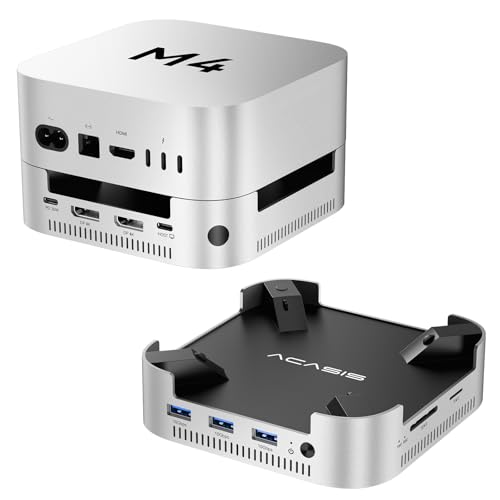
ACASIS 40Gbps Mac mini M4 Dock with Dual-Bay NVMe
About this pick
Supports two NVMe SSDs for up to 16TB at 2,869MB/s in RAID 0 or 8TB at 1,594MB/s in other modes, paired with dual/triple display support (dual DisplayPort at 4K@144Hz single-screen or 4K@60Hz dual-screen) alongside the Mac mini M4's own ports.
The included 30W PD adapter provides stable self-power to minimize disconnection or drive-failure risk, and ACASIS warns not to plug/unplug SSDs while powered on. Dual cooling fans (~52dB) maintain a safe 60°C even after hours of operation, molded to a 1:1 match of the Mac mini M4's shape.
Dual DisplayPort output alongside storage in one dock. On the other hand, aCASIS explicitly warns against hot-plugging SSDs while powered on. Neither should be a surprise once you know to look for it.
Best for: buyers prioritizing 40gbps, dual-bay nvme, up to 16tb raid 0
Check price on AmazonPros
- +Dual-bay NVMe with RAID 0 support for up to 16TB at 2,869MB/s
- +Dual DisplayPort output alongside storage in one dock
- +1:1 molded fit to the Mac mini M4 with anti-slip padding
- +Dual fans keep sustained temperature at a safe 60°C over hours
Cons
- −ACASIS explicitly warns against hot-plugging SSDs while powered on
- −Requires careful troubleshooting steps (per ACASIS's own guide) if display or SSD issues occur
How We Evaluated These Thunderbolt SSD RAID Enclosures
Each pick was assessed across 5 criteria weighted for real-world use.
Interface Protocol & Link Rate
Verified the exact USB/Thunderbolt protocol and rated speed from each listing rather than assuming USB-C connector shape implies a specific bandwidth tier.
Bridge Controller & Host Compatibility
Checked which bridge chip each enclosure uses where published, and cross-referenced explicit host compatibility statements (Mac generation, Thunderbolt version, USB4 V1 vs V2) against real-world limitations sellers disclosed.
M.2 Size, Keying & SSD Compatibility
Confirmed supported M.2 lengths (2230/2242/2260/2280), keying (M-Key vs B+M Key), and NVMe-versus-SATA protocol support rather than assuming universal compatibility.
Thermal Design & Sustained Performance
Weighed published tested throughput figures, fan trigger temperatures, and passive-versus-active cooling design over marketing language that repeats across nearly identical products.
Real Feature Differentiators
Prioritized genuine differentiators, RAID mode support, write-lock switches, health-monitoring displays, magnetic attachment systems, over generic "fast and durable" claims with nothing behind them.
How to Choose the Right Thunderbolt SSD RAID Enclosures
By Rating Confidence: Highest Rated vs Most Reviewed
| Your priority | Recommended pick |
|---|---|
| Highest average rating | OWC Express 4M2 Four |
| Largest review base, strongest reliability signal | OWC Express 4M2 Four |
By Budget
| Budget | Recommended pick |
|---|---|
| Under $160 | ACASIS 40Gbps Mac mini M4 Dock with Dual |
| Up to $200 | TERRAMASTER D4 SSD 4 |
ACASIS 40Gbps Mac mini M4 Dock with Dual vs TERRAMASTER D4 SSD 4
ACASIS 40Gbps Mac mini M4 Dock with Dual
The lower-priced option in this comparison, worth checking its actual specs and review history against your specific need before assuming it's enough.
TERRAMASTER D4 SSD 4
The higher-priced option, worth it if it offers real, checkable headroom in build quality, capacity, or features over the cheaper pick.
Default to ACASIS 40Gbps Mac mini M4 Dock with Dual unless your specific need genuinely calls for the pricier pick's extra headroom.
By Review Base Confidence
| Your priority | Recommended pick |
|---|---|
| Largest, most-established review base | OWC Express 4M2 Four |
For a First-Time Buyer Specifically
Look for
Clear, specific dimensions or capacity and a real, established review history, not just marketing language.
In this comparison
OWC Express 4M2 Four is worth checking against its listed specs before buying, given its strong review base.
When to Spend More
Spend more if
You need real durability and feature depth for regular use, where TERRAMASTER D4 SSD 4's build gives real headroom over the cheaper picks.
Save if
You only need this for light or occasional use, where ACASIS 40Gbps Mac mini M4 Dock with Dual covers the same job at a lower price.
Frequently Asked Questions
Does a faster enclosure automatically mean faster real-world transfers?
Not necessarily. Real throughput depends on the SSD's own generation and speed, the bridge controller inside the enclosure, cable quality, and whether the host port actually supports the claimed protocol. A 40Gbps enclosure with a slow SSD won't outperform a 10Gbps enclosure with a fast one by much.
Can I use any M.2 NVMe SSD in any enclosure in this list?
No. Check the exact M.2 length (2230/2242/2260/2280) and keying (M-Key vs B+M Key) the enclosure supports against your specific SSD before buying, and confirm whether the enclosure supports NVMe only or also SATA M.2 drives.
Why does my enclosure run slower than its advertised speed?
The most common causes are a host port that doesn't actually support the claimed protocol (many Macs cap USB 3.2 Gen 2x2 at 10Gbps, for example), an underrated USB-C cable, or sustained thermal throttling on a fanless design during a long transfer.
Bottom Line
best overall: OWC Express 4M2 Four-Slot Enclosure - best overall pick in this roundup.
See the full rankings above for all picks with pros, cons, and best-for summaries.
Browse on Amazon
All Prime-eligible options with current pricing.
Shop on Amazon →