
8 Best Quiet NAS for Home Offices in 2026
8 best quiet NAS for home offices in 2026, from a $153.99 drives-included pick to a $379 fanless-style mini PC NAS. Compare real-world noise, not just idle specs.

New to Amazon Prime?
Get fast, free shipping on every pick in this guide, plus Prime Video and exclusive deals.
Try Prime Free



At a Glance
Synology DS223 Home & Office Backup Hub (2-Bay Diskless NAS)
↓ See why we picked itUGREEN NAS DXP2800, 2-Bay for Content Creators
↓ See why we picked itBUFFALO LinkStation 210 2TB, 1-Bay NAS (Drives Included)
↓ See why we picked itQNAP TR-004, 4 Bay USB Type-C Direct Attached Storage (Diskless)
↓ See why we picked itA NAS sitting a few feet from your desk needs to stay quiet under actual daily use, not just at idle, which is the number most spec sheets advertise. Manufacturer dB ratings are almost always measured with no drive activity, but the moment a backup job runs or a RAID rebuild kicks off, fan speed rises and spinning drives ramp up, and the real noise at your desk ends up higher than the number on the box.
Below are 8 NAS units we evaluated on idle versus load noise, drive-noise contribution, and how placement affects what you actually hear, ranging from a $153.99 drives-included 1-bay unit to a $379 fanless-style mini PC NAS built around a low-power CPU instead of spinning storage.
5 Criteria to Look For Before Buying a Quiet NAS for Home Office
Key buying criteria so you get the right fit the first time.
Remember every listed NAS here is diskless, budget drives separately
The price shown for a NAS enclosure covers the hardware chassis, CPU, and RAM only, not the actual storage drives, NAS-grade drives built for 24/7 operation like Seagate IronWolf or WD Red still need to be budgeted on top, often adding $80 to $200 or more per bay depending on capacity and drive type.
This matters because comparing NAS units purely by enclosure price without factoring in drive cost gives a misleading picture of the real total investment, a cheaper enclosure with more bays to fill can end up costing more overall than a pricier enclosure with fewer bays.
Check whether a listing is diskless or ships with drives included, and add realistic per-bay drive costs to the enclosure price before comparing total cost across options.
Weigh CPU class and RAM over bay count for real day-to-day performance
Bay count determines maximum storage capacity, but CPU architecture (Intel, AMD, or ARM) and RAM amount determine how well the NAS actually handles real workloads, running apps, transcoding media on the fly, or serving multiple simultaneous users, and a higher bay count with a weak CPU can bottleneck performance regardless of how much raw storage it holds.
This matters more the more the NAS will do beyond simple file storage, like Plex transcoding or running multiple docker containers, less if it's purely a basic backup target.
Check the specific CPU model and RAM amount (and whether RAM is upgradeable) rather than choosing primarily by bay count.
Understand RAID as a rebuild-time safety net, not a substitute for real backup
RAID configurations protect against a single drive failure by letting the array rebuild from redundant data, but RAID is not a backup, it does nothing to protect against accidental deletion, ransomware, theft, fire, or a controller failure that affects the whole array at once.
This distinction matters because treating RAID redundancy as sufficient backup protection is a common and genuinely risky misunderstanding, a real backup strategy needs a copy of critical data stored somewhere physically separate from the NAS itself.
Check what RAID level a given NAS supports, and separately plan an actual backup strategy, ideally following a 3-2-1 approach, rather than relying on RAID redundancy alone.
Match drive type (HDD vs SSD/NVMe) to your actual access pattern
Traditional hard drives offer the lowest cost per terabyte for bulk storage like media libraries or backups, while SSD or NVMe-based NAS storage costs significantly more per terabyte but delivers much faster random access speeds, genuinely useful for frequently-accessed files, active project work, or serving as a fast cache tier.
This matters directly based on how you'll actually use the storage, a media library accessed sequentially benefits little from SSD speed, while an active working file share benefits considerably.
Check whether the NAS supports the drive type you need, and weigh the real cost-per-terabyte difference against how much you'll actually benefit from faster random access.
Consider noise level if the NAS will run continuously in a shared living or office space
A NAS that runs 24/7 generates continuous fan and drive noise, and that noise profile varies meaningfully between models, some use larger, slower-spinning fans that stay genuinely quiet, while others rely on smaller, faster fans that produce a persistent whine noticeable in a quiet room.
This matters a great deal if the NAS will sit in a bedroom, living room, or shared home office rather than a dedicated closet or basement out of earshot.
Check reviews specifically for real-world noise level mentions during continuous operation, not just idle noise, since drive activity and fan speed both increase under load.
8 Best Quiet NAS for Home Offices in 2026
Synology DS223 Home & Office Backup Hub (2-Bay Diskless NAS)
About this pick
The Synology DS223 pairs Synology's well-tuned fan curve with a 2-bay design, which matters because in real-world use the spinning drives you install typically contribute more audible noise than the fan itself. Synology's DSM software also lets you schedule intensive tasks like backups for overnight hours when they're least disruptive.
It centralizes file backup, protects data, and can monitor a property, all from a compact enclosure suited to sitting on or near a desk. Since drive noise dominates over fan noise on any 2-bay unit, pairing it with quieter NAS-rated drives makes a bigger difference here than chasing a slightly lower fan dB rating alone.
Can schedule noisy tasks like backups for off-hours. That's a real strength, but weigh it against the flip side: diskless, drives sold separately add to total cost.
Best for: Home office buyers who want a proven, software-mature quiet NAS for daily backup
Check price on AmazonPros
- +Well-tuned fan curve from a mature DSM platform
- +Can schedule noisy tasks like backups for off-hours
- +Centralizes backup for multiple computers
- +Trusted software ecosystem for home office use
Cons
- −Diskless, drives sold separately add to total cost
- −Real-world noise still depends heavily on which drives you install
- −2-bay limits total capacity versus 4-bay units
Beelink Mini PC ME Pro, 2 Hard Drive Bays NAS
About this pick
The Beelink ME Pro takes a different approach to quiet operation, an Intel N95 low-power CPU built for mini PC efficiency rather than a full NAS-class processor, paired with 3 M.2 SSD slots alongside its 2 hard drive bays. Loading it with M.2 SSDs instead of spinning HDDs gets noise close to silent, since SSD storage adds essentially zero mechanical noise.
That flexibility comes at a tradeoff familiar to fanless and low-power NAS builds: higher cost per TB and a lower practical capacity ceiling than a dedicated multi-bay NAS chassis, so it suits buyers prioritizing silence over maximum storage.
Worth calling out specifically: low-power CPU runs cooler and quieter than full NAS processors. The catch is higher cost per TB than a traditional HDD-based NAS.
Best for: Buyers who want the quietest possible setup and are willing to prioritize SSDs over raw capacity
Check price on AmazonPros
- +SSD-first configuration adds near-zero mechanical noise
- +Low-power CPU runs cooler and quieter than full NAS processors
- +Flexible mixed SSD and HDD storage
- +Dual LAN for network flexibility
Cons
- −Higher cost per TB than a traditional HDD-based NAS
- −Lower practical capacity ceiling than a dedicated 4-bay NAS
- −Requires more manual OS setup than a turnkey NAS platform
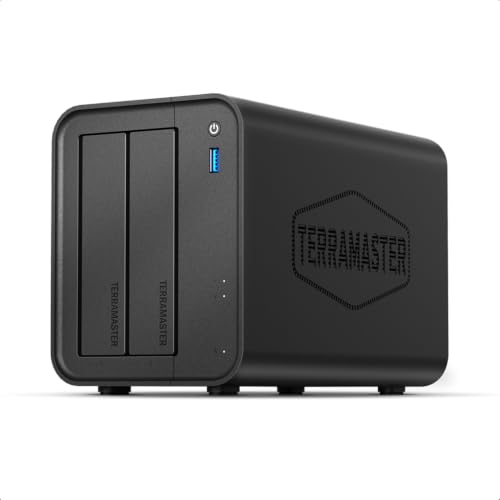
TERRAMASTER F2-425 2-Bay NAS Storage
About this pick
The F2-425 pairs an Intel x86 quad-core CPU and 4GB RAM with 2.5GbE networking, letting large backup and media transfers finish faster, which shortens the total window of load noise compared to a slower gigabit connection doing the same job. A shorter high-load period means less total time spent at the higher, load-level dB your desk actually hears.
Built for home users with multimedia server needs, it handles transcoding and file serving duties well while keeping the enclosure compact enough to place discreetly near a desk or on a nearby shelf.
Quad-core Intel CPU handles transcoding without excess strain. Set against that, diskless, drives add to total cost. Both matter when comparing it to the other picks here.
Best for: Buyers who want faster transfers to minimize how long the NAS spends under noisier load
Check price on AmazonPros
- +2.5GbE shortens the duration of load-level noise during transfers
- +Quad-core Intel CPU handles transcoding without excess strain
- +Compact 2-bay footprint
- +Good balance of performance and price
Cons
- −Diskless, drives add to total cost
- −2.5GbE only helps if your network switch or router also supports it
- −2-bay ceiling versus larger multi-bay units
UGREEN NAS DXP2800, 2-Bay for Content Creators
About this pick
UGREEN built the DXP2800 for content creators moving large video files, which means it's engineered with cooling headroom that lets its fan run at a lower, steadier speed under sustained load rather than spinning up aggressively the way undersized cooling systems do. A stable, moderate fan speed under real work is generally less noticeable than a fan that surges up and down.
At this price point you're paying for that extra performance headroom as much as for storage capacity, a fair tradeoff for anyone regularly editing or transferring large media files near their desk.
A genuine advantage here is that strong performance for large media file workflows. The tradeoff is higher price than basic 2-bay diskless units.
Best for: Content creators who want steady, predictable fan noise under sustained heavy transfer loads
Check price on AmazonPros
- +Cooling headroom keeps fan speed steadier under sustained load
- +Strong performance for large media file workflows
- +Compact enough for a desk or nearby shelf
- +Growing UGREEN NAS software ecosystem
Cons
- −Higher price than basic 2-bay diskless units
- −Diskless, drives sold separately
- −Newer platform with a smaller long-term track record than Synology
Asustor Drivestor 2 Gen 2 AS1202T, 2-Bay NAS
About this pick
The Drivestor 2 Gen 2 is Asustor's entry-level personal cloud NAS, built around a quad-core 1.7GHz CPU and 2.5GbE networking at a price well under the content-creator-class picks in this list. A smaller, simpler NAS like this generally runs a smaller fan under lighter loads than a high-performance unit doing 4K transcoding constantly.
It's a reasonable starting point for a home office that mainly needs reliable backup and occasional media serving rather than heavy daily transcoding, keeping both cost and typical noise output on the lower end.
2.5GbE networking at a budget price point. That's a real strength, but weigh it against the flip side: 1GB RAM is limiting for heavier multitasking.
Best for: Budget-conscious home offices that mainly need quiet backup, not constant transcoding
Check price on AmazonPros
- +Lower entry price than the content-creator-class picks
- +2.5GbE networking at a budget price point
- +Lighter typical workloads mean less fan strain
- +Good fit for backup-first, not transcoding-heavy, use
Cons
- −1GB RAM is limiting for heavier multitasking
- −Diskless, drives add to total cost
- −Less headroom for sustained 4K transcoding than pricier picks
UGREEN NAS DH2300, 2-Bay Desktop NAS (Diskless)
About this pick
The DH2300 is a straightforward 2-bay desktop NAS supporting up to 64TB across its 2 bays, aimed at buyers who want simple, reliable storage rather than a heavy-duty content-creation workstation. Its more modest internals mean it doesn't need to push fan speeds as hard under typical home office backup workloads.
Anti-vibration design matters more than most buyers expect here: placing any desktop NAS on a hollow wooden desk transmits and amplifies vibration noise compared to a solid surface, so a rubber-footed placement on a stable shelf noticeably reduces what you actually hear at your desk.
Worth calling out specifically: modest internals mean lighter typical fan load. The catch is fewer performance-oriented features than the content-creator picks.
Best for: Home offices that want simple, quiet backup storage without content-creation extras
Check price on AmazonPros
- +Straightforward setup for basic backup needs
- +Modest internals mean lighter typical fan load
- +Supports up to 64TB across 2 bays
- +Reasonable price for a 2-bay diskless unit
Cons
- −Fewer performance-oriented features than the content-creator picks
- −Diskless, drives sold separately
- −Perceived noise depends heavily on desk placement and surface
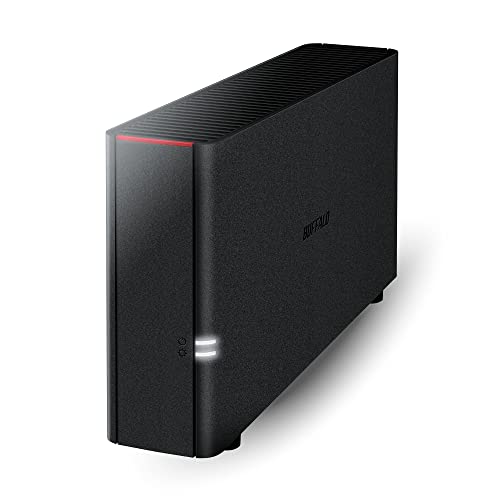
BUFFALO LinkStation 210 2TB, 1-Bay NAS (Drives Included)
About this pick
The LinkStation 210 ships with its 2TB drive already installed, avoiding the drive-compatibility research and separate purchase that diskless NAS units require. As a single-bay unit, it also runs a single drive rather than the 2 or more spinning in the multi-bay picks in this list, which generally means less total drive noise contributing on top of the fan.
It's a simple home cloud and network storage device rather than a performance NAS, well suited to buyers who mainly want one quiet, low-maintenance backup destination rather than RAID redundancy or transcoding power.
Single-bay design means less total drive noise than multi-bay units. Set against that, no RAID redundancy with only 1 bay. Both matter when comparing it to the other picks here.
Best for: Buyers who want the simplest possible quiet NAS with drives already included
Check price on AmazonPros
- +Drives already included, no separate compatibility research needed
- +Single-bay design means less total drive noise than multi-bay units
- +Simple setup for non-technical buyers
- +Lower total cost than buying an enclosure plus drives separately
Cons
- −No RAID redundancy with only 1 bay
- −2TB capacity is modest for growing storage needs
- −Less powerful CPU than the transcoding-focused picks
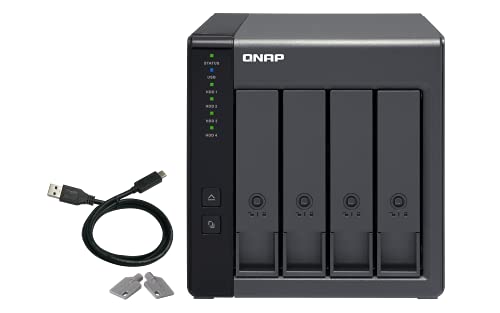
QNAP TR-004, 4 Bay USB Type-C Direct Attached Storage (Diskless)
About this pick
The QNAP TR-004 isn't a network-connected NAS in the traditional sense, it's direct attached storage over USB Type-C with hardware RAID, which sidesteps network-related noise concerns entirely since it connects straight to one computer. For a single-user home office setup, that's a genuinely quiet alternative to a full NAS if you don't need multi-device network access.
Its 4 bays give solid capacity for the price, and hardware RAID handles redundancy without leaning on a full NAS-class CPU or network stack, which keeps its overall power draw and associated fan activity comparatively modest for the bay count.
A genuine advantage here is that hardware RAID without full NAS-class overhead. The tradeoff is not accessible over the network like a true NAS.
Best for: Single-workstation home offices that want quiet, high-capacity storage without full network NAS features
Check price on AmazonPros
- +4 bays of capacity at a reasonable price
- +Hardware RAID without full NAS-class overhead
- +No network stack running means fewer background noise sources
- +Good fit for a single dedicated workstation
Cons
- −Not accessible over the network like a true NAS
- −Requires a direct USB-C connection to one computer
- −Diskless, drives add to total cost
How We Evaluated These Quiet NAS for Home Offices
Each pick was assessed across 5 criteria weighted for real-world use.
Idle vs. load noise behavior
Weighed how each NAS's fan and drive activity change between idle and active workloads like backups or RAID rebuilds, since idle dB ratings alone understate real-world noise.
Drive noise contribution
Considered how much of the total noise budget comes from spinning HDDs versus the fan itself, since modern NAS fans are often quieter than the drives installed in them.
Bay count and drive load
Weighed 1-bay, 2-bay, and 4-bay designs against how many spinning drives each realistically runs at once, since more bays generally means more potential drive noise.
Cooling headroom for sustained loads
Checked whether each unit's cooling design lets it maintain a steady fan speed under sustained transfer or transcoding load rather than surging noisily.
Value for price
Weighed CPU capability, networking speed, and included drives against price, since a drives-included 1-bay unit and a diskless content-creator NAS sit at very different points on that curve.
How to Choose the Right Quiet NAS for Home Offices
By Rating Confidence: Highest Rated vs Most Reviewed
| Your priority | Recommended pick |
|---|---|
| Highest average rating | Synology DS223 Home & Office Backup Hub |
| Largest review base, strongest reliability signal | Synology DS223 Home & Office Backup Hub |
By Budget
| Budget | Recommended pick |
|---|---|
| Under $154 | BUFFALO LinkStation 210 2TB |
| Up to $379 | Beelink Mini PC ME Pro |
Diskless Enclosure vs Drives Included
Diskless enclosure
Lets you choose your own NAS-grade drives and capacity, but budget $80-200+ per bay separately. In this comparison: Synology DS223 Home & Office Backup Hub, TERRAMASTER F2, UGREEN NAS DXP2800, Asustor Drivestor 2 Gen 2 AS1202T, UGREEN NAS DH2300, BUFFALO LinkStation 210 2TB, QNAP TR.
Drives included
Ready to use out of the box, simpler for a first NAS purchase. In this comparison: Beelink Mini PC ME Pro.
Default to diskless if you want control over drive choice and capacity, drives-included for the simplest setup.
By Drive Type Support
| Your priority | Recommended pick |
|---|---|
| SSD/NVMe for fast random access | Beelink Mini PC ME Pro |
| HDD for bulk storage is enough | Synology DS223 Home & Office Backup Hub |
For Media Streaming or Plex Specifically
Look for
A CPU capable of hardware transcoding and enough RAM to handle multiple simultaneous streams, not just total bay count.
In this comparison
Synology DS223 Home & Office Backup Hub is worth checking against its listed CPU and RAM before buying, given its strong review base.
When to Spend More
Spend more if
You need real multi-user performance, media transcoding, or business-critical reliability, where Beelink Mini PC ME Pro's CPU and RAM give real headroom over the cheaper picks.
Save if
You just need simple backup storage for one or two users, where BUFFALO LinkStation 210 2TB covers the same job at a lower price.
Frequently Asked Questions
Are NAS noise ratings on the box accurate?
Not for real-world use. Manufacturer dB ratings are almost always measured at idle with no drive activity. Once a backup job or RAID rebuild is running, fan speed increases and drives ramp up, so the actual noise at your desk is typically higher than the spec sheet number suggests.
Does the fan or the hard drives make more noise in a NAS?
In most cases, the spinning hard drives make more noise than the fan. Modern NAS fans are generally well-tuned and quiet, while HDD mechanical hum and occasional seek clicks are usually the more noticeable source. An SSD-based setup like the Beelink ME Pro's M.2 slots removes that mechanical noise almost entirely.
Does where I put my NAS affect how loud it sounds?
Yes, significantly. A NAS placed directly on a hollow wooden desk transmits vibration through the desk and sounds noticeably louder than the same unit on a solid surface. Adding rubber feet or a foam mounting pad under the unit reduces perceived noise at the listening point more than most people expect.
Which NAS in this list is the quietest overall?
The Beelink Mini PC ME Pro is the quietest when configured with M.2 SSDs instead of spinning hard drives, since SSD storage adds essentially zero mechanical noise. The tradeoff is a higher cost per TB and a lower practical capacity ceiling than a traditional multi-bay HDD NAS like the QNAP TR-004.
Should I worry more about NAS noise at night than during the day?
Yes. A NAS near a bedroom or a quiet home office is far more noticeable overnight than the same unit running in a room with daytime ambient noise. If it sits close to where you sleep, schedule backups and RAID scrubs for daytime hours, or lean toward a genuinely low-noise, SSD-first setup like the Beelink ME Pro.
Can a fanless NAS handle a home office's storage needs?
Fanless or near-silent NAS setups, typically built around low-power CPUs paired with M.2 SSDs, work well for buyers who don't need maximum capacity. The tradeoff is a higher cost per TB and a lower practical storage ceiling compared to a traditional multi-bay HDD NAS, so it suits lighter storage needs better than a media library that's still growing fast.
Bottom Line
best overall: Synology DS223 Home & Office Backup Hub (2-Bay Diskless NAS) - best overall quiet nas pick in this roundup.
See the full rankings above for all picks with pros, cons, and best-for summaries.
Browse on Amazon
All Prime-eligible options with current pricing.
Shop on Amazon →