
7 Best Portable NVMe Enclosures in 2026
Portability is more than small size. We checked weight, cable design, tool-free access, and thermal performance in a bag-friendly form factor.

New to Amazon Prime?
Get fast, free shipping on every pick in this guide, plus Prime Video and exclusive deals.
Try Prime Free



At a Glance
Portable NVMe enclosures compete on more than raw size: weight, integrated versus detachable cable design, tool-free drive access, and whether sustained transfers throttle in a compact, poorly-vented case all matter for actual travel use.
We checked published weight and dimensions where available, and favored products that address cable management explicitly, like FIDECO's combo USB-C/USB-A cable or Satechi's hidden cable compartment, over enclosures that only advertise slimness.
5 Criteria to Look For Before Buying a Portable NVMe Enclosure
Key buying criteria so you get the right fit the first time.
USB-C is a connector shape, not a speed, so check the actual protocol
The USB-C connector is used by multiple completely different speed tiers, including 10Gbps USB 3.2 Gen 2, 20Gbps Gen 2x2, and 40 or 80Gbps Thunderbolt/USB4, all of which physically plug into the exact same port shape on both the enclosure and your computer.
This matters because a listing photo or the word "USB-C" tells you nothing about which of these tiers you're actually getting, and plugging a 40Gbps enclosure into a 10Gbps port (or vice versa) simply caps your real transfer speed at whichever side is slower, wasting money if you bought the faster one for no benefit.
Check the listing's stated protocol name directly (USB 3.2 Gen 2, Gen 2x2, USB4, Thunderbolt 3/4/5) and confirm your own computer's exact port spec from its manufacturer documentation before assuming compatibility.
The bridge controller chip inside the enclosure affects real performance, not just the headline speed
Every external SSD enclosure contains a small bridge controller chip that translates between the M.2 NVMe SSD's native protocol and the external USB or Thunderbolt connection, and different controllers, such as the RTL9210, JMS583, or ASM2464PD, have measurably different real-world characteristics including sustained throughput, TRIM command support, and how gracefully they handle heat under long transfers.
Two enclosures can carry the identical headline speed rating while performing noticeably differently in practice because one uses a more capable or more recent controller chip than the other, and this is exactly the kind of difference that a spec sheet's top-line number won't reveal.
Where a listing names its specific bridge chip, treat that as a genuine signal of build quality worth researching, and be more cautious about unnamed or generic "USB 3.2 controller" language.
Confirm NVMe-only versus NVMe-plus-SATA support against your specific SSD
M.2 SSDs come in two fundamentally different protocols, NVMe (which uses the PCIe interface for high speed) and SATA (an older, slower interface that happens to share the same M.2 physical connector), and an enclosure built for one protocol generally cannot read a drive using the other, regardless of how similar the slot looks.
This is a genuine compatibility trap because both drive types are called "M.2 SSDs" and look physically identical at a glance, so a buyer who already owns a SATA M.2 drive can easily purchase an NVMe-only enclosure and find the drive simply isn't recognized at all.
Check your specific SSD's protocol (printed on the drive itself or in its own listing) against the enclosure's stated support before buying, and if you're unsure which protocol you own, look specifically for NVMe-plus-SATA dual-protocol enclosures to avoid the issue entirely.
Separate peak benchmark speed from real sustained transfer performance
A short benchmark test, the kind used in most marketing screenshots, can hit an enclosure's peak rated speed for a few seconds even on a design with genuinely poor sustained performance, because SSDs and enclosures both have cache and thermal buffers that mask throttling until a transfer runs long enough to exhaust them.
This matters most if your actual use case involves copying large video files, disk images, or backups that run for minutes rather than seconds, since that's exactly when a fanless, poorly-cooled enclosure will throttle and its real speed will drop well below the number advertised on the box.
Favor listings that publish tested read and write numbers using a named SSD and host device over theoretical link-rate claims alone, and treat passive cooling as a real limitation for sustained large-file work specifically.
Check your exact M.2 length and keying, since not every size fits every enclosure
M.2 SSDs come in several different physical lengths, commonly 2230, 2242, 2260, and 2280 (the numbers refer to width and length in millimeters), and also use different pin "keying" notches, most commonly M-Key for NVMe drives or B+M Key for drives that also support SATA, and an enclosure's internal slot is generally built to accept only a specific subset of these combinations rather than all of them universally.
A drive that's physically too long for a slot simply won't fit at all, while a keying mismatch can prevent the drive from making electrical contact even if it appears to slide in, so this isn't a minor compatibility footnote, it's a hard physical constraint.
Check your SSD's exact length and keying (usually printed on the drive or listed in its own product spec) against the enclosure's explicitly stated supported sizes, rather than trusting a generic "M.2 compatible" claim.
7 Best Portable NVMe Enclosures in 2026
Sabrent EC-PNVO USB-C NVMe Enclosure & Reader
About this pick
Flip-open, tool-free design presses the aluminum lid's thermal pad directly against the SSD for better heat transfer than slide-in enclosures. Supports NVMe-only M.2 2230/2242/2260/2280 SSDs up to at least 8TB over USB-C at 10Gbps (USB 3.2 Gen 2), no SATA support.
Reinforced ABS frame with an aluminum alloy top keeps the drive protected while staying slim enough for travel. No drivers or external power needed, works across laptops, desktops, and gaming handhelds.
It earns the top spot in this comparison over UGREEN 10Gbps Tool-Free M.2 NVMe Enclosure for one main reason. Thermal pad presses directly against the SSD for better cooling than slide-in designs. On price, it's actually priced above UGREEN 10Gbps Tool-Free M.2 NVMe Enclosure, which is worth weighing if cost is your deciding factor between the two.
Worth knowing before you decide: Tool-free flip-open installation, no screws. On the other side, 10Gbps ceiling limits it against 40/80Gbps enclosures. That's the main tradeoff to weigh against everything above.
Best for: buyers prioritizing 10gbps usb 3.2 gen 2
Check price on AmazonPros
- +Thermal pad presses directly against the SSD for better cooling than slide-in designs
- +Tool-free flip-open installation, no screws
- +Supports all four common M.2 lengths in one enclosure
- +Reinforced ABS frame plus aluminum top for durability
Cons
- −NVMe only, no SATA M.2 support
- −10Gbps ceiling limits it against 40/80Gbps enclosures
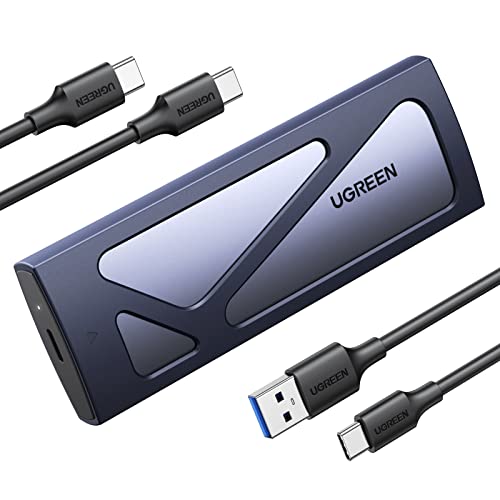
UGREEN 10Gbps Tool-Free M.2 NVMe Enclosure
About this pick
Uses the RTL9210 controller chip for UASP/TRIM support at up to 10Gbps over USB 3.2 Gen 2, with a tool-free buckle design for M/B+M key NVMe SSDs in 2230/2242/2260/2280 sizes up to 8TB. Ships with an extra silicone case for added protection.
Built-in short-circuit and over-current protection guards the SSD during transfers. Note that 10Gbps speeds require a genuine USB 3.2 Gen 2 cable, and it does not support SATA NGFF or mSATA drives.
One spot below Sabrent EC-PNVO USB-C NVMe Enclosure & Reader in this ranking, it's priced lower than Sabrent EC-PNVO USB-C NVMe Enclosure & Reader. The compromise here is straightforward: Requires a genuine USB 3.2 Gen 2 cable to hit 10Gbps. What you gain in return: RTL9210 chip includes short-circuit and over-current protection. Whether that trade is worth it depends on which side matters more for your actual transfer workload.
Worth knowing before you decide: Tool-free buckle design for quick installation. On the other side, No SATA M.2 support. That's the main tradeoff to weigh against everything above.
Best for: buyers prioritizing 10gbps usb 3.2 gen 2, rtl9210 chip
Check price on AmazonPros
- +RTL9210 chip includes short-circuit and over-current protection
- +Tool-free buckle design for quick installation
- +Extra silicone case included for portability
- +Works across Windows, macOS, Linux, Android, and iOS
Cons
- −Requires a genuine USB 3.2 Gen 2 cable to hit 10Gbps
- −No SATA M.2 support
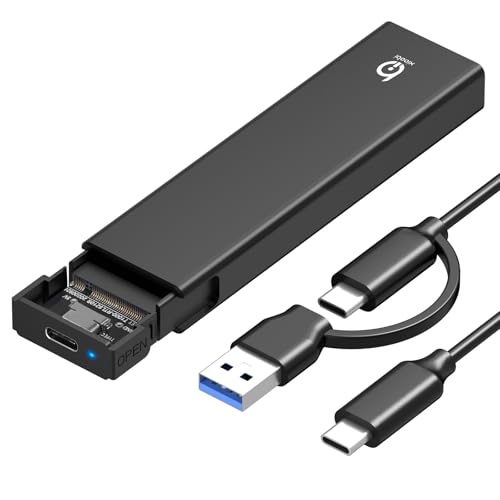
FIDECO Sandwich-Style NVMe Enclosure
About this pick
A sandwich-style design (two halves clamp around the SSD) at up to 10Gbps over USB 3.2 Gen 2, supporting M and M+B Key NVMe SSDs in 2230/2242/2260/2280 sizes, explicitly not M.2 SATA.
FIDECO says the sandwich design gives the thermal pad better contact with the SSD than slide-in designs, for a cooler running enclosure. Compact pocket-sized profile with a USB-C to USB-C cable plus an attached USB-A adapter, so one cable covers both host types while traveling.
Sitting just under UGREEN 10Gbps Tool-Free M.2 NVMe Enclosure, it's priced lower than UGREEN 10Gbps Tool-Free M.2 NVMe Enclosure. Here's the honest tradeoff: NVMe only, no SATA M.2 support. And here's what it gets you instead: Sandwich-style design gives the thermal pad better SSD contact than slide-in enclosures. That's the real difference between the two picks, not just a ranking number.
Worth knowing before you decide: One combo cable covers both USB-C and USB-A hosts. On the other side, 10Gbps ceiling versus higher-speed competitors. That's the main tradeoff to weigh against everything above.
Best for: buyers prioritizing 10gbps usb 3.2 gen 2, sandwich-style design
Check price on AmazonPros
- +Sandwich-style design gives the thermal pad better SSD contact than slide-in enclosures
- +One combo cable covers both USB-C and USB-A hosts
- +Very low price point for the feature set
- +Broad OS support (Windows, macOS, Linux)
Cons
- −NVMe only, no SATA M.2 support
- −10Gbps ceiling versus higher-speed competitors
Xiaobi Tool-Free NVMe Enclosure
About this pick
A 10Gbps USB 3.2 Gen 2 enclosure for M-Key/B+M Key NVMe SSDs in 2230/2242/2260/2280 sizes, with a secure buckle mechanism and premium aluminum housing plus a high-efficiency silicone thermal pad for heat dissipation.
Xiaobi is explicit that SSDs with a pre-installed heatsink aren't supported, and instructs removing a protective film before first use. Works across Windows, macOS, and Linux with true plug-and-play, no drivers needed.
Ranked just behind FIDECO Sandwich-Style NVMe Enclosure, it's priced lower than FIDECO Sandwich-Style NVMe Enclosure. The real tradeoff against that pick: Does not support SSDs with a pre-installed heatsink. In exchange, it offers this instead: Covers all four common M.2 lengths in one enclosure. That's the swap that decides whether this pick or the one above it is the better fit for your SSD and host setup.
Worth knowing before you decide: Secure buckle mechanism for a stable connection. On the other side, 10Gbps ceiling versus higher-speed competitors. That's the main tradeoff to weigh against everything above.
Best for: buyers prioritizing 10gbps usb 3.2 gen 2
Check price on AmazonPros
- +Covers all four common M.2 lengths in one enclosure
- +Secure buckle mechanism for a stable connection
- +Silicone thermal pad plus aluminum housing for heat management
- +True plug-and-play across Windows, macOS, and Linux
Cons
- −Does not support SSDs with a pre-installed heatsink
- −10Gbps ceiling versus higher-speed competitors
SSK M.2 NVMe/SATA SSD Enclosure
About this pick
A dual-protocol enclosure for NVMe PCIE and SATA M-Key/B+M SSDs in 2242/2260/2280 sizes, built around the RTL9210B controller for UASP/TRIM support at up to 10Gbps over USB-C, recommended specifically with USB-C Gen 2 or Thunderbolt 3 hosts for full speed.
Ships with two thermal pads, both USB-C and USB-A cables, and a screwdriver, plus a blue transfer-status indicator. The aluminum alloy shell handles heat dissipation while keeping the unit slim and portable.
One spot below Xiaobi Tool-Free NVMe Enclosure in this ranking, it costs more than Xiaobi Tool-Free NVMe Enclosure. The compromise here is straightforward: No 2230 size support. What you gain in return: Improved RTL9210B chip for UASP and TRIM support. Whether that trade is worth it depends on which side matters more for your actual transfer workload.
Worth knowing before you decide: Supports both NVMe and SATA M.2 drives. On the other side, Bus-powered only, no active cooling for sustained heavy loads. That's the main tradeoff to weigh against everything above.
Best for: buyers prioritizing 10gbps usb-c, rtl9210b chip
Check price on AmazonPros
- +Improved RTL9210B chip for UASP and TRIM support
- +Supports both NVMe and SATA M.2 drives
- +Ships with both USB-C and USB-A cables plus a screwdriver
- +Blue status LED shows transfer activity clearly
Cons
- −No 2230 size support
- −Bus-powered only, no active cooling for sustained heavy loads
SSK NVMe/SATA Enclosure (M.2 to USB)
About this pick
Dual-protocol support for both NVMe PCIe and SATA SSDs with M-Key or B+M Key connectors in 2230/2242/2260/2280 sizes, rated 10Gbps for NVMe and 6Gbps for SATA over USB-C 3.2 Gen 2.
Aluminum alloy shell with a slim profile efficiently conducts heat away from the SSD, includes 2 thermal pads plus both USB-C and USB-A cables. A blue indicator shows transfer status clearly, bus-powered with no external adapter needed.
Sitting just under SSK M.2 NVMe/SATA SSD Enclosure, it's priced lower than SSK M.2 NVMe/SATA SSD Enclosure. Here's the honest tradeoff: 10Gbps ceiling limits it against 40Gbps competitors. And here's what it gets you instead: Dual NVMe and SATA protocol support at a low price. That's the real difference between the two picks, not just a ranking number.
Worth knowing before you decide: Both USB-C and USB-A cables included in the box. On the other side, No active cooling for sustained heavy workloads. That's the main tradeoff to weigh against everything above.
Best for: buyers prioritizing 10gbps nvme / 6gbps sata dual protocol
Check price on AmazonPros
- +Dual NVMe and SATA protocol support at a low price
- +Both USB-C and USB-A cables included in the box
- +Blue status indicator shows transfer activity clearly
- +Bus-powered, no external adapter needed
Cons
- −10Gbps ceiling limits it against 40Gbps competitors
- −No active cooling for sustained heavy workloads
How We Evaluated These Portable NVMe Enclosures
Each pick was assessed across 5 criteria weighted for real-world use.
Interface Protocol & Link Rate
Verified the exact USB/Thunderbolt protocol and rated speed from each listing rather than assuming USB-C connector shape implies a specific bandwidth tier.
Bridge Controller & Host Compatibility
Checked which bridge chip each enclosure uses where published, and cross-referenced explicit host compatibility statements (Mac generation, Thunderbolt version, USB4 V1 vs V2) against real-world limitations sellers disclosed.
M.2 Size, Keying & SSD Compatibility
Confirmed supported M.2 lengths (2230/2242/2260/2280), keying (M-Key vs B+M Key), and NVMe-versus-SATA protocol support rather than assuming universal compatibility.
Thermal Design & Sustained Performance
Weighed published tested throughput figures, fan trigger temperatures, and passive-versus-active cooling design over marketing language that repeats across nearly identical products.
Real Feature Differentiators
Prioritized genuine differentiators, RAID mode support, write-lock switches, health-monitoring displays, magnetic attachment systems, over generic "fast and durable" claims with nothing behind them.
How to Choose the Right Portable NVMe Enclosures
By Interface Speed
| Your host port | Recommended pick in this comparison |
|---|---|
| 10Gbps (USB 3.2 Gen 2) | Sabrent EC-PNVO USB-C NVMe Enclosure & Reader |
| 20Gbps (USB 3.2 Gen 2x2) | Sabrent EC-PNVO USB-C NVMe Enclosure & Reader |
| 40Gbps or higher (Thunderbolt/USB4) | SSK NVMe/SATA Enclosure |
By Budget
| Price range | Recommended pick |
|---|---|
| Under $15 | Xiaobi Tool-Free NVMe Enclosure |
| Mid-range | UGREEN 10Gbps Tool-Free M.2 NVMe Enclosure |
| No firm budget ceiling, prioritizing speed or controller quality | Sabrent EC-PNVO USB-C NVMe Enclosure & Reader |
NVMe-Only vs NVMe+SATA Dual Protocol
NVMe-Only
Reads only NVMe M-Key SSDs, generally cheaper and simpler, but won't recognize a SATA M.2 drive at all if that's what you own. In this comparison: Sabrent EC-PNVO USB-C NVMe Enclosure & Reader, UGREEN 10Gbps Tool-Free M.2 NVMe Enclosure, Xiaobi Tool-Free NVMe Enclosure.
NVMe+SATA Dual Protocol
Accepts both NVMe and SATA M.2 drives in the same enclosure, more flexible if you're not certain which protocol your SSD uses. In this comparison: FIDECO Sandwich-Style NVMe Enclosure, SSK M.2 NVMe/SATA SSD Enclosure, SSK NVMe/SATA Enclosure.
Most buyers with a known NVMe SSD should default to an NVMe-only pick like Xiaobi Tool-Free NVMe Enclosure, and only pay extra for FIDECO Sandwich-Style NVMe Enclosure's dual-protocol support if you're not certain which type of drive you own.
Passive vs Active Cooling
| Your workload | Recommended pick |
|---|---|
| Occasional file transfers | Sabrent EC-PNVO USB-C NVMe Enclosure & Reader |
| Sustained large transfers (video editing, backups) | SSK NVMe/SATA Enclosure |
For Sustained Large File Transfers Specifically
Look for
Published tested read/write numbers using a named SSD and host, active cooling or substantial heatsink fins, and an explicit note about sustained (not just peak burst) performance.
In this comparison
SSK NVMe/SATA Enclosure fits this specifically: Dual NVMe and SATA protocol support at a low price.
When to Spend More
Spend more if
You want what Sabrent EC-PNVO USB-C NVMe Enclosure & Reader offers: Thermal pad presses directly against the SSD for better cooling than slide-in designs. That's a real functional upgrade over the budget picks here, not just a brand markup.
Save if
Xiaobi Tool-Free NVMe Enclosure already covers the essentials: Covers all four common M.2 lengths in one enclosure. The main thing you'd be paying extra for elsewhere in this list is a faster interface tier or dual-protocol support you may not need.
Frequently Asked Questions
Does a faster enclosure automatically mean faster real-world transfers?
Not necessarily. Real throughput depends on the SSD's own generation and speed, the bridge controller inside the enclosure, cable quality, and whether the host port actually supports the claimed protocol. A 40Gbps enclosure with a slow SSD won't outperform a 10Gbps enclosure with a fast one by much.
Can I use any M.2 NVMe SSD in any enclosure in this list?
No. Check the exact M.2 length (2230/2242/2260/2280) and keying (M-Key vs B+M Key) the enclosure supports against your specific SSD before buying, and confirm whether the enclosure supports NVMe only or also SATA M.2 drives.
Why does my enclosure run slower than its advertised speed?
The most common causes are a host port that doesn't actually support the claimed protocol (many Macs cap USB 3.2 Gen 2x2 at 10Gbps, for example), an underrated USB-C cable, or sustained thermal throttling on a fanless design during a long transfer.
Bottom Line
best overall: Sabrent EC-PNVO USB-C NVMe Enclosure & Reader - best overall pick in this roundup.
See the full rankings above for all picks with pros, cons, and best-for summaries.
Browse on Amazon
All Prime-eligible options with current pricing.
Shop on Amazon →