
4 Best PoE Extenders for IP Cameras and CCTV in 2026
We compared PoE extenders for IP cameras by real bandwidth at max distance, since several listings drop speed well below Gigabit past 600 meters.



At a Glance
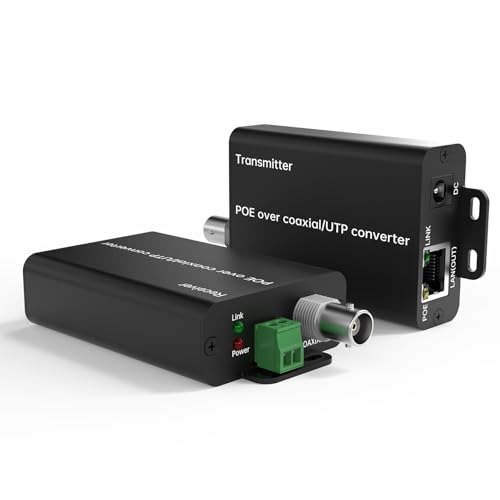
PoE Over Coax Converter BNC to Ethernet IP Extender (EOC)
↓ See why we picked itExtending Power over Ethernet to an IP camera mounted far from your switch or NVR is one of the most common home and small-business security setups, but the real bandwidth you get at maximum distance drops meaningfully on several extenders, sometimes down to 10Mbps well before the advertised maximum range.
We compared this lineup on real bandwidth at stated maximum distance, outdoor weatherproofing rating, and whether an extender requires rewiring or can reuse existing coaxial cable, since one listing specifically lets you upgrade an analog CCTV system to IP over the same RG59 coax already installed.
5 Criteria to Look For Before Buying a PoE Extenders for IP Cameras and CCTV
Key buying criteria so you get the right fit the first time.
A PoE Extender's Real Bandwidth Often Drops Well Before Its Advertised Maximum Distance
The LINOVISION pick specifically discloses that its paired-mode bandwidth drops to just 10Mbps once past 1960ft, even though its maximum stated distance is 2600ft, a real and substantial speed reduction that occurs before the extender reaches its full advertised range. This matters significantly if you're running a high-resolution camera that needs consistent bandwidth at the far end of a long cable run, and matters less if your camera only needs a modest, low-bitrate connection. Check a listing specifically for bandwidth figures at different distance milestones, not just its single best-case maximum distance number, before assuming full speed holds throughout the entire advertised range.
Reusing Existing Coaxial Cable Can Avoid a Costly Rewiring Project When Upgrading an Analog CCTV System
The PoE Over Coax Converter pick specifically lets you reuse existing RG59, RG6, or RG11 coaxial cable already installed for an older analog CCTV system, converting it to carry both PoE power and IP data without pulling new cable runs. This matters significantly if you're upgrading a building with existing coax infrastructure, since rewiring can be expensive or physically impractical in settings like elevator shafts or finished walls, and matters less if you're installing a fresh system with no existing cabling to reuse. Check whether an extender specifically supports coax reuse if avoiding a rewiring project is a real cost consideration for your upgrade.
A PoE Combiner Solves a Genuinely Different Problem Than a Straight-Line Distance Extender
The IPCamPower pick is specifically designed to run two nearby cameras over a single cable back to the switch, a fundamentally different use case from extending PoE distance to one single far-away camera, even though both product types get grouped under the general 'PoE extender' category. This matters if your actual installation has two cameras mounted near each other but far from your switch or NVR, where a combiner saves real cabling cost, and matters much less if you only have one camera per location that simply needs more distance. Identify whether your actual installation problem is distance to one device or combining multiple nearby devices onto one cable run before choosing between these genuinely different product types.
An Extender's Explicit 24V PoE Exclusion Can Cause a Real Compatibility Failure With Certain Cameras
The Gigabit PoE+ Extender pick specifically states it does not support 24V PoE devices, only standard IEEE 802.3af/at, a real and specific exclusion that matters if your particular camera or IP phone uses the less common 24V passive PoE standard rather than the more prevalent 802.3af/at active PoE standard. This matters significantly if you're not certain which PoE standard your existing camera uses, since connecting an unsupported 24V device to an 802.3af/at-only extender may simply not power the device at all. Verify your camera's exact PoE standard (802.3af, 802.3at, or 24V passive) against an extender's explicitly stated compatibility before purchasing, rather than assuming all PoE devices work with any PoE extender.
Operating Temperature Range Matters as Much as a Waterproof Rating for a Genuinely Harsh Outdoor Installation
The Gigabit PoE+ Extender pick specifically states an operating range of -40F to 158F, a notably wider tolerance than a typical -10C to 50C range seen on some other outdoor-rated extenders, which matters in climates with genuine temperature extremes beyond what a standard outdoor rating anticipates. This matters if you're installing in a region with very cold winters or very hot summers where electronics could be pushed outside a more modest temperature range, and matters less in a moderate climate where any outdoor-rated unit would perform adequately. Check an extender's specific operating temperature range, not just its IP waterproof rating, if your installation location experiences genuine temperature extremes.
4 Best PoE Extenders for IP Cameras and CCTV in 2026
LINOVISION Long Distance Outdoor PoE Extender
About this pick
This extender's listing specifically discloses that pairing two units reaches up to 2600ft of PoE transmission distance, but bandwidth drops to 10Mbps after 1960ft, an honest disclosure of the real speed-versus-distance tradeoff rather than a single blended distance claim. Its IP67 waterproof rating and wide temperature range of -10C to 50F are specifically built for harsh outdoor environments.
Compared to the coax converter and outdoor Gigabit picks below, this one's Paired Mode automatically activates when two units' orange input ports are connected directly, a genuinely simple setup process for reaching maximum distance without manual configuration.
Best for buyers who need the longest possible PoE distance and can accept reduced bandwidth at the far end.
Best for: buyers who need the longest possible PoE distance and can accept reduced bandwidth at the far end
Check price on AmazonPros
- +Longest distance option in this comparison at up to 2600ft
- +Honest disclosure of bandwidth reduction at extreme distance
- +Automatic Paired Mode requires no manual configuration
Cons
- −Bandwidth drops to just 10Mbps past 1960ft in paired mode
- −Requires a standard PoE device connected first to activate for non-PoE use
PoE Over Coax Converter BNC to Ethernet IP Extender (EOC)
About this pick
This converter's listing specifically states it reuses existing RG59, RG6, or RG11 coaxial cables to upgrade an analog surveillance system to IP networking, eliminating the cost and hassle of rewiring an installed CCTV system. Its built-in BNC and twisted pair dual functions integrate power and data transmission over coax without needing extra BNC-to-twisted-pair adapters.
Compared to the LINOVISION extender above, this one's specifically stated 100Mbps at 300m or 30Mbps at 2000m over coax gives a clearer distance-to-speed tradeoff for reusing existing coax runs in elevator shafts or industrial sites where rewiring is impractical.
Best for buyers upgrading an existing analog CCTV system to IP over already-installed coaxial cable.
Best for: buyers upgrading an existing analog CCTV system to IP over already-installed coax
Check price on AmazonPros
- +Reuses existing coaxial cable, avoiding a full rewiring project
- +Built-in heat sink supports industrial-grade reliability
- +Clear distance-to-speed tradeoff documentation over coax
Cons
- −Pre-paired for indoor use only, cannot mix with other units
- −Bandwidth drops significantly at longer coax distances
IPCamPower POE Combiner Splitter Adapter
About this pick
This adapter's listing specifically solves a different problem than a straight-line distance extender: running two IP cameras mounted near each other back to a switch or NVR over a single cable run, cutting cabling costs specifically for a two-camera corner installation. Its Splitter Unit comes with weatherproof RJ45 connectors and a full IP68 rating for direct exposure to rain, sleet, snow, and sun.
Compared to the LINOVISION and coax picks above, this one's specifically stated compatibility with both Mode A and Mode B PoE, working across all standard PoE switches, NVRs, and cameras, gives it the broadest documented compatibility in this comparison at the lowest price.
Best for buyers who need to run two nearby cameras over a single cable rather than extending distance to one camera.
Best for: buyers who need to run two nearby cameras over a single cable rather than extending distance
Check price on AmazonPros
- +Lowest price in this comparison at $19.99
- +Broadest documented compatibility across Mode A and B PoE
- +IP68-rated splitter can be fully exposed to weather
Cons
- −Solves a different problem (combining 2 cameras) rather than extending distance
- −Not designed for a single camera mounted far from the switch
Gigabit PoE+ Extender Outdoor IP67 Waterproof
About this pick
This extender's listing specifically states full Gigabit 1000Mbps bandwidth over its 330ft extension range, avoiding the bandwidth reduction that several longer-range extenders in this comparison accept as a tradeoff. Its IP67 waterproof rating and an unusually wide operating temperature range of -40F to 158F are built for genuinely harsh outdoor conditions.
Compared to the LINOVISION and coax picks above, this one's listing specifically notes support for up to 3 chained extenders covering 400 meters total, while explicitly stating it does not support 24V PoE devices, an honest compatibility disclosure worth checking against your camera's actual power standard.
Best for buyers who want full Gigabit bandwidth without the distance-related speed compromise other extenders accept.
Best for: buyers who want full Gigabit bandwidth without a distance-related speed compromise
Check price on AmazonPros
- +Maintains full Gigabit bandwidth rather than dropping speed for distance
- +Unusually wide temperature range suits extreme outdoor climates
- +Chainable design extends coverage while maintaining IEEE standard compliance
Cons
- −Does not support 24V PoE devices, only standard 802.3af/at
- −Shorter single-unit range than the LINOVISION long-distance pick
How We Evaluated These PoE Extenders for IP Cameras and CCTV
Each pick was assessed across 5 criteria weighted for real-world use.
Real Bandwidth at Maximum Distance
Compared documented speed reduction as distance from the PoE source increases.
Outdoor Weatherproofing Rating
Compared IP-rated waterproofing and operating temperature range for outdoor camera installations.
Installation Method Fit
Compared straight-line extension, coax reuse, and multi-camera combining approaches to different real installation scenarios.
PoE Standard Compatibility
Compared IEEE 802.3af/at compliance and any explicit compatibility exclusions like 24V PoE.
Documentation Transparency
Compared how clearly each listing discloses bandwidth or compatibility tradeoffs rather than only headline figures.
How to Choose the Right PoE Extenders for IP Cameras and CCTV
By Installation Scenario
| Your situation | Recommended pick |
|---|---|
| A single camera very far from your switch | LINOVISION Long Distance Outdoor PoE Extender |
| Upgrading an existing analog CCTV system to IP | PoE Over Coax Converter BNC to Ethernet (EOC) |
| Two cameras mounted near each other, far from the switch | IPCamPower POE Combiner Splitter Adapter |
| Need full Gigabit speed without a distance tradeoff | Gigabit PoE+ Extender Outdoor IP67 Waterproof |
By Budget
| Price range | Recommended pick |
|---|---|
| Under $20 | IPCamPower POE Combiner Splitter Adapter ($19.99) |
| Under $66 | Gigabit PoE+ Extender Outdoor IP67 ($65.99) |
| Under $80 | PoE Over Coax Converter EOC ($79.11) |
| Under $90 | LINOVISION Long Distance Extender ($89.99) |
Maximum Distance vs Full Gigabit Speed
Maximum distance (LINOVISION)
Reaches up to 2600ft in paired mode, but bandwidth drops to just 10Mbps past 1960ft, a real tradeoff for cameras with modest bandwidth needs at extreme distance.
Full Gigabit speed (Gigabit PoE+ Extender)
Maintains full 1000Mbps bandwidth over a shorter 330ft range, better suited to high-resolution cameras that need their full bitrate preserved.
If your camera is extremely far away and doesn't need high bitrate (a basic monitoring camera), the LINOVISION's extreme distance is the right tradeoff. If you're running a high-resolution camera that needs its full bandwidth, the Gigabit extender keeps that intact over a more modest distance.
By Existing Wiring
| Your existing wiring | Recommended pick |
|---|---|
| Existing RG59/RG6/RG11 coax from an old analog system | PoE Over Coax Converter BNC to Ethernet (EOC) |
| New Cat5e/Cat6 Ethernet runs | LINOVISION Long Distance Extender or Gigabit PoE+ Extender |
| One existing cable run needing to serve two nearby cameras | IPCamPower POE Combiner Splitter Adapter |
For a Harsh Outdoor Climate Specifically
Look for
An extender with an explicitly wide operating temperature range beyond just an IP waterproof rating, since extreme heat or cold can affect electronics even in a weatherproof enclosure.
In this comparison
The Gigabit PoE+ Extender Outdoor specifically states a -40F to 158F operating range, the widest temperature tolerance of any pick here.
When to Spend More
Spend more if
You need to reach an extreme distance and can tolerate reduced bandwidth at the far end, where the LINOVISION's $89.99 price buys genuinely more reach than any other pick here.
Save if
You're combining two nearby cameras onto one cable run rather than extending a single long distance, where the IPCamPower splitter delivers that for $19.99, the lowest price in this comparison.
Frequently Asked Questions
Will a PoE extender's full bandwidth hold up at its maximum advertised distance?
Not always; the LINOVISION pick specifically discloses that bandwidth drops to 10Mbps well before its full 2600ft maximum distance, so checking a listing's bandwidth-by-distance breakdown rather than just its headline maximum range is worth doing.
What's the most common mistake buyers make when choosing a PoE extender for an IP camera?
Assuming any PoE extender works with any PoE camera, when some extenders explicitly exclude 24V PoE devices and only support the more common IEEE 802.3af/at standard, which can cause a real compatibility failure if your camera uses a different standard.
Is the LINOVISION long-distance extender worth it over the Gigabit extender if my camera doesn't need full speed?
If your camera only needs modest bandwidth and you need to reach an extreme distance, the LINOVISION's extended reach is the better fit, but if your camera needs consistent full bitrate, the Gigabit extender's shorter range with maintained speed is the better choice.
Can I use the coax converter to upgrade my analog security system without pulling new cable?
Yes, the PoE Over Coax Converter is specifically designed to reuse existing RG59, RG6, or RG11 coaxial cable from an analog CCTV system, letting you upgrade to IP networking without a full rewiring project.
Do I need a combiner or an extender if I have two cameras mounted close together but far from my switch?
A combiner like the IPCamPower pick is specifically designed for that scenario, letting you run one cable to both nearby cameras rather than extending distance separately to each one with two individual extenders.
How do I know if my camera uses 24V PoE or the standard 802.3af/at PoE?
Checking your camera's own product documentation or power specification label for the exact PoE standard it requires, and matching that against an extender's explicitly stated compatibility, is the reliable way to confirm before buying an extender that specifically excludes 24V devices.
Bottom Line
best overall: LINOVISION Long Distance Outdoor PoE Extender - best for long distance pick in this roundup.
See the full rankings above for all picks with pros, cons, and best-for summaries.
Browse on Amazon
All Prime-eligible options with current pricing.
Shop on Amazon →