
5 Best OCuLink NVMe Enclosures in 2026
OCuLink is a direct PCIe interface, fundamentally different from USB4/Thunderbolt bridge enclosures. Host support requirements are strict.

New to Amazon Prime?
Get fast, free shipping on every pick in this guide, plus Prime Video and exclusive deals.
Try Prime Free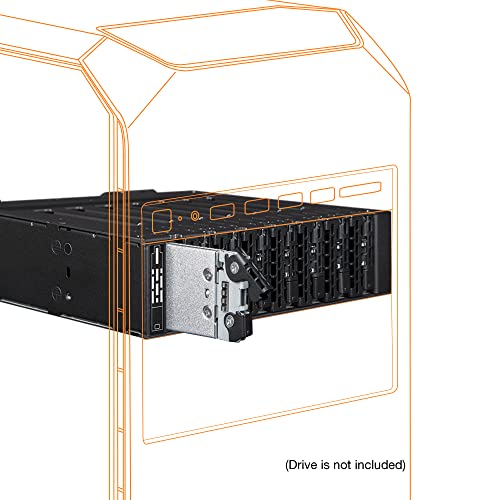


At a Glance
OCuLink exposes PCIe connectivity directly rather than through a USB or Thunderbolt bridge chip, delivering up to 64Gbps per drive, but requiring a host with genuine OCuLink support, typically mini PCs, workstation boards, or expansion hardware rather than mainstream laptops.
We separated pure storage enclosures (ICY DOCK's 4-bay and 8-bay rack mounts) from the MINISFORUM eGPU dock that happens to include an NVMe slot as a secondary feature, since they solve very different buying problems.
5 Criteria to Look For Before Buying a OCuLink NVMe Enclosure
Key buying criteria so you get the right fit the first time.
USB-C is a connector shape, not a speed, so check the actual protocol
The USB-C connector is used by multiple completely different speed tiers, including 10Gbps USB 3.2 Gen 2, 20Gbps Gen 2x2, and 40 or 80Gbps Thunderbolt/USB4, all of which physically plug into the exact same port shape on both the enclosure and your computer.
This matters because a listing photo or the word "USB-C" tells you nothing about which of these tiers you're actually getting, and plugging a 40Gbps enclosure into a 10Gbps port (or vice versa) simply caps your real transfer speed at whichever side is slower, wasting money if you bought the faster one for no benefit.
Check the listing's stated protocol name directly (USB 3.2 Gen 2, Gen 2x2, USB4, Thunderbolt 3/4/5) and confirm your own computer's exact port spec from its manufacturer documentation before assuming compatibility.
The bridge controller chip inside the enclosure affects real performance, not just the headline speed
Every external SSD enclosure contains a small bridge controller chip that translates between the M.2 NVMe SSD's native protocol and the external USB or Thunderbolt connection, and different controllers, such as the RTL9210, JMS583, or ASM2464PD, have measurably different real-world characteristics including sustained throughput, TRIM command support, and how gracefully they handle heat under long transfers.
Two enclosures can carry the identical headline speed rating while performing noticeably differently in practice because one uses a more capable or more recent controller chip than the other, and this is exactly the kind of difference that a spec sheet's top-line number won't reveal.
Where a listing names its specific bridge chip, treat that as a genuine signal of build quality worth researching, and be more cautious about unnamed or generic "USB 3.2 controller" language.
Confirm NVMe-only versus NVMe-plus-SATA support against your specific SSD
M.2 SSDs come in two fundamentally different protocols, NVMe (which uses the PCIe interface for high speed) and SATA (an older, slower interface that happens to share the same M.2 physical connector), and an enclosure built for one protocol generally cannot read a drive using the other, regardless of how similar the slot looks.
This is a genuine compatibility trap because both drive types are called "M.2 SSDs" and look physically identical at a glance, so a buyer who already owns a SATA M.2 drive can easily purchase an NVMe-only enclosure and find the drive simply isn't recognized at all.
Check your specific SSD's protocol (printed on the drive itself or in its own listing) against the enclosure's stated support before buying, and if you're unsure which protocol you own, look specifically for NVMe-plus-SATA dual-protocol enclosures to avoid the issue entirely.
Separate peak benchmark speed from real sustained transfer performance
A short benchmark test, the kind used in most marketing screenshots, can hit an enclosure's peak rated speed for a few seconds even on a design with genuinely poor sustained performance, because SSDs and enclosures both have cache and thermal buffers that mask throttling until a transfer runs long enough to exhaust them.
This matters most if your actual use case involves copying large video files, disk images, or backups that run for minutes rather than seconds, since that's exactly when a fanless, poorly-cooled enclosure will throttle and its real speed will drop well below the number advertised on the box.
Favor listings that publish tested read and write numbers using a named SSD and host device over theoretical link-rate claims alone, and treat passive cooling as a real limitation for sustained large-file work specifically.
Check your exact M.2 length and keying, since not every size fits every enclosure
M.2 SSDs come in several different physical lengths, commonly 2230, 2242, 2260, and 2280 (the numbers refer to width and length in millimeters), and also use different pin "keying" notches, most commonly M-Key for NVMe drives or B+M Key for drives that also support SATA, and an enclosure's internal slot is generally built to accept only a specific subset of these combinations rather than all of them universally.
A drive that's physically too long for a slot simply won't fit at all, while a keying mismatch can prevent the drive from making electrical contact even if it appears to slide in, so this isn't a minor compatibility footnote, it's a hard physical constraint.
Check your SSD's exact length and keying (usually printed on the drive or listed in its own product spec) against the enclosure's explicitly stated supported sizes, rather than trusting a generic "M.2 compatible" claim.
5 Best OCuLink NVMe Enclosures in 2026
ICY DOCK ToughArmor MB873MP-B 8-Bay OCuLink Enclosure
About this pick
An 8-bay professional rack enclosure for M.2 NVMe PCIe 4.0 SSDs up to 110mm in length, connecting via 8x SFF-8612 OCuLink (SFF-9402 Rev 1.1 spec, tri-mode NVMe only) for up to 64Gbps per SSD, a fundamentally different, direct-PCIe class of product from USB/Thunderbolt enclosures. Cooled by two 40mm fans plus thermal pads to manage eight drives' heat output simultaneously. Backed by a 5-year warranty, this is squarely aimed at workstation and server builders with a host that has genuine OCuLink support, not a typical desk setup. It earns the top spot in this comparison over ICY DOCK ToughArmor MB699VP-B 4-Bay U.2/U.3 Enclosure for one main reason. 64Gbps per-SSD bandwidth via direct OCuLink PCIe connection, far beyond USB/Thunderbolt enclosures. On value, it's actually priced above ICY DOCK ToughArmor MB699VP-B 4-Bay U.2/U.3 Enclosure, which is worth weighing if cost is your deciding factor between the two. Worth knowing before you decide: 5-year warranty, longest in this cluster. On the other side, Premium price reflects its workstation/server positioning. That's the main tradeoff to weigh against everything above.
Best for: buyers prioritizing 8-bay, 64gbps per ssd via oculink
Check price on AmazonPros
- +64Gbps per-SSD bandwidth via direct OCuLink PCIe connection, far beyond USB/Thunderbolt enclosures
- +5-year warranty, longest in this cluster
- +Dual 40mm fans for genuine 8-drive thermal management
- +Professional rack-mount 5.25" form factor
Cons
- −Requires a host with genuine OCuLink support, not compatible with typical USB-C laptops
- −Premium price ($749.95) reflects its workstation/server positioning
ICY DOCK ToughArmor MB699VP-B 4-Bay U.2/U.3 Enclosure
About this pick
A 4-bay enclosure for 2.5" PCIe NVMe U.2/U.3 SSDs (up to 15mm drive height) rather than M.2 form factor, connecting via 4x OCuLink (SFF-8612) for up to 64Gb/s per drive bay, with tri-mode controller support (Broadcom, Areca, and more).
Ruggedized full-metal enclosure with removable drive trays for easy maintenance, dual 40x20mm cooling fans with three speed settings (High/Low/Off). Backed by a 5-year warranty and professionally trained technical support, positioned for server/workstation U.2/U.3 drive bays specifically, not consumer M.2 SSDs.
One spot below ICY DOCK ToughArmor MB873MP-B 8-Bay OCuLink Enclosure in this ranking, it's priced lower than ICY DOCK ToughArmor MB873MP-B 8-Bay OCuLink Enclosure. The compromise here is straightforward: Not compatible with consumer M.2 NVMe SSDs, U.2/U.3 only. What you gain in return: Supports enterprise-grade U.2/U.3 drives that consumer M.2 enclosures can't handle. Whether that trade is worth it depends on which side matters more for your actual transfer workload.
Worth knowing before you decide: Removable tray system for easy drive maintenance. On the other side, Requires a host with genuine tri-mode OCuLink controller support. That's the main tradeoff to weigh against everything above.
Best for: buyers prioritizing 4-bay, 64gb/s per drive via oculink
Check price on AmazonPros
- +Supports enterprise-grade U.2/U.3 drives that consumer M.2 enclosures can't handle
- +Removable tray system for easy drive maintenance
- +3-speed fan control (High/Low/Off) for noise/cooling tradeoffs
- +5-year warranty with professional technical support
Cons
- −Not compatible with consumer M.2 NVMe SSDs, U.2/U.3 only
- −Requires a host with genuine tri-mode OCuLink controller support
Kingwin Dual NVMe OCuLink Mobile Rack
About this pick
A 3.5" bay-mounted dual M.2 NVMe enclosure via 2x OCuLink (SFF-8611) 4i connectors, supporting PCIe 3.0/4.0 at full 64Gbps NVMe bandwidth, compatible with 2230/2242/2260/2280 sizes across both bays.
Hot-swap capable when paired with a PCIe 3.0/4.0 NVMe HBA or RAID card, tool-free installation into any standard 3.5" or floppy bay, full metal chassis for durability. Aimed at desktop builders adding hot-swappable NVMe storage to an existing case.
Sitting just under ICY DOCK ToughArmor MB699VP-B 4-Bay U.2/U.3 Enclosure, it's priced lower than ICY DOCK ToughArmor MB699VP-B 4-Bay U.2/U.3 Enclosure. Here's the honest tradeoff: Hot-swap requires a separate compatible HBA/RAID card, not included. And here's what it gets you instead: Hot-swap capability when paired with a compatible HBA/RAID card. That's the real difference between the two picks, not just a ranking number.
Worth knowing before you decide: 64Gbps full NVMe bandwidth via direct OCuLink connection. On the other side, Requires a host with genuine OCuLink support. That's the main tradeoff to weigh against everything above.
Best for: buyers prioritizing dual bay, 64gbps via oculink, pcie 3.0/4.0
Check price on AmazonPros
- +Hot-swap capability when paired with a compatible HBA/RAID card
- +64Gbps full NVMe bandwidth via direct OCuLink connection
- +Fits any standard 3.5" or floppy bay for desktop integration
- +Full metal chassis for durability
Cons
- −Hot-swap requires a separate compatible HBA/RAID card, not included
- −Requires a host with genuine OCuLink support
Cablecc OCuLink-to-M.2 Adapter
About this pick
A minimal internal adapter converting an SFF-8612/8611 OCuLink port to an M.2 NGFF M-Key slot for a single NVMe PCIe SSD in 2280/2260/2242/2230 sizes, installed inside the system chassis rather than as an external enclosure.
Cablecc is explicit this only works for PCIe SSDs, not SAS or Slimline SAS drives, and cannot convert NVMe to SATA or NGFF/SATA to OCuLink. Ships with just the enclosure, one OCuLink cable, and one DC power cable, a bare-bones internal component for builders who already have OCuLink motherboard headers.
Ranked just behind Kingwin Dual NVMe OCuLink Mobile Rack, it's priced lower than Kingwin Dual NVMe OCuLink Mobile Rack. The real tradeoff against that pick: Cannot convert NVMe to SATA or NGFF/SATA to OCuLink, PCIe SSDs only. In exchange, it offers this instead: Direct internal OCuLink connection avoids USB bridge overhead entirely. That's the swap that decides whether this pick or the one above it is the better fit for your SSD and host setup.
Worth knowing before you decide: Supports all four common M.2 sizes. On the other side, Requires existing OCuLink motherboard support, not a plug-and-play external product. That's the main tradeoff to weigh against everything above.
Best for: buyers prioritizing internal oculink-to-m.2 adapter, single nvme slot
Check price on AmazonPros
- +Direct internal OCuLink connection avoids USB bridge overhead entirely
- +Supports all four common M.2 sizes
- +Simple, minimal design for builders who know exactly what they need
- +Low price for a genuine PCIe 4.0 x4 pass-through
Cons
- −Cannot convert NVMe to SATA or NGFF/SATA to OCuLink, PCIe SSDs only
- −Requires existing OCuLink motherboard support, not a plug-and-play external product
MINISFORUM DEG2 USB4/OCuLink eGPU Dock with NVMe Slot
About this pick
Primarily an eGPU dock, not a pure storage enclosure, but includes a built-in M.2 2280 NVMe slot alongside dual-link USB4 V2 (Thunderbolt 5 compatible) and OCuLink interfaces supporting up to 80Gbps (TB5) or 64Gbps (OCuLink).
A hardware switch instantly toggles between all-in-one docking mode and pure GPU performance mode, with a built-in re-drive signal booster to stabilize PCIe data transfer during high-bandwidth tasks like AI inference or 8K rendering. Supports universal ATX/SFX power supplies and various desktop graphics cards for a modular workstation setup.
One spot below Cablecc OCuLink-to-M.2 Adapter in this ranking, it costs more than Cablecc OCuLink-to-M.2 Adapter. The compromise here is straightforward: Primarily an eGPU product, storage is a secondary feature not the focus. What you gain in return: Combines eGPU docking and NVMe storage in one modular unit. Whether that trade is worth it depends on which side matters more for your actual transfer workload.
Worth knowing before you decide: Hardware switch for instant docking-mode vs GPU-mode toggle. On the other side, Significant price and complexity if you only need NVMe storage, not GPU docking. That's the main tradeoff to weigh against everything above.
Best for: buyers prioritizing usb4 v2/tb5 (80gbps) or oculink (64gbps)
Check price on AmazonPros
- +Combines eGPU docking and NVMe storage in one modular unit
- +Hardware switch for instant docking-mode vs GPU-mode toggle
- +Re-drive signal booster stabilizes high-bandwidth PCIe tasks
- +Single-cable workflow for data, display, and laptop charging
Cons
- −Primarily an eGPU product, storage is a secondary feature not the focus
- −Significant price and complexity if you only need NVMe storage, not GPU docking
How We Evaluated These OCuLink NVMe Enclosures
Each pick was assessed across 5 criteria weighted for real-world use.
Interface Protocol & Link Rate
Verified the exact USB/Thunderbolt protocol and rated speed from each listing rather than assuming USB-C connector shape implies a specific bandwidth tier.
Bridge Controller & Host Compatibility
Checked which bridge chip each enclosure uses where published, and cross-referenced explicit host compatibility statements (Mac generation, Thunderbolt version, USB4 V1 vs V2) against real-world limitations sellers disclosed.
M.2 Size, Keying & SSD Compatibility
Confirmed supported M.2 lengths (2230/2242/2260/2280), keying (M-Key vs B+M Key), and NVMe-versus-SATA protocol support rather than assuming universal compatibility.
Thermal Design & Sustained Performance
Weighed published tested throughput figures, fan trigger temperatures, and passive-versus-active cooling design over marketing language that repeats across nearly identical products.
Real Feature Differentiators
Prioritized genuine differentiators, RAID mode support, write-lock switches, health-monitoring displays, magnetic attachment systems, over generic "fast and durable" claims with nothing behind them.
How to Choose the Right OCuLink NVMe Enclosures
By Interface Speed
| Your host port | Recommended pick in this comparison |
|---|---|
| 10Gbps (USB 3.2 Gen 2) | ICY DOCK ToughArmor MB699VP-B 4-Bay U.2/U.3 Enclosure |
| 20Gbps (USB 3.2 Gen 2x2) | ICY DOCK ToughArmor MB699VP-B 4-Bay U.2/U.3 Enclosure |
| 40Gbps or higher (Thunderbolt/USB4) | ICY DOCK ToughArmor MB873MP-B 8-Bay OCuLink Enclosure |
By Budget
| Price range | Recommended pick |
|---|---|
| Under $40 | Cablecc OCuLink-to-M.2 Adapter |
| Mid-range | MINISFORUM DEG2 USB4/OCuLink eGPU Dock with NVMe Slot |
| No firm budget ceiling, prioritizing speed or controller quality | ICY DOCK ToughArmor MB873MP-B 8-Bay OCuLink Enclosure |
NVMe-Only vs NVMe+SATA Dual Protocol
NVMe-Only
Reads only NVMe M-Key SSDs, generally cheaper and simpler, but won't recognize a SATA M.2 drive at all if that's what you own. In this comparison: ICY DOCK ToughArmor MB873MP-B 8-Bay OCuLink Enclosure, ICY DOCK ToughArmor MB699VP-B 4-Bay U.2/U.3 Enclosure, Kingwin Dual NVMe OCuLink Mobile Rack.
NVMe+SATA Dual Protocol
Accepts both NVMe and SATA M.2 drives in the same enclosure, more flexible if you're not certain which protocol your SSD uses. In this comparison: none explicitly confirmed in this specific roundup, check the listing before assuming.
Every pick in this specific comparison is NVMe-only; check our broader enclosure roundup if you specifically need SATA M.2 support.
Passive vs Active Cooling
| Your workload | Recommended pick |
|---|---|
| Occasional file transfers | Kingwin Dual NVMe OCuLink Mobile Rack |
| Sustained large transfers (video editing, backups) | ICY DOCK ToughArmor MB873MP-B 8-Bay OCuLink Enclosure |
For Sustained Large File Transfers Specifically
Look for
Published tested read/write numbers using a named SSD and host, active cooling or substantial heatsink fins, and an explicit note about sustained (not just peak burst) performance.
In this comparison
ICY DOCK ToughArmor MB873MP-B 8-Bay OCuLink Enclosure fits this specifically: 64Gbps per-SSD bandwidth via direct OCuLink PCIe connection, far beyond USB/Thunderbolt enclosures.
When to Spend More
Spend more if
You want what ICY DOCK ToughArmor MB873MP-B 8-Bay OCuLink Enclosure offers: 64Gbps per-SSD bandwidth via direct OCuLink PCIe connection, far beyond USB/Thunderbolt enclosures. That's a real functional upgrade over the budget picks here, not just a brand markup.
Save if
Cablecc OCuLink-to-M.2 Adapter already covers the essentials: Direct internal OCuLink connection avoids USB bridge overhead entirely. The main thing you'd be paying extra for elsewhere in this list is a faster interface tier or dual-protocol support you may not need.
Frequently Asked Questions
Does a faster enclosure automatically mean faster real-world transfers?
Not necessarily. Real throughput depends on the SSD's own generation and speed, the bridge controller inside the enclosure, cable quality, and whether the host port actually supports the claimed protocol. A 40Gbps enclosure with a slow SSD won't outperform a 10Gbps enclosure with a fast one by much.
Can I use any M.2 NVMe SSD in any enclosure in this list?
No. Check the exact M.2 length (2230/2242/2260/2280) and keying (M-Key vs B+M Key) the enclosure supports against your specific SSD before buying, and confirm whether the enclosure supports NVMe only or also SATA M.2 drives.
Why does my enclosure run slower than its advertised speed?
The most common causes are a host port that doesn't actually support the claimed protocol (many Macs cap USB 3.2 Gen 2x2 at 10Gbps, for example), an underrated USB-C cable, or sustained thermal throttling on a fanless design during a long transfer.
Bottom Line
best overall: ICY DOCK ToughArmor MB873MP-B 8-Bay OCuLink Enclosure - best overall pick in this roundup.
See the full rankings above for all picks with pros, cons, and best-for summaries.
Browse on Amazon
All Prime-eligible options with current pricing.
Shop on Amazon →