
8 Best Network Switches in 2026
We compared unmanaged, smart, and managed network switches by real port speed, PoE budget, and build quality rather than port count alone.

New to Amazon Prime?
Get fast, free shipping on every pick in this guide, plus Prime Video and exclusive deals.
Try Prime Free



At a Glance
A network switch's job sounds simple, split one Ethernet connection into several, but the gap between a $15 unmanaged 5-port box and a $200 managed 24-port unit comes down to real differences in speed tier, power delivery, and how much visibility you get once something goes wrong.
We compared this cluster's current lineup on port count versus PoE budget versus management depth, the three variables that actually determine whether a switch fits your specific network rather than just looking like more ports for less money.
6 Criteria to Look For Before Buying a Network Switch
Key buying criteria so you get the right fit the first time.
Port count is a headroom decision, not a current-need one
Buy for what you'll plug in over the next 2-3 years, not just today. An 8-port switch that's already full the day it arrives means buying a second switch and daisy-chaining, which adds a hop of latency and another point of failure.
PoE budget is a shared pool, not per-port
A switch rated for 8 PoE+ ports at 120W total does not mean every port gets 30W simultaneously. Add up the real draw of every camera, AP, and phone you'll connect, and make sure the total budget clears it with room to spare.
Managed vs unmanaged changes what you can diagnose later
An unmanaged switch is zero-configuration but gives you no visibility when something goes wrong. A smart-managed switch adds VLANs, port mirroring, and traffic monitoring for a modest price increase, worth it the first time you need to isolate a misbehaving device.
Fanless does not always mean silent under load
Most desktop switches are genuinely fanless and silent, but high-port-count PoE switches sometimes add active cooling once the power budget climbs past 200-300W. Check for a fan explicitly if a quiet office or bedroom install matters.
Multi-gig speed needs matching cable and network gear
A 2.5G or 10G switch only delivers those speeds if your cabling is Cat5e or better (Cat6a for 10G) and the devices on both ends actually support that speed. Mixing a multi-gig switch into an all-Gigabit network gets you nothing extra.
Renewed enterprise gear needs a licensing check first
Cisco Meraki, Juniper, and some Aruba/HPE switches on Amazon are frequently sold as renewed hardware without an active license or support contract. Confirm what functions before assuming a discounted enterprise switch works like a new one out of the box.
8 Best Network Switches in 2026
NETGEAR GS308 8-Port Gigabit Unmanaged Switch
About this pick
The GS308 packs 8 auto-negotiating Gigabit ports into a fanless metal case that supports desktop or wall mounting. Auto-MDI/MDIX detection means any standard Cat5e or Cat6 cable works without crossover cables.
IEEE 802.3az Energy Efficient Ethernet cuts idle-port power draw without touching throughput. There is no web interface at all here, this is a true plug-and-play unmanaged switch with zero configuration options.
Best for: buyers prioritizing 8 gigabit ports, fanless metal housing
Check price on AmazonPros
- +Genuinely zero-configuration setup
- +Silent fanless operation
- +Compact metal housing resists heat buildup
Cons
- −No VLAN, QoS, or any management features
- −US/CA regional model only
TP-Link TL-SG108 8-Port Gigabit Unmanaged Switch
About this pick
TP-Link's TL-SG108 is an 8-port fanless Gigabit switch in a sturdy shielded-port metal case, backed by TP-Link's live 24x7 technical support line, a differentiator most budget unmanaged switches skip entirely.
It is a pure Layer 1 unmanaged switch with no software or app to configure. The metal housing and shielded ports are built for the kind of daily plug/unplug abuse a desk or closet switch takes over years of use.
Best for: buyers prioritizing 8 gigabit ports, shielded metal housing
Check price on AmazonPros
- +Live phone/chat support unusual at this price
- +Shielded ports resist interference and wear
- +Fanless silent operation
Cons
- −No management features at all
- −No mounting hardware beyond basic screw holes
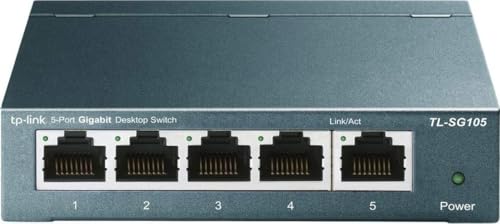
TP-Link TL-SG105 5-Port Gigabit Unmanaged Switch
About this pick
The TL-SG105 is TP-Link's 5-port entry point, with Port-based 802.1p/DSCP QoS and IGMP Snooping baked in even though the switch itself is otherwise unmanaged, useful for prioritizing video or voice traffic without a management interface.
It ships with a 3-year warranty and free technical support, and its metal casing supports both desktop and wall-mount placement. IEEE 802.3X flow control keeps data transfer reliable even on a saturated small network.
Best for: buyers prioritizing 5 gigabit ports, qos + igmp snooping
Check price on AmazonPros
- +QoS traffic prioritization unusual for unmanaged tier
- +3-year warranty plus free support
- +Energy-efficient design lowers running cost
Cons
- −Only 5 ports limits room to grow
- −No web interface despite QoS features
NETGEAR GS324 24-Port Gigabit Unmanaged Switch
About this pick
The GS324 scales NETGEAR's unmanaged design up to 24 Gigabit ports while staying fanless, supporting desktop, wall-mount, or full rack-mount placement, a genuine step up in flexibility from NETGEAR's smaller 5- and 8-port models.
Like the rest of the GS-series, it's true zero-configuration: no software, no app, no web login. The tradeoff for that simplicity is no VLANs or port monitoring at all, appropriate for a straightforward port-count expansion, not network segmentation.
Best for: buyers prioritizing 24 gigabit ports, fanless
Check price on AmazonPros
- +High port count stays fully fanless
- +Rack-mount option adds real deployment flexibility
- +Simple zero-touch setup
Cons
- −No management, VLANs, or port monitoring
- −US/CA regional model only
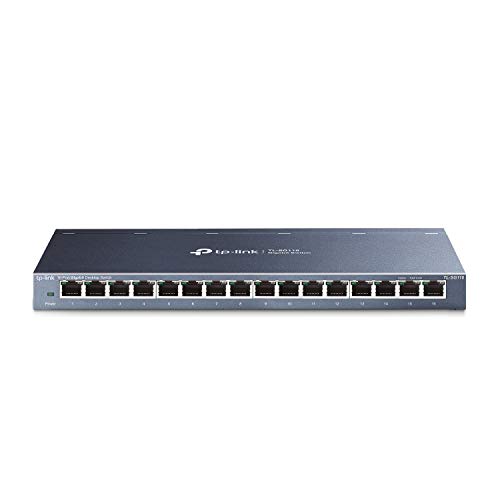
TP-Link TL-SG116 16-Port Gigabit Unmanaged Switch
About this pick
The TL-SG116 brings TP-Link's Gigabit unmanaged line to 16 ports in the same sturdy fanless metal case, rated for a 0 to 40 degree Celsius operating range that's wider than most desktop switches bother to publish.
802.1p/DSCP QoS and IGMP Snooping carry over from the smaller models, giving basic multicast and voice/video prioritization without a management interface. Backed by the same 3-year warranty as the rest of the TP-Link SG line.
Best for: buyers prioritizing 16 gigabit ports, qos + igmp snooping
Check price on AmazonPros
- +Wide temperature rating for closets/garages
- +QoS and IGMP snooping despite unmanaged design
- +Consistent 3-year warranty across the line
Cons
- −No VLAN or web management
- −Larger footprint than 8-port models
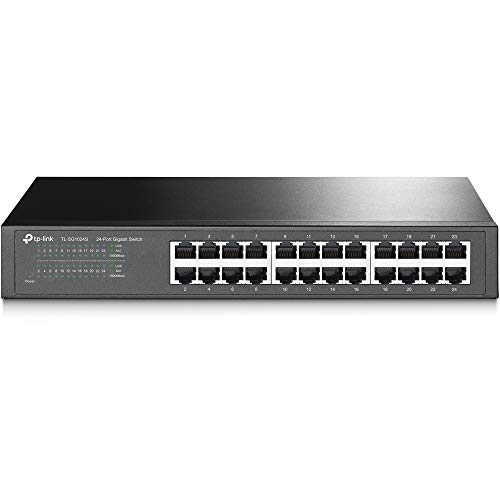
TP-Link TL-SG1024S 24-Port Gigabit Switch
About this pick
Built specifically for rack deployment, the TL-SG1024S measures a standard 11.6 x 7.1 x 1.7 inches to fit a 1U rackmount slot, while its all-metal casing improves heat dissipation and EMI protection over cheaper plastic-cased switches.
It remains a fully unmanaged, fanless design despite the port count, so it's whisper-quiet even in an enclosed rack. TP-Link backs it with the same 3-year warranty and free technical support as its smaller SG-series models.
Best for: buyers prioritizing 24 gigabit ports, 1u rackmount
Check price on AmazonPros
- +True 1U rack fit, not just rack-adjacent
- +Fanless even at 24 ports
- +Metal casing improves EMI protection
Cons
- −No management features at 24-port scale
- −Rack ears/kit sold separately on some listings
TP-Link TL-SX105 5-Port 10G Unmanaged Switch
About this pick
The TL-SX105 packs five true 10-Gigabit ports into an unmanaged switch, auto-negotiating across five speed tiers (100Mb/1G/2.5G/5G/10G) so it works with everything from a legacy Gigabit NAS to a fresh 10G NIC without configuration.
At 100Gbps of total switching capacity it's positioned for creators, gamers, and small offices upgrading past Gigabit incrementally rather than all at once. Like TP-Link's Gigabit line, it's fanless and backed by a 3-year warranty.
Best for: buyers prioritizing 5x 10g ports, 100gbps switching capacity
Check price on AmazonPros
- +True 10G on every port, not just uplinks
- +Auto-negotiation covers 5 speed tiers
- +Fanless despite the speed jump
Cons
- −Needs Cat6a+ cabling to hit full 10G
- −Higher price per port than Gigabit models
How We Evaluated These Network Switches
Each pick was assessed across 5 criteria weighted for real-world use.
Port Count & Speed Tier
Verified the actual port count, Gigabit vs multi-gig speed rating, and whether every port runs at the advertised speed or only some do, since several switches mix full-speed and lower-speed ports.
PoE Power Budget
Checked the total PoE wattage budget against realistic device counts, not just the per-port maximum, since a switch's total power pool is what actually limits how many cameras or access points it can run.
Management Depth
Classified each switch as unmanaged, smart/easy-managed, or fully managed Layer 2/3, since this determines what troubleshooting and segmentation options are available after installation, not just at setup.
Build & Mounting Flexibility
Weighed fanless vs active cooling, metal vs plastic housing, and desktop/wall/rack mounting options against the switch's likely install environment.
Real-World Documentation Honesty
Favored listings that clearly state cabling requirements, host port requirements, and speed caveats over ones that only advertise the theoretical maximum.
How to Choose the Right Network Switches
By What You're Actually Connecting
| Your situation | Best pick |
|---|---|
| Just need to split one drop into a few devices | TP-Link TL-SG105 5-Port |
| Filling a media closet or small office | NETGEAR GS308 8-Port |
| Rack-mounted server room expansion | TP-Link TL-SG1024S 24-Port |
Unmanaged vs Smart-Managed
Every switch in this list is genuinely plug-and-play, but only some offer VLANs or port monitoring if you need to diagnose an issue later.
Want zero configuration, ever
Stick to NETGEAR GS-series or TP-Link SG-series unmanaged models, true zero-touch setup.
Might need VLANs or traffic monitoring later
Consider a smart-managed switch from the start rather than replacing an unmanaged one down the line.
Frequently Asked Questions
Does a more expensive switch mean faster internet?
No. A switch only manages traffic between devices on your local network; your internet speed is set by your ISP plan and router. A switch matters for local file transfers, streaming to multiple devices, or connecting more wired gear than your router has ports for.
Do I need a managed switch for a home network?
Most home networks work fine with an unmanaged switch. Consider a managed one only if you want VLANs to separate guest devices, IoT gear, or a homelab from your main network, or need to diagnose which device is saturating your bandwidth.
Bottom Line
best overall: NETGEAR GS308 8-Port Gigabit Unmanaged Switch - best overall pick in this roundup.
See the full rankings above for all picks with pros, cons, and best-for summaries.
Browse on Amazon
All Prime-eligible options with current pricing.
Shop on Amazon →