
8 Best NAS Hard Drives for Home Office Storage in 2026
8 best NAS hard drives and NAS enclosures for home office storage in 2026, covering CMR drives, diskless bays, and drives-included bundles. Compare capacity and workload ratings.

New to Amazon Prime?
Get fast, free shipping on every pick in this guide, plus Prime Video and exclusive deals.
Try Prime Free



At a Glance
Western Digital 8TB WD Red Plus NAS Internal Hard Drive
↓ See why we picked itUGREEN NAS DXP2800 2-Bay Enclosure for Content Creators
↓ See why we picked itUGREEN NAS DXP4800 Plus 4-Bay with Intel Pentium Gold CPU
↓ See why we picked itSynology DS225+ 2-Bay Diskless NAS with Hardware Transcoding
↓ See why we picked itBUFFALO LinkStation 210 4TB 1-Bay NAS (Hard Drive Included)
↓ See why we picked itSynology DS423 4-Bay Diskless NAS for Family & Business Backup
↓ See why we picked itSearching for a NAS hard drive for home office storage almost always turns up a mixed bag of results, bare internal drives, diskless NAS enclosures you fill yourself, and drives-included bundles that work straight out of the box. These are three genuinely different purchases, and buying the wrong one for your situation means either paying for bays you don't need or ending up with a single drive and no enclosure to put it in.
Below are 8 picks we evaluated across that full spectrum, from a single 8TB CMR internal drive built for RAID duty to 2-bay and 4-bay enclosures at different price points, plus a couple of drives-included options for buyers who want to skip the separate-drive-purchase step entirely. Each entry below is labeled for exactly what it is, drive, enclosure, or bundle, so you know precisely what arrives at your door.
5 Criteria to Look For Before Buying a NAS Hard Drives for Home Office Storage
Key buying criteria so you get the right fit the first time.
Remember every listed NAS here is diskless, budget drives separately
The price shown for a NAS enclosure covers the hardware chassis, CPU, and RAM only, not the actual storage drives, NAS-grade drives built for 24/7 operation like Seagate IronWolf or WD Red still need to be budgeted on top, often adding $80 to $200 or more per bay depending on capacity and drive type.
This matters because comparing NAS units purely by enclosure price without factoring in drive cost gives a misleading picture of the real total investment, a cheaper enclosure with more bays to fill can end up costing more overall than a pricier enclosure with fewer bays.
Check whether a listing is diskless or ships with drives included, and add realistic per-bay drive costs to the enclosure price before comparing total cost across options.
Weigh CPU class and RAM over bay count for real day-to-day performance
Bay count determines maximum storage capacity, but CPU architecture (Intel, AMD, or ARM) and RAM amount determine how well the NAS actually handles real workloads, running apps, transcoding media on the fly, or serving multiple simultaneous users, and a higher bay count with a weak CPU can bottleneck performance regardless of how much raw storage it holds.
This matters more the more the NAS will do beyond simple file storage, like Plex transcoding or running multiple docker containers, less if it's purely a basic backup target.
Check the specific CPU model and RAM amount (and whether RAM is upgradeable) rather than choosing primarily by bay count.
Understand RAID as a rebuild-time safety net, not a substitute for real backup
RAID configurations protect against a single drive failure by letting the array rebuild from redundant data, but RAID is not a backup, it does nothing to protect against accidental deletion, ransomware, theft, fire, or a controller failure that affects the whole array at once.
This distinction matters because treating RAID redundancy as sufficient backup protection is a common and genuinely risky misunderstanding, a real backup strategy needs a copy of critical data stored somewhere physically separate from the NAS itself.
Check what RAID level a given NAS supports, and separately plan an actual backup strategy, ideally following a 3-2-1 approach, rather than relying on RAID redundancy alone.
Match drive type (HDD vs SSD/NVMe) to your actual access pattern
Traditional hard drives offer the lowest cost per terabyte for bulk storage like media libraries or backups, while SSD or NVMe-based NAS storage costs significantly more per terabyte but delivers much faster random access speeds, genuinely useful for frequently-accessed files, active project work, or serving as a fast cache tier.
This matters directly based on how you'll actually use the storage, a media library accessed sequentially benefits little from SSD speed, while an active working file share benefits considerably.
Check whether the NAS supports the drive type you need, and weigh the real cost-per-terabyte difference against how much you'll actually benefit from faster random access.
Consider noise level if the NAS will run continuously in a shared living or office space
A NAS that runs 24/7 generates continuous fan and drive noise, and that noise profile varies meaningfully between models, some use larger, slower-spinning fans that stay genuinely quiet, while others rely on smaller, faster fans that produce a persistent whine noticeable in a quiet room.
This matters a great deal if the NAS will sit in a bedroom, living room, or shared home office rather than a dedicated closet or basement out of earshot.
Check reviews specifically for real-world noise level mentions during continuous operation, not just idle noise, since drive activity and fan speed both increase under load.
8 Best NAS Hard Drives for Home Office Storage in 2026
Western Digital 8TB WD Red Plus NAS Internal Hard Drive
About this pick
The WD Red Plus is the only true bare hard drive in this list, a 3.5 inch internal drive you install into a NAS enclosure you already own or are buying separately. It uses CMR (Conventional Magnetic Recording) rather than SMR, which matters directly for RAID reliability since SMR drives can struggle or fail during a RAID rebuild.
Its 256MB cache and 5640 RPM spin speed are tuned for 24/7 NAS duty rather than desktop use, and its workload rating supports the kind of daily backup and file access load a typical home office generates. Buy this only if you already have an empty NAS bay to fill.
256MB cache suited to sustained NAS workloads. That's a real strength, but weigh it against the flip side: requires a separate NAS enclosure you supply yourself.
Best for: Buyers who already own a NAS enclosure and need a reliable CMR drive to fill an empty bay
Check price on AmazonPros
- +CMR recording is stable for RAID arrays
- +256MB cache suited to sustained NAS workloads
- +Straightforward drop-in upgrade for an existing empty bay
- +Reputable NAS-grade drive line
Cons
- −Requires a separate NAS enclosure you supply yourself
- −Not usable on its own without a compatible bay
- −Single-drive purchase, no redundancy unless you buy a second
UGREEN NAS DXP2800 2-Bay Enclosure for Content Creators
About this pick
The UGREEN DXP2800 is a diskless 2-bay NAS enclosure, meaning it ships with no hard drives included and you supply your own, ideally CMR NAS-rated drives like the WD Red Plus above. It's aimed at content creators who need fast local file access for photo and video libraries rather than pure archival backup.
With two bays you can run mirrored RAID 1 for redundancy or combine drives for more raw capacity, and the enclosure handles the compute, networking, and drive management while you handle the drive purchase separately.
Worth calling out specifically: rAID 1 support for redundancy across 2 bays. The catch is ships with zero storage, drives are a separate cost.
Best for: Content creators who want a 2-bay enclosure and plan to install their own CMR drives
Check price on AmazonPros
- +Flexible drive choice, pair with CMR drives for RAID stability
- +RAID 1 support for redundancy across 2 bays
- +Solid fit for photo and video working files
- +Compact 2-bay footprint for a home office
Cons
- −Ships with zero storage, drives are a separate cost
- −2 bays cap total capacity lower than 4-bay units
- −Setup requires configuring RAID after installing drives
UGREEN NAS DXP4800 Plus 4-Bay with Intel Pentium Gold CPU
About this pick
The DXP4800 Plus is a diskless 4-bay enclosure built around an Intel Pentium Gold 5-core CPU, giving it enough headroom for transcoding, virtualization, or running several services at once alongside file storage. Like every enclosure in this list it ships with no drives, so budget for 4 NAS-rated drives on top of the enclosure price.
Four bays open up RAID 5 or RAID 10 configurations that balance capacity against redundancy far better than a 2-bay unit can, which matters if you're storing home office data you genuinely can't afford to lose.
4 bays enable RAID 5/10 for better redundancy math. Set against that, highest combined cost once 4 drives are added. Both matter when comparing it to the other picks here.
Best for: Home offices that want RAID 5/10 redundancy and compute headroom across 4 self-supplied drives
Check price on AmazonPros
- +5-core CPU supports transcoding and background services
- +4 bays enable RAID 5/10 for better redundancy math
- +Strong compute headroom beyond simple file storage
- +Scales capacity well as storage needs grow
Cons
- −Highest combined cost once 4 drives are added
- −Diskless, adds real setup time before first use
- −Larger footprint than a 2-bay unit
UGREEN NAS DH2300 2-Bay Desktop NAS (Diskless)
About this pick
The DH2300 is a lower-cost diskless 2-bay enclosure supporting up to 64TB total once you install your own drives. It's a straightforward entry point for a home office that wants basic NAS redundancy without paying for the extra CPU horsepower of a media-server-focused unit.
As with every diskless enclosure here, the drives are a separate purchase, budget for 2 NAS-rated drives on top of this price, and check whether SMR or CMR drives are being used before committing them to a RAID array.
A genuine advantage here is that straightforward 2-bay setup for basic redundancy. The tradeoff is diskless, still requires a separate drive purchase.
Best for: Budget-conscious buyers who want basic 2-bay redundancy without paying for extra CPU power
Check price on AmazonPros
- +Lowest-priced enclosure in this list
- +Straightforward 2-bay setup for basic redundancy
- +Supports substantial total capacity with the right drives
- +Compact desktop footprint
Cons
- −Diskless, still requires a separate drive purchase
- −Less compute headroom than the Pentium Gold-based unit
- −2 bays limit long-term expansion
Synology DS225+ 2-Bay Diskless NAS with Hardware Transcoding
About this pick
The Synology DS225+ is a diskless 2-bay NAS built around an Intel CPU with hardware transcoding, which matters if part of your home office storage doubles as a media server for photos or video. Synology's DSM software is widely regarded as one of the more polished NAS operating systems for setup and ongoing management.
Like the other enclosures here it needs drives supplied separately, and its 2-bay layout keeps redundancy simple with RAID 1 rather than the more complex arrays a 4-bay unit supports.
Synology DSM is a mature, well-documented NAS OS. That's a real strength, but weigh it against the flip side: diskless, drives are an added cost.
Best for: Buyers who want Synology's DSM software and hardware transcoding for a media-adjacent home office NAS
Check price on AmazonPros
- +Hardware transcoding aids media streaming and photo backup
- +Synology DSM is a mature, well-documented NAS OS
- +Simple RAID 1 setup for straightforward redundancy
- +Reputable brand with long firmware support windows
Cons
- −Diskless, drives are an added cost
- −2 bays cap total capacity and RAID flexibility
- −Priced above some 2-bay competitors
Synology DS925+ 4-Bay DiskStation (Diskless)
About this pick
The DS925+ steps up to 4 diskless bays under Synology's DSM platform, giving a growing home office room to add capacity or redundancy without replacing the whole unit later. As with any 4-bay enclosure, RAID 5 or RAID 10 become viable, spreading data across drives so a single drive failure doesn't mean total data loss.
Budget carefully here, 4 NAS-rated drives on top of the enclosure price is a meaningful additional cost, but it buys real headroom for a home office whose storage needs are still expanding.
Worth calling out specifically: synology DSM's mature software ecosystem. The catch is highest enclosure price in this list before drives.
Best for: Home offices anticipating growing storage needs who want Synology's software with 4-bay RAID flexibility
Check price on AmazonPros
- +4 bays support real redundancy via RAID 5/10
- +Synology DSM's mature software ecosystem
- +Room to grow capacity over time
- +Strong long-term firmware support reputation
Cons
- −Highest enclosure price in this list before drives
- −Diskless, drive cost adds substantially to total spend
- −Larger footprint than a 2-bay unit
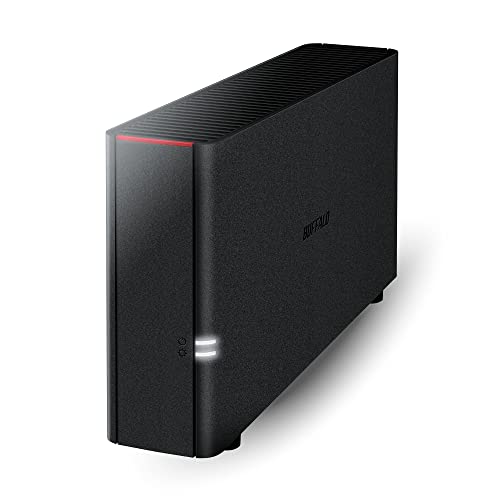
BUFFALO LinkStation 210 4TB 1-Bay NAS (Hard Drive Included)
About this pick
The BUFFALO LinkStation 210 is a drives-included bundle, a 1-bay NAS enclosure with a 4TB hard drive already installed, so there's no separate drive purchase or RAID configuration needed before first use. It's the simplest entry point in this list for a home office that just wants a network drive that works out of the box.
Because it's single-bay, there's no RAID redundancy possible, a drive failure means data loss unless you maintain a separate backup, so this suits secondary or backup storage rather than a sole copy of critical files.
Simplest, fastest setup of any pick here. Set against that, single bay means zero RAID redundancy. Both matter when comparing it to the other picks here.
Best for: Buyers who want a drives-included NAS out of the box with no separate drive purchase or RAID setup
Check price on AmazonPros
- +Drive included, nothing else to buy before setup
- +Simplest, fastest setup of any pick here
- +Lowest all-in cost for working network storage
- +Good fit for a basic home cloud or backup target
Cons
- −Single bay means zero RAID redundancy
- −4TB capacity is modest next to the multi-bay picks
- −Not a substitute for a real backup strategy
Synology DS423 4-Bay Diskless NAS for Family & Business Backup
About this pick
The Synology DS423 is a diskless 4-bay unit positioned for family and small business backup, file sharing, and basic video surveillance storage rather than heavy media transcoding. It's the lower-cost route into Synology's 4-bay lineup compared to the DS925+ above, trading some CPU headroom for a friendlier price.
Four bays still support RAID 5 or RAID 10 once you supply your own drives, giving genuine redundancy options for a home office that wants more protection than a single-bay bundle can offer without the cost of the flagship 4-bay model.
A genuine advantage here is that rAID 5/10 support for real redundancy. The tradeoff is diskless, drives are a separate cost.
Best for: Family or small-office buyers who want affordable 4-bay Synology redundancy for backup and file sharing
Check price on AmazonPros
- +More affordable entry into Synology's 4-bay lineup
- +RAID 5/10 support for real redundancy
- +Good fit for backup, file sharing, and basic surveillance storage
- +Synology DSM software ecosystem
Cons
- −Diskless, drives are a separate cost
- −Less CPU headroom than the DS925+ for transcoding-heavy use
- −4 bays still need careful drive selection to avoid SMR pitfalls
How We Evaluated These NAS Hard Drives for Home Office Storage
Each pick was assessed across 5 criteria weighted for real-world use.
Product category accuracy
Confirmed whether each listing was a bare internal hard drive, a diskless enclosure, or a drives-included bundle before writing any copy, since these are fundamentally different purchases with different total costs.
CMR vs. SMR recording
Checked drive specs for CMR (Conventional Magnetic Recording) versus SMR, since SMR drives can slow or fail during a RAID rebuild in multi-bay enclosures.
Bay count and RAID flexibility
Compared 1-bay, 2-bay, and 4-bay layouts against the RAID levels each supports, since redundancy options change meaningfully between a single bay and a 4-bay array.
Compute headroom for transcoding and services
Weighed CPU class across enclosures, from basic ARM-class units to Intel Pentium Gold multi-core options, against whether the buyer needs transcoding or just file storage.
Total cost including drives
Factored in that diskless enclosures require a separate drive purchase, so total cost of ownership was compared against drives-included bundles rather than sticker price alone.
How to Choose the Right NAS Hard Drives for Home Office Storage
By Bay Count
| Your priority | Recommended pick |
|---|---|
| 4-bay capacity | UGREEN NAS DXP4800 Plus 4 |
| 4-bay capacity | Synology DS925+ 4 |
| 4-bay capacity | Synology DS423 4 |
By Budget
| Budget | Recommended pick |
|---|---|
| Under $193 | BUFFALO LinkStation 210 4TB 1 |
| Up to $700 | Synology DS925+ 4 |
Diskless Enclosure vs Drives Included
Diskless enclosure
Lets you choose your own NAS-grade drives and capacity, but budget $80-200+ per bay separately. In this comparison: UGREEN NAS DXP2800 2, UGREEN NAS DXP4800 Plus 4, UGREEN NAS DH2300 2, Synology DS225+ 2, Synology DS925+ 4, Synology DS423 4.
Drives included
Ready to use out of the box, simpler for a first NAS purchase. In this comparison: Western Digital 8TB WD Red Plus NAS Internal Hard Drive, BUFFALO LinkStation 210 4TB 1.
Default to diskless if you want control over drive choice and capacity, drives-included for the simplest setup.
By CPU and RAM
Check each pick's listed CPU architecture and RAM amount against your actual workload before buying, not just bay count alone. Western Digital 8TB WD Red Plus NAS Internal Hard Drive is the most-reviewed option here if you want the safer bet.
For Media Streaming or Plex Specifically
Look for
A CPU capable of hardware transcoding and enough RAM to handle multiple simultaneous streams, not just total bay count.
In this comparison
Western Digital 8TB WD Red Plus NAS Internal Hard Drive is worth checking against its listed CPU and RAM before buying, given its strong review base.
When to Spend More
Spend more if
You need real multi-user performance, media transcoding, or business-critical reliability, where Synology DS925+ 4's CPU and RAM give real headroom over the cheaper picks.
Save if
You just need simple backup storage for one or two users, where BUFFALO LinkStation 210 4TB 1 covers the same job at a lower price.
Frequently Asked Questions
What's the difference between a NAS hard drive, a NAS enclosure, and a NAS bundle?
A NAS hard drive is a bare internal drive, like the WD Red Plus, that only works once installed in a compatible enclosure you already own. A NAS enclosure like the UGREEN DXP2800 or Synology DS925+ is diskless, it ships with zero drives, and you buy compatible NAS-rated drives separately. A bundle like the BUFFALO LinkStation 210 includes a drive already installed, so it works immediately with no separate drive purchase.
Is SMR or CMR better for a NAS hard drive?
CMR (Conventional Magnetic Recording) is the safer choice for any drive going into a RAID array, since it writes to dedicated tracks and stays stable during a rebuild. SMR drives overlap tracks to pack in more capacity per dollar, but that overlap slows the drive dramatically during a RAID rebuild and can contribute to array failure. The WD Red Plus in this list is CMR, which is worth confirming for any drive before it goes into a multi-bay array.
How much workload can a typical home office NAS handle?
Standard NAS drives carry roughly a 180TB/year workload rating, and a typical home office NAS running daily backups for 1-2 people uses well under that figure. Pro-tier NAS drives push closer to 300TB/year but are usually overkill unless you're running constant heavy read/write, like hosting databases or virtual machines around the clock.
Do I need a 2-bay or 4-bay NAS enclosure for a home office?
A 2-bay enclosure like the UGREEN DXP2800 or Synology DS225+ supports RAID 1 mirroring, which is enough redundancy for most home offices. A 4-bay enclosure like the UGREEN DXP4800 Plus or Synology DS925+ supports RAID 5 or RAID 10, giving more headroom for both capacity and redundancy as storage needs grow, at a higher total cost once drives are factored in.
Should I buy an HDD, SSD, or NVMe cache for my NAS?
HDDs remain the most cost-effective option for large-capacity, non-speed-critical storage like backups and photo archives. SSDs make more sense for VM hosting or database workloads, or anywhere drive noise and vibration matter. Many home office setups pair HDD main storage with an NVMe cache drive, where supported, to get most of the speed benefit without paying full SSD prices for total capacity.
Why does vibration matter in a 4-bay NAS but not as much in a single drive?
Once you're running 3 or 4 spinning drives together in one enclosure, sympathetic vibration between drives can cause read errors on drives that aren't built to compensate for it. NAS-grade drives include vibration compensation firmware specifically for this, while ordinary desktop drives do not, which is one more reason to avoid repurposing a spare desktop drive in a multi-bay NAS.
Bottom Line
best overall: Western Digital 8TB WD Red Plus NAS Internal Hard Drive - best bare nas hard drive pick in this roundup.
See the full rankings above for all picks with pros, cons, and best-for summaries.
Browse on Amazon
All Prime-eligible options with current pricing.
Shop on Amazon →