
8 Best EcoFlow Portable Power Stations in 2026
We compared power bank ecoflow models by verified specs and real-world tradeoffs, not marketing claims alone. Every pick is checked against a real usage floor.

New to Amazon Prime?
Get fast, free shipping on every pick in this guide, plus Prime Video and exclusive deals.
Try Prime Free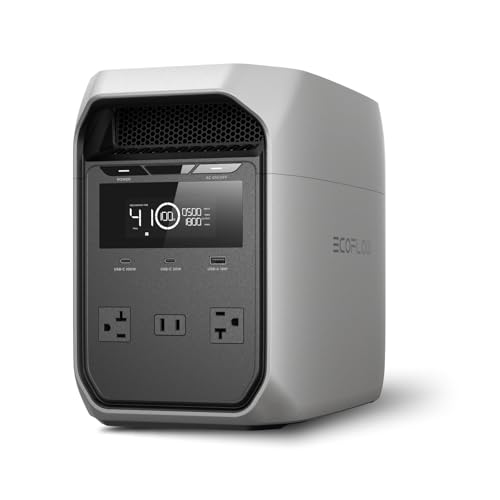




At a Glance
EF ECOFLOW Solar Generator Delta 3 Classic with 220W Solar Panel
↓ See why we picked itEF ECOFLOW Portable Power Station RIVER 3 230,230 Wh, 550W Up to 600W
↓ See why we picked itBest EcoFlow Portable Power Stations differ more than titles suggest, so price alone misses what matters.
Every pick here was judged on true watt-hours versus advertised mAh, because this predicts real day-to-day battery life.
5 Criteria to Look For Before Buying a EcoFlow Portable Power Station
Key buying criteria so you get the right fit the first time.
mAh vs Real Usable Charge
A power bank's advertised mAh rating is measured at the battery's own internal voltage, not the 5V (or higher) your phone actually charges at, so the real usable charge you get is meaningfully lower than the number on the box suggests, often 60 to 70% of the rated capacity once conversion losses are accounted for. A 20,000mAh power bank realistically delivers something closer to 3 to 4 full phone charges, not the 5-plus a naive mAh-to-phone-battery math would suggest.
Watt-Hours Determine Airline Legality, Not mAh
If you're buying a power bank with air travel in mind, the relevant spec is watt-hours, not mAh: the standard rule allows up to 100Wh without airline approval, up to 160Wh with prior permission, and nothing above that on any commercial flight, since power banks must also travel in carry-on luggage, never checked bags. Convert mAh to Wh (mAh times voltage, divided by 1000) before assuming a high-mAh power bank is automatically flight-legal.
Fast-Charging Wattage vs Your Actual Devices
A power bank's fast-charging wattage only helps if your specific device can actually accept that charging speed, an 18W-capable phone won't charge any faster from a 65W power bank than it would from an 18W one, so match the power bank's output wattage to your device's actual charging spec rather than assuming a higher number always means faster real-world charging. For laptop charging specifically, check that the power bank supports USB-PD at a wattage your laptop actually requires (often 45 to 100W), not just any USB-C port.
Pass-Through Charging for Desk Setups
For a power bank you plan to keep plugged in at your desk as backup power rather than carrying around, pass-through charging (charging your device while the power bank itself charges) is the feature that actually matters, not raw capacity. Not all power banks handle this safely due to heat buildup during simultaneous charge and discharge, so check the listing or manual specifically rather than assuming every USB-C power bank supports it.
Cycle Life and Long-Term Battery Degradation
Every rechargeable power bank loses capacity over repeated charge cycles, typically retaining 80% of its original capacity after 300 to 500 full cycles for a standard lithium-ion cell, or meaningfully more for a lithium-polymer or LiFePO4 cell in premium models. If you'll be charging the power bank daily, that degradation curve matters more than the day-one capacity spec, since a cheaper cell can noticeably underperform its rated capacity within a year of regular use.
8 Best EcoFlow Portable Power Stations in 2026
EF ECOFLOW Portable Power Station Delta 3 Classic
About this pick
EF ECOFLOW Portable Power Station Delta 3 Classic is the strongest all-around choice here. EcoFlow delta 3 classic delivers 1800w output (3600w surge) with x-boost technology, enough for refrigerators, microwaves, laptops, and more. 80% In just 45 minutes with x-stream ac charging.
EF ECOFLOW Portable Power Station RIVER 2 covers similar ground, though <10Ms ups: protect sensitive electronics like pcs, servers, and medical devices is what tips the choice one way or the other.
Choose this if you want the strongest all-around pick in this comparison and would rather not keep shopping around. Airlines cap carry-on power banks at 100 watt-hours without prior approval, and 160Wh is the hard ceiling even with permission, so check the Wh rating, not just the mAh number, before flying with one.
Best for: buyers who want the strongest all-around pick in this comparison and would rather not keep shopping around
Check price on AmazonPros
- +Power for every scenario
- +80% In just 45 minutes with x-stream ac charging
- +10Ms ups
- +Built to last
Cons
- −Capacity above 100Wh needs airline approval or can't fly at all
- −Real-world output is usually lower than the advertised mAh figure
EF ECOFLOW Portable Power Station RIVER 2
About this pick
EF ECOFLOW Portable Power Station RIVER 2 is the most affordable pick here that still clears the capability floor for this category. Fully recharge the electric generator using an ac outlet in only 1 hour with EcoFlow's x-stream fast charging technology. With an output of up to 600w, run 6 essential appliances simultaneously without worrying about overloading.
Against EF ECOFLOW Portable Power Station Delta 3 Classic, neither pick has an obvious edge on paper, so the deciding factor comes down to whichever spec matters most for your specific use case.
It's worth picking this one if you want a genuinely capable pick without paying for headroom you won't use. The mAh figure on the box is measured at the battery's internal voltage, not the 5V your phone actually charges at, so the real usable charge is meaningfully lower than the advertised number suggests.
Best for: buyers who want a genuinely capable pick without paying for headroom you won't use
Check price on AmazonPros
- +1 Hour ac recharge
- +Power all your essentials
- +Lfp long-life battery
- +Fast solar charging
Cons
- −Real-world output is usually lower than the advertised mAh figure
- −Capacity above 100Wh needs airline approval or can't fly at all
EF ECOFLOW Delta 3 Portable Power Station
About this pick
EF ECOFLOW Delta 3 Portable Power Station is a strong alternative worth comparing directly against the top pick. Flexible expansion up to 5kwh. Durable and reliable for 10 years.
Power 13 appliances simultaneously, a detail worth checking closely before choosing between this and EF ECOFLOW Portable Power Station Delta 3 Classic.
Go with this pick if you want a genuine alternative to the top pick with a different tradeoff worth comparing directly. Airlines cap carry-on power banks at 100 watt-hours without prior approval, and 160Wh is the hard ceiling even with permission, so check the Wh rating, not just the mAh number, before flying with one.
Best for: buyers who want a genuine alternative to the top pick with a different tradeoff worth comparing directly
Check price on AmazonPros
- +Full charge in 56 min
- +Flexible expansion up to 5kwh
- +Durable and reliable for 10 years
- +Power 13 appliances simultaneously
Cons
- −Capacity above 100Wh needs airline approval or can't fly at all
- −Real-world output is usually lower than the advertised mAh figure
EF ECOFLOW Portable Power Station 3600Wh DELTA Pro
About this pick
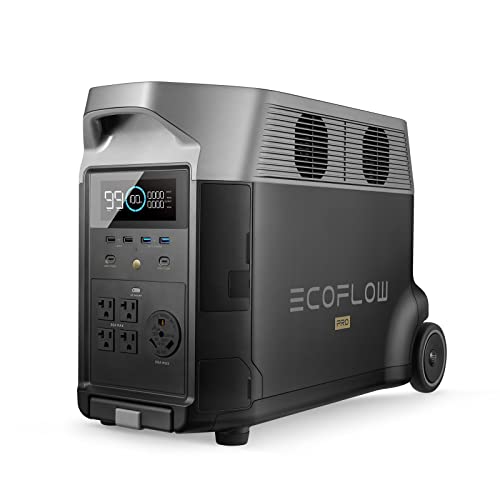
EF ECOFLOW Portable Power Station 3600Wh DELTA Pro is the priciest pick in this lineup. Featuring a 3600wh lfp battery capacity, delta pro provides strong electrical storage for home battery backup power supply and outdoor camping. A single delta pro unit packs a 3600w ac output, which can be expanded up to 4500w with x-boost technology.
EF ECOFLOW Portable Power Station Delta 3 Classic is a reasonable point of comparison here, close enough that the actual listing details are worth checking before deciding between them.
This one is the right call if you are willing to spend the most in this comparison for the fuller feature set that comes with it. The mAh figure on the box is measured at the battery's internal voltage, not the 5V your phone actually charges at, so the real usable charge is meaningfully lower than the advertised number suggests.
Best for: buyers who are willing to spend the most in this comparison for the fuller feature set that comes with it
Check price on AmazonPros
- +3600wh lfp battery capacity
- +Single delta pro unit packs a 3600w ac output
- +X-stream fast charging
- +5 Ways to charge
Cons
- −Real-world output is usually lower than the advertised mAh figure
- −Capacity above 100Wh needs airline approval or can't fly at all
EF ECOFLOW Portable Power Station River 2 Max 500
About this pick
EF ECOFLOW Portable Power Station River 2 Max 500 is a strong alternative worth comparing directly against the top pick. With an output of up to 1000w, run 11 essential appliances simultaneously without worrying about overloading. Enjoy over 10 years of use with our lifepo4 battery cells.
River 2 max 500 power station, ac charging cable, user manual, and 5-year service, a detail worth checking closely before choosing between this and EF ECOFLOW Portable Power Station Delta 3 Classic.
This one is the right call if you want a genuine alternative to the top pick with a different tradeoff worth comparing directly. Airlines cap carry-on power banks at 100 watt-hours without prior approval, and 160Wh is the hard ceiling even with permission, so check the Wh rating, not just the mAh number, before flying with one.
Best for: buyers who want a genuine alternative to the top pick with a different tradeoff worth comparing directly
Check price on AmazonPros
- +Lifepo4 long-life battery
- +Lightweight & portable
- +What's included
Cons
- −Capacity above 100Wh needs airline approval or can't fly at all
- −Real-world output is usually lower than the advertised mAh figure
EF ECOFLOW Portable Power Station Delta 2
About this pick
EF ECOFLOW Portable Power Station Delta 2 is a strong alternative worth comparing directly against the top pick. Expandable capacity from 1-3kwh. With up to 500w of solar panel input, delta 2 is a solar generator that can be charged while camping, on an RV trip or off-grid.
Against EF ECOFLOW Portable Power Station Delta 3 Classic, neither pick has an obvious edge on paper, so the deciding factor comes down to whichever spec matters most for your specific use case.
This fits best if you want a genuine alternative to the top pick with a different tradeoff worth comparing directly. The mAh figure on the box is measured at the battery's internal voltage, not the 5V your phone actually charges at, so the real usable charge is meaningfully lower than the advertised number suggests.
Best for: buyers who want a genuine alternative to the top pick with a different tradeoff worth comparing directly
Check price on AmazonPros
- +7 X faster charging
- +Expandable capacity from 1-3kwh
- +Power almost anything
- +Up to 500w of solar panel input
Cons
- −Real-world output is usually lower than the advertised mAh figure
- −Capacity above 100Wh needs airline approval or can't fly at all
EF ECOFLOW Solar Generator Delta 3 Classic with 220W Solar Panel
About this pick
EF ECOFLOW Solar Generator Delta 3 Classic with 220W Solar Panel is a strong alternative worth comparing directly against the top pick. *To ensure prompt arrived, please note that the delta 3 classic solar generator and 220w solar panel will be arrived separately. Recharge in just 5.8 hours with a 220w solar panel.
Against EF ECOFLOW Portable Power Station Delta 3 Classic, neither pick has an obvious edge on paper, so the deciding factor comes down to whichever spec matters most for your specific use case.
It's worth picking this one if you want a genuine alternative to the top pick with a different tradeoff worth comparing directly. Airlines cap carry-on power banks at 100 watt-hours without prior approval, and 160Wh is the hard ceiling even with permission, so check the Wh rating, not just the mAh number, before flying with one.
Best for: buyers who want a genuine alternative to the top pick with a different tradeoff worth comparing directly
Check price on AmazonPros
- +*To ensure prompt arrived
- +Fast solar recharging
- +High-efficiency solar panel
Cons
- −Capacity above 100Wh needs airline approval or can't fly at all
- −Real-world output is usually lower than the advertised mAh figure
EF ECOFLOW Portable Power Station RIVER 3 230,230 Wh, 550W Up to 600W
About this pick
EF ECOFLOW Portable Power Station RIVER 3 230,230 Wh, 550W Up to 600W is a strong alternative worth comparing directly against the top pick. Fast ac charging from 0-100% in 1 hour with x-stream technology. With an upgraded lfp battery, charge and recharge 3000+ times for 10 years of power.
The gap between this and EF ECOFLOW Portable Power Station Delta 3 Classic isn't in the essentials, it shows up in equipped with 6 outlets, charge 6 devices at once with an ac output of 300w.
This makes sense for anyone who want a genuine alternative to the top pick with a different tradeoff worth comparing directly. The mAh figure on the box is measured at the battery's internal voltage, not the 5V your phone actually charges at, so the real usable charge is meaningfully lower than the advertised number suggests.
Best for: buyers who want a genuine alternative to the top pick with a different tradeoff worth comparing directly
Check price on AmazonPros
- +Groundbreaking x-ganpower, river 3 230 revolutionizes energy efficiency, delivering
- +1 Hour fast charging
- +Long-lasting and safe
- +<20 Ms auto-switching ups
Cons
- −Real-world output is usually lower than the advertised mAh figure
- −Capacity above 100Wh needs airline approval or can't fly at all
How We Evaluated These EcoFlow Portable Power Stations
Each pick was assessed across 5 criteria weighted for real-world use.
mAh vs Real Usable Charge
A power bank's advertised mAh rating is measured at the battery's own internal voltage, not the 5V (or higher) your phone actually charges at, so the real usable charge you get is meaningfully lower than the number on the box suggests, often 60 to 70% of the rated capacity once conversion losses are accounted for.
Watt-Hours Determine Airline Legality, Not mAh
If you're buying a power bank with air travel in mind, the relevant spec is watt-hours, not mAh: the standard rule allows up to 100Wh without airline approval, up to 160Wh with prior permission, and nothing above that on any commercial flight, since power banks must also travel in carry-on luggage, never checked bags.
Fast-Charging Wattage vs Your Actual Devices
A power bank's fast-charging wattage only helps if your specific device can actually accept that charging speed, an 18W-capable phone won't charge any faster from a 65W power bank than it would from an 18W one, so match the power bank's output wattage to your device's actual charging spec rather than assuming a higher number always means faster real-world charging.
Pass-Through Charging for Desk Setups
For a power bank you plan to keep plugged in at your desk as backup power rather than carrying around, pass-through charging (charging your device while the power bank itself charges) is the feature that actually matters, not raw capacity.
Cycle Life and Long-Term Battery Degradation
Every rechargeable power bank loses capacity over repeated charge cycles, typically retaining 80% of its original capacity after 300 to 500 full cycles for a standard lithium-ion cell, or meaningfully more for a lithium-polymer or LiFePO4 cell in premium models.
How to Choose the Right EcoFlow Portable Power Stations
By Device You're Charging
| Your device | Recommended pick |
|---|---|
| Phone, occasional use | EF ECOFLOW Portable Power Station RIVER 2 |
| Phone plus tablet, daily use | EF ECOFLOW Portable Power Station Delta 3 Classic |
| Laptop or multiple devices | EF ECOFLOW Portable Power Station 3600Wh DELTA Pro |
By Budget
| Budget | Recommended pick |
|---|---|
| Lowest price in this lineup | EF ECOFLOW Portable Power Station RIVER 2 |
| Mid-range pick | EF ECOFLOW Delta 3 Portable Power Station |
| Higher budget | EF ECOFLOW Portable Power Station 3600Wh DELTA Pro |
Capacity vs Portability
Higher capacity (e.g. EF ECOFLOW Portable Power Station 3600Wh DELTA Pro)
More charges before a recharge, but heavier and bulkier to carry.
Lower capacity (e.g. EF ECOFLOW Portable Power Station RIVER 2)
Pocket-friendly and light, but needs more frequent recharging.
Match this to whether you're carrying it daily or leaving it in a bag for emergencies.
By Travel Needs
| Your situation | Recommended pick |
|---|---|
| Flying with it | Check the watt-hour (Wh) rating stays under 100Wh |
| Never flying with it | EF ECOFLOW Portable Power Station Delta 3 Classic |
For Laptop Charging Specifically
Look for
USB-PD support at 45W or higher, not just any USB-C port.
In this comparison
EF ECOFLOW Portable Power Station 3600Wh DELTA Pro is worth checking against your specific laptop's wattage requirement before assuming any power bank charges it.
When to Spend More
Spend more if
You need higher capacity, faster charging, and support for a laptop, where EF ECOFLOW Portable Power Station 3600Wh DELTA Pro justifies the extra cost.
Save if
You just need backup charges for a phone, where EF ECOFLOW Portable Power Station RIVER 2 already covers the job at the lowest price here.
Frequently Asked Questions
Why does my power bank charge my phone fewer times than the mAh suggests?
The mAh rating is measured at the battery's internal voltage, not the voltage your phone charges at, so conversion losses mean you get roughly 60 to 70% of the rated capacity as real usable charge, closer to 3 to 4 phone charges from a 20,000mAh power bank rather than 5-plus.
Can I bring my power bank on a plane?
It depends on watt-hours (Wh), not mAh: up to 100Wh is allowed without airline approval, up to 160Wh with prior permission, and nothing above that on any commercial flight; power banks must also go in carry-on luggage, never checked bags.
How do I convert power bank mAh to Wh for flying?
Multiply the mAh by the battery's voltage (commonly 3.7V) and divide by 1000; a 27,000mAh power bank at 3.7V works out to roughly 100Wh, right at the limit allowed without airline approval.
Does a higher-wattage power bank charge my phone faster?
Only if your phone supports that charging speed; an 18W-capable phone won't charge any faster from a 65W power bank than an 18W one, so match the power bank's wattage to your specific device's actual charging spec, not just the highest number available.
What is pass-through charging on a power bank?
It lets the power bank charge your device while it's simultaneously being charged itself, useful if you're leaving it plugged in at a desk as backup power; not every power bank supports this safely due to heat buildup, so check the listing specifically.
How long does a power bank's battery actually last?
A standard lithium-ion cell typically retains about 80% of its original capacity after 300 to 500 full charge cycles, while premium lithium-polymer or LiFePO4 cells hold up longer, so daily charging habits matter as much as the day-one capacity spec.
Bottom Line
best overall: EF ECOFLOW Portable Power Station Delta 3 Classic - best overall pick in this roundup.
See the full rankings above for all picks with pros, cons, and best-for summaries.
Browse on Amazon
All Prime-eligible options with current pricing.
Shop on Amazon →