
8 Best Docking Stations for Two Laptops in 2026
8 best docking stations for two laptops in 2026, from all-in-one KVM docks to standard docks paired with a separate switch. Compare PD, ports, and switching speed.

New to Amazon Prime?
Get fast, free shipping on every pick in this guide, plus Prime Video and exclusive deals.
Try Prime Free



At a Glance
AV Access KVM Switch Dock 2 Monitors 2 Laptops (2 USB-C MST)
↓ See why we picked itAV Access Docking Station KVM Switch 2 Monitors 2 Laptops (100W PD)
↓ See why we picked itAV Access 8K KVM Switch 2 Monitors 2 Computers for Laptop & Desktop
↓ See why we picked itKVM Switch 2 Monitors 2 Computers Docking Station (13-in-1, 100W PD)
↓ See why we picked itAnker Prime Docking Station, 14-Port with 160W Max Output
↓ See why we picked itAnker Prime Docking Station (DL7400), 14-Port Triple Display with DisplayLink
↓ See why we picked itPlugable Thunderbolt 4 Dock for M4/M5 MacBook Air & Pro
↓ See why we picked itRunning two laptops off one set of monitors and peripherals means choosing between two very different approaches: an all-in-one KVM dock that switches both computers through shared ports and displays, or a standard docking station paired with a separate KVM switch. The all-in-one route is simpler to cable up, while the dock-plus-switch route usually keeps the full spec sheet, 100W PD, 4K120Hz, faster Ethernet, that a combined KVM dock often trims to fit its switching logic into one box.
Below are 8 docking stations we evaluated for two-laptop setups, covering four all-in-one KVM docks built specifically for switching between two machines and four standard single-host docks worth pairing with a dedicated KVM switch if you need full spec headroom, ranging from $159.99 to $227.99.
5 Criteria to Look For Before Buying a Docking Stations for Two Laptop
Key buying criteria so you get the right fit the first time.
Check the real power delivery wattage, not just "PD" in the listing
Power delivery (PD) wattage determines whether a dock can actually charge your laptop while it's connected, not just pass a trickle of power through, and this number varies widely, from 60W barely-adequate figures up to 100W or higher business-tier docks.
This matters because a dock rated below what your laptop actually needs to charge under load, especially a larger laptop or one running demanding tasks while docked, will slowly drain the battery even while "charging", a frustrating and easy-to-miss problem.
Check the listing for the specific PD wattage number, and compare it against your laptop's actual charging brick wattage, not just whether the listing mentions power delivery at all.
Verify actual display support against your specific laptop and GPU, not just port count
A dock listing multiple HDMI or DisplayPort outputs doesn't guarantee your laptop can actually drive all of them at full resolution and refresh rate simultaneously, that capability depends on your laptop's specific GPU and USB-C controller, which some docks work around using DisplayLink technology and others don't.
This distinction matters a lot if you're building a dual or triple monitor setup, since a laptop that can't natively drive multiple external displays will show a blank or mirrored screen on a non-DisplayLink dock's extra port, regardless of how many ports the dock has.
Check whether the dock uses native DisplayPort Alt Mode or DisplayLink chip technology, and separately verify your specific laptop model's documented maximum number of external displays before assuming any multi-port dock will drive them all.
Match data transfer speeds and Ethernet to what you actually move and how
USB data ports on a dock range widely in real transfer speed, from basic 480Mbps USB 2.0 speeds up to 10Gbps or higher, a gap that matters enormously if you regularly move large files to and from external drives, but barely matters if you're just charging a mouse and keyboard.
Ethernet port speed follows the same logic, a dock's Gigabit or 2.5Gb Ethernet port is only as fast as your actual home or office network infrastructure supports, so paying for 2.5Gb Ethernet on a network that tops out at Gigabit gains nothing.
Check the specific listed speed for each port type you'll actually use regularly, and compare Ethernet speed against your router's actual rated speed, not just the dock's spec sheet in isolation.
Confirm compatibility with your specific laptop's USB-C or Thunderbolt port
Not every USB-C port supports the same features, some laptops only support USB-C data and charging without any video output over that port at all, while others support full Thunderbolt with much higher bandwidth for multiple 4K displays.
Docks built around Thunderbolt certification generally support more demanding multi-display and high-speed configurations, but require a genuinely Thunderbolt-capable port on your laptop to unlock that performance, plugging a Thunderbolt dock into a USB-C-only port still works but loses the extra bandwidth.
Check your specific laptop's documented port capabilities (Thunderbolt 3, Thunderbolt 4, or USB-C without Thunderbolt), not just that it has a USB-C-shaped port, before assuming any docking station will unlock its full advertised capability.
Consider heat and long-term reliability under sustained daily use
A docking station that stays plugged in and under load for 8+ hours a day handles thermal stress very differently than a hub used occasionally for a quick file transfer, and a compact plastic-bodied dock with no real heat dissipation can throttle performance or degrade faster under that kind of sustained daily use than an aluminum-bodied one.
This matters more for anyone using the dock as their primary daily workstation setup than for occasional or travel use.
Check reviews specifically for mentions of the dock running hot, disconnecting intermittently after extended use, or degrading over months, rather than relying on the unboxing-day performance most reviews describe.
8 Best Docking Stations for Two Laptops in 2026
AV Access KVM Switch Dock 2 Monitors 2 Laptops (2 USB-C MST)
About this pick
This dock switches two laptops across dual HDMI monitors through 2 USB-C MST ports, keeping a single keyboard and mouse shared between both machines without touching a separate switch box. Each PC gets 60W PD, enough for most ultrabooks but worth checking against your specific laptop's charging draw.
MST-based switching tends to be faster than software-based EDID emulation on cheaper docks, so displays reconnect with less flicker when you swap hosts. Gigabit Ethernet and EDID emulation round out a setup built specifically around dual-laptop use rather than adapted from a single-host dock.
MST switching reduces reconnect flicker vs. software-only EDID docks. That's a real strength, but weigh it against the flip side: 60W PD per PC is lower than the 100W docks in this list.
Best for: Buyers who want one box handling both laptop switching and dual-monitor output
Check price on AmazonPros
- +Purpose-built for 2-laptop KVM switching, not adapted from a single-host dock
- +MST switching reduces reconnect flicker vs. software-only EDID docks
- +Dual HDMI monitor support out of the box
- +Includes Gigabit Ethernet
Cons
- −60W PD per PC is lower than the 100W docks in this list
- −Only 2 monitors, not 3
- −New listing without an established review history yet
AV Access Docking Station KVM Switch 2 Monitors 2 Laptops (100W PD)
About this pick
This is the only all-in-one KVM dock in this list rated at 100W PD to each laptop, closing the power gap that trips up buyers who assume a KVM dock charges like a standard one. A dual-monitor 4K KVM layout plus Gigabit Ethernet and EDID emulation cover the core two-laptop feature set at a lower price than the MST-based pick above.
Because it uses EDID emulation rather than MST for display handling, expect a brief 3-5 second reconnect pause on switch rather than an instant handoff, a tradeoff worth knowing before you buy if you switch computers frequently during the day.
Lower price than most 2-laptop KVM docks in this list. On the other hand, eDID-based switching is slower than MST, expect a brief reconnect pause. Both are worth keeping in mind before deciding.
Best for: Buyers who need real 100W charging on both laptops without a separate dock and switch
Check price on AmazonPros
- +Full 100W PD to each laptop, rare among all-in-one KVM docks
- +Lower price than most 2-laptop KVM docks in this list
- +Dual 4K monitor support
- +EDID emulation keeps display settings between switches
Cons
- −EDID-based switching is slower than MST, expect a brief reconnect pause
- −Only Gigabit Ethernet, not 2.5GbE
- −New listing without an established review history yet
AV Access 8K KVM Switch 2 Monitors 2 Computers for Laptop & Desktop
About this pick
Built to switch between a laptop and a desktop as easily as between two laptops, this KVM handles 8K-capable display signal switching with Gigabit Ethernet for network handoff. It suits a common real-world setup, one work laptop and one personal desktop tower, sharing a single monitor and keyboard and mouse.
As with any KVM switch, plan on a wired, plain HID keyboard for hotkey switching. Keyboards with custom gaming firmware can fail to trigger the switch hotkey, a compatibility gap worth checking before you commit to a specific keyboard for this setup.
A genuine advantage here is that 8K-capable signal handling for high-resolution monitors. The tradeoff is that no listed PD spec for laptop charging, verify before relying on it for charging.
Best for: A mixed laptop-plus-desktop setup sharing one monitor and one set of peripherals
Check price on AmazonPros
- +Works across laptop-to-laptop or laptop-to-desktop combinations
- +8K-capable signal handling for high-resolution monitors
- +Includes Gigabit Ethernet
- +Straightforward hotkey switching
Cons
- −No listed PD spec for laptop charging, verify before relying on it for charging
- −Hotkey switching can fail with non-standard gaming keyboards
- −New listing without an established review history yet
KVM Switch 2 Monitors 2 Computers Docking Station (13-in-1, 100W PD)
About this pick
At a competitive price, this is the least expensive all-in-one KVM dock in this list, yet it still lists 100W PD and a dual 4K60Hz or single 4K120Hz output mode across its aluminum 13-in-1 body. USB-C plus HDMI and DisplayPort inputs give it more flexibility for mixed laptop generations than docks that only accept USB-C. The 13-port count spreads across both computers rather than being fully available to each simultaneously, so check the port map before assuming every port works with both machines at once. It's a reasonable starting point for a two-laptop setup on a budget. Full 100W PD rating. That said, 13 total ports are split across two hosts, not doubled. Neither should be a surprise once you know to look for it.
Best for: Budget-conscious two-laptop setups that still want 100W PD and 4K120Hz support
Check price on AmazonPros
- +Lowest price among all-in-one KVM docks in this list
- +Full 100W PD rating
- +Supports both dual 4K60Hz and single 4K120Hz modes
- +Accepts USB-C, HDMI, and DisplayPort inputs
Cons
- −13 total ports are split across two hosts, not doubled
- −Aluminum body runs warmer under sustained dual-4K load
- −New listing without an established review history yet
Anker Prime Docking Station, 14-Port with 160W Max Output
About this pick
Rather than an all-in-one KVM dock, this is a full-spec single-host dock, 14 ports, 160W max output, dual 4K displays, 10Gbps data, meant to be paired with a separate KVM switch when you need the complete spec sheet on both laptops rather than the trimmed specs a combined KVM dock has to accept.
Running one of these per laptop alongside a dedicated KVM switch adds a second box and a bit more cabling, but it avoids the power and bandwidth compromises that come from cramming switching logic into the same chassis as the dock circuitry.
Worth calling out specifically: 10Gbps data transfer, faster than typical KVM dock throughput. The catch is requires a separate KVM switch purchase to actually share with a second laptop.
Best for: Buyers who want the full dock spec sheet on each laptop and are willing to add a separate KVM switch
Check price on AmazonPros
- +Full 160W output, well above what most combined KVM docks offer
- +10Gbps data transfer, faster than typical KVM dock throughput
- +Dual 4K display support
- +Keeps full single-host spec sheet intact
Cons
- −Requires a separate KVM switch purchase to actually share with a second laptop
- −Two docks plus a switch means more cables than an all-in-one unit
- −New listing without an established review history yet
Anker Prime Docking Station (DL7400), 14-Port Triple Display with DisplayLink
About this pick
For a two-laptop setup that also needs triple-monitor output on the active machine, this DisplayLink-equipped dock delivers triple 4K60Hz displays and 140W max power, specs that a combined KVM dock rarely matches. Its cooling fan is a deliberate addition for sustained triple-4K DisplayLink rendering, which does add CPU load on the connected laptop.
Used with a separate KVM switch for keyboard and mouse sharing, this dock stays the higher-spec half of a two-laptop, triple-monitor setup rather than compromising to fit switching hardware into the same box.
140W max power for high-draw laptops. Set against that, displayLink adds CPU overhead on the connected laptop. Both matter when comparing it to the other picks here.
Best for: A two-laptop setup where one machine also needs triple-monitor output
Check price on AmazonPros
- +Triple 4K60Hz output, more than any combined KVM dock in this list
- +140W max power for high-draw laptops
- +Cooling fan helps sustain triple-display DisplayLink load
- +Highest single-host spec ceiling in this list
Cons
- −DisplayLink adds CPU overhead on the connected laptop
- −Needs a separate KVM switch for true two-laptop keyboard and mouse sharing
- −Most expensive pick in this list
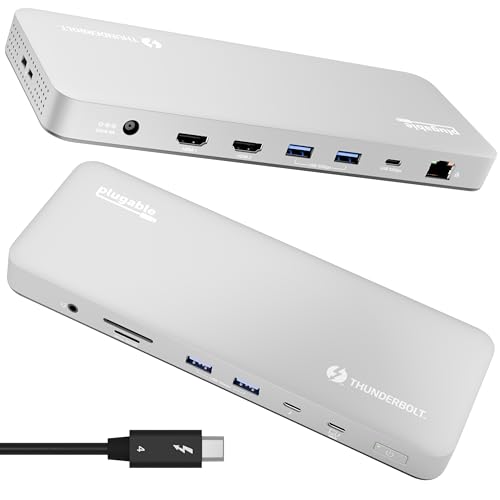
Plugable Thunderbolt 4 Dock for M4/M5 MacBook Air & Pro
About this pick
This driverless, Thunderbolt-certified dock is built specifically for current MacBook Air and Pro models, making it a natural pairing for a two-laptop setup that mixes a Mac with a Windows machine. TB4 certification means guaranteed 40Gbps and confirmed 4K or single 6K display support, a step up from the uncertified USB-C that some combined KVM docks rely on.
As a single-host dock, it needs a companion dock on the Windows side plus a separate KVM switch to actually share a monitor and peripherals between the two, but it avoids the compromises DisplayLink and generic USB-C hardware bring to a Mac connection.
The standout detail is that built specifically for current MacBook Air/Pro chips. Balancing that out, needs a matching Windows-side dock plus a KVM switch for true two-laptop sharing.
Best for: A Mac-and-Windows two-laptop pair where the Mac side needs certified TB4 performance
Check price on AmazonPros
- +TB4 certification guarantees 40Gbps and confirmed display specs
- +Built specifically for current MacBook Air/Pro chips
- +Driverless, no DisplayLink software needed on the Mac side
- +Single 6K display support
Cons
- −Needs a matching Windows-side dock plus a KVM switch for true two-laptop sharing
- −Mac-focused certification doesn't carry the same guarantee on non-Mac laptops
- −New listing without an established review history yet
Dell Pro Thunderbolt 4 Smart Dock SD25TB4
About this pick
Dell's current-generation smart dock supports up to 4 displays, 2.5GbE, and dual Thunderbolt 4 ports at 130W, aimed at business users who run a Dell work laptop alongside a second personal or secondary machine. On a Dell laptop specifically, it negotiates full rated power through Dell's proprietary protocol, a benefit that drops to standard PD levels on a non-Dell second laptop.
As a single-host dock, it's built to be the higher-spec half of a two-laptop setup rather than a switching hub, so pair it with a separate KVM switch if you need shared keyboard, mouse, and monitor access between both machines.
Full-rate 130W PD on Dell laptops via proprietary negotiation. That's a real strength, but weigh it against the flip side: non-Dell laptops only get standard PD, not the full 130W.
Best for: A Dell laptop paired with a second machine in a business two-laptop setup
Check price on AmazonPros
- +Supports up to 4 displays and 2.5GbE
- +Full-rate 130W PD on Dell laptops via proprietary negotiation
- +Dual Thunderbolt 4 ports for daisy-chaining
- +Business-grade build with sustainable design focus
Cons
- −Non-Dell laptops only get standard PD, not the full 130W
- −Needs a separate KVM switch for true two-laptop sharing
- −New listing without an established review history yet
How We Evaluated These Docking Stations for Two Laptops
Each pick was assessed across 5 criteria weighted for real-world use.
Switching architecture
Compared MST-based display switching against EDID-emulation switching, since MST reconnects faster while EDID software approaches introduce a brief pause when swapping hosts.
Power delivery per host
Checked whether PD was rated per-laptop or split unevenly between active and idle hosts, since some combined KVM docks reduce charging to the machine not currently in focus.
All-in-one vs. dock-plus-switch fit
Weighed whether each pick's full spec sheet, PD, port count, display bandwidth, held up as a combined KVM unit or whether it's better used as a single-host dock paired with a separate switch.
Peripheral and keyboard compatibility
Considered whether shared keyboard and mouse hotkey switching relies on standard HID behavior, since gaming keyboards with custom firmware can fail to trigger a KVM hotkey.
Value for a two-laptop budget
Weighed price against whether a buyer needs one all-in-one box or two single-host docks plus a switch, since the two approaches land in very different total-cost brackets.
How to Choose the Right Docking Stations for Two Laptops
By Power Delivery Wattage
| Your priority | Recommended pick |
|---|---|
| Around 130W power delivery | Dell Pro Thunderbolt 4 Smart Dock SD25TB4 |
| Around 100W power delivery | AV Access Docking Station KVM Switch 2 Monitors 2 Laptops |
| Around 100W power delivery | KVM Switch 2 Monitors 2 Computers Docking Station |
By Budget
| Budget | Recommended pick |
|---|---|
| Under $160 | KVM Switch 2 Monitors 2 Computers Docking Station |
| Up to $228 | Anker Prime Docking Station |
Thunderbolt vs USB-C Only
Thunderbolt-certified
Higher bandwidth for demanding multi-display and high-speed data setups, but requires a genuinely Thunderbolt-capable laptop port. In this comparison: Plugable Thunderbolt 4 Dock for M4/M5 MacBook Air & Pro, Dell Pro Thunderbolt 4 Smart Dock SD25TB4.
USB-C only
Usually cheaper and works with any USB-C laptop, but with less headroom for multiple high-resolution displays. In this comparison: AV Access KVM Switch Dock 2 Monitors 2 Laptops, AV Access Docking Station KVM Switch 2 Monitors 2 Laptops, AV Access 8K KVM Switch 2 Monitors 2 Computers for Laptop & Desktop, KVM Switch 2 Monitors 2 Computers Docking Station, Anker Prime Docking Station, Anker Prime Docking Station.
Default to USB-C only unless your laptop has a genuine Thunderbolt port and you need the extra display or data bandwidth.
By Ethernet Support
| Your priority | Recommended pick |
|---|---|
| Wired Ethernet needed | AV Access KVM Switch Dock 2 Monitors 2 Laptops |
| Wi-Fi only is fine | KVM Switch 2 Monitors 2 Computers Docking Station |
For a Dual or Triple Monitor Setup Specifically
Look for
Native DisplayPort Alt Mode or DisplayLink chip technology, verified against your specific laptop's documented maximum external display count.
In this comparison
AV Access KVM Switch Dock 2 Monitors 2 Laptops is worth checking against its listed display support before buying, given its strong review base.
When to Spend More
Spend more if
You need reliable multi-display support and full-speed charging under daily sustained use, where Anker Prime Docking Station's higher price buys real headroom over the cheaper picks.
Save if
You only need occasional charging and a single extra port, where KVM Switch 2 Monitors 2 Computers Docking Station covers the same job at a lower price.
Frequently Asked Questions
What's the difference between an all-in-one KVM dock and a standard dock with a separate KVM switch?
An all-in-one KVM dock, like the AV Access picks in this list, combines switching and docking in one box, simpler cabling but usually with trimmed PD, port count, or display bandwidth compared to a full single-host dock. A standard dock, like the Anker Prime 14-Port, paired with a separate KVM switch keeps the complete spec sheet on each laptop at the cost of an extra device and more cables.
Will my gaming keyboard work with a KVM switch's hotkey?
Not reliably. KVM hotkey switching depends on standard HID keyboard behavior, and gaming keyboards with custom firmware or macro software layers can fail to trigger the hotkey silently. Keep a basic wired USB keyboard nearby as a fallback if your primary keyboard has custom firmware.
Does a KVM dock charge both laptops at full power at the same time?
It depends on the model. Some KVM docks, like the AV Access Docking Station KVM Switch in this list, rate 100W PD to each laptop. Others split power unevenly, giving full charging speed only to the active host and a slower trickle charge to the idle one. Check the specific PD spec rather than assuming symmetric charging.
Do all USB devices switch automatically with a KVM dock?
Keyboard and mouse typically switch cleanly since that's the core KVM function, but USB storage devices, webcams, and audio interfaces may need a few seconds to reinitialize after a switch. If your workflow depends on an always-on webcam, test the specific dock's peripheral behavior before relying on it.
Can I use a KVM dock between a Mac and a Windows laptop?
Yes, but expect some manual display reconfiguration on the Mac side. macOS does not automatically restore display arrangement and input device settings after a KVM switch the way some Windows setups can. The Plugable Thunderbolt 4 Dock for M4/M5 MacBook in this list is built specifically for the Mac side of a mixed pairing.
Which pick in this list is best for a laptop-and-desktop combo instead of two laptops?
The AV Access 8K KVM Switch 2 Monitors 2 Computers is built for exactly this scenario, switching between a laptop and a desktop tower sharing one monitor and one set of peripherals, rather than being limited to two laptops.
Bottom Line
best overall: AV Access KVM Switch Dock 2 Monitors 2 Laptops (2 USB-C MST) - best all-in-one kvm dock pick in this roundup.
See the full rankings above for all picks with pros, cons, and best-for summaries.
Browse on Amazon
All Prime-eligible options with current pricing.
Shop on Amazon →