
8 Best Direct-Attached Storage With RAID
Same RAID DAS intent as our RAID hub guide: we verified RAID metadata ownership, supported levels, and rebuild behavior before ranking.

New to Amazon Prime?
Get fast, free shipping on every pick in this guide, plus Prime Video and exclusive deals.
Try Prime Free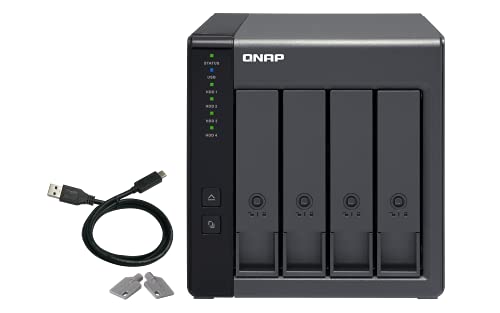


At a Glance
QNAP TR-002-A-US 2-Bay USB-C DAS with Hardware RAID (Diskless)
↓ See why we picked itTerraMaster D2-320 2-Bay USB RAID Enclosure (Diskless)
↓ See why we picked itCENMATE Aluminum 4-Bay Hardware RAID Enclosure (eSATA+USB)
↓ See why we picked itORICO 5-Bay RAID Enclosure with 150W Built-In Power (110TB)
↓ See why we picked itThis covers the same core intent as our RAID Direct-Attached Storage guide: DAS enclosures with genuine RAID capability, not just multiple bays. We required documented RAID levels and rebuild behavior before including any product here.
We separated hardware-controller RAID from host-software RAID for every pick, since portability, recovery, and CPU overhead differ meaningfully between the two approaches even when the supported RAID levels look identical on paper.
6 Criteria to Look For Before Buying a Direct-Attached Storage With RAID
Key buying criteria so you get the right fit the first time.
DAS means direct host attachment, not RAID
USB, Thunderbolt, and enterprise SAS storage can all be DAS. The term describes how the storage connects to a host, not whether it has RAID, what drive type it uses, or how many bays it has. Check those separately.
Bay count is not usable capacity
An 8-bay enclosure with 8x20TB drives does not give you 160TB of usable space in RAID 5 or RAID 6, parity drives eat real capacity. Calculate usable capacity under your intended RAID mode, not raw bay count times drive size.
Hardware RAID and host software RAID are not interchangeable
Hardware/enclosure RAID keeps the array portable across hosts and survives an OS reinstall; host software RAID (or SoftRAID on Mac) ties the array to specific software but is often more flexible and doesn't depend on one controller chip surviving.
The interface link rate is not your real transfer speed
A 10Gbps USB-C enclosure with 5 mechanical HDDs running simultaneously will bottleneck well below 10Gbps once you account for real sustained HDD throughput, typically 150-250MB/s per drive. Multi-drive aggregate speed matters more than the port's rated maximum.
RAID is not backup
RAID 1 or RAID 5 protects against a single drive failure, not against accidental deletion, ransomware, fire, or theft. Keep a genuine separate backup copy of anything irreplaceable, regardless of how much RAID redundancy your DAS provides.
Diskless enclosures need drives budgeted separately
Most multi-bay DAS enclosures ship completely empty. Factor in 2-8 hard drives or SSDs at your target capacity before comparing the enclosure's sticker price against a similarly-priced preconfigured external drive.
8 Best Direct-Attached Storage With RAID
QNAP TR-004 4-Bay USB-C DAS with Hardware RAID (Diskless)
About this pick
The TR-004 is a genuine hardware-RAID DAS, supporting RAID 0, 1, 5, JBOD, and individual disks across 4 x 3.5-inch SATA bays, connected via USB Type-C for use as either standalone external storage or QNAP NAS backup expansion.
QNAP is explicit about a real limitation: the TR-004's storage pool cannot be combined into a connected NAS's own pool, and drives can only migrate between TR-004 units, not to a different NAS model, a genuine gotcha worth knowing before buying it purely as NAS expansion.
Best for: buyers prioritizing 4x 3.5in bays, hardware raid 0/1/5/jbod
Check price on AmazonPros
- +True hardware RAID controller, not host software RAID
- +Doubles as standalone DAS or NAS backup expansion
- +Lockable bays for physical security
Cons
- −Storage pool cannot merge into a connected NAS's own pool
- −Drive migration limited to other TR-004 units only
QNAP TR-002-A-US 2-Bay USB-C DAS with Hardware RAID (Diskless)
About this pick
The compact TR-002-A-US supports 2 x 2.5/3.5-inch SATA drives with hardware RAID 0, 1, JBOD, or individual disk modes, positioned as either standalone external storage or QNAP NAS backup expansion over a USB Type-C connection.
Lockable drive bays add physical security, and the included USB Type-C to Type-A cable covers both modern and older host ports out of the box, a genuinely compact 2-bay entry point into QNAP's DAS ecosystem.
Best for: buyers prioritizing 2-bay hardware raid 0/1/jbod
Check price on AmazonPros
- +Genuine hardware RAID in a compact 2-bay footprint
- +Lockable bays for physical security
- +Includes both USB-C and USB-A cable options
Cons
- −Only 2 bays limits RAID options to mirroring, not parity
- −Same NAS-pool-separation limitation as QNAP's TR-004
QNAP TR-002 2-Bay Desktop DAS/NAS Expansion
About this pick
The TR-002 uses a physical DIP switch to toggle between Hardware Control and Software Control RAID configurations across its 2 SATA bays, connected via a USB 3.2 Gen 2 Type-C port for faster data transfer than QNAP's older TR-002 revisions.
An eject button safely disconnects the unit from a NAS or computer, and lockable hard drive trays prevent accidental removal, positioning it as a flexible optional DAS that can also serve as dedicated desktop NAS expansion depending on the buyer's workflow.
Best for: buyers prioritizing 2-bay, usb 3.2 gen 2 type-c
Check price on AmazonPros
- +DIP switch lets you choose hardware or software RAID control
- +Dedicated eject button for safe disconnection
- +Lockable trays prevent accidental drive removal
Cons
- −Only 2 bays limits RAID options to mirroring
- −Positioned as NAS expansion first, DAS second
TerraMaster D2-320 2-Bay USB RAID Enclosure (Diskless)
About this pick
The D2-320 is a genuine hardware RAID enclosure supporting RAID 0, RAID 1, JBOD, and Single mode across 2 bays, hitting up to 521MB/s in RAID 0 with two 8TB HDDs, or 1,075MB/s with two SATA SSDs in RAID 0, over a 10Gbps USB 3.2 Gen 2 link.
In RAID 1, a damaged drive can be replaced directly and data rebuilds automatically, a real mirrored-backup workflow rather than just individual disk exposure. The tool-free Push-Lock tray and intelligent temperature-controlled fan carry over from TerraMaster's larger D-series enclosures.
Best for: buyers prioritizing 2-bay, hardware raid 0/1/jbod/single
Check price on AmazonPros
- +Genuine hardware RAID 1 with automatic rebuild on drive replacement
- +Documented real throughput figures for both HDD and SSD RAID 0
- +Compact 2-bay footprint for a mirrored backup setup
Cons
- −Max 44TB total (22TB x 2) capacity ceiling
- −Diskless, drives sold separately
CENMATE Aluminum 4-Bay Hardware RAID Enclosure (eSATA+USB)
About this pick
Unlike CENMATE's non-RAID 4-bay model, this version adds a genuine hardware RAID controller (JMS567+JMB393 chip) supporting 8 modes: RAID 0/1/3/5/10, CLONE, LARGE, and NORMAL, switched via a physical toggle and reset-button sequence rather than software.
It supports up to 80TB total (20TB per drive) over USB A/C 3.0 plus an eSATA output for an alternate connection path, at up to 5Gbps. CENMATE notes macOS has no RAID software support for this unit and warns that switching RAID modes can cause data loss, back up first.
Best for: buyers prioritizing 4-bay hardware raid, 8 modes, up to 80tb
Check price on AmazonPros
- +Genuine hardware RAID controller with 8 selectable modes
- +Dual USB/eSATA connectivity options
- +150W-class stable power design for multi-drive RAID
Cons
- −No macOS RAID software support
- −RAID mode switching risks data loss if not backed up first
ORICO RAID 5-Bay HDD Enclosure (110TB, Aluminum)
About this pick
This ORICO 5-bay RAID enclosure matches the 4-bay model's 8 RAID modes (0/1/3/5/10/JBOD/CLONE/CLEAR) but scales to 110TB total (22TB per drive) with the same 235MB/s USB 3.0 transfer speed and a built-in 150W power supply for stable multi-disk operation.
An 80mm silent cooling fan with front and rear vents handles the added thermal load of a fifth drive, and the same bracket-free, independently-locked tray design carries over from ORICO's smaller RAID enclosures.
Best for: buyers prioritizing 5-bay raid, 8 modes, up to 110tb
Check price on AmazonPros
- +8 RAID modes at a larger 5-bay capacity tier
- +Built-in 150W power supply avoids a bulky adapter
- +Independent locking mechanism per the bracket-free tray design
Cons
- −235MB/s ceiling limits sustained multi-drive throughput
- −Back up data before switching RAID modes, per ORICO's own guidance
ORICO 5-Bay RAID Enclosure with 150W Built-In Power (110TB)
About this pick
This ORICO 5-bay RAID station uses hardware switches (not software) to configure RAID 0, 1, 3, 5, 10, JBOD, Clone, or Clear across up to 110TB total capacity (22TB per drive), targeting large backup projects, video editing, and media libraries.
The built-in 150W power supply keeps voltage stable across 5 simultaneously-running mechanical drives without a bulky external adapter, and a rugged aluminum alloy shell with an 80mm silent fan plus honeycomb venting is engineered for 24/7 long-term operation.
Best for: buyers prioritizing 5-bay raid, hardware switches, up to 110tb
Check price on AmazonPros
- +Hardware-switch RAID configuration, no software dependency
- +150W built-in supply keeps a creative studio desk clean and stable
- +Engineered specifically for 24/7 long-term operation
Cons
- −230MB/s USB 3.0 ceiling is modest by current multi-gig standards
- −Requires physical hardware-switch access for RAID reconfiguration
ORICO 4-Bay RAID Hard Drive Enclosure (88TB, Aluminum)
About this pick
ORICO's 4-bay RAID enclosure supports the same 8 RAID modes as its 5-bay sibling (0/1/3/5/10/JBOD/CLONE/CLEAR) for up to 88TB total (22TB per drive), reaching 235MB/s over a USB 3.0 interface matched to SATA 6Gbps drives.
A built-in 150W power supply avoids a bulky external adapter even with 4 high-consumption mechanical drives running simultaneously, and an 80mm silent cooling fan with front/rear vents handles sustained heat load. A tray-less design with an independent safety lock secures drives against accidental ejection.
Best for: buyers prioritizing 4-bay raid, 8 modes, up to 88tb
Check price on AmazonPros
- +Built-in 150W power supply eliminates a bulky external brick
- +8 RAID modes cover backup, capacity, and redundancy use cases
- +Independent safety lock prevents accidental drive ejection
Cons
- −235MB/s ceiling is modest for a RAID-capable 4-bay unit
- −22TB per-drive limit caps total capacity below newer competitors
How We Evaluated These Direct-Attached Storage With RAID
Each pick was assessed across 5 criteria weighted for real-world use.
Connection & Drive Architecture
Verified whether each product is genuinely direct-attached storage (USB, Thunderbolt, or SAS to one host) and whether drives mount individually, in JBOD, or under real hardware RAID, rather than assuming any multi-bay box works the same way.
Real Interface Speed
Checked the documented USB generation, Thunderbolt generation, or SAS link speed against real sustained throughput figures where manufacturers publish them, rather than repeating theoretical link-rate marketing numbers.
RAID/JBOD Implementation
Distinguished hardware-controller RAID from host-software RAID from plain JBOD/individual-disk presentation, since these have very different failure, portability, and rebuild behavior.
Build, Cooling & Serviceability
Weighed tool-free tray design, hot-swap support, fan noise where documented, and daisy-chain or expansion options against the product's likely desk, closet, or rack environment.
Total Ownership Cost
Considered that most DAS enclosures ship diskless, factoring in drive cost, cables, and RAID software where relevant rather than judging price on the empty enclosure alone.
How to Choose the Right Direct-Attached Storage With RAID
Hardware Switches vs Software RAID Config
Several RAID enclosures in this list configure RAID mode through physical DIP switches rather than software, meaning mode changes require powering down and following a specific reset-button sequence. Check the configuration method before assuming a purely software-driven experience.
Frequently Asked Questions
Do I need to back up before switching RAID modes?
Yes, always. Every RAID-capable enclosure in this list, and RAID generally, can lose data during a mode switch since reconfiguring the array typically wipes existing data structures. Back up first, every time.
Does RAID replace the need for a separate backup?
No. RAID protects against a single drive's hardware failure, but it does not protect against accidental deletion, ransomware, fire, theft, or a controller failure that affects the whole array at once. Keep a genuine separate backup copy of anything you can't afford to lose.
Do DAS enclosures come with drives included?
Most multi-bay DAS enclosures in this category ship completely diskless, you supply your own 2.5in or 3.5in SATA HDDs/SSDs or M.2 NVMe SSDs depending on the model. Budget for drive cost separately when comparing total price against a preconfigured external drive.
Will any USB-C or Thunderbolt cable give me full DAS speed?
No. Cable quality and rated bandwidth matter as much as the port. A basic charging-only USB-C cable can bottleneck a 10Gbps or faster enclosure well below its rated speed. Use the cable included with the enclosure, or one explicitly rated for the matching USB or Thunderbolt generation.
Can I add or remove drives from a DAS enclosure without powering it down?
Only if the specific enclosure documents hot-swap support, which most tool-free tray designs in this category do. Always check your specific product's hot-swap capability before removing a drive live, since not every budget enclosure supports it, especially some fixed-RAID-mode units.
Bottom Line
best overall: QNAP TR-004 4-Bay USB-C DAS with Hardware RAID (Diskless) - best hardware raid pick in this roundup.
See the full rankings above for all picks with pros, cons, and best-for summaries.
Browse on Amazon
All Prime-eligible options with current pricing.
Shop on Amazon →