
8 Best Budget NAS for Beginners in 2026
8 best budget NAS picks for beginners in 2026, from drives-included single-bay units to diskless 2-bay and 4-bay enclosures. Compare setup ease and true cost.

Want it even cheaper?
Browse budget-friendly finds starting at just $2.99 on Amazon Haul.
Shop Amazon Haul



At a Glance
Synology DS223 Home & Office Backup Hub (2-Bay Diskless NAS)
↓ See why we picked itBuffalo LinkStation 210 2TB 1-Bay NAS (Drives Included)
↓ See why we picked itBuffalo LinkStation 210 6TB 1-Bay NAS (Drives Included)
↓ See why we picked itQNAP TR-004 4-Bay USB Type-C Direct Attached Storage (Diskless)
↓ See why we picked itBeelink Mini PC ME Pro 2-Bay NAS (Intel N95, Diskless)
↓ See why we picked itA first NAS purchase gets confusing fast because the sticker price on a diskless enclosure almost never tells the whole story. Add two NAS-grade drives to a budget 2-bay unit and the total investment often runs close to double the enclosure price alone, which is the single biggest surprise beginners run into after checkout.
Below are 8 budget NAS picks we evaluated for beginners, ranging from drives-included single-bay units that work out of the box to diskless 2-bay and 4-bay enclosures that need drives purchased separately, with total cost, setup complexity, and drive compatibility weighed alongside the enclosure price itself.
5 Criteria to Look For Before Buying a Budget NAS for Beginner
Key buying criteria so you get the right fit the first time.
Remember every listed NAS here is diskless, budget drives separately
The price shown for a NAS enclosure covers the hardware chassis, CPU, and RAM only, not the actual storage drives, NAS-grade drives built for 24/7 operation like Seagate IronWolf or WD Red still need to be budgeted on top, often adding $80 to $200 or more per bay depending on capacity and drive type.
This matters because comparing NAS units purely by enclosure price without factoring in drive cost gives a misleading picture of the real total investment, a cheaper enclosure with more bays to fill can end up costing more overall than a pricier enclosure with fewer bays.
Check whether a listing is diskless or ships with drives included, and add realistic per-bay drive costs to the enclosure price before comparing total cost across options.
Weigh CPU class and RAM over bay count for real day-to-day performance
Bay count determines maximum storage capacity, but CPU architecture (Intel, AMD, or ARM) and RAM amount determine how well the NAS actually handles real workloads, running apps, transcoding media on the fly, or serving multiple simultaneous users, and a higher bay count with a weak CPU can bottleneck performance regardless of how much raw storage it holds.
This matters more the more the NAS will do beyond simple file storage, like Plex transcoding or running multiple docker containers, less if it's purely a basic backup target.
Check the specific CPU model and RAM amount (and whether RAM is upgradeable) rather than choosing primarily by bay count.
Understand RAID as a rebuild-time safety net, not a substitute for real backup
RAID configurations protect against a single drive failure by letting the array rebuild from redundant data, but RAID is not a backup, it does nothing to protect against accidental deletion, ransomware, theft, fire, or a controller failure that affects the whole array at once.
This distinction matters because treating RAID redundancy as sufficient backup protection is a common and genuinely risky misunderstanding, a real backup strategy needs a copy of critical data stored somewhere physically separate from the NAS itself.
Check what RAID level a given NAS supports, and separately plan an actual backup strategy, ideally following a 3-2-1 approach, rather than relying on RAID redundancy alone.
Match drive type (HDD vs SSD/NVMe) to your actual access pattern
Traditional hard drives offer the lowest cost per terabyte for bulk storage like media libraries or backups, while SSD or NVMe-based NAS storage costs significantly more per terabyte but delivers much faster random access speeds, genuinely useful for frequently-accessed files, active project work, or serving as a fast cache tier.
This matters directly based on how you'll actually use the storage, a media library accessed sequentially benefits little from SSD speed, while an active working file share benefits considerably.
Check whether the NAS supports the drive type you need, and weigh the real cost-per-terabyte difference against how much you'll actually benefit from faster random access.
Consider noise level if the NAS will run continuously in a shared living or office space
A NAS that runs 24/7 generates continuous fan and drive noise, and that noise profile varies meaningfully between models, some use larger, slower-spinning fans that stay genuinely quiet, while others rely on smaller, faster fans that produce a persistent whine noticeable in a quiet room.
This matters a great deal if the NAS will sit in a bedroom, living room, or shared home office rather than a dedicated closet or basement out of earshot.
Check reviews specifically for real-world noise level mentions during continuous operation, not just idle noise, since drive activity and fan speed both increase under load.
8 Best Budget NAS for Beginners in 2026
UGREEN NAS DH2300 2-Bay Desktop NAS (Diskless)
About this pick
The UGREEN DH2300 is a diskless 2-bay NAS built around UGREEN's own beginner-friendly UGOS software, which trades some of the deeper app ecosystem of established NAS brands for a simpler, more approachable setup flow. Supporting up to 64TB across its two bays gives a first-time buyer real room to grow into RAID mirroring later. Because it ships without drives, budget beforehand for two NAS-grade drives on top of the enclosure price. That combined cost is the real total investment, not just the sticker on the enclosure itself. Room to grow with 64TB max capacity. That's a real strength, but weigh it against the flip side: diskless, so real cost is enclosure plus 2 drives.
Best for: First-time buyers who want the simplest software experience in a diskless 2-bay unit
Check price on AmazonPros
- +Simpler software onboarding than most enterprise-style NAS brands
- +Room to grow with 64TB max capacity
- +RAID 1 mirroring protects against a single drive failure
- +Competitive enclosure-only price
Cons
- −Diskless, so real cost is enclosure plus 2 drives
- −Smaller app ecosystem than more established NAS brands
- −Newer platform with a shorter support track record
Synology DS223 Home & Office Backup Hub (2-Bay Diskless NAS)
About this pick
Synology's DSM software is the most beginner-tested interface in NAS, with wizard-driven setup, automatic backup scheduling, and centralized file access that walks a first-time user through configuration step by step. The DS223 pairs that software with a straightforward 2-bay diskless enclosure.
It costs more upfront than the UGREEN pick, but the tradeoff is a considerably shorter learning curve and a much larger library of community guides and official documentation if something goes wrong during setup.
Worth calling out specifically: large library of official and community troubleshooting guides. The catch is priciest enclosure-only pick in this list.
Best for: Beginners who want the most guided software setup and are willing to pay more for it
Check price on AmazonPros
- +Most polished, wizard-driven setup software in this list
- +Large library of official and community troubleshooting guides
- +RAID 1 protects data from a single drive failure
- +Strong reputation for long-term software support
Cons
- −Priciest enclosure-only pick in this list
- −Diskless, so drives add to total cost
- −Compatibility list for third-party drives can look restrictive to a new buyer
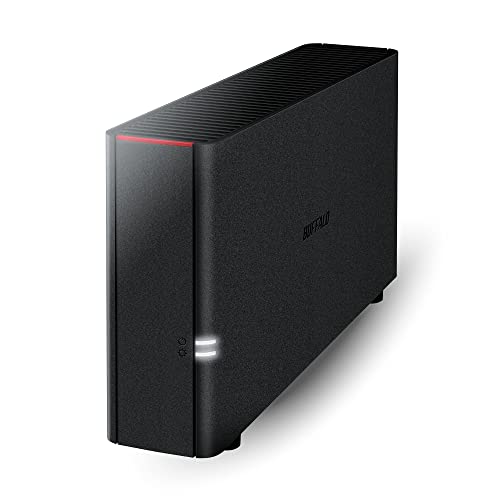
Buffalo LinkStation 210 2TB 1-Bay NAS (Drives Included)
About this pick
The LinkStation 210 is a single-bay NAS with the hard drive already installed, which removes the drive-shopping and compatibility research step entirely. For a buyer who just wants automatic backup and simple network storage without touching RAID configuration, this is the most beginner-friendly path onto a NAS.
The tradeoff is no RAID redundancy since there's only one drive bay, so a drive failure means a full data loss unless you're also backing up elsewhere. Simplicity comes at the cost of the safety net a 2-bay mirrored setup provides.
Fastest true beginner setup in this list. Set against that, no RAID redundancy, a drive failure means total data loss without a separate backup. Both matter when comparing it to the other picks here.
Best for: A true beginner who wants storage and backup running today without any drive shopping
Check price on AmazonPros
- +Drive included, no separate drive purchase or compatibility research needed
- +Fastest true beginner setup in this list
- +Lower total cost than most diskless alternatives once drives are factored in
- +Works as home cloud storage with minimal configuration
Cons
- −No RAID redundancy, a drive failure means total data loss without a separate backup
- −2TB capacity is limiting for media libraries
- −Single-bay design leaves no room to expand later
Buffalo LinkStation 210 6TB 1-Bay NAS (Drives Included)
About this pick
This is the same drives-included LinkStation 210 platform as the 2TB pick, scaled up to 6TB for a beginner who already knows they'll need more room for photos, videos, or multiple computers' backups. It keeps the identical zero-shopping, zero-compatibility-research setup experience. It lands close to the diskless 2-bay enclosures once you'd add drives to those, making it a genuinely competitive total-cost option for anyone who doesn't need RAID redundancy on day one. A genuine advantage here is that total cost is competitive with diskless 2-bay units plus drives. The tradeoff is still no RAID redundancy since it's single-bay.
Best for: Beginners who want more included capacity without adding RAID complexity
Check price on AmazonPros
- +6TB included capacity with no separate drive purchase
- +Total cost is competitive with diskless 2-bay units plus drives
- +Same simple setup as the 2TB LinkStation
- +Good fit for a growing photo or video collection
Cons
- −Still no RAID redundancy since it's single-bay
- −No expansion path if you outgrow 6TB
- −A drive failure means total data loss without a separate backup
QNAP TR-004 4-Bay USB Type-C Direct Attached Storage (Diskless)
About this pick
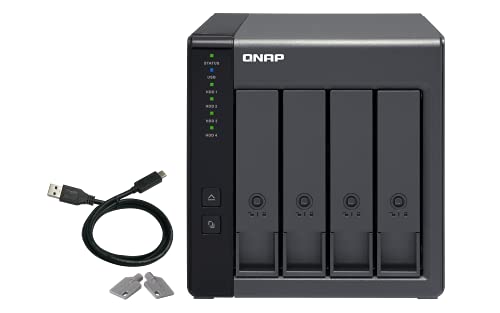
It's worth flagging clearly for a beginner: the TR-004 is direct attached storage (DAS) connected over USB-C to a single computer, not a network-attached NAS that multiple devices can reach independently. It gives 4 bays of hardware RAID at a lower price than most true network NAS units with the same bay count.
If your actual goal is centralized storage reachable from your phone, laptop, and a media server all at once, this isn't the right category. It's the right pick specifically for expanding one computer's storage with RAID protection.
Simple USB-C connection, no network configuration. That's a real strength, but weigh it against the flip side: not a true network NAS, only accessible from the connected computer.
Best for: Someone who actually wants RAID-protected expansion for one computer, not network storage
Check price on AmazonPros
- +4 bays of hardware RAID at a lower price than comparable true NAS
- +Simple USB-C connection, no network configuration
- +Good option for expanding a single computer's storage
- +Tool-less design is easy for a first-timer to load drives into
Cons
- −Not a true network NAS, only accessible from the connected computer
- −Diskless, requiring separate drive purchases across 4 bays
- −Not the right pick if multi-device network access was the actual goal
Asustor Drivestor 2 Gen 2 AS1202T 2-Bay NAS (Diskless)
About this pick
The Drivestor 2 Gen 2 pairs a quad-core CPU and 2.5GbE networking with 2-bay expandability at the same price point as the UGREEN pick, giving a beginner faster network transfer speeds without paying more upfront. Asustor's ADM software sits in a middle ground of approachability between UGREEN and Synology. As a diskless unit it carries the same buy-drives-separately consideration as most 2-bay picks in this list, so factor two NAS-grade drives into the real total cost before comparing it against the drives-included LinkStation options. Worth calling out specifically: quad-core CPU handles 4K media transcoding. The catch is diskless, so drives add to the real total cost.
Best for: Beginners who want faster 2.5GbE networking without paying more than a Gigabit-only 2-bay unit
Check price on AmazonPros
- +2.5GbE networking is faster than most budget picks' Gigabit Ethernet
- +Quad-core CPU handles 4K media transcoding
- +Same price as the UGREEN pick with faster networking
- +Entry-level personal cloud functions built in
Cons
- −Diskless, so drives add to the real total cost
- −2.5GbE only helps if your router and switch also support it
- −ADM software has a smaller community than Synology's DSM
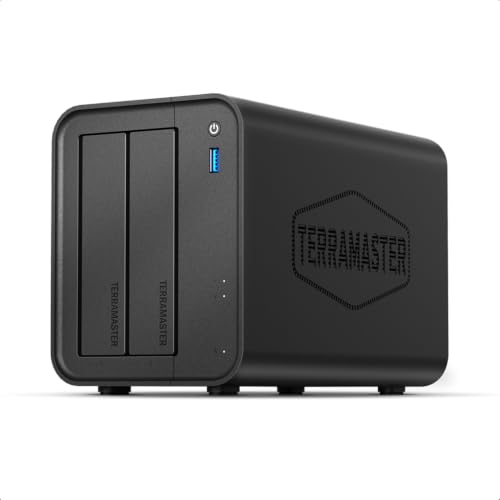
TerraMaster F2-425 2-Bay NAS (Intel x86 Quad-Core, Diskless)
About this pick
The F2-425 runs a full Intel x86 quad-core CPU with 4GB of RAM, well above what most budget 2-bay NAS units offer, plus 2.5GbE networking for faster transfers. That extra headroom means it won't feel underpowered as quickly if you start running more apps on it later.
The more capable hardware pushes the price to the top of this list's 2-bay diskless units, so it's the pick for a beginner who's fairly confident they'll grow into heavier use rather than someone who just wants basic backup running.
2.5GbE networking for faster transfers. Set against that, highest price among the 2-bay diskless picks in this list. Both matter when comparing it to the other picks here.
Best for: Beginners who expect to grow into heavier NAS use and want CPU headroom from the start
Check price on AmazonPros
- +Most powerful CPU and RAM combination among 2-bay picks in this list
- +2.5GbE networking for faster transfers
- +Strong headroom for adding apps later without feeling underpowered
- +Intel x86 architecture supports a wider software range than ARM-based budget NAS
Cons
- −Highest price among the 2-bay diskless picks in this list
- −More capability than a true beginner needs on day one
- −Diskless, so 2 drives add to the real total cost
Beelink Mini PC ME Pro 2-Bay NAS (Intel N95, Diskless)
About this pick
This is a genuinely different category from the rest of this list: a mini PC with an Intel N95 CPU, 12GB RAM, and 128GB of onboard M.2 storage that also happens to include 2 hard drive bays, so it can run as a full desktop-capable computer and a NAS at the same time. That flexibility comes with real setup complexity beyond a purpose-built NAS appliance.
This isn't the pick for someone who wants the fastest path to automatic backup. It's the pick for a beginner who's curious about running their own server software, file server, and private cloud on one box and is willing to spend more time and money to get there.
A genuine advantage here is that dual LAN and onboard SSD add flexibility beyond a standard NAS appliance. The tradeoff is most expensive pick in this list.
Best for: A tech-curious beginner who wants a mini PC and NAS combined, not just simple backup
Check price on AmazonPros
- +Doubles as a full mini PC and a 2-bay NAS in one device
- +Dual LAN and onboard SSD add flexibility beyond a standard NAS appliance
- +Good entry point for a beginner who wants to learn self-hosting
- +3 additional M.2 slots for further expansion
Cons
- −Most expensive pick in this list
- −Requires more technical setup than a purpose-built NAS appliance
- −Not the fastest path to simple automatic backup
How We Evaluated These Budget NAS for Beginners
Each pick was assessed across 5 criteria weighted for real-world use.
Total real-world cost
Weighed enclosure price against whether drives are included, since a diskless 2-bay unit plus 2 NAS-grade drives often costs close to double the enclosure price alone.
Setup complexity for a first-timer
Compared software onboarding flows, wizard-driven setup versus more manual configuration, and how much networking or RAID knowledge each platform assumes.
Drive compatibility restrictions
Checked how strict each brand's drive compatibility list is, since some show scary-looking warnings for third-party drives that are often mostly cosmetic rather than functional blockers.
True NAS versus DAS distinction
Verified whether each pick is actually network-accessible NAS or direct attached storage reachable from only one computer, a distinction that matters enormously for a beginner's actual use case.
Growth headroom
Considered CPU, RAM, networking speed, and bay count against how much a beginner is likely to expand into heavier use, like transcoding or running additional apps, over time.
How to Choose the Right Budget NAS for Beginners
By Rating Confidence: Highest Rated vs Most Reviewed
| Your priority | Recommended pick |
|---|---|
| Highest average rating | UGREEN NAS DH2300 2 |
| Largest review base, strongest reliability signal | UGREEN NAS DH2300 2 |
By Budget
| Budget | Recommended pick |
|---|---|
| Under $154 | Buffalo LinkStation 210 2TB 1 |
| Up to $379 | Beelink Mini PC ME Pro 2 |
Bay Count vs Price
Buffalo LinkStation 210 2TB 1
The lower-priced option in this comparison, worth checking its CPU and RAM against your actual workload.
Beelink Mini PC ME Pro 2
The higher-priced option, worth it if it offers real bay count or performance headroom above the cheaper pick.
Default to Buffalo LinkStation 210 2TB 1 unless your storage needs genuinely call for the pricier pick.
By Drive Type Support
| Your priority | Recommended pick |
|---|---|
| SSD/NVMe for fast random access | Beelink Mini PC ME Pro 2 |
| HDD for bulk storage is enough | UGREEN NAS DH2300 2 |
For Media Streaming or Plex Specifically
Look for
A CPU capable of hardware transcoding and enough RAM to handle multiple simultaneous streams, not just total bay count.
In this comparison
UGREEN NAS DH2300 2 is worth checking against its listed CPU and RAM before buying, given its strong review base.
When to Spend More
Spend more if
You need real multi-user performance, media transcoding, or business-critical reliability, where Beelink Mini PC ME Pro 2's CPU and RAM give real headroom over the cheaper picks.
Save if
You just need simple backup storage for one or two users, where Buffalo LinkStation 210 2TB 1 covers the same job at a lower price.
Frequently Asked Questions
Why does a budget NAS cost more than the advertised price?
Most 2-bay and 4-bay NAS units in this list ship diskless, meaning the enclosure price doesn't include storage. Adding 2 NAS-grade drives at a reasonable capacity often brings the real total investment close to double the enclosure's sticker price, which is the most common surprise for first-time buyers. Drives-included picks like the Buffalo LinkStation 210 avoid this by bundling the drive into the listed price.
Should a true beginner buy a diskless NAS or a drives-included one?
A drives-included single-bay NAS, like either Buffalo LinkStation 210 pick in this list, is the simplest true-beginner setup since it skips drive shopping and compatibility research entirely. A diskless 2-bay unit like the UGREEN DH2300 or Synology DS223 costs more in total once drives are added, but gains RAID 1 mirroring, which protects your data if one drive fails.
How long does a first NAS setup actually take?
Plan for several hours, not minutes, for a fully configured first setup, especially if you want automatic backup, remote access, or media server apps running. The basic network connection is quick, but configuring firewall rules, ports, and backup schedules correctly requires more networking knowledge than most marketing materials suggest.
What's the difference between NAS and DAS for a beginner?
NAS is network-attached storage, reachable from your phone, laptop, and other devices independently over your home network. DAS, like the QNAP TR-004 in this list, connects directly to one computer over USB and isn't accessible from other devices. If centralized, multi-device access is your goal, make sure you're buying true NAS, not DAS.
Do I even need a NAS, or would a simple external drive work?
If you're only backing up one computer, an external USB drive is usually simpler and cheaper than any NAS. A single-drive cloud-connected NAS, like the LinkStation picks, is worth it once you want file access from multiple devices. A full traditional multi-bay NAS earns its added complexity mainly for a real media server or a library that benefits from RAID redundancy.
Are third-party drive compatibility warnings a dealbreaker on budget NAS units?
Usually not. Value-series NAS models tend to be the least restrictive about third-party drives, while stepping up to a Plus-series or higher model can show compatibility warnings that look scary but often only disable some vendor-specific health monitoring rather than blocking the drive from functioning. Check the specific warning's wording before assuming a drive won't work.
Bottom Line
best overall: UGREEN NAS DH2300 2-Bay Desktop NAS (Diskless) - best overall for beginners pick in this roundup.
See the full rankings above for all picks with pros, cons, and best-for summaries.
Browse on Amazon
All Prime-eligible options with current pricing.
Shop on Amazon →