
8 Best 4-Channel USB Audio Interfaces in 2026
We compared 4 channel usb audio interface models by verified specs and real-world tradeoffs, not marketing claims alone.

New to Amazon Prime?
Get fast, free shipping on every pick in this guide, plus Prime Video and exclusive deals.
Try Prime Free




At a Glance
Zoom AMS-44 USB Audio Interface for Musicians & Podcasters
↓ See why we picked itUSB Audio Interface 4 Line Outputs & 2 Line Inputs with 48V Phantom Power
↓ See why we picked itYamaha 6-in/4-out USB-C Audio/MIDI Interface with 32-bit/192kHz Support
↓ See why we picked itBest 4-Channel USB Audio Interfaces look similar but differ in practice, so the spec sheet hides real gaps.
Every pick here was judged on honest gain and connection type, because these separate real capability from claims.
5 Criteria to Look For Before Buying a 4-Channel USB Audio Interface
Key buying criteria so you get the right fit the first time.
Input Count vs Simultaneous Sources
The number of inputs an interface has determines how many separate sound sources you can record at the exact same time, not how many you'll eventually use across different sessions. A single-input interface works fine for a solo vocalist, but recording an interview or a duet requires at least two inputs running simultaneously. Count the maximum number of sources you'll realistically record in a single take, not your total gear collection.
Preamp Gain and Noise Floor
Clean preamp gain, typically quoted in dB, determines how much you can boost a quiet microphone signal before hiss becomes audible, and this varies more between interfaces than most buyers expect. A quiet dynamic microphone needs meaningfully more clean gain than a condenser mic does, so check the specific dB figure against the microphone you'll actually pair it with.
USB vs Thunderbolt Latency
Latency is the delay between making a sound and hearing it played back, determined largely by connection type and driver quality rather than price alone. USB interfaces now commonly achieve latency low enough for real-time monitoring on most systems, while Thunderbolt offers even lower latency but mainly matters for larger multi-channel professional setups rather than a 1-2 input home setup. Check for a stated round-trip latency figure rather than assuming connection type alone tells the story.
Bit Depth and Sample Rate
24-bit recording is the current professional standard, giving meaningfully more headroom before clipping than older 16-bit audio, and the vast majority of modern interfaces, even entry-level ones, now support it by default. Sample rate matters less in practice for most home recording once you're above 44.1kHz to 48kHz, so check for 24-bit support specifically rather than chasing the highest sample rate number.
Bus-Powered vs External Power Supply
Most compact 1-2 input interfaces draw power directly from your computer's USB port, meaning no separate power adapter is needed, which matters for portability and simpler desk setups. Interfaces with more inputs or higher power draw sometimes require an external power supply, adding a cable and a dependency worth knowing about. Check the listing specifically for 'bus-powered' language.
8 Best 4-Channel USB Audio Interfaces in 2026
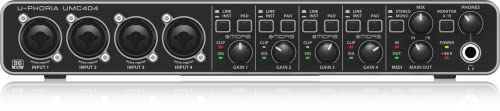
Behringer U-PHORIA UMC404HD Audiophile 4x4
About this pick
Behringer U-PHORIA UMC404HD Audiophile 4x4 is the top pick in this comparison. 4x4 USB 2.0 audio/MIDI interface for recording microphones and instruments. Audiophile 24-bit/192 kHz resolution for professional audio quality.
Compatible with popular recording software including avid pro tools, ableton live, steinberg cubase, etc, which is the main thing that distinguishes this pick from Focusrite Scarlett 4i4 4th Gen USB-C Audio Interface.
Go with this pick if you want the strongest all-around pick in this comparison and would rather not keep shopping around. Bundled software licenses vary by retailer and aren't always the full paid version, so check the specific bundle before assuming you get everything advertised.
Best for: buyers who want the strongest all-around pick in this comparison and would rather not keep shopping around
Check price on AmazonPros
- +4x4 USB 2.0 audio/MIDI interface for recording
- +Audiophile 24-bit/192 kHz resolution for professional audio
- +Compatible with popular recording software including avid
- +Streams 4 inputs / 4 outputs
Cons
- −Bundled software licenses vary and aren't always full versions
- −Driver stability can vary by operating system version
Focusrite Scarlett 4i4 4th Gen USB-C Audio Interface
About this pick
Focusrite Scarlett 4i4 4th Gen USB-C Audio Interface is the priciest pick in this lineup. The new generation of the music maker's studio hub: connect your mics, guitars, synths and drum machines to scarlett 4i4 4th gen and get audio performance that matches what you'd find in a pro studio. A new generation - ready for all your gear: two scarlett 4th gen mic preamps.
Behringer U-PHORIA UMC404HD Audiophile 4x4 covers similar ground, though with a huge 120db dynamic range, scarlett 4th gen uses the same converters as focusrite’s flagship interfaces, found in the world's biggest studios is what tips the choice one way or the other.
This fits best if you are willing to spend the most in this comparison for the fuller feature set that comes with it. Driver stability can vary by operating system version, so check recent user reports for your specific OS before buying.
Best for: buyers who are willing to spend the most in this comparison for the fuller feature set that comes with it
Check price on AmazonPros
- +The new generation of the music maker's studio hub
- +A new generation - ready for all your gear
- +Studio-quality sound
- +Find your signature sound
Cons
- −Driver stability can vary by operating system version
- −Bundled software licenses vary and aren't always full versions
Behringer UMC404HD Audiophile 4x4
About this pick
Behringer UMC404HD Audiophile 4x4 is a strong alternative worth comparing directly against the top pick.
Behringer U-PHORIA UMC404HD Audiophile 4x4 is a reasonable point of comparison here, close enough that the actual listing details are worth checking before deciding between them.
Choose this if you want a genuine alternative to the top pick with a different tradeoff worth comparing directly. Bundled software licenses vary by retailer and aren't always the full paid version, so check the specific bundle before assuming you get everything advertised.
Best for: buyers who want a genuine alternative to the top pick with a different tradeoff worth comparing directly
Check price on AmazonPros
- +Macos/windows
- +Straightforward setup based on the listed specs
- +Covers the core feature set for this category
Cons
- −Bundled software licenses vary and aren't always full versions
- −Driver stability can vary by operating system version
Zoom AMS-44 USB Audio Interface for Musicians & Podcasters
About this pick
Zoom AMS-44 USB Audio Interface for Musicians & Podcasters is a strong alternative worth comparing directly against the top pick. Features four XLR/TRS combo inputs with four low-noise preamps and 48v phantom power, delivering professional-quality audio recording and streaming for musicians and content creators. Toggle instantly between music mode for independent input routing and DAW recording and streaming mode that combines all inputs into a single signal for hassle-free livestreaming.
Weighing this against Behringer U-PHORIA UMC404HD Audiophile 4x4, monitor your input signal in real time with zero latency using the direct monitor switch, and combine input audio with computer playback for streaming with the loopback switch, all without additional software ends up being the detail that matters most for most buyers.
Go with this pick if you want a genuine alternative to the top pick with a different tradeoff worth comparing directly. Driver stability can vary by operating system version, so check recent user reports for your specific OS before buying.
Best for: buyers who want a genuine alternative to the top pick with a different tradeoff worth comparing directly
Check price on AmazonPros
- +Features four XLR/TRS combo inputs with four
- +Toggle instantly between music mode for independent
- +Monitor your input signal in real time
- +Works seamlessly across all major platforms
Cons
- −Driver stability can vary by operating system version
- −Bundled software licenses vary and aren't always full versions
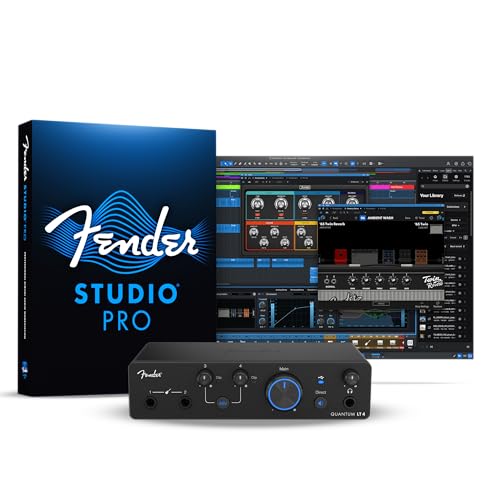
Fender Quantum LT 4
About this pick
Fender Quantum LT 4 is a strong alternative worth comparing directly against the top pick. Expanded connectivity for growing creators: 4x2 USB-C interface with dual max-HD mic preamps, dual instrument inputs, and custom low-latency drivers for responsive, studio-quality recording. Unlock the complete fender amp & FX pack in the fender studio app to access a full collection of authentic fender amp models and effects for crafting inspiring guitar and bass tones.
The gap between this and Behringer U-PHORIA UMC404HD Audiophile 4x4 isn't in the essentials, it shows up in two max-HD mic preamps with 75 dB of gain: capture vocals, instruments, and ensembles with exceptional detail using two transparent, high-gain preamps tuned for any microphone.
Choose this if you want a genuine alternative to the top pick with a different tradeoff worth comparing directly. Bundled software licenses vary by retailer and aren't always the full paid version, so check the specific bundle before assuming you get everything advertised.
Best for: buyers who want a genuine alternative to the top pick with a different tradeoff worth comparing directly
Check price on AmazonPros
- +Expanded connectivity for growing creators
- +Unlock the complete fender amp & FX
- +Two max-HD mic preamps with 75 dB of gain
- +Fender instrument inputs built for tone
Cons
- −Bundled software licenses vary and aren't always full versions
- −Driver stability can vary by operating system version
USB Audio Interface 4 Line Outputs & 2 Line Inputs with 48V Phantom Power
About this pick
USB Audio Interface 4 Line Outputs & 2 Line Inputs with 48V Phantom Power is the most affordable pick here that still clears the capability floor for this category. The interface supports sample rates up to 24-bit/192khz and features proprietary preamp technology for clean and transparent microphone amplification. The USB audio interface has 2 XLR/1/4" combo inputs, two balanced 1/4" TRS inputs and two balanced 1/4" TRS outputs, making it suitable for recording and playback of various audio sources.
Behringer U-PHORIA UMC404HD Audiophile 4x4 covers similar ground, though the USB audio interface is equipped with 48v phantom power, allowing users to use microphones that require phantom power is what tips the choice one way or the other.
This fits best if you want a genuinely capable pick without paying for headroom you won't use. Driver stability can vary by operating system version, so check recent user reports for your specific OS before buying.
Best for: buyers who want a genuinely capable pick without paying for headroom you won't use
Check price on AmazonPros
- +Interface supports sample rates up to 24-bit/192khz
- +4 inputs and 4 outputs
- +Two direct monitoring modes
- +Support 48v phantom power
Cons
- −Driver stability can vary by operating system version
- −Bundled software licenses vary and aren't always full versions
Focusrite Scarlett Solo 4th Gen USB-C Audio Interface
About this pick
Focusrite Scarlett Solo 4th Gen USB-C Audio Interface is a strong alternative worth comparing directly against the top pick. The new generation of the songwriter's interface: plug in your mic and guitar and let scarlett solo 4th gen bring big studio sound to wherever you make music. With a huge 120db dynamic range, the newest generation of scarlett uses the same converters as focusrite’s flagship interfaces, found in the world's biggest studios.
Weighing this against Behringer U-PHORIA UMC404HD Audiophile 4x4, scarlett 4th gen's improved air mode lifts vocals and guitars to the front of the mix, adding musical presence and rich harmonic drive to your recordings ends up being the detail that matters most for most buyers.
Choose this if you want a genuine alternative to the top pick with a different tradeoff worth comparing directly. Bundled software licenses vary by retailer and aren't always the full paid version, so check the specific bundle before assuming you get everything advertised.
Best for: buyers who want a genuine alternative to the top pick with a different tradeoff worth comparing directly
Check price on AmazonPros
- +The new generation of the songwriter's interface
- +Studio-quality sound
- +Find your signature sound
- +All you need to record, mix
Cons
- −Bundled software licenses vary and aren't always full versions
- −Driver stability can vary by operating system version
Yamaha 6-in/4-out USB-C Audio/MIDI Interface with 32-bit/192kHz Support
About this pick
Yamaha 6-in/4-out USB-C Audio/MIDI Interface with 32-bit/192kHz Support is a strong alternative worth comparing directly against the top pick. 32-bit integer / 192 kHz USB 3.0 audio interface with 6 x 4 analog I/o and MIDI I/o. 4 analog XLR/TRS combo inputs with class-a d-pre mic preamps supporting +48v phantom power and 2 hi-z, 2 TRS line inputs, 4 TRS line outputs and 2 main outputs.
Held up against Behringer U-PHORIA UMC404HD Audiophile 4x4, both cover the basics equally well, what actually separates them is rugged full-metal housing for ultimate durability.
Go with this pick if you want a genuine alternative to the top pick with a different tradeoff worth comparing directly. Driver stability can vary by operating system version, so check recent user reports for your specific OS before buying.
Best for: buyers who want a genuine alternative to the top pick with a different tradeoff worth comparing directly
Check price on AmazonPros
- +32-bit integer / 192 kHz USB 3.0
- +4 analog XLR/TRS combo inputs with class-a
- +Rugged full-metal housing for ultimate durability
- +Latency-free DSP-powered monitoring with rev-x reverb, channel
Cons
- −Driver stability can vary by operating system version
- −Bundled software licenses vary and aren't always full versions
How We Evaluated These 4-Channel USB Audio Interfaces
Each pick was assessed across 5 criteria weighted for real-world use.
Input Count vs Simultaneous Sources
The number of inputs an interface has determines how many separate sound sources you can record at the exact same time, not how many you'll eventually use across different sessions.
Preamp Gain and Noise Floor
Clean preamp gain, typically quoted in dB, determines how much you can boost a quiet microphone signal before hiss becomes audible, and this varies more between interfaces than most buyers expect.
USB vs Thunderbolt Latency
Latency is the delay between making a sound and hearing it played back, determined largely by connection type and driver quality rather than price alone.
Bit Depth and Sample Rate
24-bit recording is the current professional standard, giving meaningfully more headroom before clipping than older 16-bit audio, and the vast majority of modern interfaces, even entry-level ones, now support it by default.
Bus-Powered vs External Power Supply
Most compact 1-2 input interfaces draw power directly from your computer's USB port, meaning no separate power adapter is needed, which matters for portability and simpler desk setups.
How to Choose the Right 4-Channel USB Audio Interfaces
By Input Count
| Your setup | Recommended pick |
|---|---|
| Solo vocalist or single instrument | USB Audio Interface 4 Line Outputs & 2 Line Inputs with 48V Phantom Power |
| Two sources at once | Behringer U-PHORIA UMC404HD Audiophile 4x4 |
| Multiple simultaneous sources | Focusrite Scarlett 4i4 4th Gen USB-C Audio Interface |
By Budget
| Budget | Recommended pick |
|---|---|
| Lowest price in this lineup | USB Audio Interface 4 Line Outputs & 2 Line Inputs with 48V Phantom Power |
| Mid-range pick | Behringer UMC404HD Audiophile 4x4 |
| Higher budget | Focusrite Scarlett 4i4 4th Gen USB-C Audio Interface |
USB vs Thunderbolt Connectivity
USB (e.g. Behringer U-PHORIA UMC404HD Audiophile 4x4)
Works on virtually any modern computer, often runs on bus power alone, plenty of speed for a small home setup at a lower price.
Thunderbolt (higher-end setups)
Lower latency and higher bandwidth for larger channel counts, but costs more and needs a Thunderbolt port.
Most home studio and podcasting buyers should default to USB.
By Bit Depth and Sample Rate
| Priority | Recommended pick |
|---|---|
| 24-bit standard, suitable for most home recording | Behringer U-PHORIA UMC404HD Audiophile 4x4 |
| Verify your DAW's actual project settings first | Check your recording software is configured to match |
For Podcasting and Streaming Specifically
Look for
Low-latency direct monitoring so you can hear your own voice without delay while recording or streaming live.
In this comparison
Behringer U-PHORIA UMC404HD Audiophile 4x4 is worth checking against its specific direct-monitoring spec before assuming any interface handles live monitoring equally well.
When to Spend More
Spend more if
You regularly record multiple sources at once and want the best all-around pick, where Focusrite Scarlett 4i4 4th Gen USB-C Audio Interface justifies the extra cost.
Save if
You're recording a single source, where USB Audio Interface 4 Line Outputs & 2 Line Inputs with 48V Phantom Power already covers the job at the lowest price here.
Frequently Asked Questions
Do I need an audio interface if I already have a USB microphone?
No, a USB microphone already contains its own basic audio interface internally; a separate interface is only needed if you want to use an XLR microphone, record multiple sources at once, or want better preamp quality.
How many inputs do I actually need?
Count the maximum number of separate sound sources you'll realistically record in a single take, not your total microphone collection; a solo vocalist typically needs just one input, while an interview needs at least two.
Is Thunderbolt worth it over USB for a home studio?
Usually not for a 1-2 input home setup. USB now delivers latency low enough for real-time monitoring on most systems, and Thunderbolt's main advantage mostly matters for larger professional multi-channel setups.
What does 'bus-powered' mean on an audio interface?
It means the interface draws power directly from your computer's USB connection, so no separate power adapter is needed, simplifying setup, especially useful for a portable or minimal desk arrangement.
Do I need 24-bit or is 16-bit enough for recording?
24-bit is the current professional standard and gives meaningfully more headroom before clipping than 16-bit, and the vast majority of modern interfaces, including entry-level models, now support it by default.
Can I use an audio interface with my phone or tablet?
Some interfaces support mobile devices via USB-C, but check the specific listing for iOS or Android compatibility and power requirements, since not every USB interface is designed to draw power correctly from a mobile device.
Bottom Line
best overall: Behringer U-PHORIA UMC404HD Audiophile 4x4 - best overall pick in this roundup.
See the full rankings above for all picks with pros, cons, and best-for summaries.
Browse on Amazon
All Prime-eligible options with current pricing.
Shop on Amazon →