
6 Best 144Hz 4K Monitors for Gaming in 2026
We compared 144hz 4k monitors for gaming models by verified specs and real-world tradeoffs, not marketing claims alone. Every pick is checked against a real.

New to Amazon Prime?
Get fast, free shipping on every pick in this guide, plus Prime Video and exclusive deals.
Try Prime Free


At a Glance
Acer Nitro 27in 4K 3840x2160 IPS 72Hz DFR 144Hz Gaming Monitor VG270K L1
↓ See why we picked itASUS TUF Gaming VG27UQ1A 27 Inch 4K 160Hz G-SYNC Gaming Monitor
↓ See why we picked itZZA 27 Inch 4K Gaming Monitor, UHD(3840x2160) 4K 144Hz Flat Monitor
↓ See why we picked itBest 144Hz 4K Monitors for Gaming carry real hidden gaps. That means 144hz 4k monitors for gaming, details stay hidden.
144hz 4k monitors for gaming comparisons come down to real HDR certification, given that HDMI version caps the real refresh rate.
5 Criteria to Look For Before Buying a 144Hz 4K Monitors for Gaming
Key buying criteria so you get the right fit the first time.
Ideal Screen Size Depends on Your Actual Viewing Distance, Not Just Desk Space
A 4K monitor's pixel density benefit (crisp text and detail) is most noticeable at closer viewing distances typical of desk use, a 27 or 32-inch 4K panel viewed from a normal desk distance shows a genuine sharpness improvement over 1440p, but the same panel viewed from across a room shows a smaller relative benefit, match screen size to your realistic viewing distance rather than just maximizing size for the sake of it.
4K at Smaller Screen Sizes Requires OS Scaling, Which Isn't Always Smooth
Smaller 4K monitors need OS scaling to keep text a readable size, and while this works smoothly in most modern software, certain older applications or specialized tools can render blurry or misaligned at scaled resolutions, if you rely on niche software for work, verify it handles Windows or macOS scaling cleanly before buying a smaller 4K panel expecting flawless native-resolution use.
HDR Certification Tiers Vary Wildly in Actual Peak Brightness Delivered
A 4K monitor labeled 'HDR' or even carrying a VESA DisplayHDR certification can range from a genuinely bright, wide-gamut panel to one that barely exceeds standard dynamic range brightness, check the specific certification tier (DisplayHDR 400 is a low bar many panels barely meet meaningfully, DisplayHDR 600 and above indicates real HDR capability) rather than trusting the word 'HDR' alone on the box.
HDMI 2.0 vs 2.1 Determines Whether You Actually Get 4K at High Refresh Rates
A high advertised refresh rate on a 4K monitor is only real if both the monitor's HDMI port and your source device (console or graphics card) support HDMI 2.1, HDMI 2.0 hardware caps out around 60Hz at full 4K resolution regardless of what the panel itself is capable of, verify both ends of the connection before expecting the full advertised refresh rate.
Advertised Response Time Numbers Use Best-Case Conditions, Not Real-World Motion
The response time printed on a 4K monitor's box is a best-case lab number, not a guarantee of real-world motion clarity, aggressive overdrive settings used to hit a low advertised number can actually introduce ghosting or overshoot artifacts in practice, look for independent motion-clarity reviews rather than comparing spec sheet numbers directly.
6 Best 144Hz 4K Monitors for Gaming in 2026
Samsung 27" Odyssey G5 (G51F) Series QHD (1440P) Gaming Monitor
About this pick
Samsung 27" Odyssey G5 (G51F) Series QHD (1440P) Gaming Monitor is the strongest all-around choice here. Qhd resolution (2560 x 1440) has 1.7 times the pixel density of full HD for incredibly detailed pinsharp images. Hdr10 provides brighter highlights and nuanced shadow for added depth - making every scene feel more vivid and realistic.
The 180hz refresh rate minimizes lag for gameplay with ultra-smooth action, which is the main thing that distinguishes this pick from Acer Nitro 27in 4K 3840x2160 IPS 72Hz DFR 144Hz Gaming Monitor VG270K L1.
It's worth picking this one if you want the strongest all-around pick in this comparison and would rather not keep shopping around. Marketed specs and real-world performance can differ, so check independent reviews before assuming the headline number tells the full story.
Best for: buyers who want the strongest all-around pick in this comparison and would rather not keep shopping around
Check price on AmazonPros
- +Qhd resolution (2560 x 1440) has 1.7 times
- +Hdr10 provides brighter highlights and nuanced shadow for added
- +180hz refresh rate minimizes lag for gameplay with ultra-smooth action
- +Amd freesync reduces choppiness
Cons
- −Marketed specs and real-world specs often differ
- −Check compatibility with your exact setup before buying
Acer Nitro 27in 4K 3840x2160 IPS 72Hz DFR 144Hz Gaming Monitor VG270K L1
About this pick
Acer Nitro 27in 4K 3840x2160 IPS 72Hz DFR 144Hz Gaming Monitor VG270K L1 is a strong alternative worth comparing directly against the top pick. The vg270k 27" ips monitor with 3840 x 2160 uhd resolution in a 16:9 aspect ratio presents stunning, high-quality images with excellent detail. Say “goodbye” to stuttering and tearing.
Side by side with Samsung 27" Odyssey G5 (G51F) Series QHD (1440P) Gaming Monitor, the real difference worth noting is up to 0.5ms gtg (gray to gray) response time enhanced gamers’ in-game experience.
Choose this if you want a genuine alternative to the top pick with a different tradeoff worth comparing directly. Compatibility with your exact setup matters more than the spec sheet alone, so confirm it works with your specific gear before buying.
Best for: buyers who want a genuine alternative to the top pick with a different tradeoff worth comparing directly
Check price on AmazonPros
- +Quality visuals
- +Say “goodbye” to stuttering and tearing
- +Quick refresh rate
- +Up to 0.5ms gtg (gray to gray) response time enhanced gamers’ in-game experience
Cons
- −Check compatibility with your exact setup before buying
- −Marketed specs and real-world specs often differ
ASUS TUF Gaming VG27UQ1A 27 Inch 4K 160Hz G-SYNC Gaming Monitor
About this pick
ASUS TUF Gaming VG27UQ1A 27 Inch 4K 160Hz G-SYNC Gaming Monitor is the top-tier pick in this comparison. Features 3840 x 2160 resolution gaming monitor with ultra-fast 160hz refresh rate designed for professional gamers and immersive gameplay. Elmb sync technology enables elmb and variable-refresh-rate technologies to work simultaneously to eliminate ghosting and tearing for sharp gaming visuals with high frame rates.
Against Samsung 27" Odyssey G5 (G51F) Series QHD (1440P) Gaming Monitor, neither pick has an obvious edge on paper, so the deciding factor comes down to whichever spec matters most for your specific use case.
It's worth picking this one if you are willing to spend the most in this comparison for the fuller feature set that comes with it. Marketed specs and real-world performance can differ, so check independent reviews before assuming the headline number tells the full story.
Best for: buyers who are willing to spend the most in this comparison for the fuller feature set that comes with it
Check price on AmazonPros
- +Features 3840 x 2160 resolution gaming monitor with ultra-fast
- +Elmb sync technology enables elmb and variable-refresh-rate technologies
- +Nvidia g-sync compatible
- +Superior color performance
Cons
- −Marketed specs and real-world specs often differ
- −Check compatibility with your exact setup before buying
ZZA 27 Inch 4K Gaming Monitor, UHD(3840x2160) 4K 144Hz Flat Monitor
About this pick
ZZA 27 Inch 4K Gaming Monitor, UHD(3840x2160) 4K 144Hz Flat Monitor is a strong alternative worth comparing directly against the top pick. 27 Inch 4K 144hz gaming monitor, offering a crystal-clear uhd resolution of 3840x2160 and a remarkable contrast ratio of 4000:1, perfect for both gaming and creative projects. Equipped with HDMI 2.1 and displayport 1.4, this 27-inch flat panel display supports seamless connections to a variety of devices, making it ideal for both your PC and gaming consoles.
Samsung 27" Odyssey G5 (G51F) Series QHD (1440P) Gaming Monitor is a reasonable point of comparison here, close enough that the actual listing details are worth checking before deciding between them.
This one is the right call if you want a genuine alternative to the top pick with a different tradeoff worth comparing directly. Compatibility with your exact setup matters more than the spec sheet alone, so confirm it works with your specific gear before buying.
Best for: buyers who want a genuine alternative to the top pick with a different tradeoff worth comparing directly
Check price on AmazonPros
- +27 Inch 4K 144hz gaming monitor
- +HDMI 2.1 and displayport 1.4
- +27-Inch 4K 144hz monitor with dynamic lighting
- +100% Srgb + eye-care tech :27 inch 4K 144hz
Cons
- −Check compatibility with your exact setup before buying
- −Marketed specs and real-world specs often differ
CRUA 32" 4K UHD 160Hz Curved Gaming Monitor
About this pick
CRUA 32" 4K UHD 160Hz Curved Gaming Monitor is a strong alternative worth comparing directly against the top pick. 4K curved monitor: this 32inch 4K uhd curved monitor with 3840×2160 resolution and 1500r curvature delivers sharp detail and a wider, more immersive field of view. Enjoy fluid visuals with a 160hz refresh rate that helps reduce blur and input lag during fast movement.
Samsung 27" Odyssey G5 (G51F) Series QHD (1440P) Gaming Monitor is a reasonable point of comparison here, close enough that the actual listing details are worth checking before deciding between them.
Go with this pick if you want a genuine alternative to the top pick with a different tradeoff worth comparing directly. Marketed specs and real-world performance can differ, so check independent reviews before assuming the headline number tells the full story.
Best for: buyers who want a genuine alternative to the top pick with a different tradeoff worth comparing directly
Check price on AmazonPros
- +4K curved monitor
- +Smooth high refresh
- +120% srgb color gamut and a 3000:1 high-contrast va panel
- +Speakers & easy setup
Cons
- −Marketed specs and real-world specs often differ
- −Check compatibility with your exact setup before buying
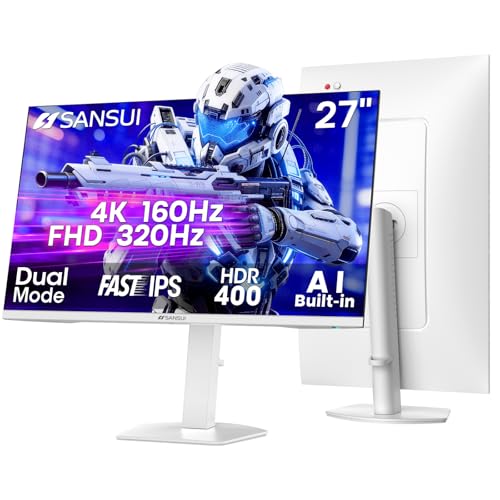
SANSUI 27" 4K Gaming Monitor
About this pick
SANSUI 27" 4K Gaming Monitor is a strong alternative worth comparing directly against the top pick. Sanui 27" dual mode (4K 160hz/144hz or fhd 1080p 320hz/240hz) PC monitor for gaming & office. Mprt 1ms response time丨freesync premium丨ai crosshair丨sniper scope丨night vision丨racing/rts game mode.
Samsung 27" Odyssey G5 (G51F) Series QHD (1440P) Gaming Monitor covers similar ground, though 2×HDMI 2.1 丨 2×displayport 1.4丨3.5mm audio jack丨speakers built-in is what tips the choice one way or the other.
Go with this pick if you want a genuine alternative to the top pick with a different tradeoff worth comparing directly. Compatibility with your exact setup matters more than the spec sheet alone, so confirm it works with your specific gear before buying.
Best for: buyers who want a genuine alternative to the top pick with a different tradeoff worth comparing directly
Check price on AmazonPros
- +Sanui 27" dual mode (4K 160hz/144hz or fhd 1080p 320hz/240hz) PC monitor for gaming & office
- +Mprt 1ms response time丨freesync premium丨ai crosshair丨sniper scope丨night vision丨racing/rts game mode
- +Suplendid colors
- +Output & input
Cons
- −Check compatibility with your exact setup before buying
- −Marketed specs and real-world specs often differ
How We Evaluated These 144Hz 4K Monitors for Gaming
Each pick was assessed across 5 criteria weighted for real-world use.
Ideal Screen Size Depends on Your Actual Viewing Distance, Not Just Desk Space
A 4K monitor's pixel density benefit (crisp text and detail) is most noticeable at closer viewing distances typical of desk use, a 27 or 32-inch 4K panel viewed from a normal desk distance shows a genuine sharpness improvement over 1440p, but the same panel viewed from across a room shows a smaller relative benefit, match screen size to your realistic viewing distance rather than just maximizing size for the sake of it..
4K at Smaller Screen Sizes Requires OS Scaling, Which Isn't Always Smooth
Smaller 4K monitors need OS scaling to keep text a readable size, and while this works smoothly in most modern software, certain older applications or specialized tools can render blurry or misaligned at scaled resolutions, if you rely on niche software for work, verify it handles Windows or macOS scaling cleanly before buying a smaller 4K panel expecting flawless native-resolution use..
HDR Certification Tiers Vary Wildly in Actual Peak Brightness Delivered
A 4K monitor labeled 'HDR' or even carrying a VESA DisplayHDR certification can range from a genuinely bright, wide-gamut panel to one that barely exceeds standard dynamic range brightness, check the specific certification tier (DisplayHDR 400 is a low bar many panels barely meet meaningfully, DisplayHDR 600 and above indicates real HDR capability) rather than trusting the word 'HDR' alone on the box..
HDMI 2.0 vs 2.1 Determines Whether You Actually Get 4K at High Refresh Rates
A high advertised refresh rate on a 4K monitor is only real if both the monitor's HDMI port and your source device (console or graphics card) support HDMI 2.1, HDMI 2.0 hardware caps out around 60Hz at full 4K resolution regardless of what the panel itself is capable of, verify both ends of the connection before expecting the full advertised refresh rate..
Advertised Response Time Numbers Use Best-Case Conditions, Not Real-World Motion
The response time printed on a 4K monitor's box is a best-case lab number, not a guarantee of real-world motion clarity, aggressive overdrive settings used to hit a low advertised number can actually introduce ghosting or overshoot artifacts in practice, look for independent motion-clarity reviews rather than comparing spec sheet numbers directly..
How to Choose the Right 144Hz 4K Monitors for Gaming
By Primary Use
| Your use | Recommended pick |
|---|---|
| General office and browsing | Acer Nitro 27in 4K 3840x2160 IPS 72Hz DFR 144Hz Gaming Monitor VG270K L1 |
| Color-critical creative work | Samsung 27" Odyssey G5 (G51F) Series QHD (1440P) Gaming Monitor |
| Fast-paced gaming | ASUS TUF Gaming VG27UQ1A 27 Inch 4K 160Hz G-SYNC Gaming Monitor |
By Budget
| Budget | Recommended pick |
|---|---|
| Lowest price in this lineup | Acer Nitro 27in 4K 3840x2160 IPS 72Hz DFR 144Hz Gaming Monitor VG270K L1 |
| Mid-range pick | ZZA 27 Inch 4K Gaming Monitor, UHD(3840x2160) 4K 144Hz Flat Monitor |
| Higher budget | ASUS TUF Gaming VG27UQ1A 27 Inch 4K 160Hz G-SYNC Gaming Monitor |
IPS vs OLED Panel
IPS (e.g. Acer Nitro 27in 4K 3840x2160 IPS 72Hz DFR 144Hz Gaming Monitor VG270K L1)
Consistent accurate color from wide angles, weaker black levels.
OLED
Deeper contrast and faster response, real long-term burn-in risk on static content.
Match this to your actual setup and priorities.
By Screen Size
| Your desk depth | Recommended pick |
|---|---|
| Standard desk distance | Samsung 27" Odyssey G5 (G51F) Series QHD (1440P) Gaming Monitor |
| Larger or multi-monitor desk | ZZA 27 Inch 4K Gaming Monitor, UHD(3840x2160) 4K 144Hz Flat Monitor |
For Laptop Charging Specifically
Look for
A confirmed USB-C power delivery wattage that matches your laptop's actual charging requirement, not just a USB-C port.
In this comparison
Samsung 27" Odyssey G5 (G51F) Series QHD (1440P) Gaming Monitor is worth checking against its specific spec sheet before assuming any pick here covers your exact need.
When to Spend More
Spend more if
You need the strongest real-world performance and sturdiest build, where ASUS TUF Gaming VG27UQ1A 27 Inch 4K 160Hz G-SYNC Gaming Monitor justifies the extra cost.
Save if
You want straightforward everyday use without paying for headroom you won't need, where Acer Nitro 27in 4K 3840x2160 IPS 72Hz DFR 144Hz Gaming Monitor VG270K L1 already covers the job at the lowest price here.
Frequently Asked Questions
Can I trust the response time number on the box?
Not fully, it's usually a best-case lab number under aggressive overdrive settings, real-world motion clarity is often worse and can show ghosting, check independent motion-clarity reviews instead.
Is a smaller 4K monitor harder to use than a larger one?
It needs OS-level scaling to keep text readable, which works well in most modern software but can render blurry in some older or niche applications, verify your specific software handles scaling before buying a smaller panel.
Will a USB-C 4K monitor charge my laptop?
Only if its power delivery wattage matches or exceeds your laptop's charging requirement, check the monitor's specific PD wattage spec rather than assuming any USB-C monitor fully charges any laptop.
Do all 4K monitors come with height-adjustable stands?
No, it ranges from tilt-only to full ergonomic adjustment, check the specific stand spec against your desk setup, a VESA-compatible arm is a simple add-on if the included stand falls short.
Why isn't my 4K monitor hitting its advertised refresh rate?
Check whether both the monitor's port and your source device support HDMI 2.1, HDMI 2.0 caps out around 60Hz at full 4K regardless of what the panel itself is rated for.
Does HDR on a 4K monitor actually look different?
It depends heavily on the certification tier, DisplayHDR 400 is a low bar with modest brightness gains, DisplayHDR 600 and above reflects genuinely capable HDR hardware, check the specific tier rather than trusting the word HDR alone.
Bottom Line
best overall: Samsung 27" Odyssey G5 (G51F) Series QHD (1440P) Gaming Monitor - best overall pick in this roundup.
See the full rankings above for all picks with pros, cons, and best-for summaries.
Browse on Amazon
All Prime-eligible options with current pricing.
Shop on Amazon →